AERIAL PHOTOGRAPHY
Outline
Definition of aerial photography
Characteristics of aerial photographs
Aerial cameras and their types
Geometric properties of aerial photographs
Aerial Photo Interpretation Elements
An Introduction to photogrammetry
Photo interpretation and photogrammetric equipment
Taking measurements from aerial photographs
Mapping with aerial photographs
Defining Aerial Photography
Photography means the art, hobby, or profession of taking
photographs, and developing and printing the film or
processing the digitized array image
Photography is production of permanent images by means of
the action of light on sensitized surfaces (film or array inside a
camera), which finally giving rise to a new form of visual art
Aerial Photography means photography from the air
The word ‘aerial’ originated in early 17th century
[Formed from Latin aerius , from Greek aerios , from aēr
‘air’.]
Aerial Photography: An Overview
Aerial Photography is one of the most common, versatile and
economical forms of remote sensing.
It is a means of fixing time within the framework of space (de
Latil, 1961).
Aerial photography was the first method of remote sensing
and even used today in the era of satellite and electronic
scanners. Aerial photographs will still remain the most widely
used type of remote sensing data.
Aerial photographs were taken from balloons and kites as
early as the mid-1800s.
1858 - Gasper Felix Tournachon "Nadar" took the first aerial
photograph from a captive balloon from an altitude of 1,200
feet over Paris.
Characteristics of Aerial
Photography
Synoptic viewpoint: Aerial photographs give a bird’s eye view of
large areas enabling us to see surface features in their spatial
context. They enable the detection of small scale features and
spatial relationships that would not be found on the ground.
Time freezing ability: They are virtually permanent records of the
existing conditions on the Earth’s surface at one point in time, and
used as an historical document.
Capability to stop action: They provides a stop action view of
dynamic conditions and are useful in studying dynamic phenomena
such as flooding, moving wildlife, traffic, oil spills, forest fires.
Three dimensional perspective: It provides a stereoscopic view
of the Earth’s surface and make it possible to take measurements
horizontally and vertically - a characteristic that is lacking for the
majority of remotely sensed data.
Characteristics of Aerial
Photography (2)
Spectral and spatial resolution: Aerial photographs
are sensitive to radiation in wavelengths that are outside
of the spectral sensitivity of the human eye (0.3 µm to
0.9 µm versus 0.4 µm to 0.7 µm).
They are sensitive to objects outside the spatial
resolving power of human eye.
Availability: Aerial photographs are readily available at
a range of scales for much of the world.
Economy: They are much cheaper than field surveys
and are often cheaper and more accurate than maps.
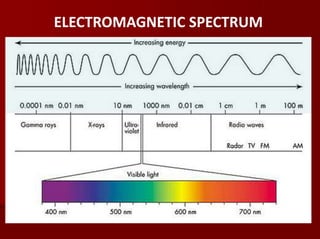
ELECTROMAGNETIC SPECTRUM
Aerial Cameras
Aerial photographs can be made with any type of camera (e.g. 35
mm small amateur or 70 mm or special cameras that are purpose
built meant for mapping).
Many successful applications have employed aerial photography
made from light aircraft with handheld 35 mm cameras.
For the aerial study of large areas, high geometric and radiometric
accuracy are required and these can only be obtained from by using
cameras that are purpose built.
Aerial camera are precision built and specifically designed to expose
a large number of films/photographs in rapid succession with the
ultimate in geometric fidelity and quality.
These cameras usually have a medium to large format, a high quality
lens, a large film magazine, a mount to hold the camera in a vertical
position and a motor drive.
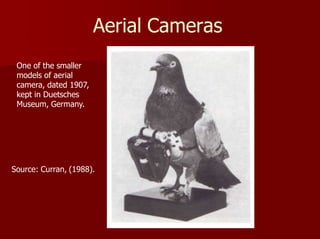
Aerial Cameras
One of the smaller
models of aerial
camera, dated 1907,
kept in Duetsches
Museum, Germany.
Source: Curran, (1988).
Types of Aerial Cameras
array
There are many types of aerial cameras:
Aerial mapping camera (single lens),
Reconnaissance camera,
Strip camera,
Panoramic camera,
Multilens camera, the multi camera
(multiband aerial camera) and
Digital camera.
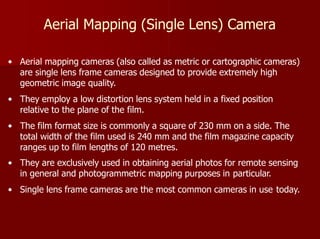
Aerial Mapping (Single Lens) Camera
• Aerial mapping cameras (also called as metric or cartographic cameras)
are single lens frame cameras designed to provide extremely high
geometric image quality.
• They employ a low distortion lens system held in a fixed position
relative to the plane of the film.
• The film format size is commonly a square of 230 mm on a side. The
total width of the film used is 240 mm and the film magazine capacity
ranges up to film lengths of 120 metres.
• They are exclusively used in obtaining aerial photos for remote sensing
in general and photogrammetric mapping purposes in particular.
• Single lens frame cameras are the most common cameras in use today.
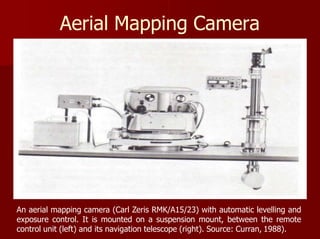
Aerial Mapping Camera
An aerial mapping camera (Carl Zeris RMK/A15/23) with automatic levelling and
exposure control. It is mounted on a suspension mount, between the remote
control unit (left) and its navigation telescope (right). Source: Curran, 1988).
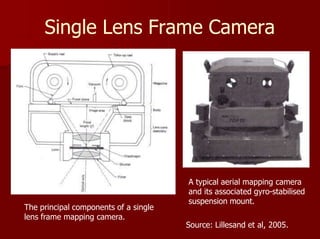
Single Lens Frame Camera
A typical aerial mapping camera
and its associated gyro-stabilised
suspension mount.
The principal components of a single
lens frame mapping camera.
Source: Lillesand et al, 2005.
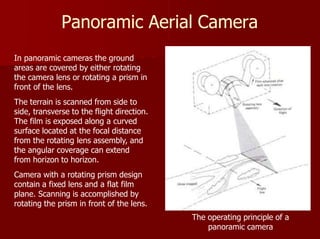
Panoramic Aerial Camera
In panoramic cameras the ground
areas are covered by either rotating
the camera lens or rotating a prism in
front of the lens.
The terrain is scanned from side to
side, transverse to the flight direction.
The film is exposed along a curved
surface located at the focal distance
from the rotating lens assembly, and
the angular coverage can extend
from horizon to horizon.
Camera with a rotating prism design
contain a fixed lens and a flat film
plane. Scanning is accomplished by
rotating the prism in front of the lens.
The operating principle of a
panoramic camera
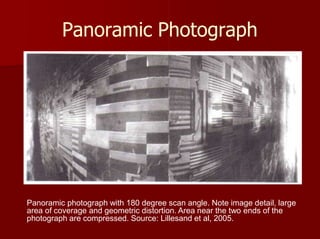
Panoramic Photograph
Panoramic photograph with 180 degree scan angle. Note image detail, large
area of coverage and geometric distortion. Area near the two ends of the
photograph are compressed. Source: Lillesand et al, 2005.
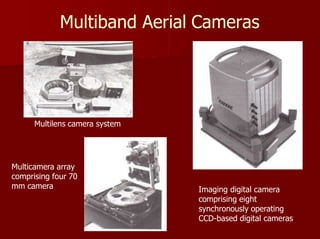
Multiband Aerial Cameras
Multilens camera system
Multicamera array
comprising four 70
mm camera Imaging digital camera
comprising eight
synchronously operating
CCD-based digital cameras
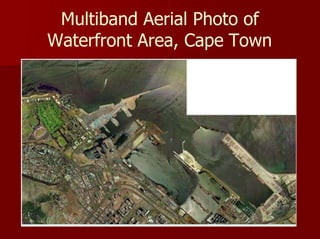
Multiband Aerial Photo of
Waterfront Area, Cape Town
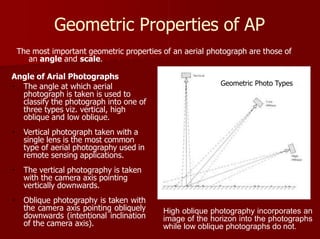
Geometric Properties of AP
The most important geometric properties of an aerial photograph are those of
an angle and scale.
Angle of Arial Photographs
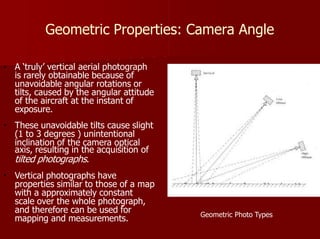
Geometric Photo Types
High oblique photography incorporates an
image of the horizon into the photographs
while low oblique photographs do not.
The angle at which aerial
photograph is taken is used to
classify the photograph into one of
three types viz. vertical, high
oblique and low oblique.
Vertical photograph taken with a
single lens is the most common
type of aerial photography used in
remote sensing applications.
The vertical photography is taken
with the camera axis pointing
vertically downwards.
Oblique photography is taken with
the camera axis pointing obliquely
downwards (intentional inclination
of the camera axis).
Geometric Properties: Camera Angle
Geometric Photo Types
A ‘truly’ vertical aerial photograph
is rarely obtainable because of
unavoidable angular rotations or
tilts, caused by the angular attitude
of the aircraft at the instant of
exposure.
These unavoidable tilts cause slight
(1 to 3 degrees ) unintentional
inclination of the camera optical
axis, resulting in the acquisition of
tilted photographs.
Vertical photographs have
properties similar to those of a map
with a approximately constant
scale over the whole photograph,
and therefore can be used for
mapping and measurements.
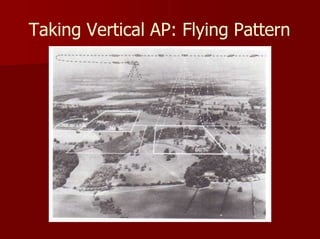
Taking Vertical AP: Flying Pattern
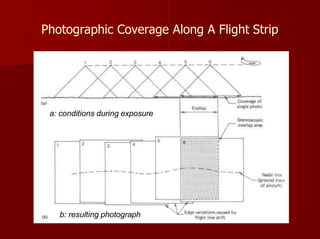
Photographic Coverage Along A Flight Strip
a: conditions during exposure
b: resulting photograph
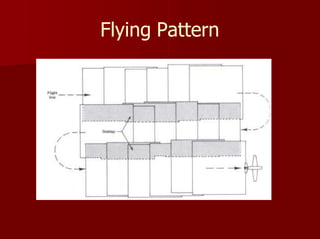
Flying Pattern
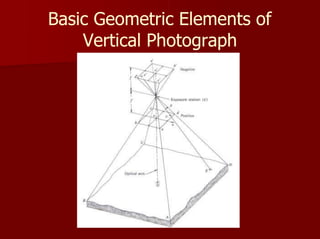
Basic Geometric Elements of
Vertical Photograph
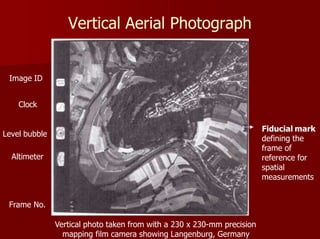
Vertical Aerial Photograph
Image ID
Clock
Fiducial mark
defining the
frame of
reference for
spatial
measurements
Level bubble
Altimeter
Frame No.
Vertical photo taken from with a 230 x 230-mm precision
mapping film camera showing Langenburg, Germany
Geometric Characteristics: Photo Scale
Scale of Arial Photographs (Photographic Scale)
The scale of a photograph expresses the mathematical relationship
between a distance measured on the photo and the corresponding
distance measured on the ground.
A photograph scale is an expression that states one unit of distance
on a photograph represents a specific number of units of actual
ground distance.
Scales may be expressed as unit equivalents (1 mm = 25 m),
representative fractions (1/25,000) or ratios (1: 25,000).
The most straight forward method for determining photo scale is to
measure the corresponding photo and ground distances between
any two points. The scale S is then computed as the ratio of
the photo distance d to the ground distance D.
S = photo scale = photo distance/ground distance = d/D
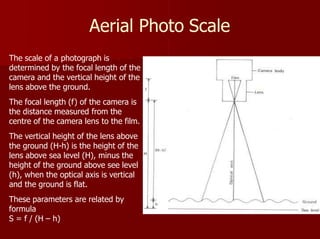
Aerial Photo Scale
The scale of a photograph is
determined by the focal length of the
camera and the vertical height of the
lens above the ground.
The focal length (f) of the camera is
the distance measured from the
centre of the camera lens to the film.
The vertical height of the lens above
the ground (H-h) is the height of the
lens above sea level (H), minus the
height of the ground above see level
(h), when the optical axis is vertical
and the ground is flat.
These parameters are related by
formula
S = f / (H – h)
Geometric Characteristics: Scale
Photographic Scale Contd.
For instance, if the photo scale were 1:63,360,, then 1 inch on the
photo would represent 63,360 inches. The first number (map
distance) is always 1. The second number (ground distance) is
different for each scale; the larger the second number is, the
smaller the scale of the map. i.e. Large is Small.
Quite often the terms large scale and small scale are confusing to
those whose who are not working with scale expression on a routine
basis.
A convenient way to make scale comparisons is to remember that
the same objects are smaller on a smaller scale photograph than on
a larger scale photo.
A large scale photograph will provide a detailed and high resolution
view of a small area.
Large Scale Vs. Small Scale
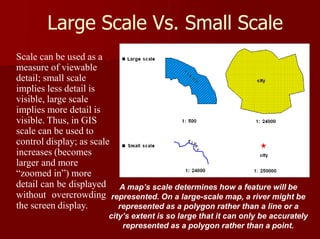
A map’s scale determines how a feature will be
represented. On a large-scale map, a river might be
represented as a polygon rather than a line or a
city’s extent is so large that it can only be accurately
represented as a polygon rather than a point.
Scale can be used as a
measure of viewable
detail; small scale
implies less detail is
visible, large scale
implies more detail is
visible. Thus, in GIS
scale can be used to
control display; as scale
increases (becomes
larger and more
“zoomed in”) more
detail can be displayed
without overcrowding
the screen display.
Comparative Geometry of a Map
and a Vertical Photograph
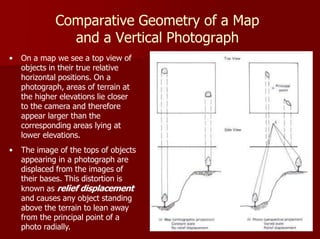
• On a map we see a top view of
objects in their true relative
horizontal positions. On a
photograph, areas of terrain at
the higher elevations lie closer
to the camera and therefore
appear larger than the
corresponding areas lying at
lower elevations.
• The image of the tops of objects
appearing in a photograph are
displaced from the images of
their bases. This distortion is
known as relief displacement
and causes any object standing
above the terrain to lean away
from the principal point of a
photo radially.
Aerial Photo Interpretation
• When we look at a photo we see various objects of different sizes and
shapes. Some of these objects may be readily identifying while others
may not, depending on our individual perceptions and experience.
• When we can identify certain objects or areas and communicates the
information identified to others we are then practicing image
interpretation.
• Aerial photographic interpretation is defined as the act of examining
photographic images for the purpose of identifying objects and judging
their significance (Curran, 1988).
• During the process of interpretation, the aerial photo interpreters usually
make use of seven tasks, which form a chain of events. They are: 1)
detection, 2) recognition and identification, 3) analysis, 4) deduction, 5)
classification, 6) idealisation and 7) accuracy determination.
Elements of Photo Interpretation
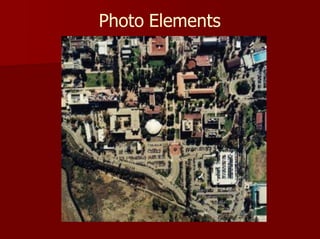
• An interpreter uses following basic characteristics of photograph such as tone,
texture, pattern, place, shape, shadow and size.
• Tone or hue refers to the relative brightness or colour of objects on an image.
It is the most important characteristics of the photo. It represents a record of
the radiation that has been reflected from the Earth’s surface onto the film.
• Light tone represents areas with a high reflectance/radiance and dark tone
represents areas with low radiance. The nature of the materials on the Earth’s
surface affects the amount of light reflected.
• Texture is the frequency of tonal changes within an aerial photo that arises
when a number of features are viewed together. Texture is produced by an
aggregation of unit features that may be too small may be discerned
individually on the image such as the tree leaves and leaf shadows. It
determines the overall visual “smoothness” or “coarseness” of image features.
• Texture is dependent on the scale of aerial photograph. As the scale is reduced
the texture progressively becomes finer and ultimately disappears.
Photo Elements
Elements of Photo Interpretation (2)
• Pattern is the spatial arrangement of objects. The repetition of certain
general forms or relationships is characteristic of many objects. For
examples road patterns or drainage pattern, crop disease pattern and
lithological pattern.
• Place/site is a statement of an object’s position in relation to others in
its vicinity and usually aids in its identification (e.g. certain vegetations
or tree species are expected to occur on well drained uplands or in
certain countries).
• Shape is a qualitative statement referring to the general form,
configuration or outline of an object (e.g. ‘V’ shaped valleys indicative of
deeply incised river).
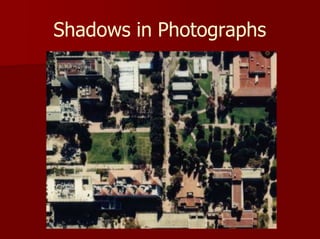
• Shadows of objects aid in their identification. Shadows are important
in two opposing respects: (1) the shape or outline of shadow affords an
impression of the profile view of objects (which aids in interpretation)
and (2) objects with shadows reflect little light and are difficult to
discern on a photo.
Shadows in Photographs
Elements of Photo Interpretation (3)
• Size of an object is a function of photo scale. The sizes of objects can be
estimated by comparing them with objects whose sizes are known.
• Sizes of objects must be considered while interpreting features and some
features may be misinterpreted if sizes were not considered (e.g., a small
storage shed might be misinterpreted as a barn if size was not considered).
• Association refers to the occurrence of certain features in relation to others.
• Success in interpretation varies with the training and experience of the
interpreter, the nature of the objects/phenomena being interpreted, and the
quality of the image/photo being utilised.
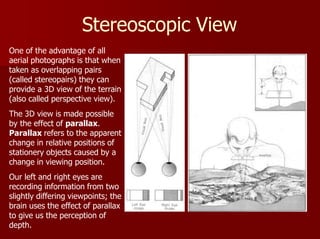
Stereoscopic View
One of the advantage of all
aerial photographs is that when
taken as overlapping pairs
(called stereopairs) they can
provide a 3D view of the terrain
(also called perspective view).
The 3D view is made possible
by the effect of parallax.
Parallax refers to the apparent
change in relative positions of
stationery objects caused by a
change in viewing position.
Our left and right eyes are
recording information from two
slightly differing viewpoints; the
brain uses the effect of parallax
to give us the perception of
depth.
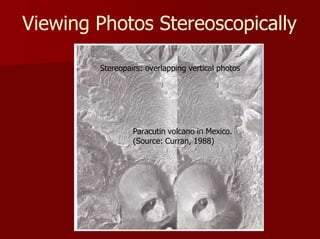
Viewing Photos Stereoscopically
Paracutin volcano in Mexico.
(Source: Curran, 1988)
Stereopairs: overlapping vertical photos
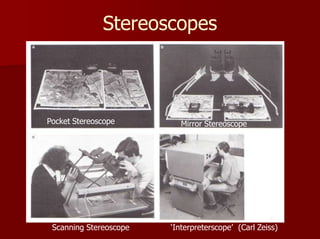
Stereoscopes
Pocket Stereoscope Mirror Stereoscope
Scanning Stereoscope ‘Interpreterscope’ (Carl Zeiss)
Photogrammetry: An Introduction
• Photogrammetry is the science and technology of obtaining spatial
measurements and other geometrically derived products from aerial
photographs (Lillisand et al., 2005).
• Photogrammetric analysis procedures range from obtaining distances, area,
elevations using hardcopy (analog) photographic products, equipment and
simple geometric concepts to generating precise digital elevation models
(DEMs), orthophotos, thematic data and other derived products/information
through the use of digital images and analytical techniques.
• Digital or soft copy photogrammetry refers to any photogrammetric operation
involving the use of digital raster photographic image.
• Historically, one of the most widespread uses of photogrammetry is in
preparation of topographic maps. Today, photogrammetric operations are
extensively used to produce a range of GIS data products such as thematic data
in 2D and 3D, raster image backdrops and DEMs.
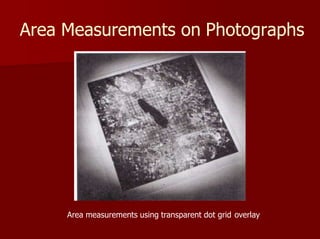
Area Measurements on Photographs
Area measurements using transparent dot grid overlay
Area Measurements on Photographs
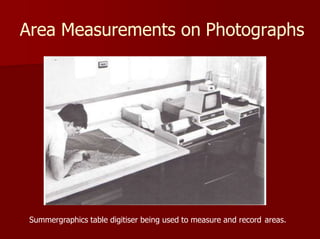
Summergraphics table digitiser being used to measure and record areas.
Mapping With Aerial Photograph
Monoscopic
zoom
trasnferscope
Monoscopic
trasnferscope
Stereoscopic
radial line
plotter
Stereosketch
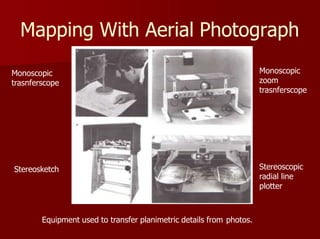
Equipment used to transfer planimetric details from photos.
Accurate Plotting of Topography
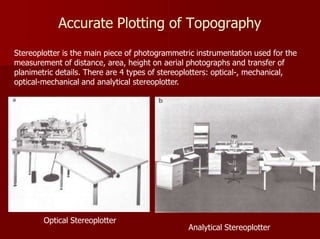
Stereoplotter is the main piece of photogrammetric instrumentation used for the
measurement of distance, area, height on aerial photographs and transfer of
planimetric details. There are 4 types of stereoplotters: optical-, mechanical,
optical-mechanical and analytical stereoplotter.
Optical Stereoplotter
Analytical Stereoplotter
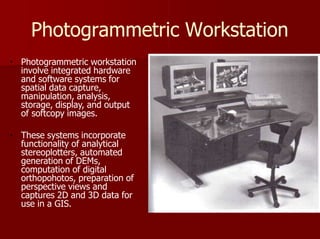
Photogrammetric Workstation
Photogrammetric workstation
involve integrated hardware
and software systems for
spatial data capture,
manipulation, analysis,
storage, display, and output
of softcopy images.
These systems incorporate
functionality of analytical
stereoplotters, automated
generation of DEMs,
computation of digital
orthopohotos, preparation of
perspective views and
captures 2D and 3D data for
use in a GIS.

Aerial Photography.pptx

  • 1.
  • 2.
    Outline Definition of aerialphotography Characteristics of aerial photographs Aerial cameras and their types Geometric properties of aerial photographs Aerial Photo Interpretation Elements An Introduction to photogrammetry Photo interpretation and photogrammetric equipment Taking measurements from aerial photographs Mapping with aerial photographs
  • 3.
    Defining Aerial Photography Photographymeans the art, hobby, or profession of taking photographs, and developing and printing the film or processing the digitized array image Photography is production of permanent images by means of the action of light on sensitized surfaces (film or array inside a camera), which finally giving rise to a new form of visual art Aerial Photography means photography from the air The word ‘aerial’ originated in early 17th century [Formed from Latin aerius , from Greek aerios , from aēr ‘air’.]
  • 4.
    Aerial Photography: AnOverview Aerial Photography is one of the most common, versatile and economical forms of remote sensing. It is a means of fixing time within the framework of space (de Latil, 1961). Aerial photography was the first method of remote sensing and even used today in the era of satellite and electronic scanners. Aerial photographs will still remain the most widely used type of remote sensing data. Aerial photographs were taken from balloons and kites as early as the mid-1800s. 1858 - Gasper Felix Tournachon "Nadar" took the first aerial photograph from a captive balloon from an altitude of 1,200 feet over Paris.
  • 5.
    Characteristics of Aerial Photography Synopticviewpoint: Aerial photographs give a bird’s eye view of large areas enabling us to see surface features in their spatial context. They enable the detection of small scale features and spatial relationships that would not be found on the ground. Time freezing ability: They are virtually permanent records of the existing conditions on the Earth’s surface at one point in time, and used as an historical document. Capability to stop action: They provides a stop action view of dynamic conditions and are useful in studying dynamic phenomena such as flooding, moving wildlife, traffic, oil spills, forest fires. Three dimensional perspective: It provides a stereoscopic view of the Earth’s surface and make it possible to take measurements horizontally and vertically - a characteristic that is lacking for the majority of remotely sensed data.
  • 6.
    Characteristics of Aerial Photography(2) Spectral and spatial resolution: Aerial photographs are sensitive to radiation in wavelengths that are outside of the spectral sensitivity of the human eye (0.3 µm to 0.9 µm versus 0.4 µm to 0.7 µm). They are sensitive to objects outside the spatial resolving power of human eye. Availability: Aerial photographs are readily available at a range of scales for much of the world. Economy: They are much cheaper than field surveys and are often cheaper and more accurate than maps.
  • 7.
  • 8.
    Aerial Cameras Aerial photographscan be made with any type of camera (e.g. 35 mm small amateur or 70 mm or special cameras that are purpose built meant for mapping). Many successful applications have employed aerial photography made from light aircraft with handheld 35 mm cameras. For the aerial study of large areas, high geometric and radiometric accuracy are required and these can only be obtained from by using cameras that are purpose built. Aerial camera are precision built and specifically designed to expose a large number of films/photographs in rapid succession with the ultimate in geometric fidelity and quality. These cameras usually have a medium to large format, a high quality lens, a large film magazine, a mount to hold the camera in a vertical position and a motor drive.
  • 9.
    Aerial Cameras One ofthe smaller models of aerial camera, dated 1907, kept in Duetsches Museum, Germany. Source: Curran, (1988).
  • 10.
    Types of AerialCameras array There are many types of aerial cameras: Aerial mapping camera (single lens), Reconnaissance camera, Strip camera, Panoramic camera, Multilens camera, the multi camera (multiband aerial camera) and Digital camera.
  • 11.
    Aerial Mapping (SingleLens) Camera • Aerial mapping cameras (also called as metric or cartographic cameras) are single lens frame cameras designed to provide extremely high geometric image quality. • They employ a low distortion lens system held in a fixed position relative to the plane of the film. • The film format size is commonly a square of 230 mm on a side. The total width of the film used is 240 mm and the film magazine capacity ranges up to film lengths of 120 metres. • They are exclusively used in obtaining aerial photos for remote sensing in general and photogrammetric mapping purposes in particular. • Single lens frame cameras are the most common cameras in use today.
  • 12.
    Aerial Mapping Camera Anaerial mapping camera (Carl Zeris RMK/A15/23) with automatic levelling and exposure control. It is mounted on a suspension mount, between the remote control unit (left) and its navigation telescope (right). Source: Curran, 1988).
  • 13.
    Single Lens FrameCamera A typical aerial mapping camera and its associated gyro-stabilised suspension mount. The principal components of a single lens frame mapping camera. Source: Lillesand et al, 2005.
  • 14.
    Panoramic Aerial Camera Inpanoramic cameras the ground areas are covered by either rotating the camera lens or rotating a prism in front of the lens. The terrain is scanned from side to side, transverse to the flight direction. The film is exposed along a curved surface located at the focal distance from the rotating lens assembly, and the angular coverage can extend from horizon to horizon. Camera with a rotating prism design contain a fixed lens and a flat film plane. Scanning is accomplished by rotating the prism in front of the lens. The operating principle of a panoramic camera
  • 15.
    Panoramic Photograph Panoramic photographwith 180 degree scan angle. Note image detail, large area of coverage and geometric distortion. Area near the two ends of the photograph are compressed. Source: Lillesand et al, 2005.
  • 16.
    Multiband Aerial Cameras Multilenscamera system Multicamera array comprising four 70 mm camera Imaging digital camera comprising eight synchronously operating CCD-based digital cameras
  • 17.
    Multiband Aerial Photoof Waterfront Area, Cape Town
  • 18.
    Geometric Properties ofAP The most important geometric properties of an aerial photograph are those of an angle and scale. Angle of Arial Photographs Geometric Photo Types High oblique photography incorporates an image of the horizon into the photographs while low oblique photographs do not. The angle at which aerial photograph is taken is used to classify the photograph into one of three types viz. vertical, high oblique and low oblique. Vertical photograph taken with a single lens is the most common type of aerial photography used in remote sensing applications. The vertical photography is taken with the camera axis pointing vertically downwards. Oblique photography is taken with the camera axis pointing obliquely downwards (intentional inclination of the camera axis).
  • 19.
    Geometric Properties: CameraAngle Geometric Photo Types A ‘truly’ vertical aerial photograph is rarely obtainable because of unavoidable angular rotations or tilts, caused by the angular attitude of the aircraft at the instant of exposure. These unavoidable tilts cause slight (1 to 3 degrees ) unintentional inclination of the camera optical axis, resulting in the acquisition of tilted photographs. Vertical photographs have properties similar to those of a map with a approximately constant scale over the whole photograph, and therefore can be used for mapping and measurements.
  • 20.
    Taking Vertical AP:Flying Pattern
  • 21.
    Photographic Coverage AlongA Flight Strip a: conditions during exposure b: resulting photograph
  • 22.
  • 23.
    Basic Geometric Elementsof Vertical Photograph
  • 24.
    Vertical Aerial Photograph ImageID Clock Fiducial mark defining the frame of reference for spatial measurements Level bubble Altimeter Frame No. Vertical photo taken from with a 230 x 230-mm precision mapping film camera showing Langenburg, Germany
  • 25.
    Geometric Characteristics: PhotoScale Scale of Arial Photographs (Photographic Scale) The scale of a photograph expresses the mathematical relationship between a distance measured on the photo and the corresponding distance measured on the ground. A photograph scale is an expression that states one unit of distance on a photograph represents a specific number of units of actual ground distance. Scales may be expressed as unit equivalents (1 mm = 25 m), representative fractions (1/25,000) or ratios (1: 25,000). The most straight forward method for determining photo scale is to measure the corresponding photo and ground distances between any two points. The scale S is then computed as the ratio of the photo distance d to the ground distance D. S = photo scale = photo distance/ground distance = d/D
  • 26.
    Aerial Photo Scale Thescale of a photograph is determined by the focal length of the camera and the vertical height of the lens above the ground. The focal length (f) of the camera is the distance measured from the centre of the camera lens to the film. The vertical height of the lens above the ground (H-h) is the height of the lens above sea level (H), minus the height of the ground above see level (h), when the optical axis is vertical and the ground is flat. These parameters are related by formula S = f / (H – h)
  • 27.
    Geometric Characteristics: Scale PhotographicScale Contd. For instance, if the photo scale were 1:63,360,, then 1 inch on the photo would represent 63,360 inches. The first number (map distance) is always 1. The second number (ground distance) is different for each scale; the larger the second number is, the smaller the scale of the map. i.e. Large is Small. Quite often the terms large scale and small scale are confusing to those whose who are not working with scale expression on a routine basis. A convenient way to make scale comparisons is to remember that the same objects are smaller on a smaller scale photograph than on a larger scale photo. A large scale photograph will provide a detailed and high resolution view of a small area.
  • 28.
    Large Scale Vs.Small Scale A map’s scale determines how a feature will be represented. On a large-scale map, a river might be represented as a polygon rather than a line or a city’s extent is so large that it can only be accurately represented as a polygon rather than a point. Scale can be used as a measure of viewable detail; small scale implies less detail is visible, large scale implies more detail is visible. Thus, in GIS scale can be used to control display; as scale increases (becomes larger and more “zoomed in”) more detail can be displayed without overcrowding the screen display.
  • 29.
    Comparative Geometry ofa Map and a Vertical Photograph • On a map we see a top view of objects in their true relative horizontal positions. On a photograph, areas of terrain at the higher elevations lie closer to the camera and therefore appear larger than the corresponding areas lying at lower elevations. • The image of the tops of objects appearing in a photograph are displaced from the images of their bases. This distortion is known as relief displacement and causes any object standing above the terrain to lean away from the principal point of a photo radially.
  • 30.
    Aerial Photo Interpretation •When we look at a photo we see various objects of different sizes and shapes. Some of these objects may be readily identifying while others may not, depending on our individual perceptions and experience. • When we can identify certain objects or areas and communicates the information identified to others we are then practicing image interpretation. • Aerial photographic interpretation is defined as the act of examining photographic images for the purpose of identifying objects and judging their significance (Curran, 1988). • During the process of interpretation, the aerial photo interpreters usually make use of seven tasks, which form a chain of events. They are: 1) detection, 2) recognition and identification, 3) analysis, 4) deduction, 5) classification, 6) idealisation and 7) accuracy determination.
  • 31.
    Elements of PhotoInterpretation • An interpreter uses following basic characteristics of photograph such as tone, texture, pattern, place, shape, shadow and size. • Tone or hue refers to the relative brightness or colour of objects on an image. It is the most important characteristics of the photo. It represents a record of the radiation that has been reflected from the Earth’s surface onto the film. • Light tone represents areas with a high reflectance/radiance and dark tone represents areas with low radiance. The nature of the materials on the Earth’s surface affects the amount of light reflected. • Texture is the frequency of tonal changes within an aerial photo that arises when a number of features are viewed together. Texture is produced by an aggregation of unit features that may be too small may be discerned individually on the image such as the tree leaves and leaf shadows. It determines the overall visual “smoothness” or “coarseness” of image features. • Texture is dependent on the scale of aerial photograph. As the scale is reduced the texture progressively becomes finer and ultimately disappears.
  • 32.
  • 33.
    Elements of PhotoInterpretation (2) • Pattern is the spatial arrangement of objects. The repetition of certain general forms or relationships is characteristic of many objects. For examples road patterns or drainage pattern, crop disease pattern and lithological pattern. • Place/site is a statement of an object’s position in relation to others in its vicinity and usually aids in its identification (e.g. certain vegetations or tree species are expected to occur on well drained uplands or in certain countries). • Shape is a qualitative statement referring to the general form, configuration or outline of an object (e.g. ‘V’ shaped valleys indicative of deeply incised river). • Shadows of objects aid in their identification. Shadows are important in two opposing respects: (1) the shape or outline of shadow affords an impression of the profile view of objects (which aids in interpretation) and (2) objects with shadows reflect little light and are difficult to discern on a photo.
  • 34.
  • 35.
    Elements of PhotoInterpretation (3) • Size of an object is a function of photo scale. The sizes of objects can be estimated by comparing them with objects whose sizes are known. • Sizes of objects must be considered while interpreting features and some features may be misinterpreted if sizes were not considered (e.g., a small storage shed might be misinterpreted as a barn if size was not considered). • Association refers to the occurrence of certain features in relation to others. • Success in interpretation varies with the training and experience of the interpreter, the nature of the objects/phenomena being interpreted, and the quality of the image/photo being utilised.
  • 36.
    Stereoscopic View One ofthe advantage of all aerial photographs is that when taken as overlapping pairs (called stereopairs) they can provide a 3D view of the terrain (also called perspective view). The 3D view is made possible by the effect of parallax. Parallax refers to the apparent change in relative positions of stationery objects caused by a change in viewing position. Our left and right eyes are recording information from two slightly differing viewpoints; the brain uses the effect of parallax to give us the perception of depth.
  • 37.
    Viewing Photos Stereoscopically Paracutinvolcano in Mexico. (Source: Curran, 1988) Stereopairs: overlapping vertical photos
  • 38.
    Stereoscopes Pocket Stereoscope MirrorStereoscope Scanning Stereoscope ‘Interpreterscope’ (Carl Zeiss)
  • 39.
    Photogrammetry: An Introduction •Photogrammetry is the science and technology of obtaining spatial measurements and other geometrically derived products from aerial photographs (Lillisand et al., 2005). • Photogrammetric analysis procedures range from obtaining distances, area, elevations using hardcopy (analog) photographic products, equipment and simple geometric concepts to generating precise digital elevation models (DEMs), orthophotos, thematic data and other derived products/information through the use of digital images and analytical techniques. • Digital or soft copy photogrammetry refers to any photogrammetric operation involving the use of digital raster photographic image. • Historically, one of the most widespread uses of photogrammetry is in preparation of topographic maps. Today, photogrammetric operations are extensively used to produce a range of GIS data products such as thematic data in 2D and 3D, raster image backdrops and DEMs.
  • 40.
    Area Measurements onPhotographs Area measurements using transparent dot grid overlay
  • 41.
    Area Measurements onPhotographs Summergraphics table digitiser being used to measure and record areas.
  • 42.
    Mapping With AerialPhotograph Monoscopic zoom trasnferscope Monoscopic trasnferscope Stereoscopic radial line plotter Stereosketch Equipment used to transfer planimetric details from photos.
  • 43.
    Accurate Plotting ofTopography Stereoplotter is the main piece of photogrammetric instrumentation used for the measurement of distance, area, height on aerial photographs and transfer of planimetric details. There are 4 types of stereoplotters: optical-, mechanical, optical-mechanical and analytical stereoplotter. Optical Stereoplotter Analytical Stereoplotter
  • 44.
    Photogrammetric Workstation Photogrammetric workstation involveintegrated hardware and software systems for spatial data capture, manipulation, analysis, storage, display, and output of softcopy images. These systems incorporate functionality of analytical stereoplotters, automated generation of DEMs, computation of digital orthopohotos, preparation of perspective views and captures 2D and 3D data for use in a GIS.