ADMINISTRATION 
By- ASHOK BISHNOI 
Lecturer 
JINR
MEANING:- 
• The word “ Administer derived from 
the Latin word – “ad + ministraire” 
means care for’ or look after people 
to manage affairs.
DEFINITION:- 
“Administration is the organization & direction of human 
& material resources to achieve desired ends.” 
-Pfiffner & Presthus. 
Or 
“Administration is the direction, coordination an control 
of many persons to achieve some purposes or 
objectives.” 
- L.D. White
MANAGEMENT:- 
DEFINITION:- 
“It is the process in which directs and guieds the 
operation of an 0rganization on the 
establishing aims” 
-Ordway tead 
or 
“Management is getting things done through 
other people” 
–James L Hayes
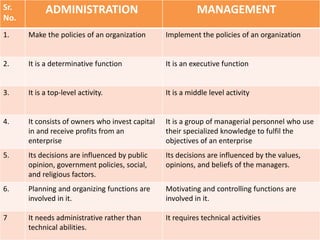
• Difference between the Administration 
& management
Sr. 
No. 
ADMINISTRATION MANAGEMENT 
1. Make the policies of an organization Implement the policies of an organization 
2. It is a determinative function It is an executive function 
3. It is a top-level activity. It is a middle level activity 
4. It consists of owners who invest capital 
in and receive profits from an 
enterprise 
It is a group of managerial personnel who use 
their specialized knowledge to fulfil the 
objectives of an enterprise 
5. Its decisions are influenced by public 
opinion, government policies, social, 
and religious factors. 
Its decisions are influenced by the values, 
opinions, and beliefs of the managers. 
6. Planning and organizing functions are 
involved in it. 
Motivating and controlling functions are 
involved in it. 
7 It needs administrative rather than 
technical abilities. 
It requires technical activities
NATURE OF ADMINISTRATION:- 
• It is universal. 
• It is holistic. 
• It is continuous & on going process. 
• It is goal oriented. 
• It is social & human nature. 
• It is dynamic. 
• It is creative or innovative.
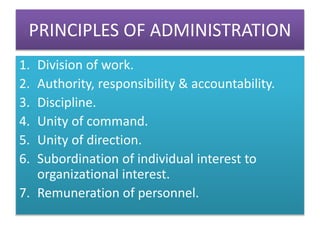
PRINCIPLES OF ADMINISTRATION 
1. Division of work. 
2. Authority, responsibility & accountability. 
3. Discipline. 
4. Unity of command. 
5. Unity of direction. 
6. Subordination of individual interest to 
organizational interest. 
7. Remuneration of personnel.
8. Centralization. 
9. Scalar chain of command. 
10. Order. 
11. Equity. 
12. Stability of tenure of personnel. 
13. Initiative. 
14. Esprit de corps.
ELEMENTS OF ADMINISTRATION:- 
“POSDCORB” 
1. Planning. 
2. Organizing. 
3. Staffing. 
4. Directing. 
5. Co-ordinating. 
6. Reporting. 
7. Budgeting.
PPT on Administration

PPT on Administration

  • 1.
    ADMINISTRATION By- ASHOKBISHNOI Lecturer JINR
  • 2.
    MEANING:- • Theword “ Administer derived from the Latin word – “ad + ministraire” means care for’ or look after people to manage affairs.
  • 3.
    DEFINITION:- “Administration isthe organization & direction of human & material resources to achieve desired ends.” -Pfiffner & Presthus. Or “Administration is the direction, coordination an control of many persons to achieve some purposes or objectives.” - L.D. White
  • 4.
    MANAGEMENT:- DEFINITION:- “Itis the process in which directs and guieds the operation of an 0rganization on the establishing aims” -Ordway tead or “Management is getting things done through other people” –James L Hayes
  • 5.
    • Difference betweenthe Administration & management
  • 6.
    Sr. No. ADMINISTRATIONMANAGEMENT 1. Make the policies of an organization Implement the policies of an organization 2. It is a determinative function It is an executive function 3. It is a top-level activity. It is a middle level activity 4. It consists of owners who invest capital in and receive profits from an enterprise It is a group of managerial personnel who use their specialized knowledge to fulfil the objectives of an enterprise 5. Its decisions are influenced by public opinion, government policies, social, and religious factors. Its decisions are influenced by the values, opinions, and beliefs of the managers. 6. Planning and organizing functions are involved in it. Motivating and controlling functions are involved in it. 7 It needs administrative rather than technical abilities. It requires technical activities
  • 7.
    NATURE OF ADMINISTRATION:- • It is universal. • It is holistic. • It is continuous & on going process. • It is goal oriented. • It is social & human nature. • It is dynamic. • It is creative or innovative.
  • 8.
    PRINCIPLES OF ADMINISTRATION 1. Division of work. 2. Authority, responsibility & accountability. 3. Discipline. 4. Unity of command. 5. Unity of direction. 6. Subordination of individual interest to organizational interest. 7. Remuneration of personnel.
  • 9.
    8. Centralization. 9.Scalar chain of command. 10. Order. 11. Equity. 12. Stability of tenure of personnel. 13. Initiative. 14. Esprit de corps.
  • 10.
    ELEMENTS OF ADMINISTRATION:- “POSDCORB” 1. Planning. 2. Organizing. 3. Staffing. 4. Directing. 5. Co-ordinating. 6. Reporting. 7. Budgeting.