Delegation
“The act of delegating, or investing with
authority to act for another”
(dictionary.com)
OR….
“the distribution of responsibility and
authority to others while holding them
accountable for their performance.”
(www.lawsoncg.com)
 Sharing

or transfer of authority and
the associated responsibility from
an employer or superior (who has the
right to delegate)
an employee or subordinate.
Definition
 Delegation

means delegation of
power by higher officials to
lower officials
- Moone
Definition
 Delegation

means delegation of
power by executive officer or
organisatory unit to other
- Terry
Why Delegate?
To use skills and
resources already
within the group
 To develop new
leaders and build
new skills within the
group
 To prevent the
group from
getting too
dependent on one
or two leaders










To become more
powerful as a group
To allow everyone to
feel a part of the
effort and the
success
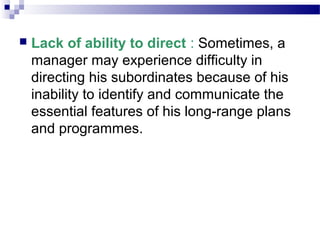
Group members feel
more committed if
they have a role and
feel needed
To get things done
Why Not?
…its too hard!

…it takes too much time!
…nobody can do it as good as I can
…nobody else has any time
either……
TYPES OF DELEGATION






General Delegation: the subordinate is granted
authority to perform all the functions in his department
or division. However, the subordinate will be under the
overall guidance and control of the
superior.
Specific delegation: a person is given authority
regarding specific function. For example, a sales
person may be given the authority to collect payments
from debtors.
Specific delegation is precise and the subordinate
clearly understands what he is expected to do. But it
may create inflexibility in the organisation.
Formal Delegation: When authority is
delegated as per the organisation structure.
Such delegation is effective because it
leaves no option to the subordinate but to
obey the commands of the
superior
 Informal delegation: Takes place when an
individual or a group agrees to work under
the direction of an informal leader.

 Written

Delegation: Delegation made
by written orders and instructions is
known as written delegation.
 Oral delegation: Unwritten or oral
delegation is based in custom and
conventions.
Downward Delegation: Downward
delegation occurs when a superior
assigns duties and grants authority to his
immediate subordinate. This is the most
common type of delegation.
 Sideward delegation: It takes place when
a subordinate assigns some of his duties
and authority to another subordinate of the
same rank

Elements of delegation


Responsibility refers to the assignment
itself and the intended results. That means
setting clear expectations. It also means
that you should avoid prescribing the
employee HOW the assignment should be
completed.
Authority refers to the appropriate power given
to the individual or group including the right to
act and make decisions.
 Accountability refers to the fact that the
relevant individual must ‘ answer ’ for
his/her/their actions and decisions along with
the rewards or penalties that accompany those
actions or decisions.

Benefits of Delegation
 Benefits

to the Manager / Supervisor
• Makes your job easy and exciting
• Reduces stress and makes you look
good.
• Frees you to do what you should be
doing
• Develops trust and rapport with your
employees
• Grooms your successor so that you can
move on to bigger and better things.


Benefits to the employee
• Provides professional growth opportunities
• Develops their professional knowledge and
skills
• Elevates their self-image and ultimately
self-esteem
• Enhances their confidence and value to the
organization
• Brings them personal satisfaction and a
sense of achievement
• Gives them opportunities to be involved
with decision making which in turn leads to
more commitment and increased morale
Benefits for the organization
• Saves money
• Promotes teamwork
• Brings about professionalism
• Increases productivity and efficiency


Steps in Delegation
I –Introduce the task
D-Demonstrate clearly what needs to be done
E-Ensure understanding
A-Allocate authority, information and resources
L-Let go
S-Support and monitor
Introduce the Task
Determine task to
be delegated
 Determine tasks to
retain
 Select delegate

Introduce the Task
Use What-Why
Statements:
I want you to do…..
Because you……
Demonstrate Clearly
Show examples of
previous work
 Explain objectives
 Discuss timetable, set
deadlines

Ensuring Understanding
 Clear

communication
 Ask for clarification
 Secure commitment
 Don’t say no for them
 Collaboratively
determine methods for
follow-up
Allocate…
authority, information, resources
Grant authority to determine process, not
desired outcomes
 Provide access to all information sources
 Refer delegate to contact persons or
specific resources that have assisted
previously
 Provide appropriate training to ensure
success

Let go…
Communicate delegate’s
authority
 Step back, let them work
 Use constrained access
 Don’t allow for reverse
delegation

Support and Monitor
Schedule follow-up meetings
 Review progress
 Assist, when requested
 Avoid interference
 Publicly praise progress and completion
 Encourage problem solving

Principles of Effective Delegation
 Knowledge

of Objectives : Before
delegating authority, the subordinates
should be made to understand their
duties and responsibilities.
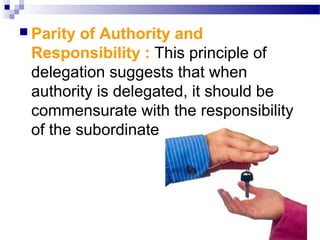
 Parity

of Authority and
Responsibility : This principle of
delegation suggests that when
authority is delegated, it should be
commensurate with the responsibility
of the subordinate
 Unity

of Command : It that everyone
should have only one boss. A
subordinate should get orders and
instructions from one superior and
should be made accountable to one
superior only
The Scalar Principle : The scalar
principle of delegation maintains that there
should be clear and direct lines of
authority in the Organisation, running from
the top to the bottom.
 The subordinate should know who
delegates authority to him and to whom he
should contact for matters beyond his
authority.

 Clarity

of Delegation : It suggests
that while delegating authority to
subordinates, they should be made to
understand the limits of authority so
that they know the area of their
operation and the extent of freedom
of action available to them.
 Effective

Communication Support
System : It suggests that there
should be continuous flow of
information between the superior and
the subordinates with a view to
furnishing relevant information to
subordinate for decision-making
 Reward

for Effective Delegation : It
suggests that effective delegation and
successful assumption of authority
should be rewarded.
Common delegation errors
 Under

delegating
 Over delegating
 Improperly delegating
Barriers on the Part of Manager /
Superior / Delegator


Wanting to be in the Limelight
Sometimes, ego holds the manager
back from delegating his authority to
a subordinate. He worships power
and autocracy so much that he feels
delegating can reduce his influence
over the organization.
Unwillingness of the manager to
delegate authority
 Some

superiors/managers tend to
think that they can do the job better
when they themselves handle the job.
The attitude that 'I can do it better
myself' on the part of superior acts
as an obstacle to delegation.
Lack of Trust/ confidence in
Subordinates
 In most cases, managers don’t
delegate because they worry that a
task will not be done properly and
successfully if they don’t do it all by
themselves.
Fear of Competition
 Some insecure managers refuse to
recognize or acknowledge the skills of
their subordinates out of the fear that if
their subordinates will be given some
tasks and do better than they can, they
become afraid that their
subordinates’ good performance will
cause them to be replaced someday.


Lack of ability to direct : Sometimes, a
manager may experience difficulty in
directing his subordinates because of his
inability to identify and communicate the
essential features of his long-range plans
and programmes.


Desire to dominate subordinates :
Managers (Superiors) normally, have a
desire to dominate the subordinates
functioning under their control. They feel
that their domination will reduce if the
powers are delegated to subordinates.
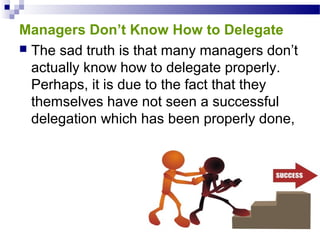
Managers Don’t Know How to Delegate
 The sad truth is that many managers don’t
actually know how to delegate properly.
Perhaps, it is due to the fact that they
themselves have not seen a successful
delegation which has been properly done,
(B) Obstacles / Barriers on the
Part of Subordinates


Too much dependence on the manager
for decisions : Some subordinates avoid
responsibility even when the
superior/manager is prepared to delegate
authority. They want the manager to tackle
problems and take decisions
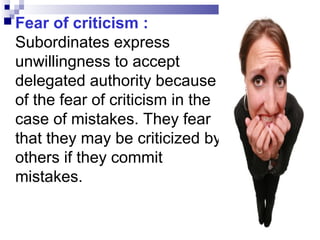
 Fear

of criticism :
Subordinates express
unwillingness to accept
delegated authority because
of the fear of criticism in the
case of mistakes. They fear
that they may be criticized by
others if they commit
mistakes.


Lack of information : A subordinate may
hesitate to accept a new assignment,
when he knows that necessary information
to perform the job is not likely to be made
available to him
Absence of positive incentives :
Positive incentives like recognition of work
and rewards go a long way in building up
the morale of subordinates.
 In the absence of such incentives in the
form of recognition, appreciation or
monetary benefit, a subordinate may not
be prepared to accept delegation of
authority.

Absence of self-confidence : A
subordinate may lack self-confidence
about his ability to take quick and correct
decisions.
 He may not like to accept new challenging
functions as he lacks self-confidence.

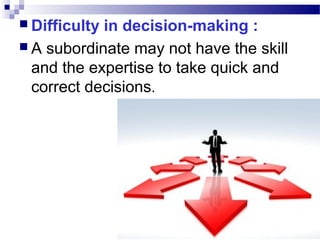
 Difficulty

in decision-making :
 A subordinate may not have the skill
and the expertise to take quick and
correct decisions.
Poor superior-subordinate relations :
 Absence of cordial relations in between the
superior and the subordinates hampers the
process of delegation of authority.
 The attitude of the superior towards
subordinate may not be friendly but hostile.
 Even the good work of subordinate may not be
appreciated by the superior.
Undue interference by superior :

A superior should not interfere in the
duties delegated to the subordinate.
 Some superiors interfere in the work of
his subordinate and try to control him often
and again.
Fear of being exposed :
 Some subordinates may have inferiority
complex.
 They feel that they have limited capacity to
accept the challenges which are bound to
come out to delegation.
 They feel that their inability to deal with
new problems will be exposed due to
delegation.
Avoid Pitfalls
Reverse or upward delegation.
 Sometimes employees feel they don’t
know how to do what they were delegated.
In this situation, you may find them coming
back and asking you what to do.
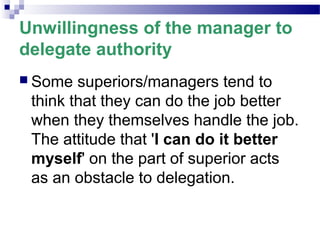
Dumping.
 The poor communication.
 The employee should know and
understand your motivation, but often the
employee perceives that he is being
“dumped on,”

Grabbing the glory. Some managers
seem to overlook the importance of giving
credit where credit is due, and take credit
for the delegatees’ hard work.
 Make sure that you give the appropriate
recognition and then quietly appreciate
yourself for being a great delegator.

And, finally…..

“The secret of success is not in doing your
own work but in recognizing the right
[person] to do it.” ~Andrew Carnegie
Delegation msc

Delegation msc

  • 1.
  • 2.
    “The act ofdelegating, or investing with authority to act for another” (dictionary.com) OR…. “the distribution of responsibility and authority to others while holding them accountable for their performance.” (www.lawsoncg.com)
  • 3.
     Sharing or transferof authority and the associated responsibility from an employer or superior (who has the right to delegate) an employee or subordinate.
  • 5.
    Definition  Delegation means delegationof power by higher officials to lower officials - Moone
  • 6.
    Definition  Delegation means delegationof power by executive officer or organisatory unit to other - Terry
  • 7.
    Why Delegate? To useskills and resources already within the group  To develop new leaders and build new skills within the group  To prevent the group from getting too dependent on one or two leaders      To become more powerful as a group To allow everyone to feel a part of the effort and the success Group members feel more committed if they have a role and feel needed To get things done
  • 8.
    Why Not? …its toohard! …it takes too much time! …nobody can do it as good as I can …nobody else has any time either……
  • 9.
    TYPES OF DELEGATION    GeneralDelegation: the subordinate is granted authority to perform all the functions in his department or division. However, the subordinate will be under the overall guidance and control of the superior. Specific delegation: a person is given authority regarding specific function. For example, a sales person may be given the authority to collect payments from debtors. Specific delegation is precise and the subordinate clearly understands what he is expected to do. But it may create inflexibility in the organisation.
  • 10.
    Formal Delegation: Whenauthority is delegated as per the organisation structure. Such delegation is effective because it leaves no option to the subordinate but to obey the commands of the superior  Informal delegation: Takes place when an individual or a group agrees to work under the direction of an informal leader. 
  • 11.
     Written Delegation: Delegationmade by written orders and instructions is known as written delegation.  Oral delegation: Unwritten or oral delegation is based in custom and conventions.
  • 12.
    Downward Delegation: Downward delegationoccurs when a superior assigns duties and grants authority to his immediate subordinate. This is the most common type of delegation.  Sideward delegation: It takes place when a subordinate assigns some of his duties and authority to another subordinate of the same rank 
  • 13.
    Elements of delegation  Responsibilityrefers to the assignment itself and the intended results. That means setting clear expectations. It also means that you should avoid prescribing the employee HOW the assignment should be completed.
  • 14.
    Authority refers tothe appropriate power given to the individual or group including the right to act and make decisions.  Accountability refers to the fact that the relevant individual must ‘ answer ’ for his/her/their actions and decisions along with the rewards or penalties that accompany those actions or decisions. 
  • 15.
    Benefits of Delegation Benefits to the Manager / Supervisor • Makes your job easy and exciting • Reduces stress and makes you look good. • Frees you to do what you should be doing • Develops trust and rapport with your employees • Grooms your successor so that you can move on to bigger and better things.
  • 16.
     Benefits to theemployee • Provides professional growth opportunities • Develops their professional knowledge and skills • Elevates their self-image and ultimately self-esteem • Enhances their confidence and value to the organization • Brings them personal satisfaction and a sense of achievement • Gives them opportunities to be involved with decision making which in turn leads to more commitment and increased morale
  • 17.
    Benefits for theorganization • Saves money • Promotes teamwork • Brings about professionalism • Increases productivity and efficiency 
  • 18.
    Steps in Delegation I–Introduce the task D-Demonstrate clearly what needs to be done E-Ensure understanding A-Allocate authority, information and resources L-Let go S-Support and monitor
  • 19.
    Introduce the Task Determinetask to be delegated  Determine tasks to retain  Select delegate 
  • 20.
    Introduce the Task UseWhat-Why Statements: I want you to do….. Because you……
  • 21.
    Demonstrate Clearly Show examplesof previous work  Explain objectives  Discuss timetable, set deadlines 
  • 22.
    Ensuring Understanding  Clear communication Ask for clarification  Secure commitment  Don’t say no for them  Collaboratively determine methods for follow-up
  • 23.
    Allocate… authority, information, resources Grantauthority to determine process, not desired outcomes  Provide access to all information sources  Refer delegate to contact persons or specific resources that have assisted previously  Provide appropriate training to ensure success 
  • 24.
    Let go… Communicate delegate’s authority Step back, let them work  Use constrained access  Don’t allow for reverse delegation 
  • 25.
    Support and Monitor Schedulefollow-up meetings  Review progress  Assist, when requested  Avoid interference  Publicly praise progress and completion  Encourage problem solving 
  • 26.
    Principles of EffectiveDelegation  Knowledge of Objectives : Before delegating authority, the subordinates should be made to understand their duties and responsibilities.
  • 27.
     Parity of Authorityand Responsibility : This principle of delegation suggests that when authority is delegated, it should be commensurate with the responsibility of the subordinate
  • 28.
     Unity of Command: It that everyone should have only one boss. A subordinate should get orders and instructions from one superior and should be made accountable to one superior only
  • 29.
    The Scalar Principle: The scalar principle of delegation maintains that there should be clear and direct lines of authority in the Organisation, running from the top to the bottom.  The subordinate should know who delegates authority to him and to whom he should contact for matters beyond his authority. 
  • 30.
     Clarity of Delegation: It suggests that while delegating authority to subordinates, they should be made to understand the limits of authority so that they know the area of their operation and the extent of freedom of action available to them.
  • 31.
     Effective Communication Support System: It suggests that there should be continuous flow of information between the superior and the subordinates with a view to furnishing relevant information to subordinate for decision-making
  • 32.
     Reward for EffectiveDelegation : It suggests that effective delegation and successful assumption of authority should be rewarded.
  • 33.
    Common delegation errors Under delegating  Over delegating  Improperly delegating
  • 34.
    Barriers on thePart of Manager / Superior / Delegator  Wanting to be in the Limelight Sometimes, ego holds the manager back from delegating his authority to a subordinate. He worships power and autocracy so much that he feels delegating can reduce his influence over the organization.
  • 35.
    Unwillingness of themanager to delegate authority  Some superiors/managers tend to think that they can do the job better when they themselves handle the job. The attitude that 'I can do it better myself' on the part of superior acts as an obstacle to delegation.
  • 36.
    Lack of Trust/confidence in Subordinates  In most cases, managers don’t delegate because they worry that a task will not be done properly and successfully if they don’t do it all by themselves.
  • 37.
    Fear of Competition Some insecure managers refuse to recognize or acknowledge the skills of their subordinates out of the fear that if their subordinates will be given some tasks and do better than they can, they become afraid that their subordinates’ good performance will cause them to be replaced someday.
  • 38.
     Lack of abilityto direct : Sometimes, a manager may experience difficulty in directing his subordinates because of his inability to identify and communicate the essential features of his long-range plans and programmes.
  • 39.
     Desire to dominatesubordinates : Managers (Superiors) normally, have a desire to dominate the subordinates functioning under their control. They feel that their domination will reduce if the powers are delegated to subordinates.
  • 40.
    Managers Don’t KnowHow to Delegate  The sad truth is that many managers don’t actually know how to delegate properly. Perhaps, it is due to the fact that they themselves have not seen a successful delegation which has been properly done,
  • 41.
    (B) Obstacles /Barriers on the Part of Subordinates  Too much dependence on the manager for decisions : Some subordinates avoid responsibility even when the superior/manager is prepared to delegate authority. They want the manager to tackle problems and take decisions
  • 42.
     Fear of criticism: Subordinates express unwillingness to accept delegated authority because of the fear of criticism in the case of mistakes. They fear that they may be criticized by others if they commit mistakes.
  • 43.
     Lack of information: A subordinate may hesitate to accept a new assignment, when he knows that necessary information to perform the job is not likely to be made available to him
  • 44.
    Absence of positiveincentives : Positive incentives like recognition of work and rewards go a long way in building up the morale of subordinates.  In the absence of such incentives in the form of recognition, appreciation or monetary benefit, a subordinate may not be prepared to accept delegation of authority. 
  • 45.
    Absence of self-confidence: A subordinate may lack self-confidence about his ability to take quick and correct decisions.  He may not like to accept new challenging functions as he lacks self-confidence. 
  • 46.
     Difficulty in decision-making:  A subordinate may not have the skill and the expertise to take quick and correct decisions.
  • 47.
    Poor superior-subordinate relations:  Absence of cordial relations in between the superior and the subordinates hampers the process of delegation of authority.  The attitude of the superior towards subordinate may not be friendly but hostile.  Even the good work of subordinate may not be appreciated by the superior.
  • 48.
    Undue interference bysuperior :  A superior should not interfere in the duties delegated to the subordinate.  Some superiors interfere in the work of his subordinate and try to control him often and again.
  • 49.
    Fear of beingexposed :  Some subordinates may have inferiority complex.  They feel that they have limited capacity to accept the challenges which are bound to come out to delegation.  They feel that their inability to deal with new problems will be exposed due to delegation.
  • 50.
    Avoid Pitfalls Reverse orupward delegation.  Sometimes employees feel they don’t know how to do what they were delegated. In this situation, you may find them coming back and asking you what to do.
  • 51.
    Dumping.  The poorcommunication.  The employee should know and understand your motivation, but often the employee perceives that he is being “dumped on,” 
  • 52.
    Grabbing the glory.Some managers seem to overlook the importance of giving credit where credit is due, and take credit for the delegatees’ hard work.  Make sure that you give the appropriate recognition and then quietly appreciate yourself for being a great delegator. 
  • 53.
    And, finally….. “The secretof success is not in doing your own work but in recognizing the right [person] to do it.” ~Andrew Carnegie