1
Mr. Visanth V S
Asso. Professor
Dept of Psychiatric Nursing
2
Staffing
Staffing is the systematic approach to
the problem of selecting, training,
motivating and retaining professional and
non professional personnel in any
organization.
It involves manpower planning to
have the right person in the right place and
avoid “Square peg in round hole.”
3
Functions of Staffing
Identifying the type and amount of service needed by agency client.
Determining the personnel categories that have the knowledge and
skill to perform needed service measures.
Predicting the number of personnel in each job category that will be
needed to meet anticipated service demands.
Obtaining, budgeted positions for the number in each job category
needed to service for the expected types and number of clients.
Recruiting personnel to fill available positions.
Selecting and appointing personnel from suitable applicants.
Combining personnel into desired configurations by unit and shift.
Orienting personnel to fulfil assigned responsibilities.
Assigning responsibilities for client services to available personnel.
4
Nature of Staffing
People centered
Responsibility of Every Manager
Human Skills- Training
Continuous function
5
Steps of Staffing
Determine the number and types of personnel needed to
fulfil the philosophy, responsibilities of the organization
Recruit and assign personnel based on established job
description.
Use organizational resources for induction and
orientation
Ascertain that each employee is adequately socialized to
organizational values and unit norms.
Use creative and flexible scheduling based on patient
care needs to increase productivity.
Develop a program of staff education that will assist
employees meeting the goals of the organization.
6
Philosophy of staffing in Nursing
Nurse administrators of a hospital nursing department might
adopt the following philosophy. Nurse administrators believe
that
1. It is possible to match employee‘s knowledge and skills to
patient care needs in a manner that optimizes job satisfaction
and care quality.
2. The technical and humanistic care needs of critically ill
patients are complex that all aspects of that care should be
provided by professional nurses.
3. The health teaching and rehabilitation needs of chronically
ill patients are so complex that direct care for chronically ill
patients should be provided by professional and technical
nurses.
7
Should believe that patient assessment, and job
analysis to be assigned for patients of each type
(such as coronary care, renal failure, etc.,).
should believe that a master staffing plan and
policies to implement the plan in all units
should be developed centrally by the nursing
heads and staff of the hospital.
Staffing plan should be administrated at the unit
level by the head nurse, so that can change
based on unit workload and workflow.
8
Objectives of Staffing in Nursing
Provide professional nursing staff in all units
Provide sufficient staff to permit a 1:1 nurse-patient ratio
for each shift in every critical care unit.
Provide sufficient nursing staff in general medical,
surgical, obstetric, pediatric and psychiatric units to
permit a 1: 5 nurse-patient ratio on a day and after noon
shifts an d1:10 nurse –patient ratio on the night shift.
Involves the head of the nursing staff and all nursing
personnel in designing the department overall staffing
programme.
9
Empower the head nurse to adjust work
schedules for unit .
Inform each nursing employee that request for
specific vacation holiday time will be honored
within the limits imposed by patients care and
labor contract requirements .
Reward employees for long term services by
granting individuals special time requests on the
basis of seniority.
10
Staffing Study
A staffing study should gather data about environmental
factors within and outside the organization.
Aydelotte listed four techniques drawn from engineering
to measure the work of nurses, all of which involve the
concept of time required for performance.
Time study and task frequency
Work sampling
Continuous sampling
Self-reporting
11
Staffing Norms
Norms are standards that guide, control, and regulate
individuals and communities.
For planning nursing manpower we have to follow
some norms.
The nursing norms are recommended by various
committees, such as; the Nursing Man Power
Committee, the High-power Committee, Dr. Bajaj
Committee, and the staff inspection committee,
TNAI and INC.
12
All the above committees and the staff
inspection unit recommended the norms for
optimum nurse-patient ratio.
Such as 1:3 for Non Teaching Hospital and 1:5
for the Teaching Hospital.
The Staff Inspection Unit (S.I.U.) is the unit
which has recommended the nursing norms in
the year 1991-92.
As per this S.I.U. norm the present nurse-patient
ratio is based and practiced in all central
government hospitals.
13
Recommendations of SIU
The norms taken into account the workload projected in the
wards and the other areas of the hospital.
The posts of nursing sisters and staff nurses have been
clubbed together for calculating the staff entitlement for
performing nursing care work which the staff nurse will
continue to perform even after she is promoted to the
existing scale of nursing sister.
Out of the entitlement worked out on the basis of the norms,
30%posts may be sanctioned as nursing sister. This would
further improve the existing ratio of 1 nursing sister to 3
staff nurses fixed by the government in settlement with the
Delhi nurse union in May 1990.
14
The assistant nursing superintendent are recommended in the ratio of 1
ANS to every 4.5 nursing sisters. The ANS will perform the duty presently
performed by nursing sisters and perform duty in shift also.
The posts of Deputy Nursing Superintendent may continue at the level of
1 DNS per every 7.5 ANS
There will be a post of Nursing Superintendent for every hospital having
250 or beds.
There will be a post of 1 Chief Nursing Officer for every hospital having
500 or more beds.
It is recommended that 45% posts added for the area of 365 days working
including 10% leave reserve (maternity leave, earned leave, and days off
as nurses are entitled for 8 days off per month and 3 National Holidays
per year when doing 3 shift duties).
15
1. General Ward
2. Special Ward)
1:6
1:4
3. Nursery  1:1(Nothing mentioned about the
shifts)
4. I.C.U.  1:l per table
5. Labour Room  Major - 1 :2 per table
 Minor - 1:l per table
6. O.T.  1:1(Nothing mentioned about the
shifts)
7. Casualty-
a. Casualty main attendance up to
100 patients per day thereafter
b.for every additional attendance of
35 patients
c. gynae/ obstetric attendance
d. thereafter every additional
attendance of 15 patients.
3 staff nurses for 24 hours, 1:1per shift.
1:35
·3 staff nurses for 24 hours, 1:1/ shift
1:15
16
8. Injection room OPD Attendance upto 100 patients per day 1 staff nurse
120-220 patients: 2 staff nurses
221-320 patients: 3 staff nurses
321-420 patients: 4 staff nurses
9. OPD
NAME OF THE DEPARTMENT
· Blood bank
· Paediatric
· Immunization
· Eye
· ENT
· Pre anaesthetic
· Cardio lab
· Bronchoscopy lab
· Vaccination anti rabis
· Family planning
· Medical
· Dental
· Central sample collection centre
· Orthopaedic
· Gyne
· Xray
· Skin
· V D centre
· Chemotherapy
· Neurology
· Microbiology
· Psychiatry
· Burns
1
2
2
1
1
1
1
1
1
2
1
1
1
1
2
2
3
2
2
2
1
2
1
2
17
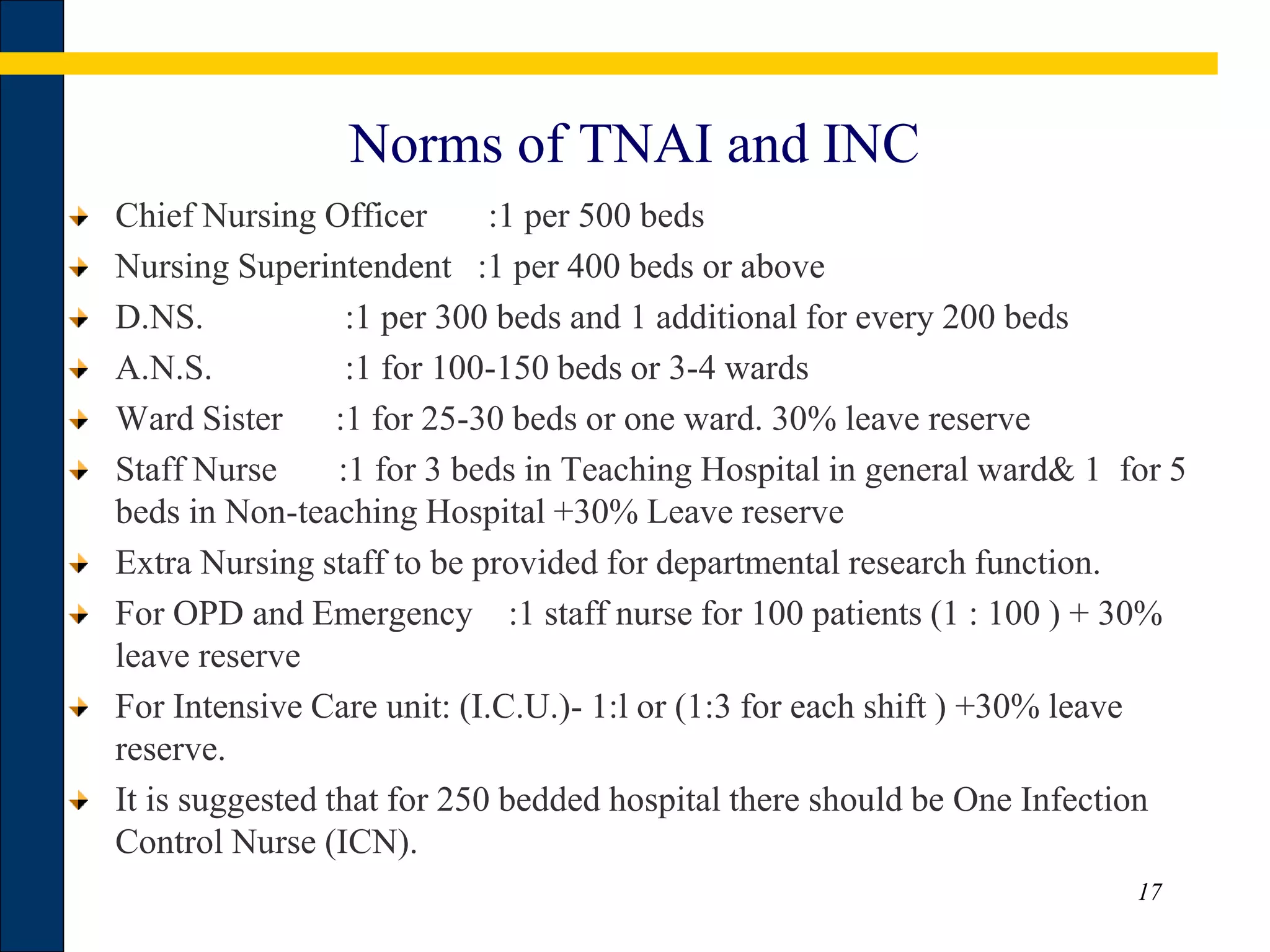
Norms of TNAI and INC
Chief Nursing Officer :1 per 500 beds
Nursing Superintendent :1 per 400 beds or above
D.NS. :1 per 300 beds and 1 additional for every 200 beds
A.N.S. :1 for 100-150 beds or 3-4 wards
Ward Sister :1 for 25-30 beds or one ward. 30% leave reserve
Staff Nurse :1 for 3 beds in Teaching Hospital in general ward& 1 for 5
beds in Non-teaching Hospital +30% Leave reserve
Extra Nursing staff to be provided for departmental research function.
For OPD and Emergency :1 staff nurse for 100 patients (1 : 100 ) + 30%
leave reserve
For Intensive Care unit: (I.C.U.)- 1:l or (1:3 for each shift ) +30% leave
reserve.
It is suggested that for 250 bedded hospital there should be One Infection
Control Nurse (ICN).
18
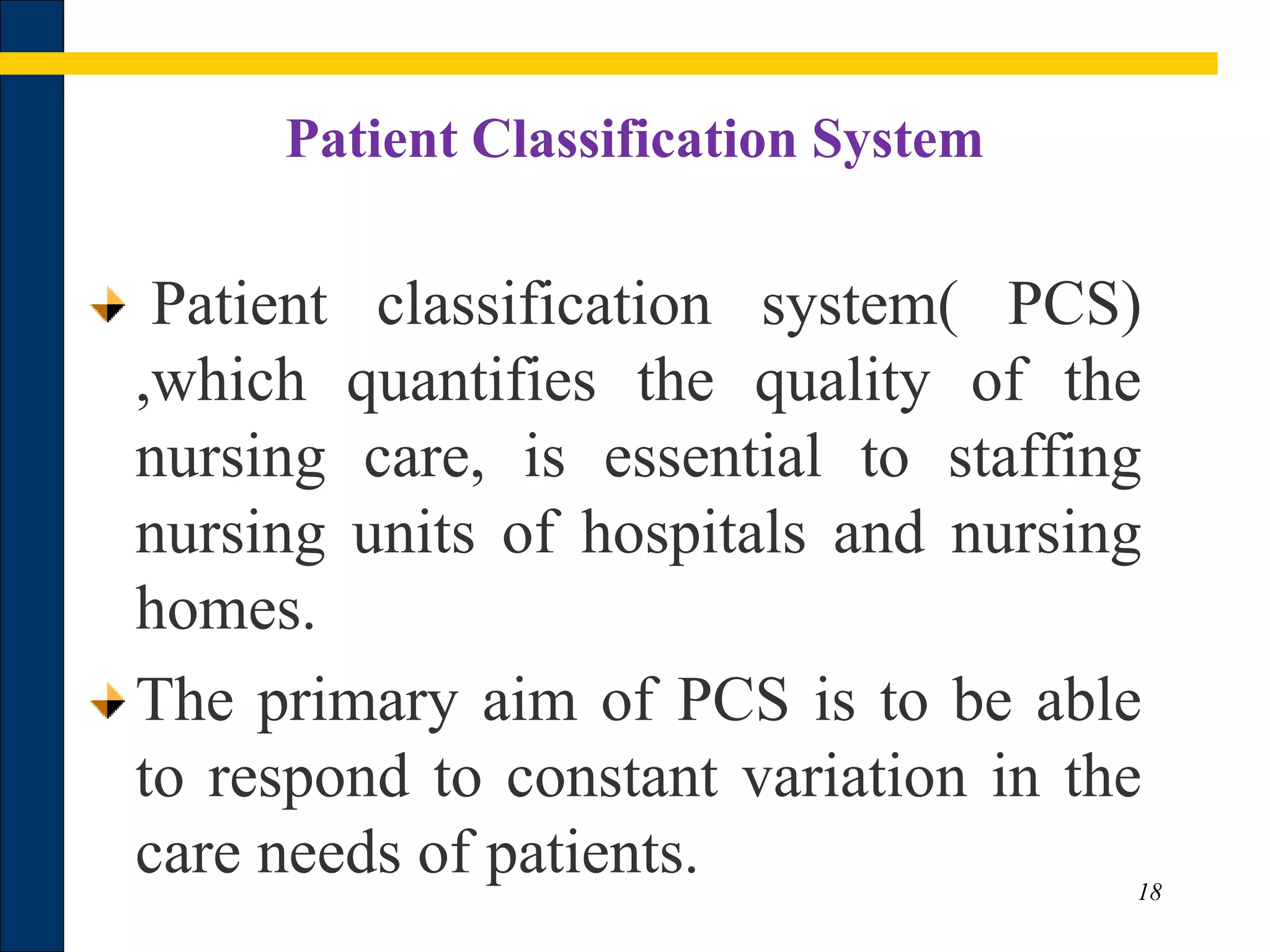
Patient Classification System
Patient classification system( PCS)
,which quantifies the quality of the
nursing care, is essential to staffing
nursing units of hospitals and nursing
homes.
The primary aim of PCS is to be able
to respond to constant variation in the
care needs of patients.
19
Purposes
The system will establish a unit of measure for
nursing, that is , time , which will be used to
determine numbers and kinds of staff needed.
Program costing and formulation of the nursing
budget.
Tracking changes in patients care needs.
Determining the values of the productivity
Determine the quality
20
THANK YOU

Staffing- Nursing Management

  • 1.
    1 Mr. Visanth VS Asso. Professor Dept of Psychiatric Nursing
  • 2.
    2 Staffing Staffing is thesystematic approach to the problem of selecting, training, motivating and retaining professional and non professional personnel in any organization. It involves manpower planning to have the right person in the right place and avoid “Square peg in round hole.”
  • 3.
    3 Functions of Staffing Identifyingthe type and amount of service needed by agency client. Determining the personnel categories that have the knowledge and skill to perform needed service measures. Predicting the number of personnel in each job category that will be needed to meet anticipated service demands. Obtaining, budgeted positions for the number in each job category needed to service for the expected types and number of clients. Recruiting personnel to fill available positions. Selecting and appointing personnel from suitable applicants. Combining personnel into desired configurations by unit and shift. Orienting personnel to fulfil assigned responsibilities. Assigning responsibilities for client services to available personnel.
  • 4.
    4 Nature of Staffing Peoplecentered Responsibility of Every Manager Human Skills- Training Continuous function
  • 5.
    5 Steps of Staffing Determinethe number and types of personnel needed to fulfil the philosophy, responsibilities of the organization Recruit and assign personnel based on established job description. Use organizational resources for induction and orientation Ascertain that each employee is adequately socialized to organizational values and unit norms. Use creative and flexible scheduling based on patient care needs to increase productivity. Develop a program of staff education that will assist employees meeting the goals of the organization.
  • 6.
    6 Philosophy of staffingin Nursing Nurse administrators of a hospital nursing department might adopt the following philosophy. Nurse administrators believe that 1. It is possible to match employee‘s knowledge and skills to patient care needs in a manner that optimizes job satisfaction and care quality. 2. The technical and humanistic care needs of critically ill patients are complex that all aspects of that care should be provided by professional nurses. 3. The health teaching and rehabilitation needs of chronically ill patients are so complex that direct care for chronically ill patients should be provided by professional and technical nurses.
  • 7.
    7 Should believe thatpatient assessment, and job analysis to be assigned for patients of each type (such as coronary care, renal failure, etc.,). should believe that a master staffing plan and policies to implement the plan in all units should be developed centrally by the nursing heads and staff of the hospital. Staffing plan should be administrated at the unit level by the head nurse, so that can change based on unit workload and workflow.
  • 8.
    8 Objectives of Staffingin Nursing Provide professional nursing staff in all units Provide sufficient staff to permit a 1:1 nurse-patient ratio for each shift in every critical care unit. Provide sufficient nursing staff in general medical, surgical, obstetric, pediatric and psychiatric units to permit a 1: 5 nurse-patient ratio on a day and after noon shifts an d1:10 nurse –patient ratio on the night shift. Involves the head of the nursing staff and all nursing personnel in designing the department overall staffing programme.
  • 9.
    9 Empower the headnurse to adjust work schedules for unit . Inform each nursing employee that request for specific vacation holiday time will be honored within the limits imposed by patients care and labor contract requirements . Reward employees for long term services by granting individuals special time requests on the basis of seniority.
  • 10.
    10 Staffing Study A staffingstudy should gather data about environmental factors within and outside the organization. Aydelotte listed four techniques drawn from engineering to measure the work of nurses, all of which involve the concept of time required for performance. Time study and task frequency Work sampling Continuous sampling Self-reporting
  • 11.
    11 Staffing Norms Norms arestandards that guide, control, and regulate individuals and communities. For planning nursing manpower we have to follow some norms. The nursing norms are recommended by various committees, such as; the Nursing Man Power Committee, the High-power Committee, Dr. Bajaj Committee, and the staff inspection committee, TNAI and INC.
  • 12.
    12 All the abovecommittees and the staff inspection unit recommended the norms for optimum nurse-patient ratio. Such as 1:3 for Non Teaching Hospital and 1:5 for the Teaching Hospital. The Staff Inspection Unit (S.I.U.) is the unit which has recommended the nursing norms in the year 1991-92. As per this S.I.U. norm the present nurse-patient ratio is based and practiced in all central government hospitals.
  • 13.
    13 Recommendations of SIU Thenorms taken into account the workload projected in the wards and the other areas of the hospital. The posts of nursing sisters and staff nurses have been clubbed together for calculating the staff entitlement for performing nursing care work which the staff nurse will continue to perform even after she is promoted to the existing scale of nursing sister. Out of the entitlement worked out on the basis of the norms, 30%posts may be sanctioned as nursing sister. This would further improve the existing ratio of 1 nursing sister to 3 staff nurses fixed by the government in settlement with the Delhi nurse union in May 1990.
  • 14.
    14 The assistant nursingsuperintendent are recommended in the ratio of 1 ANS to every 4.5 nursing sisters. The ANS will perform the duty presently performed by nursing sisters and perform duty in shift also. The posts of Deputy Nursing Superintendent may continue at the level of 1 DNS per every 7.5 ANS There will be a post of Nursing Superintendent for every hospital having 250 or beds. There will be a post of 1 Chief Nursing Officer for every hospital having 500 or more beds. It is recommended that 45% posts added for the area of 365 days working including 10% leave reserve (maternity leave, earned leave, and days off as nurses are entitled for 8 days off per month and 3 National Holidays per year when doing 3 shift duties).
  • 15.
    15 1. General Ward 2.Special Ward) 1:6 1:4 3. Nursery  1:1(Nothing mentioned about the shifts) 4. I.C.U.  1:l per table 5. Labour Room  Major - 1 :2 per table  Minor - 1:l per table 6. O.T.  1:1(Nothing mentioned about the shifts) 7. Casualty- a. Casualty main attendance up to 100 patients per day thereafter b.for every additional attendance of 35 patients c. gynae/ obstetric attendance d. thereafter every additional attendance of 15 patients. 3 staff nurses for 24 hours, 1:1per shift. 1:35 ·3 staff nurses for 24 hours, 1:1/ shift 1:15
  • 16.
    16 8. Injection roomOPD Attendance upto 100 patients per day 1 staff nurse 120-220 patients: 2 staff nurses 221-320 patients: 3 staff nurses 321-420 patients: 4 staff nurses 9. OPD NAME OF THE DEPARTMENT · Blood bank · Paediatric · Immunization · Eye · ENT · Pre anaesthetic · Cardio lab · Bronchoscopy lab · Vaccination anti rabis · Family planning · Medical · Dental · Central sample collection centre · Orthopaedic · Gyne · Xray · Skin · V D centre · Chemotherapy · Neurology · Microbiology · Psychiatry · Burns 1 2 2 1 1 1 1 1 1 2 1 1 1 1 2 2 3 2 2 2 1 2 1 2
  • 17.
    17 Norms of TNAIand INC Chief Nursing Officer :1 per 500 beds Nursing Superintendent :1 per 400 beds or above D.NS. :1 per 300 beds and 1 additional for every 200 beds A.N.S. :1 for 100-150 beds or 3-4 wards Ward Sister :1 for 25-30 beds or one ward. 30% leave reserve Staff Nurse :1 for 3 beds in Teaching Hospital in general ward& 1 for 5 beds in Non-teaching Hospital +30% Leave reserve Extra Nursing staff to be provided for departmental research function. For OPD and Emergency :1 staff nurse for 100 patients (1 : 100 ) + 30% leave reserve For Intensive Care unit: (I.C.U.)- 1:l or (1:3 for each shift ) +30% leave reserve. It is suggested that for 250 bedded hospital there should be One Infection Control Nurse (ICN).
  • 18.
    18 Patient Classification System Patientclassification system( PCS) ,which quantifies the quality of the nursing care, is essential to staffing nursing units of hospitals and nursing homes. The primary aim of PCS is to be able to respond to constant variation in the care needs of patients.
  • 19.
    19 Purposes The system willestablish a unit of measure for nursing, that is , time , which will be used to determine numbers and kinds of staff needed. Program costing and formulation of the nursing budget. Tracking changes in patients care needs. Determining the values of the productivity Determine the quality
  • 20.