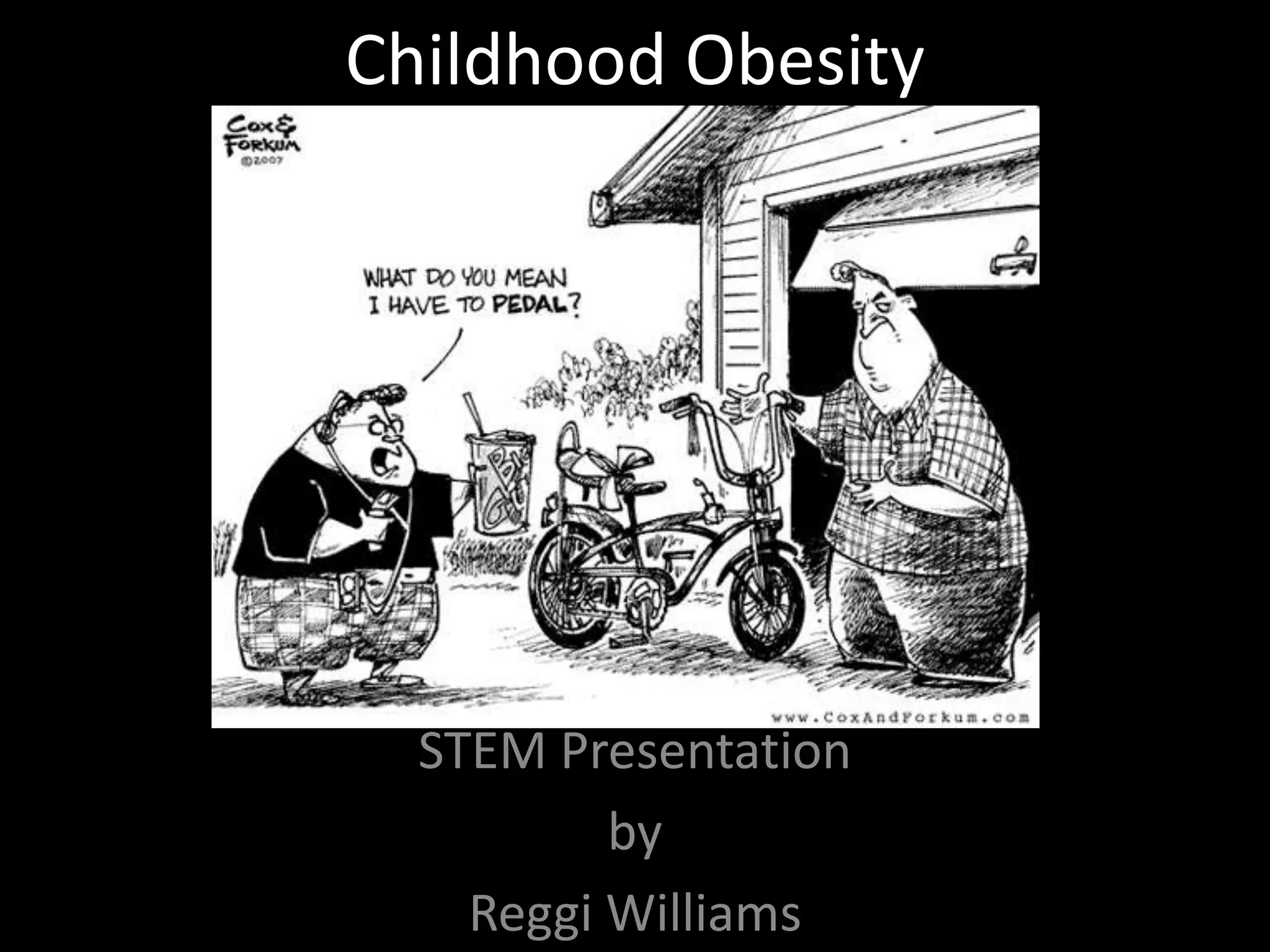
Childhood ObesitySTEM PresentationbyReggi Williams
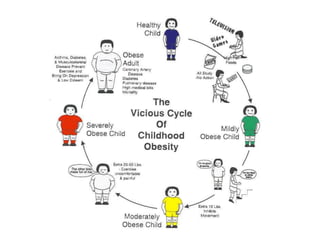
OutlineChildhood Obesity Defined [Interactive Exercise Available]Childhood Obesity, AboutCausesHealth ComplicationsControversyComplications of Childhood Obesity Explained [Visual Diagram]Statistical Demographics within Minority Groups (Addressing a PEER Question from WEEK 6)Statistical Demographics  Based Upon Income Brackets (Addressing a PEER Question from WEEK 6) [Interactive Exercise Available]Statistical Demographics: Bring the Message HOME [to Illinois and Chicago in particular]The Vicious Cycle of Childhood Obesity [Visual Diagram]StakeholdersChildren and their potential offspringParent(s) and other family membersCommunities and societyAddressing the CureLifestyle habits to change, moderate, or otherwise promote healthy and happy childrenThe Fast Food Corporation (Addressing a PEER Question from WEEK 6)Summary: Stakeholders, Scientists, the Scientific Community, and SocietyBibliography
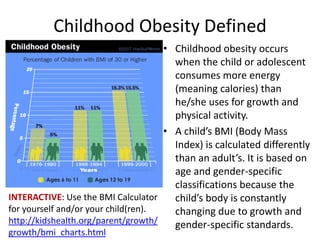
Childhood Obesity DefinedChildhood obesity occurs when the child or adolescent consumes more energy (meaning calories) than he/she uses for growth and physical activity.A child’s BMI (Body Mass Index) is calculated differently than an adult’s. It is based on age and gender-specific classifications because the child’s body is constantly changing due to growth and gender-specific standards. INTERACTIVE: Use the BMI Calculator for yourself and/or your child(ren). http://kidshealth.org/parent/growth/growth/bmi_charts.html
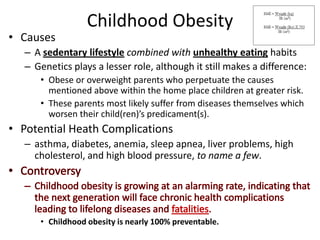
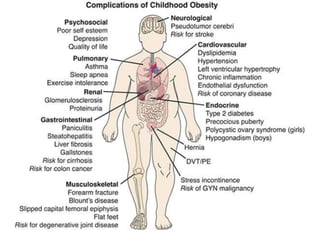
Childhood ObesityCausesA sedentary lifestylecombined withunhealthy eating habitsGenetics plays a lesser role, although it still makes a difference:Obese or overweight parents who perpetuate the causes mentioned above within the home place children at greater risk.These parents most likely suffer from diseases themselves which worsen their child(ren)’s predicament(s).Potential Heath Complicationsasthma, diabetes, anemia, sleep apnea, liver problems, high cholesterol, and high blood pressure, to name a few.ControversyChildhood obesity is growing at an alarming rate, indicating that the next generation will face chronic health complications leading to lifelong diseases and fatalities.Childhood obesity is nearly 100% preventable.
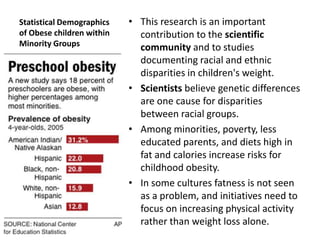
Statistical Demographics of Obese children within Minority GroupsThis research is an important contribution to the scientific community and to studies documenting racial and ethnic disparities in children's weight.Scientists believe genetic differences are one cause for disparities between racial groups.Among minorities, poverty, less educated parents, and diets high in fat and calories increase risks for childhood obesity.In some cultures fatness is not seen as a problem, and initiatives need to focus on increasing physical activity rather than weight loss alone.
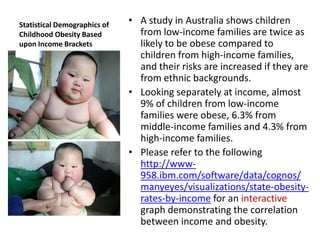
Statistical Demographics of Childhood Obesity Based upon Income BracketsA study in Australia shows children from low-income families are twice as likely to be obese compared to children from high-income families, and their risks are increased if they are from ethnic backgrounds.Looking separately at income, almost 9% of children from low-income families were obese, 6.3% from middle-income families and 4.3% from high-income families.Please refer to the following http://www-958.ibm.com/software/data/cognos/manyeyes/visualizations/state-obesity-rates-by-income for an interactive graph demonstrating the correlation between income and obesity.
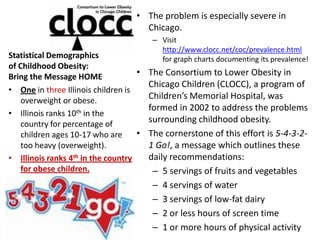
The problem is especially severe in Chicago.Visit http://www.clocc.net/coc/prevalence.html for graph charts documenting its prevalence!The Consortium to Lower Obesity in Chicago Children (CLOCC), a program of Children’s Memorial Hospital, was formed in 2002 to address the problems surrounding childhood obesity.The cornerstone of this effort is 5-4-3-2-1 Go!, a message which outlines these daily recommendations:  5 servings of fruits and vegetables4 servings of water 3 servings of low-fat dairy2 or less hours of screen time1 or more hours of physical activityStatistical Demographics  of Childhood Obesity: Bring the Message HOMEOne in three Illinois children is overweight or obese.
Illinois ranks 10th in the country for percentage of children ages 10-17 who are too heavy (overweight).
Illinois ranks 4th in the country for obese children.
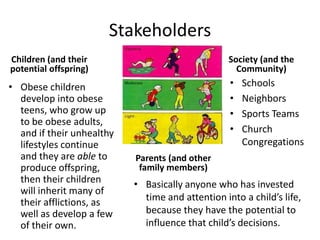
StakeholdersChildren (and their potential offspring)Society (and the Community)SchoolsNeighborsSports TeamsChurch CongregationsObese children develop into obese teens, who grow up to be obese adults, and if their unhealthy lifestyles continue and they are able to produce offspring, then their children will inherit many of their afflictions, as well as develop a few of their own.Parents (and other family members)Basically anyone who has invested time and attention into a child’s life, because they have the potential to influence that child’s decisions.
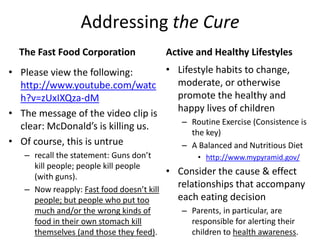
Addressing the CureThe Fast Food CorporationActive and Healthy LifestylesLifestyle habits to change, moderate, or otherwise promote the healthy and happy lives of childrenRoutine Exercise (Consistence is the key)A Balanced and Nutritious Diethttp://www.mypyramid.gov/Consider the cause & effect relationships that accompany each eating decisionParents, in particular, are responsible for alerting their children to health awareness.Please view the following: http://www.youtube.com/watch?v=zUxIXQza-dMThe message of the video clip is clear: McDonald’s is killing us.Of course, this is untrue recall the statement: Guns don’t kill people; people kill people (with guns).Now reapply: Fast food doesn’t kill people; but people who put too much and/or the wrong kinds of food in their own stomach kill themselves (and those they feed).
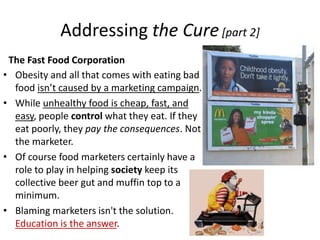
Addressing the Cure [part 2]The Fast Food CorporationObesity and all that comes with eating bad food isn’t caused by a marketing campaign.While unhealthy food is cheap, fast, and easy, people control what they eat. If they eat poorly, they pay the consequences. Not the marketer.Of course food marketers certainly have a role to play in helping society keep its collective beer gut and muffin top to a minimum.Blaming marketers isn't the solution. Education is the answer.
Scientists have collected sufficient data to demonstrate that childhood obesity is a fatal health concern for the public.  The stakeholders are (1) children, (2) parents and other family members, and (3) the communities and society as a whole.  As a generally accepted concept within the scientific community, childhood obesity is a public health concern which effects more than just the afflicted child(ren).  Additionally, children are considered to be juveniles by definition and therefore not solely responsible for their lifestyles and eating habits.  For this reason, all stakeholders must act responsibly and prove to be positive advocates for active and healthy living.Summary (something worth remembering)

Childhood Obesity

  • 1.
  • 2.
    OutlineChildhood Obesity Defined[Interactive Exercise Available]Childhood Obesity, AboutCausesHealth ComplicationsControversyComplications of Childhood Obesity Explained [Visual Diagram]Statistical Demographics within Minority Groups (Addressing a PEER Question from WEEK 6)Statistical Demographics Based Upon Income Brackets (Addressing a PEER Question from WEEK 6) [Interactive Exercise Available]Statistical Demographics: Bring the Message HOME [to Illinois and Chicago in particular]The Vicious Cycle of Childhood Obesity [Visual Diagram]StakeholdersChildren and their potential offspringParent(s) and other family membersCommunities and societyAddressing the CureLifestyle habits to change, moderate, or otherwise promote healthy and happy childrenThe Fast Food Corporation (Addressing a PEER Question from WEEK 6)Summary: Stakeholders, Scientists, the Scientific Community, and SocietyBibliography
  • 3.
    Childhood Obesity DefinedChildhoodobesity occurs when the child or adolescent consumes more energy (meaning calories) than he/she uses for growth and physical activity.A child’s BMI (Body Mass Index) is calculated differently than an adult’s. It is based on age and gender-specific classifications because the child’s body is constantly changing due to growth and gender-specific standards. INTERACTIVE: Use the BMI Calculator for yourself and/or your child(ren). http://kidshealth.org/parent/growth/growth/bmi_charts.html
  • 4.
    Childhood ObesityCausesA sedentarylifestylecombined withunhealthy eating habitsGenetics plays a lesser role, although it still makes a difference:Obese or overweight parents who perpetuate the causes mentioned above within the home place children at greater risk.These parents most likely suffer from diseases themselves which worsen their child(ren)’s predicament(s).Potential Heath Complicationsasthma, diabetes, anemia, sleep apnea, liver problems, high cholesterol, and high blood pressure, to name a few.ControversyChildhood obesity is growing at an alarming rate, indicating that the next generation will face chronic health complications leading to lifelong diseases and fatalities.Childhood obesity is nearly 100% preventable.
  • 6.
    Statistical Demographics ofObese children within Minority GroupsThis research is an important contribution to the scientific community and to studies documenting racial and ethnic disparities in children's weight.Scientists believe genetic differences are one cause for disparities between racial groups.Among minorities, poverty, less educated parents, and diets high in fat and calories increase risks for childhood obesity.In some cultures fatness is not seen as a problem, and initiatives need to focus on increasing physical activity rather than weight loss alone.
  • 7.
    Statistical Demographics ofChildhood Obesity Based upon Income BracketsA study in Australia shows children from low-income families are twice as likely to be obese compared to children from high-income families, and their risks are increased if they are from ethnic backgrounds.Looking separately at income, almost 9% of children from low-income families were obese, 6.3% from middle-income families and 4.3% from high-income families.Please refer to the following http://www-958.ibm.com/software/data/cognos/manyeyes/visualizations/state-obesity-rates-by-income for an interactive graph demonstrating the correlation between income and obesity.
  • 8.
    The problem isespecially severe in Chicago.Visit http://www.clocc.net/coc/prevalence.html for graph charts documenting its prevalence!The Consortium to Lower Obesity in Chicago Children (CLOCC), a program of Children’s Memorial Hospital, was formed in 2002 to address the problems surrounding childhood obesity.The cornerstone of this effort is 5-4-3-2-1 Go!, a message which outlines these daily recommendations:  5 servings of fruits and vegetables4 servings of water 3 servings of low-fat dairy2 or less hours of screen time1 or more hours of physical activityStatistical Demographics of Childhood Obesity: Bring the Message HOMEOne in three Illinois children is overweight or obese.
  • 9.
    Illinois ranks 10thin the country for percentage of children ages 10-17 who are too heavy (overweight).
  • 10.
    Illinois ranks 4thin the country for obese children.
  • 11.
    StakeholdersChildren (and theirpotential offspring)Society (and the Community)SchoolsNeighborsSports TeamsChurch CongregationsObese children develop into obese teens, who grow up to be obese adults, and if their unhealthy lifestyles continue and they are able to produce offspring, then their children will inherit many of their afflictions, as well as develop a few of their own.Parents (and other family members)Basically anyone who has invested time and attention into a child’s life, because they have the potential to influence that child’s decisions.
  • 12.
    Addressing the CureTheFast Food CorporationActive and Healthy LifestylesLifestyle habits to change, moderate, or otherwise promote the healthy and happy lives of childrenRoutine Exercise (Consistence is the key)A Balanced and Nutritious Diethttp://www.mypyramid.gov/Consider the cause & effect relationships that accompany each eating decisionParents, in particular, are responsible for alerting their children to health awareness.Please view the following: http://www.youtube.com/watch?v=zUxIXQza-dMThe message of the video clip is clear: McDonald’s is killing us.Of course, this is untrue recall the statement: Guns don’t kill people; people kill people (with guns).Now reapply: Fast food doesn’t kill people; but people who put too much and/or the wrong kinds of food in their own stomach kill themselves (and those they feed).
  • 13.
    Addressing the Cure[part 2]The Fast Food CorporationObesity and all that comes with eating bad food isn’t caused by a marketing campaign.While unhealthy food is cheap, fast, and easy, people control what they eat. If they eat poorly, they pay the consequences. Not the marketer.Of course food marketers certainly have a role to play in helping society keep its collective beer gut and muffin top to a minimum.Blaming marketers isn't the solution. Education is the answer.
  • 14.
    Scientists have collectedsufficient data to demonstrate that childhood obesity is a fatal health concern for the public. The stakeholders are (1) children, (2) parents and other family members, and (3) the communities and society as a whole. As a generally accepted concept within the scientific community, childhood obesity is a public health concern which effects more than just the afflicted child(ren). Additionally, children are considered to be juveniles by definition and therefore not solely responsible for their lifestyles and eating habits. For this reason, all stakeholders must act responsibly and prove to be positive advocates for active and healthy living.Summary (something worth remembering)