PRAVIN KUMAR
DAMOR
MSC NURSING FINAL
GOVT. COLLEGE OF
NURSING UDAIPUR
CONCEPT, NATURE, FUNCTION AND
PRINCIPLES OF MANAGEMENT AND
ADMINISTRATION
Nursing is a major component of the health
care delivery system, and nurses make up
the longest employment group within the
system. Nursing services are necessary for
virtually every client seeking care of any
type, including health promotion, diagnosis
and treatment and rehabilitation. In this
connection nurses need to understand the
system to effectively deliver quality care
Every nurse practice today needs
to appreciate that health care in a
business. The success of health
care business depends on nursing
participation in changing the
system for delivering cost
effective care.
The word “Administer” is derived from the
Latin word “Ad+ministraire”, means to
care for or to look after people to manage
affairs. Administraire means “serve.” The
meaning is suggestive enough as it insists
on the administrator to regard himself as
servant, not that the master to look after,
perform all functions.
Administration is a process
performing all collective effort, be it
public or private, civil or military, large
scale otherwise, and in that of
universal nature it is a corporate
effort, directed towards the realization
of a consciously laid down
objective(s).
1. Administration is the organization and
direction of human and material resources
to achieve desired ends. — Pfiffner and
Dresitus
2. Administration is the direction,
coordination and control of many persons to
achieve some purposes or objectives. —
L.D. White
3. Administration is concerned with what and
the ‘how’ of Government. The what in the
subject matter the technical knowledge of field
which enables the administrator to perform his
tasks. The how in the technique of
management the principles according to which
cooperative programmes are carried to
success. — Marshall E. Dimock
4. Administration may be defined as the
management of affairs with the use of well
thought out principles and practices and
rationalized techniques to achieve certain
goals/objectives. — Herbert A. Simon
1. Universal and Holistic
2. Intangible
3. Continuous and ongoing
4. Goal oriented
5. Social and human
6. Dynamic
7. Creative or Innovative
Organization is a group of people
working together to achieve
certain laid down common goals
or objectives. These goals are
achieved through the harmonised
coordinated and conscious efforts
to all categories of people
constituting the organization.
It is extreme important that goals which are
formulated for an organization and in
achieving these goals. Administration and
management are interchangeably used.
Whether these two terms are different or
synonymous and the different
interpretation of the term management.
1. “Management is defined as the process by
which a cooperative group directs actions
towards common goal.” — Joseph Massie
2. “Management is the process and agency
which directs and guides the operations of an
organizations in realizing established aims.” — O.
Tead
3. “Management is simply the process of
decision making and control over the action of
human being for the express purpose of attaining
predetermined goal.” — Stanley Vance
INTRODUCTION
The sequence of administration attempts to
discover and impart, principles of
administration. Principles can mean either
of two things: i.e., cubical nature and
generalization of behaviour.
Principles are based with any types of
administration and management with
principles can not fulfil any determined
outcomes of management effectively.
Meaning of word principle is a
generalization from behaviour. A succinct
statement that experience has shows that
if “A” (a purpose) is to be attained then “B”
(a train of policies and activities) must be
employed.
There are many authors described the
organizational principles to mean the
administration and management effectively
to achieve the goals.
 According to’’Finer” following are the
principles of administration.
1. Principle of oneness
 From the apprehension of purpose, from its
absorption, flows directly the oneness of leadership
that gives from to the whole aggregate of people
whose skills are needed for its fulfilment.
Leadership must take the form of a single
executive or a due or triumvirate and they are
numerous forms of collective administrative bodies.
2. Principle of specialisation and the
whole
Principle of oneness offers guidance in an
endemic problem in administration. The
relationship of the specialist or expert to
the total plan. In the administration, each
one should become an expert.
3. Principle of hierarchy and
regimentation
Administration has accepted the idea
of hierarchy to denote authority
coming downwards from above, but
do not in the sense of chastising
dogmatic rule it accepts it in the sense
only of functional super ordination sub
ordination.
4. Principle of morale
Morale is the spirit of active devotion to the
persons working together for a common
purpose. When it is high, the subjective burden
of the work, its hours, its routine the patience it
demands the submission of personal interesting
and values, are highly carried, and there is an
easy and cheerful demeanour on the part of
those who take and give order.
5. Principle of bureaucracy
Bureaucracy is diseased administration, the
disease may be defined deficiency in the spirit
that created its purpose that caused
organization to be created, so that either co-
operation has fallen apart activities are
executed without any interest in the object
originally assigned to them. Bureaucracy in
administration without purpose, ethos, oneness
or morale, it is the organizational form of
personality equal to individual person called the
“Hollowman.”
6 Principle of self administration
Administration begins with the self in
relationship to the fulfilment of a purpose.
The administrator begins with the self
administration, the adaptation of his own
stubborn, passive, incompetent or
dissentient self to the purpose, even if no
one else is at work with him on the job.
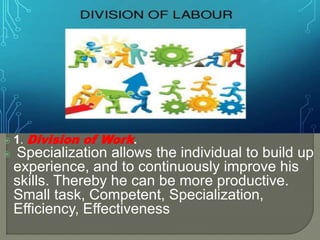
 1. Division of Work.
 Specialization allows the individual to build up
experience, and to continuously improve his
skills. Thereby he can be more productive.
Small task, Competent, Specialization,
Efficiency, Effectiveness
2. Principle of Authority and
Responsibility : Authority
means power to take
decisions. Responsibility
means obligation to
complete the job
3. PRINCIPLE OF DISCIPLINE: General
rules and regulations for systematic
working in an organization.
4. Principle of unity of command:
Employee should receive orders from one
boss only.
5. Unity of direction: All the efforts of the
members and employees of the
organization must be directed to one
direction that is the achievement of
common goal.
 6. Subordination of individual interest to general interest:
Subordination of individual interest to general
interest the interest of the organization must
supersede the interest of the individuals.
 7. Principle of remuneration of persons:
Employees must be paid fairly or adequately to give
them maximum satisfaction
 8. Principle of centralization and decentralization:
Centralization refers to concentration of power in few
hands. Decentralization means evenly distribution
of power at every level.
9. Principle of scalar chain: Means line
of authority or chain of superiors from
highest to lowest rank
10. Principle of Order: Principle of Order
It refers to orderly arrangement of men and
material a fixed place for everything and
everyone in the organization
11. Principle of Equity:
Principle of Equity Fair
and just treatment to
employees.
12. Stability of
tenure of
personnel:
Stability of
tenure of
personnel No
frequent
termination or
transfer.
13. Principle of
Initiative: Principle
of Initiative
Employees must
be given
opportunity to take
some initiative in
making and
executing a plan
14. Principle of
Esprit De
Corps:
Principle of
Esprit De
Corps
Means union
THANK YOU

Administration

  • 1.
    PRAVIN KUMAR DAMOR MSC NURSINGFINAL GOVT. COLLEGE OF NURSING UDAIPUR
  • 2.
    CONCEPT, NATURE, FUNCTIONAND PRINCIPLES OF MANAGEMENT AND ADMINISTRATION
  • 3.
    Nursing is amajor component of the health care delivery system, and nurses make up the longest employment group within the system. Nursing services are necessary for virtually every client seeking care of any type, including health promotion, diagnosis and treatment and rehabilitation. In this connection nurses need to understand the system to effectively deliver quality care
  • 4.
    Every nurse practicetoday needs to appreciate that health care in a business. The success of health care business depends on nursing participation in changing the system for delivering cost effective care.
  • 5.
    The word “Administer”is derived from the Latin word “Ad+ministraire”, means to care for or to look after people to manage affairs. Administraire means “serve.” The meaning is suggestive enough as it insists on the administrator to regard himself as servant, not that the master to look after, perform all functions.
  • 6.
    Administration is aprocess performing all collective effort, be it public or private, civil or military, large scale otherwise, and in that of universal nature it is a corporate effort, directed towards the realization of a consciously laid down objective(s).
  • 7.
    1. Administration isthe organization and direction of human and material resources to achieve desired ends. — Pfiffner and Dresitus 2. Administration is the direction, coordination and control of many persons to achieve some purposes or objectives. — L.D. White
  • 8.
    3. Administration isconcerned with what and the ‘how’ of Government. The what in the subject matter the technical knowledge of field which enables the administrator to perform his tasks. The how in the technique of management the principles according to which cooperative programmes are carried to success. — Marshall E. Dimock 4. Administration may be defined as the management of affairs with the use of well thought out principles and practices and rationalized techniques to achieve certain goals/objectives. — Herbert A. Simon
  • 9.
    1. Universal andHolistic 2. Intangible 3. Continuous and ongoing 4. Goal oriented 5. Social and human 6. Dynamic 7. Creative or Innovative
  • 10.
    Organization is agroup of people working together to achieve certain laid down common goals or objectives. These goals are achieved through the harmonised coordinated and conscious efforts to all categories of people constituting the organization.
  • 11.
    It is extremeimportant that goals which are formulated for an organization and in achieving these goals. Administration and management are interchangeably used. Whether these two terms are different or synonymous and the different interpretation of the term management.
  • 12.
    1. “Management isdefined as the process by which a cooperative group directs actions towards common goal.” — Joseph Massie 2. “Management is the process and agency which directs and guides the operations of an organizations in realizing established aims.” — O. Tead 3. “Management is simply the process of decision making and control over the action of human being for the express purpose of attaining predetermined goal.” — Stanley Vance
  • 14.
    INTRODUCTION The sequence ofadministration attempts to discover and impart, principles of administration. Principles can mean either of two things: i.e., cubical nature and generalization of behaviour. Principles are based with any types of administration and management with principles can not fulfil any determined outcomes of management effectively.
  • 15.
    Meaning of wordprinciple is a generalization from behaviour. A succinct statement that experience has shows that if “A” (a purpose) is to be attained then “B” (a train of policies and activities) must be employed. There are many authors described the organizational principles to mean the administration and management effectively to achieve the goals.
  • 16.
     According to’’Finer”following are the principles of administration. 1. Principle of oneness  From the apprehension of purpose, from its absorption, flows directly the oneness of leadership that gives from to the whole aggregate of people whose skills are needed for its fulfilment. Leadership must take the form of a single executive or a due or triumvirate and they are numerous forms of collective administrative bodies.
  • 17.
    2. Principle ofspecialisation and the whole Principle of oneness offers guidance in an endemic problem in administration. The relationship of the specialist or expert to the total plan. In the administration, each one should become an expert.
  • 18.
    3. Principle ofhierarchy and regimentation Administration has accepted the idea of hierarchy to denote authority coming downwards from above, but do not in the sense of chastising dogmatic rule it accepts it in the sense only of functional super ordination sub ordination.
  • 19.
    4. Principle ofmorale Morale is the spirit of active devotion to the persons working together for a common purpose. When it is high, the subjective burden of the work, its hours, its routine the patience it demands the submission of personal interesting and values, are highly carried, and there is an easy and cheerful demeanour on the part of those who take and give order.
  • 20.
    5. Principle ofbureaucracy Bureaucracy is diseased administration, the disease may be defined deficiency in the spirit that created its purpose that caused organization to be created, so that either co- operation has fallen apart activities are executed without any interest in the object originally assigned to them. Bureaucracy in administration without purpose, ethos, oneness or morale, it is the organizational form of personality equal to individual person called the “Hollowman.”
  • 21.
    6 Principle ofself administration Administration begins with the self in relationship to the fulfilment of a purpose. The administrator begins with the self administration, the adaptation of his own stubborn, passive, incompetent or dissentient self to the purpose, even if no one else is at work with him on the job.
  • 23.
     1. Divisionof Work.  Specialization allows the individual to build up experience, and to continuously improve his skills. Thereby he can be more productive. Small task, Competent, Specialization, Efficiency, Effectiveness
  • 24.
    2. Principle ofAuthority and Responsibility : Authority means power to take decisions. Responsibility means obligation to complete the job
  • 25.
    3. PRINCIPLE OFDISCIPLINE: General rules and regulations for systematic working in an organization.
  • 26.
    4. Principle ofunity of command: Employee should receive orders from one boss only. 5. Unity of direction: All the efforts of the members and employees of the organization must be directed to one direction that is the achievement of common goal.
  • 27.
     6. Subordinationof individual interest to general interest: Subordination of individual interest to general interest the interest of the organization must supersede the interest of the individuals.  7. Principle of remuneration of persons: Employees must be paid fairly or adequately to give them maximum satisfaction  8. Principle of centralization and decentralization: Centralization refers to concentration of power in few hands. Decentralization means evenly distribution of power at every level.
  • 28.
    9. Principle ofscalar chain: Means line of authority or chain of superiors from highest to lowest rank 10. Principle of Order: Principle of Order It refers to orderly arrangement of men and material a fixed place for everything and everyone in the organization
  • 29.
    11. Principle ofEquity: Principle of Equity Fair and just treatment to employees.
  • 30.
    12. Stability of tenureof personnel: Stability of tenure of personnel No frequent termination or transfer.
  • 31.
    13. Principle of Initiative:Principle of Initiative Employees must be given opportunity to take some initiative in making and executing a plan
  • 32.
    14. Principle of EspritDe Corps: Principle of Esprit De Corps Means union
  • 33.