THE DSM 5
UPDATE ON ADHD DIAGNOSTIC CRITERIA
Dr. Yael Leitner
CHILD DEVELOPMENT CENTER & ADHD CLINIC
Dana -Dwek Children’s Hospital
Sourasky Medical Center, Tel Aviv
The Revision
(by the ADHD and Disruptive Behavior Disorders Workgroup ,APA, May 2012)
Changing to a “life span” disorder:
 Diagnostic category
 Age of onset.
 Number of symptoms required for diagnosis in people< 17 years.
Changing the description of the examples for each symptom
Changing the from subtypes into presentations
More lenient requirements for clinical impairment of
symptoms and for situational pervasiveness
Removing ASD from the exclusion criteria
Other changes
New overall Diagnostic Category
 DSM IV:
Disorders usually first diagnosed in infancy,
childhood, or adolescence
 DSM V:
Neurodevelopmental Disorders
Changing the age of onset
 DSM IV:
B. Some hyperactive-impulsive or inattentive
symptoms that caused impairment were present
before age 7 years.
 DSM V:
B. Several inattentive or hyperactive-impulsive
symptoms were present before age 12 years*.
*…thus, symptoms can now appear up to 5
years later. And, there is no longer the
requirement that the symptoms create
impairment by age 12, just that they are
present.
Changing the age of onset*
The rational for changing the age of onset
 96 percent of lifetime cases of ADHD are captured
with an onset by age 12 to 14, suggesting that an
age 12 cutoff is superior to most alternatives
 Research published since DSM-IV did not identify
meaningful differences in individuals whose
symptoms were present at younger vs. older ages
in functioning ,response to treatment, or outcomes
Number of symptoms required
and duration of symptoms
 Individuals younger than 17
at least 6 of 9 inattentive and/or hyperactive impulsive
symptoms. (=DSM IV)
 For individuals 17 and above
only 5 or more symptoms are needed*.
 As in DSM-IV, the symptoms must be present for at least 6
months to a degree that is judged to be inconsistent with an
individual’s developmental level.
*This change from DSM-IV was made because of the reduction in symptoms that tends to occur
with increasing age.
The explanation for this change provided on the DSM-V web site is that a slightly lower
symptom threshold is sufficient to make a reliable diagnosis in adults.
Inattentive symptoms & examples
 Often fails to give close attention to details or makes careless mistakes in
schoolwork, work, or during other activities
(e.g. overlooks or misses details, work is inaccurate).
 Often has difficulty sustaining attention in tasks or play activities
(e.g., has difficulty remaining focused during lectures, conversations, or
lengthy reading).
 Often does not seem to listen when spoken to directly
(e.g., mind seems elsewhere, even in the absence of any obvious distraction).
 Often does not follow through on instructions and fails to finish school work,
chores, or duties in the work place
(e.g., starts tasks but quickly loses focus and is easily sidetracked).
 Often has difficulty organizing tasks and activities. (e.g., difficulty managing
sequential tasks; difficulty keeping materials and belongings in order; messy,
disorganized work; has poor time management; fails to meet deadlines)
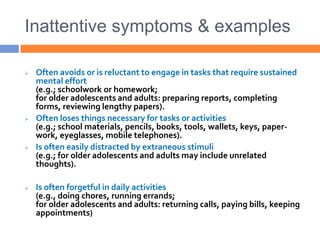
Inattentive symptoms & examples
 Often avoids or is reluctant to engage in tasks that require sustained
mental effort
(e.g.; schoolwork or homework;
for older adolescents and adults: preparing reports, completing
forms, reviewing lengthy papers).
 Often loses things necessary for tasks or activities
(e.g.; school materials, pencils, books, tools, wallets, keys, paper-
work, eyeglasses, mobile telephones).
 Is often easily distracted by extraneous stimuli
(e.g.; for older adolescents and adults may include unrelated
thoughts).
 Is often forgetful in daily activities
(e.g., doing chores, running errands;
for older adolescents and adults: returning calls, paying bills, keeping
appointments)
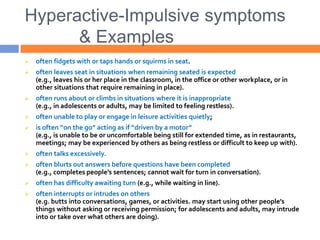
Hyperactive-Impulsive symptoms
& Examples
 often fidgets with or taps hands or squirms in seat.
 often leaves seat in situations when remaining seated is expected
(e.g., leaves his or her place in the classroom, in the office or other workplace, or in
other situations that require remaining in place).
 often runs about or climbs in situations where it is inappropriate
(e.g., in adolescents or adults, may be limited to feeling restless).
 often unable to play or engage in leisure activities quietly;
 is often “on the go” acting as if “driven by a motor”
(e.g., is unable to be or uncomfortable being still for extended time, as in restaurants,
meetings; may be experienced by others as being restless or difficult to keep up with).
 often talks excessively.
 often blurts out answers before questions have been completed
(e.g., completes people’s sentences; cannot wait for turn in conversation).
 often has difficulty awaiting turn (e.g., while waiting in line).
 often interrupts or intrudes on others
(e.g. butts into conversations, games, or activities. may start using other people’s
things without asking or receiving permission; for adolescents and adults, may intrude
into or take over what others are doing).
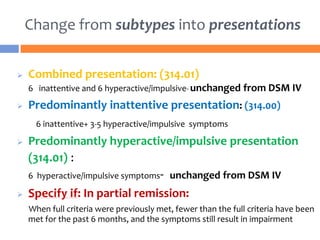
Change from subtypes into presentations
 Combined presentation: (314.01)
6 inattentive and 6 hyperactive/impulsive- unchanged from DSM IV
 Predominantly inattentive presentation: (314.00)
6 inattentive+ 3-5 hyperactive/impulsive symptoms
 Predominantly hyperactive/impulsive presentation
(314.01) :
6 hyperactive/impulsive symptoms- unchanged from DSM IV
 Specify if: In partial remission:
When full criteria were previously met, fewer than the full criteria have been
met for the past 6 months, and the symptoms still result in impairment
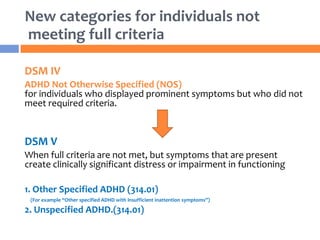
New categories for individuals not
meeting full criteria
DSM IV
ADHD Not Otherwise Specified (NOS)
for individuals who displayed prominent symptoms but who did not
meet required criteria.
DSM V
When full criteria are not met, but symptoms that are present
create clinically significant distress or impairment in functioning
1. Other Specified ADHD (314.01)
(For example “Other specified ADHD with insufficient inattention symptoms”)
2. Unspecified ADHD.(314.01)
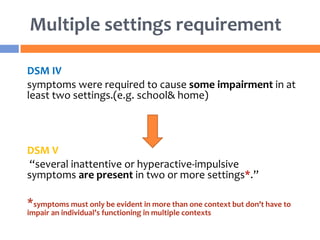
Multiple settings requirement
DSM IV
symptoms were required to cause some impairment in at
least two settings.(e.g. school& home)
DSM V
“several inattentive or hyperactive-impulsive
symptoms are present in two or more settings*.”
*symptoms must only be evident in more than one context but don’t have to
impair an individual’s functioning in multiple contexts
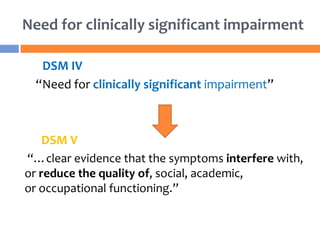
Need for clinically significant impairment
DSM IV
“Need for clinically significant impairment”
DSM V
“…clear evidence that the symptoms interfere with,
or reduce the quality of, social, academic,
or occupational functioning.”
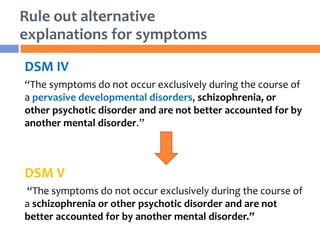
Rule out alternative
explanations for symptoms
DSM IV
“The symptoms do not occur exclusively during the course of
a pervasive developmental disorders, schizophrenia, or
other psychotic disorder and are not better accounted for by
another mental disorder.”
DSM V
“The symptoms do not occur exclusively during the course of
a schizophrenia or other psychotic disorder and are not
better accounted for by another mental disorder.”
DSM V: ASD & ADHD
 ADHD can now be diagnosed in conjunction
with Autism Spectrum Disorder.
 In the past, ADHD would have been ruled out
based on the assumption that ADHD symptoms
were always better explained by the child’s
autism.
New requirement to specify severity
 Mild* = there are few, if any, symptoms beyond those required to
make the diagnosis and no more than minor impairment in functioning.
Moderate* = symptoms or functional impairment between ‘mild’ and
‘severe’. People in this category may not necessarily show clinically
significant impairment.
Severe = reserved for cases with many symptoms in excess of those
required for the diagnosis, or several symptoms that are especially
severe, or marked impairment resulting from symptoms.
** In DSM-IV, where clinically significant impairment was required,
these individuals would not be diagnosed.
Possible impact of the proposed changes
 Although the main concept is unchanged,
the suggested changes might increase the
prevalence of ADHD, especially in adolescents and
adults.
 The added examples might also result in necessary
revisions and new validations of rating scales and
diagnostic interviews.
 Refocus research on ADHD/ASD “comorbidity”.
NIH Director -Tom Insel , M.D.
On the new DSM 5
“….The goal of this new manual, as with all previous editions, is to provide a common
language for describing psychopathology. While DSM has been described as a
“Bible” for the field, it is, at best, a dictionary, creating a set of labels and defining
each. The strength of each of the editions of DSM has been “reliability” – each
edition has ensured that clinicians use the same terms in the same ways. The
weakness is its lack of validity. Unlike our definitions of ischemic heart disease,
lymphoma, or AIDS, the DSM diagnoses are based on a consensus about clusters of
clinical symptoms, not any objective laboratory measure. In the rest of medicine,
this would be equivalent to creating diagnostic systems based on the nature of
chest pain or the quality of fever…..”
“…Patients with mental disorders deserve better. NIMH has launched the
Research Domain Criteria (RDoC) project to transform diagnosis by
incorporating genetics, imaging, cognitive science, and other levels of information
to lay the foundation for a new classification system. Through a series of
workshops over the past 18 months, we have tried to define several major
categories for a new nosology” ….
April 2013

שינויים באבחנת Adhd דר ליטנר

  • 1.
    THE DSM 5 UPDATEON ADHD DIAGNOSTIC CRITERIA Dr. Yael Leitner CHILD DEVELOPMENT CENTER & ADHD CLINIC Dana -Dwek Children’s Hospital Sourasky Medical Center, Tel Aviv
  • 2.
    The Revision (by theADHD and Disruptive Behavior Disorders Workgroup ,APA, May 2012) Changing to a “life span” disorder:  Diagnostic category  Age of onset.  Number of symptoms required for diagnosis in people< 17 years. Changing the description of the examples for each symptom Changing the from subtypes into presentations More lenient requirements for clinical impairment of symptoms and for situational pervasiveness Removing ASD from the exclusion criteria Other changes
  • 3.
    New overall DiagnosticCategory  DSM IV: Disorders usually first diagnosed in infancy, childhood, or adolescence  DSM V: Neurodevelopmental Disorders
  • 4.
    Changing the ageof onset  DSM IV: B. Some hyperactive-impulsive or inattentive symptoms that caused impairment were present before age 7 years.  DSM V: B. Several inattentive or hyperactive-impulsive symptoms were present before age 12 years*.
  • 5.
    *…thus, symptoms cannow appear up to 5 years later. And, there is no longer the requirement that the symptoms create impairment by age 12, just that they are present. Changing the age of onset*
  • 6.
    The rational forchanging the age of onset  96 percent of lifetime cases of ADHD are captured with an onset by age 12 to 14, suggesting that an age 12 cutoff is superior to most alternatives  Research published since DSM-IV did not identify meaningful differences in individuals whose symptoms were present at younger vs. older ages in functioning ,response to treatment, or outcomes
  • 7.
    Number of symptomsrequired and duration of symptoms  Individuals younger than 17 at least 6 of 9 inattentive and/or hyperactive impulsive symptoms. (=DSM IV)  For individuals 17 and above only 5 or more symptoms are needed*.  As in DSM-IV, the symptoms must be present for at least 6 months to a degree that is judged to be inconsistent with an individual’s developmental level. *This change from DSM-IV was made because of the reduction in symptoms that tends to occur with increasing age. The explanation for this change provided on the DSM-V web site is that a slightly lower symptom threshold is sufficient to make a reliable diagnosis in adults.
  • 8.
    Inattentive symptoms &examples  Often fails to give close attention to details or makes careless mistakes in schoolwork, work, or during other activities (e.g. overlooks or misses details, work is inaccurate).  Often has difficulty sustaining attention in tasks or play activities (e.g., has difficulty remaining focused during lectures, conversations, or lengthy reading).  Often does not seem to listen when spoken to directly (e.g., mind seems elsewhere, even in the absence of any obvious distraction).  Often does not follow through on instructions and fails to finish school work, chores, or duties in the work place (e.g., starts tasks but quickly loses focus and is easily sidetracked).  Often has difficulty organizing tasks and activities. (e.g., difficulty managing sequential tasks; difficulty keeping materials and belongings in order; messy, disorganized work; has poor time management; fails to meet deadlines)
  • 9.
    Inattentive symptoms &examples  Often avoids or is reluctant to engage in tasks that require sustained mental effort (e.g.; schoolwork or homework; for older adolescents and adults: preparing reports, completing forms, reviewing lengthy papers).  Often loses things necessary for tasks or activities (e.g.; school materials, pencils, books, tools, wallets, keys, paper- work, eyeglasses, mobile telephones).  Is often easily distracted by extraneous stimuli (e.g.; for older adolescents and adults may include unrelated thoughts).  Is often forgetful in daily activities (e.g., doing chores, running errands; for older adolescents and adults: returning calls, paying bills, keeping appointments)
  • 10.
    Hyperactive-Impulsive symptoms & Examples often fidgets with or taps hands or squirms in seat.  often leaves seat in situations when remaining seated is expected (e.g., leaves his or her place in the classroom, in the office or other workplace, or in other situations that require remaining in place).  often runs about or climbs in situations where it is inappropriate (e.g., in adolescents or adults, may be limited to feeling restless).  often unable to play or engage in leisure activities quietly;  is often “on the go” acting as if “driven by a motor” (e.g., is unable to be or uncomfortable being still for extended time, as in restaurants, meetings; may be experienced by others as being restless or difficult to keep up with).  often talks excessively.  often blurts out answers before questions have been completed (e.g., completes people’s sentences; cannot wait for turn in conversation).  often has difficulty awaiting turn (e.g., while waiting in line).  often interrupts or intrudes on others (e.g. butts into conversations, games, or activities. may start using other people’s things without asking or receiving permission; for adolescents and adults, may intrude into or take over what others are doing).
  • 11.
    Change from subtypesinto presentations  Combined presentation: (314.01) 6 inattentive and 6 hyperactive/impulsive- unchanged from DSM IV  Predominantly inattentive presentation: (314.00) 6 inattentive+ 3-5 hyperactive/impulsive symptoms  Predominantly hyperactive/impulsive presentation (314.01) : 6 hyperactive/impulsive symptoms- unchanged from DSM IV  Specify if: In partial remission: When full criteria were previously met, fewer than the full criteria have been met for the past 6 months, and the symptoms still result in impairment
  • 12.
    New categories forindividuals not meeting full criteria DSM IV ADHD Not Otherwise Specified (NOS) for individuals who displayed prominent symptoms but who did not meet required criteria. DSM V When full criteria are not met, but symptoms that are present create clinically significant distress or impairment in functioning 1. Other Specified ADHD (314.01) (For example “Other specified ADHD with insufficient inattention symptoms”) 2. Unspecified ADHD.(314.01)
  • 13.
    Multiple settings requirement DSMIV symptoms were required to cause some impairment in at least two settings.(e.g. school& home) DSM V “several inattentive or hyperactive-impulsive symptoms are present in two or more settings*.” *symptoms must only be evident in more than one context but don’t have to impair an individual’s functioning in multiple contexts
  • 14.
    Need for clinicallysignificant impairment DSM IV “Need for clinically significant impairment” DSM V “…clear evidence that the symptoms interfere with, or reduce the quality of, social, academic, or occupational functioning.”
  • 15.
    Rule out alternative explanationsfor symptoms DSM IV “The symptoms do not occur exclusively during the course of a pervasive developmental disorders, schizophrenia, or other psychotic disorder and are not better accounted for by another mental disorder.” DSM V “The symptoms do not occur exclusively during the course of a schizophrenia or other psychotic disorder and are not better accounted for by another mental disorder.”
  • 16.
    DSM V: ASD& ADHD  ADHD can now be diagnosed in conjunction with Autism Spectrum Disorder.  In the past, ADHD would have been ruled out based on the assumption that ADHD symptoms were always better explained by the child’s autism.
  • 17.
    New requirement tospecify severity  Mild* = there are few, if any, symptoms beyond those required to make the diagnosis and no more than minor impairment in functioning. Moderate* = symptoms or functional impairment between ‘mild’ and ‘severe’. People in this category may not necessarily show clinically significant impairment. Severe = reserved for cases with many symptoms in excess of those required for the diagnosis, or several symptoms that are especially severe, or marked impairment resulting from symptoms. ** In DSM-IV, where clinically significant impairment was required, these individuals would not be diagnosed.
  • 18.
    Possible impact ofthe proposed changes  Although the main concept is unchanged, the suggested changes might increase the prevalence of ADHD, especially in adolescents and adults.  The added examples might also result in necessary revisions and new validations of rating scales and diagnostic interviews.  Refocus research on ADHD/ASD “comorbidity”.
  • 19.
    NIH Director -TomInsel , M.D. On the new DSM 5 “….The goal of this new manual, as with all previous editions, is to provide a common language for describing psychopathology. While DSM has been described as a “Bible” for the field, it is, at best, a dictionary, creating a set of labels and defining each. The strength of each of the editions of DSM has been “reliability” – each edition has ensured that clinicians use the same terms in the same ways. The weakness is its lack of validity. Unlike our definitions of ischemic heart disease, lymphoma, or AIDS, the DSM diagnoses are based on a consensus about clusters of clinical symptoms, not any objective laboratory measure. In the rest of medicine, this would be equivalent to creating diagnostic systems based on the nature of chest pain or the quality of fever…..” “…Patients with mental disorders deserve better. NIMH has launched the Research Domain Criteria (RDoC) project to transform diagnosis by incorporating genetics, imaging, cognitive science, and other levels of information to lay the foundation for a new classification system. Through a series of workshops over the past 18 months, we have tried to define several major categories for a new nosology” …. April 2013