ADHD Attention-Deficit/Hyperactivity Disorder
What is adhd?The DSM-IV-TR defines ADHD as a “persistent pattern of inattention and/or hyperactivity-impulsivity that is more frequently displayed and more severe than is typically observed in individuals at a comparable level of development”?? What does this mean??
What is adhd? (cont.)a disorder that appears in early childhood*signs and symptoms of ADHD typically appear before the age of 7**it can be difficult to distinguish between ADHD and normal “kid behavior.” ***
Specific culture, age, gender featuresADHD is known to occur in various cultures, with variations in reported prevalence among Western countries probably arising from different diagnostic practices than from differences in clinical presentation
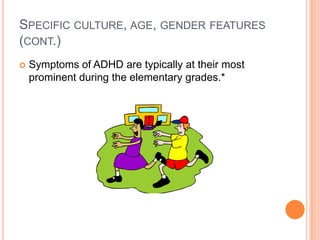
Specific culture, age, gender features (cont.)Symptoms of ADHD are typically at their most prominent during the elementary grades.*
prevalence3% - 7% in school age children*
Familial patternADHD has been found to be more common in the first-degree biological relatives of children with ADHD than in the general population.*
Subtypes*Attention-Deficit/Hyperactivity Disorder, Combined TypeThis subtype should be used if six (or more) symptoms of inattention and six (or more) symptoms of hyperactivity-impulsivity have persisted for at least 6 months. Most children and adolescents with the disorder have the Combined Type.
Subtypes (cont.)Attention-Deficit/Hyperactivity Disorder, Predominantly Inattentive TypeThis subtype should be used if six (or more) symptoms of inattention (but fewer than six symptoms of hyperactivity-impulsivity) have persisted for at least 6 months.
Subtypes (cont.)Attention-Deficit/Hyperactivity, Predominantly Hyperactive-Impulsive TypeThis subtype should be used if six (or more) symptoms of hyperactivity-impulsivity (but fewer than six symptoms of inattention) have persisted for at least 6 months.
Diagnostic criteria
Diagnostic criteria6 or more of the following symptoms of INATTENTION have persisted for at least 6 months to a degree that is maladaptive and inconsistent with developmental level :
Diagnostic criteria-InattentionFails to give close attention to details or makes careless mistakes in schoolwork, work, or other activitiesDifficulty sustaining attention in tasks or play activitiesDoes not seem to listen when spoken to directlyDoes not follow through on instructions and fails to finish school-work, chores, or duties in the workplaceDifficulty organizing tasks and activitiesAvoids, dislikes, or is reluctant to engage in tasks that require sustained mental effortLoses things necessary for tasks or activitiesDistracted by extraneous stimuliForgetful in daily activities
Diagnostic criteria6 or more of the following symptoms of HYPERACTIVITY-IMPULSIVITY have persisted for at least 6 months to a degree that is maladaptive and inconsistent with developmental level:
Diagnostic criteria-hyperactivity-impulsivityHyperactivityFidgets with hands or feet or squirms in seatLeaves seat in classroom or in other situations in which remaining seated is expectedRuns about or climbs excessively in situations in which it is inappropriateOften has difficulty playing or engaging in leisure activities quietlyIs often “on the go” or often acts if “driven by a motor”Talks excessively
Diagnostic criteria-hyperactivity-impulsivity (cont.)ImpulsivityBlurts out answers before questions have been completedHas difficulty awaiting turnInterrupts or intrudes on others
Conclusion	In early childhood, it may be difficult to distinguish symptoms of ADHD from age-appropriate behaviors in active children (e.g., running around or being noisy)Inattention in the classroom may also occur when children with high intelligence are placed in academically understimulating environments.
Questions??

Adhd powerpoint

  • 1.
  • 2.
    What is adhd?TheDSM-IV-TR defines ADHD as a “persistent pattern of inattention and/or hyperactivity-impulsivity that is more frequently displayed and more severe than is typically observed in individuals at a comparable level of development”?? What does this mean??
  • 3.
    What is adhd?(cont.)a disorder that appears in early childhood*signs and symptoms of ADHD typically appear before the age of 7**it can be difficult to distinguish between ADHD and normal “kid behavior.” ***
  • 4.
    Specific culture, age,gender featuresADHD is known to occur in various cultures, with variations in reported prevalence among Western countries probably arising from different diagnostic practices than from differences in clinical presentation
  • 5.
    Specific culture, age,gender features (cont.)Symptoms of ADHD are typically at their most prominent during the elementary grades.*
  • 6.
    prevalence3% - 7%in school age children*
  • 7.
    Familial patternADHD hasbeen found to be more common in the first-degree biological relatives of children with ADHD than in the general population.*
  • 8.
    Subtypes*Attention-Deficit/Hyperactivity Disorder, CombinedTypeThis subtype should be used if six (or more) symptoms of inattention and six (or more) symptoms of hyperactivity-impulsivity have persisted for at least 6 months. Most children and adolescents with the disorder have the Combined Type.
  • 9.
    Subtypes (cont.)Attention-Deficit/Hyperactivity Disorder,Predominantly Inattentive TypeThis subtype should be used if six (or more) symptoms of inattention (but fewer than six symptoms of hyperactivity-impulsivity) have persisted for at least 6 months.
  • 10.
    Subtypes (cont.)Attention-Deficit/Hyperactivity, PredominantlyHyperactive-Impulsive TypeThis subtype should be used if six (or more) symptoms of hyperactivity-impulsivity (but fewer than six symptoms of inattention) have persisted for at least 6 months.
  • 11.
  • 12.
    Diagnostic criteria6 ormore of the following symptoms of INATTENTION have persisted for at least 6 months to a degree that is maladaptive and inconsistent with developmental level :
  • 13.
    Diagnostic criteria-InattentionFails togive close attention to details or makes careless mistakes in schoolwork, work, or other activitiesDifficulty sustaining attention in tasks or play activitiesDoes not seem to listen when spoken to directlyDoes not follow through on instructions and fails to finish school-work, chores, or duties in the workplaceDifficulty organizing tasks and activitiesAvoids, dislikes, or is reluctant to engage in tasks that require sustained mental effortLoses things necessary for tasks or activitiesDistracted by extraneous stimuliForgetful in daily activities
  • 14.
    Diagnostic criteria6 ormore of the following symptoms of HYPERACTIVITY-IMPULSIVITY have persisted for at least 6 months to a degree that is maladaptive and inconsistent with developmental level:
  • 15.
    Diagnostic criteria-hyperactivity-impulsivityHyperactivityFidgets withhands or feet or squirms in seatLeaves seat in classroom or in other situations in which remaining seated is expectedRuns about or climbs excessively in situations in which it is inappropriateOften has difficulty playing or engaging in leisure activities quietlyIs often “on the go” or often acts if “driven by a motor”Talks excessively
  • 16.
    Diagnostic criteria-hyperactivity-impulsivity (cont.)ImpulsivityBlurtsout answers before questions have been completedHas difficulty awaiting turnInterrupts or intrudes on others
  • 17.
    Conclusion In early childhood,it may be difficult to distinguish symptoms of ADHD from age-appropriate behaviors in active children (e.g., running around or being noisy)Inattention in the classroom may also occur when children with high intelligence are placed in academically understimulating environments.
  • 18.

Editor's Notes

  • #4 *You may know it by the name attention deficit disorder, or ADD. ADD / ADHD makes it difficult for people to inhibit their spontaneous responses—responses that can involve everything from movement to speech and attentiveness. ** Hyperactivity may vary with the individual’s age and developmental level, and the diagnosis should be made cautiously in young children.***If you spot just a few signs, or the symptoms appear only in some situations, it’s probably not ADD / ADHD. On the other hand, if your child shows a number of disruptive ADD / ADHD signs and symptoms that are present across all situations – at home, at school, and at play – it’s time to take a closer look. Attentional and behavioral manifestations usually appear in multiple contexts, including home, school, work, and social situations.
  • #6 It is difficult to establish the diagnosis in children younger than age 4 or 5 years, because their characteristic behavior is much more variable than that of older children and may include features that are similar to symptoms of ADHD.By late childhood and early adolescence, signs of gross motor activity (e.g., excessive running and climbing, not remaining seated) are less common, and hyperactivity symptoms may be confined to fidgetiness or an inner feeling of jitteriness or restlessness.
  • #7 * Data on prevalence in adolescence and adulthood are limited. Evidence suggests that the prevalence of ADHD as defined in the DSM-IV may be somewhat greater than the prevalence of the disorder based in DSM-III-R criteria.
  • #8 *Family, school, and peer influences are also crucial in determining the extent of impairments and comorbidity. Studies also suggest that there is a higher prevalence of Mood and Anxiety Disorders, Learning Disorders, Substance-Related Disorders, and Antisocial Personality Disorder in family members of individuals with ADHD.
  • #9 *Although many individuals present symptoms of both inattention and hyperactivity-impulsivity, there are individuals in whom one or the other pattern is predominant.