Look Listen & Test:  Mental Health Assessment In Primary Care  Dr Gabriel Ivbijaro MBBS, FRCGP. FWACPsych, MMedSci, DFFP, MA Family Doctor Chair Wonca Working Party on Mental Health
International Reference Group Culturally Sensitive Depression Guideline  www.globalfamilydoctor.com G Ivbijaro, L Kolkiewicz, E Palazidou, H Parmentier, A Abyad, B Ali, A Al-khatami, K Aswani, S Bammeke, H Bell-Gamm, J Benson, A Bideman, M Carmi, A Cohen, I Crabbe, C Dorwick,  J Gensichen, M Grenville, S Gupta, S Hiew, N Jackson, R Jenkins, A Khan, T Khoja, M Lee, F McMillan, L Risdale, H Rodenberg, T Swanwick, A Tylee, I Wilson, H Yaman, F Zizzo
Look, Listen And Test: Mental Health Assessment – The WONCA Culturally Sensitive Depression Guideline Primary Care Mental Health 2005; 3: 145 -147
Goldberg Huxley Model Level Filter Filter description Rate  (per 1000) 1 Community (total) 250 1 st  Filter Illness Behaviour 2 Primary Care (total) 230 2 nd  Filter Ability to detect 3 Primary  Care   (identified) 140 3 rd  Filter Willingness to refer 4 Mental Illness Services (total) 17 4 th  Filter Factors determining admission 5 Mental Illness (admissions) 6
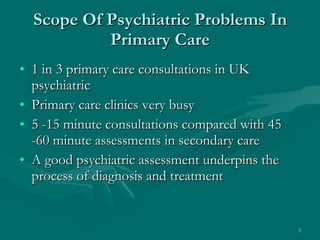
Scope Of Psychiatric Problems In Primary Care 1 in 3 primary care consultations in UK psychiatric Primary care clinics very busy 5 -15 minute consultations compared with 45 -60 minute assessments in secondary care A good psychiatric assessment underpins the process of diagnosis and treatment
Barriers To Making A Psychiatric Assessment In Primary Care Lack of emphasis on psychiatry in Continuing Professional Development (CPD) Plans in primary care Psychiatric terminology daunting Short consultation times Variable expression of symptoms across cultures (class, ethnicity, gender, sexuality, age)
Qualities That Primary Care Physicians Bring To Psychiatric Assessment  Knowledge of patients longitudinal history Knowledge of patients personality over time Knowledge of patients family and social context Time – the opportunity for GP to ask patient to come back repeatedly for further assessment (unless patient presenting in an emergency)
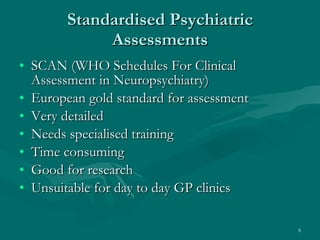
Standardised Psychiatric Assessments SCAN (WHO Schedules For Clinical Assessment in Neuropsychiatry) European gold standard for assessment  Very detailed Needs specialised training Time consuming Good for research Unsuitable for day to day GP clinics
Look, Listen, Test (LLT) A generic schema Informs consultation process regardless of pathology presented Supports a holistic view by providing a psychological element to the formulation Helpful schema for a primary care consultation Useful for medical students
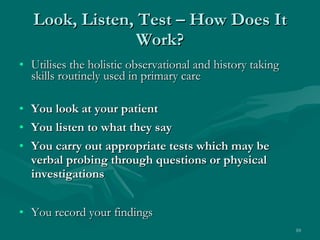
Look, Listen, Test – How Does It Work? Utilises the holistic observational and history taking skills routinely used in primary care You look at your patient You listen to what they say You carry out appropriate tests which may be verbal probing through questions or physical investigations You record your findings
Cross-cultural implementation of a Chinese version of SCAN in Taiwan Cheng ATA, Tien AT, Chang CJ et al . British Journal of Psychiatry 2001 178, 576 - 572
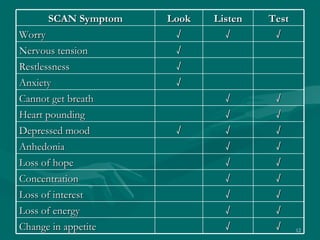
SCAN Symptom Look Listen Test Worry √ √ √ Nervous tension √ Restlessness √ Anxiety √ Cannot get breath √ √ Heart pounding √ √ Depressed mood √ √ √ Anhedonia √ √ Loss of hope √ √ Concentration √ √ Loss of interest √ √ Loss of energy √ √ Change in appetite √ √
SCAN Symptom Look Listen Test Sleep problems √ √ Difficulty dropping off √ √ Expansive mood √ √ √ Irritable mood √ √ √ Over talkative √ √ Frequency of alcohol use √ √ Tolerance to drugs √ √ Derealisation √ √ Auditory hallucinations √ √ √ Voice commenting √ √ Thought broadcasting √ √ Being spied upon √ √ √ Unusual sensations √ √
LLT A practical schema Can record symptoms and signs from SCAN Taps into skills already developed in primary care Has face validity Jargon free & descriptive Developed within primary care
Definition of schizophrenia – reminder  Thought echo, thought withdrawal, thought broadcasting  Delusions of control influence or passivity clearly referred to body or limb movements or specific thoughts actions or sensations. Delusional perception Hallucinatory voices giving running commentary or discussing the patient among themsleves Persistent delusions of other kinds that are culturally inappropriate and completely impossible  Persistent hallucinations in any modality, accompanied by fleeting or half formed delusions without clear affective content or by persistent over-valued ideas, or when occurring every day for weeks on end Breaks or interpolations in the train of thought resulting in incoherence , irrelevant speech or neologisms Catatonic behaviour eg excitement, posturing, waxy flexibility, negativism, mutism and stupor ‘ negative’ symptoms eg marked apathy, paucity of speech, blunting or incongruity of emotional response, usually resulting in social withdrawal Significant and consistent change in overall quality of asome aspects of personal behaviour including loss of interest, aimlessness, idleness, a self absorbed attitude and social withdrawal Clear cut symptoms Other symptoms
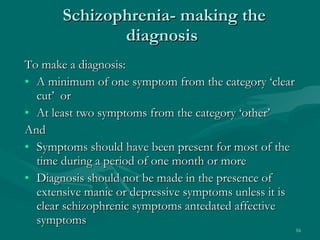
Schizophrenia- making the diagnosis  To make a diagnosis: A minimum of one symptom from the category ‘clear cut’  or  At least two symptoms from the category ‘other’ And Symptoms should have been present for most of the time during a period of one month or more Diagnosis should not be made in the presence of extensive manic or depressive symptoms unless it is clear schizophrenic symptoms antedated affective symptoms
Case 1 85 year old lady Consulting he doctors since she can not go to sleep at night Lost husband 4 years ago, living herself, son living 45 minutes drive away Medical history: diet controlled diabetes, hypothyroidism, polymyalgia rheumatica, hyprtension Medication: prednisolone 10 mg, levothyroxine 75 mic, ramipril 5 mg, aspirin 75 mg
HISTORY +LLT  Mental health diagnosis? Social factors? Medication? Possible co-morbidity factors? Other factors?
EXAM HISTORY LONGITUDINAL BACK GROUND CURRENT PROBLEMS MSE L L T FORMULATIO TREAT
 
Thank you! [email_address]

Ivbijaro 03

  • 1.
    Look Listen &Test: Mental Health Assessment In Primary Care Dr Gabriel Ivbijaro MBBS, FRCGP. FWACPsych, MMedSci, DFFP, MA Family Doctor Chair Wonca Working Party on Mental Health
  • 2.
    International Reference GroupCulturally Sensitive Depression Guideline www.globalfamilydoctor.com G Ivbijaro, L Kolkiewicz, E Palazidou, H Parmentier, A Abyad, B Ali, A Al-khatami, K Aswani, S Bammeke, H Bell-Gamm, J Benson, A Bideman, M Carmi, A Cohen, I Crabbe, C Dorwick, J Gensichen, M Grenville, S Gupta, S Hiew, N Jackson, R Jenkins, A Khan, T Khoja, M Lee, F McMillan, L Risdale, H Rodenberg, T Swanwick, A Tylee, I Wilson, H Yaman, F Zizzo
  • 3.
    Look, Listen AndTest: Mental Health Assessment – The WONCA Culturally Sensitive Depression Guideline Primary Care Mental Health 2005; 3: 145 -147
  • 4.
    Goldberg Huxley ModelLevel Filter Filter description Rate (per 1000) 1 Community (total) 250 1 st Filter Illness Behaviour 2 Primary Care (total) 230 2 nd Filter Ability to detect 3 Primary Care (identified) 140 3 rd Filter Willingness to refer 4 Mental Illness Services (total) 17 4 th Filter Factors determining admission 5 Mental Illness (admissions) 6
  • 5.
    Scope Of PsychiatricProblems In Primary Care 1 in 3 primary care consultations in UK psychiatric Primary care clinics very busy 5 -15 minute consultations compared with 45 -60 minute assessments in secondary care A good psychiatric assessment underpins the process of diagnosis and treatment
  • 6.
    Barriers To MakingA Psychiatric Assessment In Primary Care Lack of emphasis on psychiatry in Continuing Professional Development (CPD) Plans in primary care Psychiatric terminology daunting Short consultation times Variable expression of symptoms across cultures (class, ethnicity, gender, sexuality, age)
  • 7.
    Qualities That PrimaryCare Physicians Bring To Psychiatric Assessment Knowledge of patients longitudinal history Knowledge of patients personality over time Knowledge of patients family and social context Time – the opportunity for GP to ask patient to come back repeatedly for further assessment (unless patient presenting in an emergency)
  • 8.
    Standardised Psychiatric AssessmentsSCAN (WHO Schedules For Clinical Assessment in Neuropsychiatry) European gold standard for assessment Very detailed Needs specialised training Time consuming Good for research Unsuitable for day to day GP clinics
  • 9.
    Look, Listen, Test(LLT) A generic schema Informs consultation process regardless of pathology presented Supports a holistic view by providing a psychological element to the formulation Helpful schema for a primary care consultation Useful for medical students
  • 10.
    Look, Listen, Test– How Does It Work? Utilises the holistic observational and history taking skills routinely used in primary care You look at your patient You listen to what they say You carry out appropriate tests which may be verbal probing through questions or physical investigations You record your findings
  • 11.
    Cross-cultural implementation ofa Chinese version of SCAN in Taiwan Cheng ATA, Tien AT, Chang CJ et al . British Journal of Psychiatry 2001 178, 576 - 572
  • 12.
    SCAN Symptom LookListen Test Worry √ √ √ Nervous tension √ Restlessness √ Anxiety √ Cannot get breath √ √ Heart pounding √ √ Depressed mood √ √ √ Anhedonia √ √ Loss of hope √ √ Concentration √ √ Loss of interest √ √ Loss of energy √ √ Change in appetite √ √
  • 13.
    SCAN Symptom LookListen Test Sleep problems √ √ Difficulty dropping off √ √ Expansive mood √ √ √ Irritable mood √ √ √ Over talkative √ √ Frequency of alcohol use √ √ Tolerance to drugs √ √ Derealisation √ √ Auditory hallucinations √ √ √ Voice commenting √ √ Thought broadcasting √ √ Being spied upon √ √ √ Unusual sensations √ √
  • 14.
    LLT A practicalschema Can record symptoms and signs from SCAN Taps into skills already developed in primary care Has face validity Jargon free & descriptive Developed within primary care
  • 15.
    Definition of schizophrenia– reminder Thought echo, thought withdrawal, thought broadcasting Delusions of control influence or passivity clearly referred to body or limb movements or specific thoughts actions or sensations. Delusional perception Hallucinatory voices giving running commentary or discussing the patient among themsleves Persistent delusions of other kinds that are culturally inappropriate and completely impossible Persistent hallucinations in any modality, accompanied by fleeting or half formed delusions without clear affective content or by persistent over-valued ideas, or when occurring every day for weeks on end Breaks or interpolations in the train of thought resulting in incoherence , irrelevant speech or neologisms Catatonic behaviour eg excitement, posturing, waxy flexibility, negativism, mutism and stupor ‘ negative’ symptoms eg marked apathy, paucity of speech, blunting or incongruity of emotional response, usually resulting in social withdrawal Significant and consistent change in overall quality of asome aspects of personal behaviour including loss of interest, aimlessness, idleness, a self absorbed attitude and social withdrawal Clear cut symptoms Other symptoms
  • 16.
    Schizophrenia- making thediagnosis To make a diagnosis: A minimum of one symptom from the category ‘clear cut’ or At least two symptoms from the category ‘other’ And Symptoms should have been present for most of the time during a period of one month or more Diagnosis should not be made in the presence of extensive manic or depressive symptoms unless it is clear schizophrenic symptoms antedated affective symptoms
  • 17.
    Case 1 85year old lady Consulting he doctors since she can not go to sleep at night Lost husband 4 years ago, living herself, son living 45 minutes drive away Medical history: diet controlled diabetes, hypothyroidism, polymyalgia rheumatica, hyprtension Medication: prednisolone 10 mg, levothyroxine 75 mic, ramipril 5 mg, aspirin 75 mg
  • 18.
    HISTORY +LLT Mental health diagnosis? Social factors? Medication? Possible co-morbidity factors? Other factors?
  • 19.
    EXAM HISTORY LONGITUDINALBACK GROUND CURRENT PROBLEMS MSE L L T FORMULATIO TREAT
  • 20.
  • 22.

Editor's Notes

  • #21 © Henk Parmentier 2005 © Henk Parmentier 2005
  • #23 World Health Organization January 28, 2011