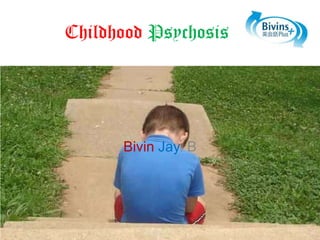

Childhood Psychosis

Bivin Jay. B
Introduction
• Pediatric schizophrenia, childhood onset
schizophrenia, childhood psychoses (DSM III)
• Dysregulation in thinking, motor, emotional
processess in child and adoloscents under the age
of 18 years
• Rare among children of ages from 7-8 yrs
• 50% of the young schizophrenics will experience
severe neuropsychiatric disturbances in the future
• Diagnostic criteria are same to adult population
• Childhood psychoses was added to DSM III in
1980s.
Prevalence & Epidemiology
• Studies using strict Dx criteria are limited
(because of the diagnostic diversity)
• Autism is more prevalent than childhood
schizophrenia
• 2/100,000 (based on the DSM III)
• Male to female ratio= 1.5:1 to 2.5:1
• Diagnosis is made frequently in adults than
children
• The peak age of onset is 15 yrs
Clinical features
• Almost similar to the adult schizophrenia
• Earlier signs are developmental lags/ language
and motor delays
• Positive & negative symptoms
• Auditory hallucinations are the most common Sx in
75%
• Visual and somatic hallucinations are not rare but
less frequent when compared to AH.
• Delusions (50-80%) – persecutory, feeling of being
tormented, somatic concerns, grandiose
perception or religious ideation
Etiology
• A neurodevelopmental disorder with no
demonstrable single etiology
• Genetic factors:
– Schizophrenia & schizophrenia spectrum ds. are
found in high rate among families of pts with F20
– Concordance rate: monozygotic twins (50%) &
dizygotic twins (17%)
– F20 is genetically mediated but not genetically
determined and results from an interaction of
gene & evmnt.
• Neurobiological deficits:
– No clear premorbid personality profile
explanations available
– Enlargement of the ventricular structure &
overall reduction in cortical grey matter and
brain volumes (Brain imaging studies)

• Psychology:
– 10-20% of children with F20 have borderline
IQ
– Cognitive deficits include lowered IQ, low
information processing, sustained
attention, memory and executive functions
especially working memory
• Family factors:
–
–
–
–

Abberant communication patterns
Double bound communications
Levels of EE
Communication deviance predispose to develop
schizophrenia in adoloscents

• Environment
– Low SES is associated with higher rate of
schizophrenia
– Adverse life events such as death of a parent,
rejection of the child
– Relationship of schizophrenia onset with SES is
still contradictory
– Incidence of clinical syndrome similar in a variey
of cultural settings
Assessment
•
•
•

Evaluate all areas of functioning
Dignostic procedures are often prolonged and require multiple informants
History and development
– History of current difficulties
– Age of onset
– Course and nature of symptoms
– Premorbid functioning
– School & cognitive skills
– Psychosocial adaptive skills
– Precipitants
– History of trauma
– Family H/o
– Family adaptive funtioning
– Substance use H/o
– Developmental H/o
– Communication and speech functioning
• Mental status examination:
– Level of consciousness and orientation
– Hallucinations or delusions
– Thought ds & negative symptoms
– Affective symptoms
– Assessment of dangerous and impulsive acts
– Suicidality & homicidality
• Psycho logic evaluation
– Projective testing for evaluation of thought
disturbances, hallucinations etc
– IQ and formal educational testing for assessment
of achievement
– Assessment of adaptive skills
– Assessment of communication/speech and
language

• Medical & neurological history and evaluation
• Physical examination for associated medical
conditions
• Toxicology screen for evaluation of substance
abuse
• Neurological consultation including EEG
• Autistic spectrum dis.
– Aspergers dis., Autistic Dis., childhood disintegrative dis., PDDs
• Psychoses associated with mood dis
– BPAD., MDD
• Other psychotic dis
– Psychosis NOS, Schizoaffective Dis.
• OCD
• PTSD
– Dissociative Dis.
• PDs
• Communication Dis
• SUDs
• Medical conditions
– Delirium, epilepsy, CNS trauma or neoplasms
• Infectious dis.
– HIV, HSV, Neurosyphilis, Encephalitis.
Treatment
• Require a multi-model approach
• Goals:
– ↓ the characteristic ψtic symptoms
– Returning the child to more appropriate lines
of management
– Re-integrating the child into his/her
community
Psychopharmacolgoy
• Clozapine is effective than HPL
• Clozapine has S/E of drowsiness, weight
gain, non specific changes in EEG, and
hypersalivation (Wt gain is approximately
7kg/6wks)
• RSPN – weight gain, sedation, and EPS
• OLZ- ↑ appetite, sedation
• Quitiapine- well tollerated in longer term
use/ sustained symptom improvement
• Care full practice parameters to be included
in Antipsychotic dosage
• Patient education abt the S/Es and informed
consent
• Baseline monitoring using AIMS for motor
S/Es
• Ongoing monitoring needs for SE of atypical
APs
• A combination of psychoeducational family
Rx + medication Rx + social skill training has
decreased relapse rate
• Support the child and the family with proper
explanations
• Supportive and CBT interventions are used to
promote adaptive functioning
• Individual/group interventions focus on
improving conflict resolution, social skills,
problem solving, and ADL
• Advocacy and educational groups are
beneficial- ↓ the stigma, and isolation
experienced by the families.
• School based interventions: spl education to
address the possible learning and
developmental disabilities
• Community based interventions: case
management, in-home therapeutic care,
therapeutic recreational activities and
vocational rehabilitation
Prognosis
• Low IQ and poor premorbid functioning- ↓
outcome
• Good prognosis: presence of affective
symptoms, A/c and old age onset, better
premorbid functioning and adjustment
• Poor prognosis: poor premorbid
character, non acute onset and early age
of onset.
Thank You

Childhood Psychosis

  • 1.
  • 2.
    Introduction • Pediatric schizophrenia,childhood onset schizophrenia, childhood psychoses (DSM III) • Dysregulation in thinking, motor, emotional processess in child and adoloscents under the age of 18 years • Rare among children of ages from 7-8 yrs • 50% of the young schizophrenics will experience severe neuropsychiatric disturbances in the future • Diagnostic criteria are same to adult population • Childhood psychoses was added to DSM III in 1980s.
  • 3.
    Prevalence & Epidemiology •Studies using strict Dx criteria are limited (because of the diagnostic diversity) • Autism is more prevalent than childhood schizophrenia • 2/100,000 (based on the DSM III) • Male to female ratio= 1.5:1 to 2.5:1 • Diagnosis is made frequently in adults than children • The peak age of onset is 15 yrs
  • 4.
    Clinical features • Almostsimilar to the adult schizophrenia • Earlier signs are developmental lags/ language and motor delays • Positive & negative symptoms • Auditory hallucinations are the most common Sx in 75% • Visual and somatic hallucinations are not rare but less frequent when compared to AH. • Delusions (50-80%) – persecutory, feeling of being tormented, somatic concerns, grandiose perception or religious ideation
  • 5.
    Etiology • A neurodevelopmentaldisorder with no demonstrable single etiology • Genetic factors: – Schizophrenia & schizophrenia spectrum ds. are found in high rate among families of pts with F20 – Concordance rate: monozygotic twins (50%) & dizygotic twins (17%) – F20 is genetically mediated but not genetically determined and results from an interaction of gene & evmnt.
  • 6.
    • Neurobiological deficits: –No clear premorbid personality profile explanations available – Enlargement of the ventricular structure & overall reduction in cortical grey matter and brain volumes (Brain imaging studies) • Psychology: – 10-20% of children with F20 have borderline IQ – Cognitive deficits include lowered IQ, low information processing, sustained attention, memory and executive functions especially working memory
  • 7.
    • Family factors: – – – – Abberantcommunication patterns Double bound communications Levels of EE Communication deviance predispose to develop schizophrenia in adoloscents • Environment – Low SES is associated with higher rate of schizophrenia – Adverse life events such as death of a parent, rejection of the child – Relationship of schizophrenia onset with SES is still contradictory – Incidence of clinical syndrome similar in a variey of cultural settings
  • 8.
    Assessment • • • Evaluate all areasof functioning Dignostic procedures are often prolonged and require multiple informants History and development – History of current difficulties – Age of onset – Course and nature of symptoms – Premorbid functioning – School & cognitive skills – Psychosocial adaptive skills – Precipitants – History of trauma – Family H/o – Family adaptive funtioning – Substance use H/o – Developmental H/o – Communication and speech functioning
  • 9.
    • Mental statusexamination: – Level of consciousness and orientation – Hallucinations or delusions – Thought ds & negative symptoms – Affective symptoms – Assessment of dangerous and impulsive acts – Suicidality & homicidality
  • 10.
    • Psycho logicevaluation – Projective testing for evaluation of thought disturbances, hallucinations etc – IQ and formal educational testing for assessment of achievement – Assessment of adaptive skills – Assessment of communication/speech and language • Medical & neurological history and evaluation • Physical examination for associated medical conditions • Toxicology screen for evaluation of substance abuse • Neurological consultation including EEG
  • 11.
    • Autistic spectrumdis. – Aspergers dis., Autistic Dis., childhood disintegrative dis., PDDs • Psychoses associated with mood dis – BPAD., MDD • Other psychotic dis – Psychosis NOS, Schizoaffective Dis. • OCD • PTSD – Dissociative Dis. • PDs • Communication Dis • SUDs • Medical conditions – Delirium, epilepsy, CNS trauma or neoplasms • Infectious dis. – HIV, HSV, Neurosyphilis, Encephalitis.
  • 12.
    Treatment • Require amulti-model approach • Goals: – ↓ the characteristic ψtic symptoms – Returning the child to more appropriate lines of management – Re-integrating the child into his/her community
  • 13.
    Psychopharmacolgoy • Clozapine iseffective than HPL • Clozapine has S/E of drowsiness, weight gain, non specific changes in EEG, and hypersalivation (Wt gain is approximately 7kg/6wks) • RSPN – weight gain, sedation, and EPS • OLZ- ↑ appetite, sedation • Quitiapine- well tollerated in longer term use/ sustained symptom improvement
  • 14.
    • Care fullpractice parameters to be included in Antipsychotic dosage • Patient education abt the S/Es and informed consent • Baseline monitoring using AIMS for motor S/Es • Ongoing monitoring needs for SE of atypical APs • A combination of psychoeducational family Rx + medication Rx + social skill training has decreased relapse rate • Support the child and the family with proper explanations
  • 15.
    • Supportive andCBT interventions are used to promote adaptive functioning • Individual/group interventions focus on improving conflict resolution, social skills, problem solving, and ADL • Advocacy and educational groups are beneficial- ↓ the stigma, and isolation experienced by the families. • School based interventions: spl education to address the possible learning and developmental disabilities • Community based interventions: case management, in-home therapeutic care, therapeutic recreational activities and vocational rehabilitation
  • 16.
    Prognosis • Low IQand poor premorbid functioning- ↓ outcome • Good prognosis: presence of affective symptoms, A/c and old age onset, better premorbid functioning and adjustment • Poor prognosis: poor premorbid character, non acute onset and early age of onset.
  • 17.