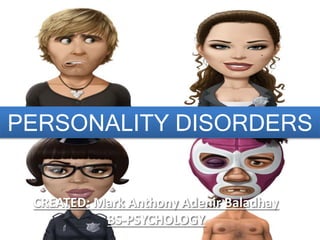












PERSONALITY DISORDERS 
CREATED: Mark Anthony Adenir Baladhay 
BS-PSYCHOLOGY
PERSONALITY? 
comes from the Latin word persona, which 
referred to a theatrical mask work by 
performers in order to either project 
different roles or disguise their identities. 
pattern of relatively permanent traits and 
unique characteristics that give both 
consistency and individuality to a person's 
behavior.“ (Feist and Feist, 2009)
PERSONALITY DISORDER? 
DSM IV-TR: 
An enduring pattern of 
inner experience and 
behavior that deviates 
markedly from the 
expectations of the 
individual's culture.
PERSONALITY DISORDER? 
manifested in two (or more) of the following 
areas: 
Cognition – ways of perceiving and interpreting 
Affectivity – intensity of emotional response 
Interpersonal functioning – social functioning 
Impulse control – control actions after thinking
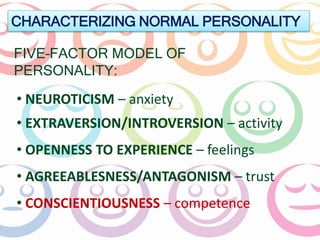
CHARACTERIZING NORMAL PERSONALITY 
FIVE–FACTOR MODEL OF 
PERSONALITY: 
• NEUROTICISM – anxiety 
• EXTRAVERSION/INTROVERSION – activity 
• OPENNESS TO EXPERIENCE – feelings 
• AGREEABLESNESS/ANTAGONISM – trust 
• CONSCIENTIOUSNESS – competence
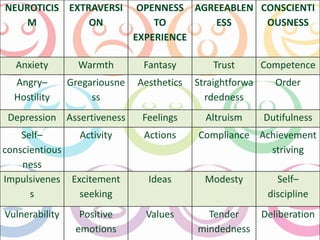
NEUROTICIS 
M 
EXTRAVERSI 
ON 
OPENNESS 
TO 
EXPERIENCE 
AGREEABLEN 
ESS 
CONSCIENTI 
OUSNESS 
Anxiety Warmth Fantasy Trust Competence 
Angry– 
Gregariousne 
Aesthetics Straightforwa 
Order 
Hostility 
ss 
rdedness 
Depression Assertiveness Feelings Altruism Dutifulness 
Self– 
conscientious 
ness 
Activity Actions Compliance Achievement 
striving 
Impulsivenes 
s 
Excitement 
seeking 
Ideas Modesty Self– 
discipline 
Vulnerability Positive 
emotions 
Values Tender 
mindedness 
Deliberation
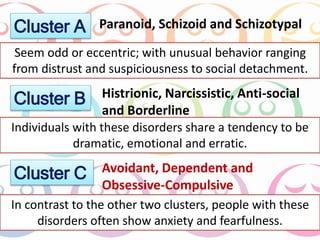
Cluster A Paranoid, Schizoid and Schizotypal 
Seem odd or eccentric; with unusual behavior ranging 
from distrust and suspiciousness to social detachment. 
Cluster B 
Histrionic, Narcissistic, Anti-social 
and Borderline 
Individuals with these disorders share a tendency to be 
dramatic, emotional and erratic. 
Cluster C 
Avoidant, Dependent and 
Obsessive-Compulsive 
In contrast to the other two clusters, people with these 
disorders often show anxiety and fearfulness.
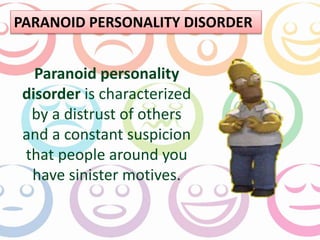
PARANOID PERSONALITY DISORDER 
Paranoid personality 
disorder is characterized 
by a distrust of others 
and a constant suspicion 
that people around you 
have sinister motives.
CRITERIA FOR PARANOID 
PERSONALITY DISORDER 
DSM-IV-TR 
A. Evidence of pervasive distrust or 
suspiciousness of others present in 
at least four of the 7 following ways:
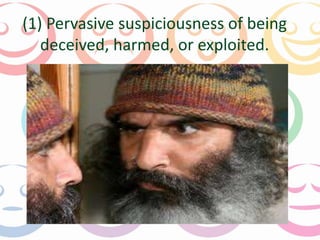
(1) Pervasive suspiciousness of being 
deceived, harmed, or exploited.
(2) Unjustified doubts about loyalty or 
trustworthiness of friends or associates.
(3) Reluctance to confide in others because 
of doubts of loyalty or trustworthiness
(4) Hidden demeaning or threatening 
meanings read into benign remarks or events
(5) Bears grudges; does not forgive 
insults, injuries, or slights
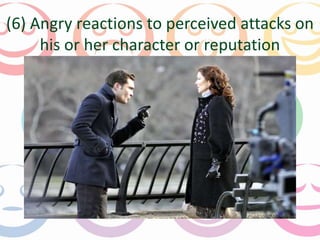
(6) Angry reactions to perceived attacks on 
his or her character or reputation
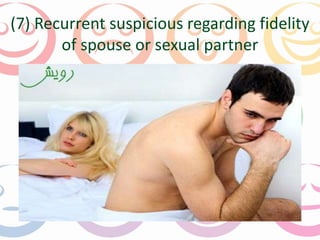
(7) Recurrent suspicious regarding fidelity 
of spouse or sexual partner
B. Does not occur exclusively during 
course of Schizophrenia, Mood disorder 
with Psychotic Features, or other 
psychotic disorder 
It is important to remember that 
people with PPD are not usually 
psychotic; most of the time they 
are in clear contact with reality.
CAUSAL FACTORS of PPD 
– Little is known for the causes and no clear cut 
– Partial genetic transmission that may link the 
disorder to schizophrenia, but results examining 
this issue are inconsistent (Kendler, Czajkowski, 
et al., 2006; M. B. Miller et al., 2001)
CAUSAL FACTORS of PPD 
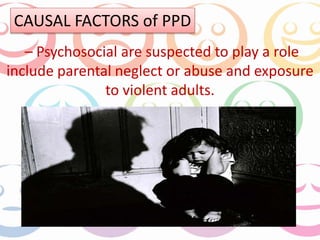
– Psychosocial are suspected to play a role 
include parental neglect or abuse and exposure 
to violent adults.
SCHIZOID PERSONALITY DISORDER 
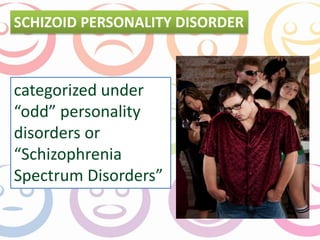
categorized under 
“odd” personality 
disorders or 
“Schizophrenia 
Spectrum Disorders”
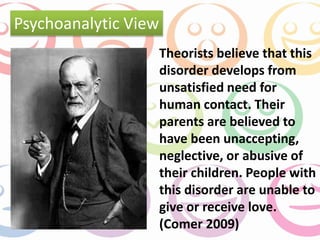
Theorists believe that this 
disorder develops from 
unsatisfied need for 
human contact. Their 
parents are believed to 
have been unaccepting, 
neglective, or abusive of 
their children. People with 
this disorder are unable to 
give or receive love. 
(Comer 2009) 
Psychoanalytic View
CRITERIA FOR SCHIZOID 
PERSONALITY DISORDER 
A. Evidence of a pervasive pattern of 
detachment from social relationships and 
a restricted range of expression of 
emotions in interpersonal settings shown 
in at least four of the 7 followings ways:
(1) Neither desires nor enjoys close 
relationships.
(2) Almost always chooses solitary 
activities
(3) Has little if any interest in sexual 
experiences with another person.
(4) Takes pleasure in few if any activities.
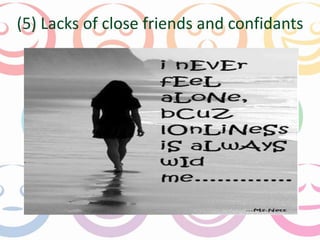
(5) Lacks of close friends and confidants
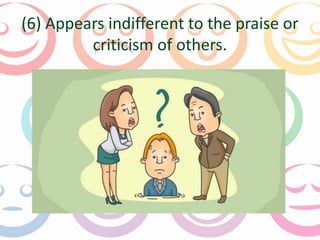
(6) Appears indifferent to the praise or 
criticism of others.
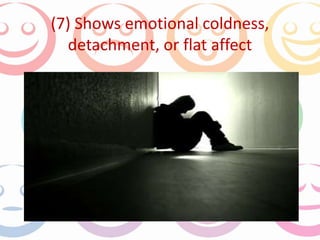
(7) Shows emotional coldness, 
detachment, or flat affect
B. Does not occur exclusively during 
course of Schizophrenia, Mood disorder 
with Psychotic Features, or other 
psychotic disorder or Pervasive 
Developmental Disorders
CAUSAL FACTORS of Schizoid PD 
• Little causes known and inconsistent. 
• Likely precursor to the development 
of schizophrenia but still challenged. 
• Traits have shown to have 
only modest heritability.
Paranoid PD vs. Schizoid PD 
NEO-PI-R 
Paranoid PD High Angry-hostility, 
(Neuroticisim) 
Low in Trust, 
Straightforwardness 
, and compliance 
(Agreeableness)
Paranoid PD vs. Schizoid PD 
NEO-PI-R 
Schizoid PD Low in warmth, 
gregariousness, 
positive emotions 
(EXTRAVERSION) 
Low in feelings 
(OPENNESS)
DEMOGRAPHICS AND PREVALENCE OF 
PERSONALITY DISORDERS 
The estimated overall prevalence of DSM-IV 
personality disorders was 9%. Cluster A 
disorders were most prevalent in men who 
had never married. Cluster B disorders were 
most prevalent in young men without a high 
school degree, and cluster C disorders in high 
school graduates who had never married.
DEMOGRAPHICS AND PREVALENCE OF 
PERSONALITY DISORDERS 
In general, the prevalence of personality 
disorders in this community sample was 
higher in men than in women; higher in 
formerly married and highest in never-married, 
compared with ever-married 
individuals; and higher in people who 
dropped out of high school than in 
graduates.
TREATMENTS FOR PPD 
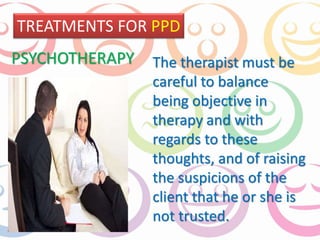
The therapist must be 
careful to balance 
being objective in 
therapy and with 
regards to these 
thoughts, and of raising 
the suspicions of the 
client that he or she is 
not trusted. 
PSYCHOTHERAPY
TREATMENTS FOR PPD 
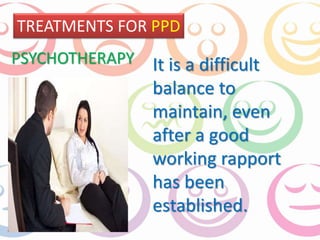
It is a difficult 
balance to 
maintain, even 
after a good 
working rapport 
has been 
established. 
PSYCHOTHERAPY
TREATMENTS FOR PPD 
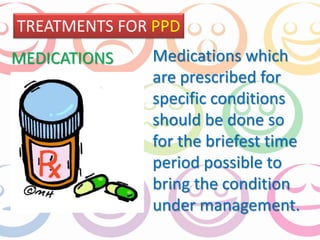
Medications which 
are prescribed for 
specific conditions 
should be done so 
for the briefest time 
period possible to 
bring the condition 
under management. 
MEDICATIONS
TREATMENTS FOR PPD 
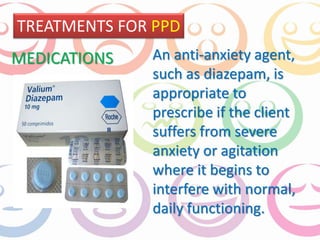
An anti-anxiety agent, 
such as diazepam, is 
appropriate to 
prescribe if the client 
suffers from severe 
anxiety or agitation 
where it begins to 
interfere with normal, 
daily functioning. 
MEDICATIONS
TREATMENTS FOR PPD 
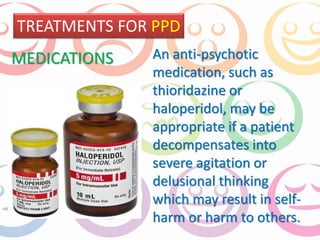
An anti-psychotic 
medication, such as 
thioridazine or 
haloperidol, may be 
appropriate if a patient 
decompensates into 
severe agitation or 
delusional thinking 
which may result in self-harm 
or harm to others. 
MEDICATIONS
TREATMENTS FOR PPD 
There are not any 
self-help support 
groups or 
communities that 
we are aware of that 
would be conducive 
to someone 
suffering from this 
disorder. 
SELP-HELP
TREATMENTS FOR PPD 
Such approaches would 
likely not be very 
effective because a 
person with this 
disorder is likely to be 
mistrustful and 
suspicious of others and 
their motivations, 
making group help and 
dynamics unlikely and 
possibly harmful. 
SELP-HELP
TREATMENTS FOR SPD 
While there are many 
suggested treatment 
approaches one could 
make for this disorder, 
none of them are likely 
to be easily effective. As 
with all personality 
disorders, the treatment 
of choice is individual 
psychotherapy. 
PSYCHOTHERAPY
TREATMENTS FOR SPD 
However, people with 
this disorder are 
unlikely to seek 
treatment unless they 
are under increased 
stress or pressure in 
their life. 
PSYCHOTHERAPY
TREATMENTS FOR SPD 
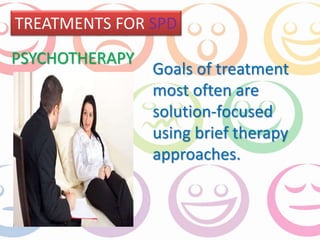
Goals of treatment 
most often are 
solution-focused 
using brief therapy 
approaches. 
PSYCHOTHERAPY
TREATMENTS FOR SPD 
Medication is usually 
not an issue for 
someone who suffers 
from this disorder, 
unless they also have 
an additional Axis I 
disorder, such as major 
depression. 
MEDICATIONS
TREATMENTS FOR SPD 
Most patients show no 
additional improvement 
with the addition of an 
antidepressant 
medication, though, 
unless they are also 
suffering from suicidal 
ideation or a major 
depressive episode. 
MEDICATIONS
TREATMENTS FOR SPD 
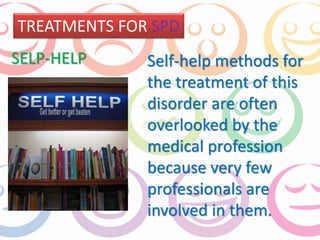
SELP-HELP Self-help methods for 
the treatment of this 
disorder are often 
overlooked by the 
medical profession 
because very few 
professionals are 
involved in them.
TREATMENTS FOR SPD 
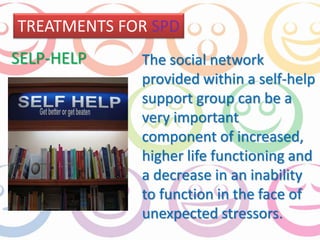
SELP-HELP The social network 
provided within a self-help 
support group can be a 
very important 
component of increased, 
higher life functioning and 
a decrease in an inability 
to function in the face of 
unexpected stressors.
Prognosis of Paranoid and 
Schizoid Personality Disorders 
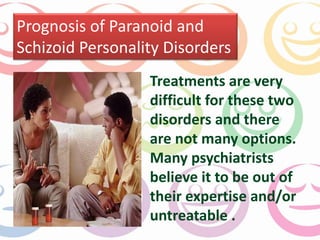
Treatments are very 
difficult for these two 
disorders and there 
are not many options. 
Many psychiatrists 
believe it to be out of 
their expertise and/or 
untreatable .
Prognosis of Paranoid and 
Schizoid Personality Disorders 
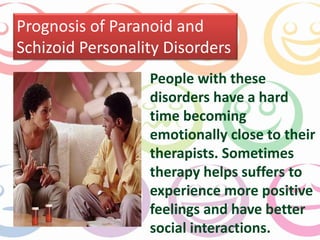
People with these 
disorders have a hard 
time becoming 
emotionally close to their 
therapists. Sometimes 
therapy helps suffers to 
experience more positive 
feelings and have better 
social interactions.
Prognosis of Paranoid and 
Schizoid Personality Disorders 
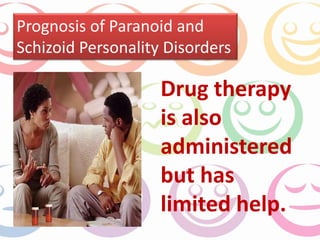
Drug therapy 
is also 
administered 
but has 
limited help.
Personality disordersparanoidandschizoidfinaledit

Personality disordersparanoidandschizoidfinaledit

  • 1.
    PERSONALITY DISORDERS CREATED:Mark Anthony Adenir Baladhay BS-PSYCHOLOGY
  • 2.
    PERSONALITY? comes fromthe Latin word persona, which referred to a theatrical mask work by performers in order to either project different roles or disguise their identities. pattern of relatively permanent traits and unique characteristics that give both consistency and individuality to a person's behavior.“ (Feist and Feist, 2009)
  • 3.
    PERSONALITY DISORDER? DSMIV-TR: An enduring pattern of inner experience and behavior that deviates markedly from the expectations of the individual's culture.
  • 4.
    PERSONALITY DISORDER? manifestedin two (or more) of the following areas: Cognition – ways of perceiving and interpreting Affectivity – intensity of emotional response Interpersonal functioning – social functioning Impulse control – control actions after thinking
  • 5.
    CHARACTERIZING NORMAL PERSONALITY FIVE–FACTOR MODEL OF PERSONALITY: • NEUROTICISM – anxiety • EXTRAVERSION/INTROVERSION – activity • OPENNESS TO EXPERIENCE – feelings • AGREEABLESNESS/ANTAGONISM – trust • CONSCIENTIOUSNESS – competence
  • 6.
    NEUROTICIS M EXTRAVERSI ON OPENNESS TO EXPERIENCE AGREEABLEN ESS CONSCIENTI OUSNESS Anxiety Warmth Fantasy Trust Competence Angry– Gregariousne Aesthetics Straightforwa Order Hostility ss rdedness Depression Assertiveness Feelings Altruism Dutifulness Self– conscientious ness Activity Actions Compliance Achievement striving Impulsivenes s Excitement seeking Ideas Modesty Self– discipline Vulnerability Positive emotions Values Tender mindedness Deliberation
  • 7.
    Cluster A Paranoid,Schizoid and Schizotypal Seem odd or eccentric; with unusual behavior ranging from distrust and suspiciousness to social detachment. Cluster B Histrionic, Narcissistic, Anti-social and Borderline Individuals with these disorders share a tendency to be dramatic, emotional and erratic. Cluster C Avoidant, Dependent and Obsessive-Compulsive In contrast to the other two clusters, people with these disorders often show anxiety and fearfulness.
  • 8.
    PARANOID PERSONALITY DISORDER Paranoid personality disorder is characterized by a distrust of others and a constant suspicion that people around you have sinister motives.
  • 9.
    CRITERIA FOR PARANOID PERSONALITY DISORDER DSM-IV-TR A. Evidence of pervasive distrust or suspiciousness of others present in at least four of the 7 following ways:
  • 10.
    (1) Pervasive suspiciousnessof being deceived, harmed, or exploited.
  • 11.
    (2) Unjustified doubtsabout loyalty or trustworthiness of friends or associates.
  • 12.
    (3) Reluctance toconfide in others because of doubts of loyalty or trustworthiness
  • 13.
    (4) Hidden demeaningor threatening meanings read into benign remarks or events
  • 14.
    (5) Bears grudges;does not forgive insults, injuries, or slights
  • 15.
    (6) Angry reactionsto perceived attacks on his or her character or reputation
  • 16.
    (7) Recurrent suspiciousregarding fidelity of spouse or sexual partner
  • 17.
    B. Does notoccur exclusively during course of Schizophrenia, Mood disorder with Psychotic Features, or other psychotic disorder It is important to remember that people with PPD are not usually psychotic; most of the time they are in clear contact with reality.
  • 18.
    CAUSAL FACTORS ofPPD – Little is known for the causes and no clear cut – Partial genetic transmission that may link the disorder to schizophrenia, but results examining this issue are inconsistent (Kendler, Czajkowski, et al., 2006; M. B. Miller et al., 2001)
  • 19.
    CAUSAL FACTORS ofPPD – Psychosocial are suspected to play a role include parental neglect or abuse and exposure to violent adults.
  • 20.
    SCHIZOID PERSONALITY DISORDER categorized under “odd” personality disorders or “Schizophrenia Spectrum Disorders”
  • 21.
    Theorists believe thatthis disorder develops from unsatisfied need for human contact. Their parents are believed to have been unaccepting, neglective, or abusive of their children. People with this disorder are unable to give or receive love. (Comer 2009) Psychoanalytic View
  • 22.
    CRITERIA FOR SCHIZOID PERSONALITY DISORDER A. Evidence of a pervasive pattern of detachment from social relationships and a restricted range of expression of emotions in interpersonal settings shown in at least four of the 7 followings ways:
  • 23.
    (1) Neither desiresnor enjoys close relationships.
  • 24.
    (2) Almost alwayschooses solitary activities
  • 25.
    (3) Has littleif any interest in sexual experiences with another person.
  • 26.
    (4) Takes pleasurein few if any activities.
  • 27.
    (5) Lacks ofclose friends and confidants
  • 28.
    (6) Appears indifferentto the praise or criticism of others.
  • 29.
    (7) Shows emotionalcoldness, detachment, or flat affect
  • 30.
    B. Does notoccur exclusively during course of Schizophrenia, Mood disorder with Psychotic Features, or other psychotic disorder or Pervasive Developmental Disorders
  • 31.
    CAUSAL FACTORS ofSchizoid PD • Little causes known and inconsistent. • Likely precursor to the development of schizophrenia but still challenged. • Traits have shown to have only modest heritability.
  • 32.
    Paranoid PD vs.Schizoid PD NEO-PI-R Paranoid PD High Angry-hostility, (Neuroticisim) Low in Trust, Straightforwardness , and compliance (Agreeableness)
  • 33.
    Paranoid PD vs.Schizoid PD NEO-PI-R Schizoid PD Low in warmth, gregariousness, positive emotions (EXTRAVERSION) Low in feelings (OPENNESS)
  • 35.
    DEMOGRAPHICS AND PREVALENCEOF PERSONALITY DISORDERS The estimated overall prevalence of DSM-IV personality disorders was 9%. Cluster A disorders were most prevalent in men who had never married. Cluster B disorders were most prevalent in young men without a high school degree, and cluster C disorders in high school graduates who had never married.
  • 36.
    DEMOGRAPHICS AND PREVALENCEOF PERSONALITY DISORDERS In general, the prevalence of personality disorders in this community sample was higher in men than in women; higher in formerly married and highest in never-married, compared with ever-married individuals; and higher in people who dropped out of high school than in graduates.
  • 38.
    TREATMENTS FOR PPD The therapist must be careful to balance being objective in therapy and with regards to these thoughts, and of raising the suspicions of the client that he or she is not trusted. PSYCHOTHERAPY
  • 39.
    TREATMENTS FOR PPD It is a difficult balance to maintain, even after a good working rapport has been established. PSYCHOTHERAPY
  • 40.
    TREATMENTS FOR PPD Medications which are prescribed for specific conditions should be done so for the briefest time period possible to bring the condition under management. MEDICATIONS
  • 41.
    TREATMENTS FOR PPD An anti-anxiety agent, such as diazepam, is appropriate to prescribe if the client suffers from severe anxiety or agitation where it begins to interfere with normal, daily functioning. MEDICATIONS
  • 42.
    TREATMENTS FOR PPD An anti-psychotic medication, such as thioridazine or haloperidol, may be appropriate if a patient decompensates into severe agitation or delusional thinking which may result in self-harm or harm to others. MEDICATIONS
  • 43.
    TREATMENTS FOR PPD There are not any self-help support groups or communities that we are aware of that would be conducive to someone suffering from this disorder. SELP-HELP
  • 44.
    TREATMENTS FOR PPD Such approaches would likely not be very effective because a person with this disorder is likely to be mistrustful and suspicious of others and their motivations, making group help and dynamics unlikely and possibly harmful. SELP-HELP
  • 45.
    TREATMENTS FOR SPD While there are many suggested treatment approaches one could make for this disorder, none of them are likely to be easily effective. As with all personality disorders, the treatment of choice is individual psychotherapy. PSYCHOTHERAPY
  • 46.
    TREATMENTS FOR SPD However, people with this disorder are unlikely to seek treatment unless they are under increased stress or pressure in their life. PSYCHOTHERAPY
  • 47.
    TREATMENTS FOR SPD Goals of treatment most often are solution-focused using brief therapy approaches. PSYCHOTHERAPY
  • 48.
    TREATMENTS FOR SPD Medication is usually not an issue for someone who suffers from this disorder, unless they also have an additional Axis I disorder, such as major depression. MEDICATIONS
  • 49.
    TREATMENTS FOR SPD Most patients show no additional improvement with the addition of an antidepressant medication, though, unless they are also suffering from suicidal ideation or a major depressive episode. MEDICATIONS
  • 50.
    TREATMENTS FOR SPD SELP-HELP Self-help methods for the treatment of this disorder are often overlooked by the medical profession because very few professionals are involved in them.
  • 51.
    TREATMENTS FOR SPD SELP-HELP The social network provided within a self-help support group can be a very important component of increased, higher life functioning and a decrease in an inability to function in the face of unexpected stressors.
  • 53.
    Prognosis of Paranoidand Schizoid Personality Disorders Treatments are very difficult for these two disorders and there are not many options. Many psychiatrists believe it to be out of their expertise and/or untreatable .
  • 54.
    Prognosis of Paranoidand Schizoid Personality Disorders People with these disorders have a hard time becoming emotionally close to their therapists. Sometimes therapy helps suffers to experience more positive feelings and have better social interactions.
  • 55.
    Prognosis of Paranoidand Schizoid Personality Disorders Drug therapy is also administered but has limited help.