OCPDF A T M A H A L I
1 INTRODUCTION
2 PREVELANCE
3 D X C R I T E R I A
4 MANAGEMENT
PART01I N T R O D U C T I O N
01 INTRODUCTION
ANIXIETY
Fearfulness
Constriction
Common defense mechanisms:
isolation, avoidance, hypochondriasis
01 CLUSTER C CORE TRAIT
http://www.docer.com/稻壳儿
OCPDObsessive-compulsive personality
disorder is characterized by
perfectionism and inflexibility
associated with:
overconscientiousness
constricted emotions
01 INTRODUCTION
PART02P R E V E L A N C E
1 – 2 %
02 PREVELANCE
Men are two times more likely to have OCPD than women.
01 Epidemiology
0
0.1
0.2
0.3
0.4
0.5
0.6
0.7
0.8
0.9
1
1 2 3 4 5 6 7 8 9 10 11 12 13 14 15 16 17 18 19 20
Unlike other personality disorders,
this disorder appears to be more
common in those with higher levels
of education and those in higher
income brackets. Comorbidity with
mood and anxiety disorders is
frequent.
02 PREVELANCE
PART03DIAGNOSTIC CRITERIA
perfectionism that interferes
with task completion
Excludes leisure due to devotion
to work
Inflexible in matters of morality,
ethics, values
Rule/detail obsessed
unable to discard worthless objects
reluctant to work with others
01 DIAGNOSTIC CRITERIA
preoccupation with orderliness, perfectionism,
and mental and interpersonal control,
indicated by four (or more) of the following:
Miserlyrigidity and stubbornness.
DDx:
Obsessive-compulsive disorder (OCD)
Narcissistic personality disorder
03 DIFFERENTIAL DIAGNOSIS
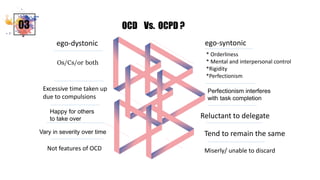
Os/Cs/or both
Happy for others
to take over
Excessive time taken up
due to compulsions
* Orderliness
* Mental and interpersonal control
*Rigidity
*Perfectionism
Perfectionism interferes
with task completion
03 OCD Vs. OCPD ?
Reluctant to delegate
Miserly/ unable to discardNot features of OCD
ego-syntonicego-dystonic
Tend to remain the sameVary in severity over time
Unpredictable course.
Some patients can have
comorbid OCD (most do not).
1
2
03 COURSE
PART04M A N A G E M E M T
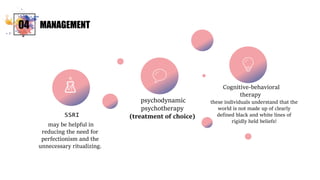
may be helpful in
reducing the need for
perfectionism and the
unnecessary ritualizing.
SSRI
psychodynamic
psychotherapy
(treatment of choice)
these individuals understand that the
world is not made up of clearly
defined black and white lines of
rigidly held beliefs!
Cognitive-behavioral
therapy
04 MANAGEMENT
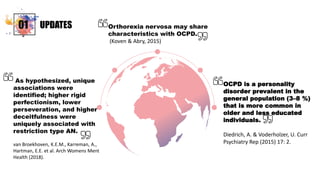
OCPD is a personality
disorder prevalent in the
general population (3–8 %)
that is more common in
older and less educated
individuals.
Diedrich, A. & Voderholzer, U. Curr
Psychiatry Rep (2015) 17: 2.
As hypothesized, unique
associations were
identified; higher rigid
perfectionism, lower
perseveration, and higher
deceitfulness were
uniquely associated with
restriction type AN.
van Broekhoven, K.E.M., Karreman, A.,
Hartman, E.E. et al. Arch Womens Ment
Health (2018).
Orthorexia nervosa may share
characteristics with OCPD.
(Koven & Abry, 2015)
01 UPDATES
?
?
?
?
04 Any Questions ?
 Introductory Textbook of
Psychiatry 6th Ed
 Kaplan and Sadock’s Synopsis of
Psychiatry
04 REFERENCES
THANKS

Ocpd

  • 1.
    OCPDF A TM A H A L I
  • 2.
    1 INTRODUCTION 2 PREVELANCE 3D X C R I T E R I A 4 MANAGEMENT
  • 3.
    PART01I N TR O D U C T I O N
  • 4.
  • 5.
    ANIXIETY Fearfulness Constriction Common defense mechanisms: isolation,avoidance, hypochondriasis 01 CLUSTER C CORE TRAIT
  • 6.
    http://www.docer.com/稻壳儿 OCPDObsessive-compulsive personality disorder ischaracterized by perfectionism and inflexibility associated with: overconscientiousness constricted emotions 01 INTRODUCTION
  • 7.
    PART02P R EV E L A N C E
  • 8.
    1 – 2% 02 PREVELANCE
  • 9.
    Men are twotimes more likely to have OCPD than women. 01 Epidemiology
  • 10.
    0 0.1 0.2 0.3 0.4 0.5 0.6 0.7 0.8 0.9 1 1 2 34 5 6 7 8 9 10 11 12 13 14 15 16 17 18 19 20 Unlike other personality disorders, this disorder appears to be more common in those with higher levels of education and those in higher income brackets. Comorbidity with mood and anxiety disorders is frequent. 02 PREVELANCE
  • 11.
  • 12.
    perfectionism that interferes withtask completion Excludes leisure due to devotion to work Inflexible in matters of morality, ethics, values Rule/detail obsessed unable to discard worthless objects reluctant to work with others 01 DIAGNOSTIC CRITERIA preoccupation with orderliness, perfectionism, and mental and interpersonal control, indicated by four (or more) of the following: Miserlyrigidity and stubbornness.
  • 13.
    DDx: Obsessive-compulsive disorder (OCD) Narcissisticpersonality disorder 03 DIFFERENTIAL DIAGNOSIS
  • 14.
    Os/Cs/or both Happy forothers to take over Excessive time taken up due to compulsions * Orderliness * Mental and interpersonal control *Rigidity *Perfectionism Perfectionism interferes with task completion 03 OCD Vs. OCPD ? Reluctant to delegate Miserly/ unable to discardNot features of OCD ego-syntonicego-dystonic Tend to remain the sameVary in severity over time
  • 15.
    Unpredictable course. Some patientscan have comorbid OCD (most do not). 1 2 03 COURSE
  • 16.
    PART04M A NA G E M E M T
  • 17.
    may be helpfulin reducing the need for perfectionism and the unnecessary ritualizing. SSRI psychodynamic psychotherapy (treatment of choice) these individuals understand that the world is not made up of clearly defined black and white lines of rigidly held beliefs! Cognitive-behavioral therapy 04 MANAGEMENT
  • 18.
    OCPD is apersonality disorder prevalent in the general population (3–8 %) that is more common in older and less educated individuals. Diedrich, A. & Voderholzer, U. Curr Psychiatry Rep (2015) 17: 2. As hypothesized, unique associations were identified; higher rigid perfectionism, lower perseveration, and higher deceitfulness were uniquely associated with restriction type AN. van Broekhoven, K.E.M., Karreman, A., Hartman, E.E. et al. Arch Womens Ment Health (2018). Orthorexia nervosa may share characteristics with OCPD. (Koven & Abry, 2015) 01 UPDATES
  • 19.
  • 20.
     Introductory Textbookof Psychiatry 6th Ed  Kaplan and Sadock’s Synopsis of Psychiatry 04 REFERENCES
  • 21.

Editor's Notes

  • #5 Rule/detail obsessed perfectionism Miserly Unable Delegate tasks Stubborn Excludes leisure due to devotion to work Inflexible in ethics of morality Anxious
  • #9 2 to 8 percent.
  • #13 to the extent that the major point of the activity is lost. 5. unless they submit to exactly his or her way of doing things
  • #14  Both personalities involve assertiveness and achievement, but NPD patients are motivated by status, whereas OCPD patients are motivated by the work itself