Learning
Outcomes
What are learning outcomes?
 • Formal statements that articulate:
   – What students are able to do after
     instruction

   – Why students need to do this

 • Objectives vs. Outcomes
Why assess?
• It builds evidence for accountability,
  accreditation and improvement.

  – Show evidence of how well our students
    learn.

  – Use evidence for continuous improvement.
In short, teachers must:
• Know what you are doing

• Know why you are doing it

• Know what students are learning as a
  result

• Encourage students to change because of
  that information
Some benefits of learning outcomes
• select content

• develop of instructional strategy

• develop and select instructional materials

• construct tests and other instruments for assessing and
  evaluating

• improve you as a teacher, and your overall program
Writing Learning Outcomes

• Learning Outcomes Formula
• Bloom’s Taxonomy
• Characteristics of Good Learning
  Outcomes
• Learning Outcomes Exercise
• Write Your Learning Outcomes
Theory Into Practice
5 Questions for Instructional Design

1. What do you want the student to be able to do?
   (Outcome)
2. What does the student need to know in order to
   do this well? (Curriculum)
3. What activity will facilitate the learning?
   (Pedagogy)
4. How will the student demonstrate the learning?
   (Assessment)
5. How will I know the student has done this well?
   (Criteria)


                      ACRL’s IIL Immersion Summer 2005
1. What do you want the
    student to be able to do?
This question asks you to develop
 the outcome.
For Example:
Student identifies, consults and
 evaluates reference books
 appropriate to the topic in order to
 locate background information and
 statistics.


                 ACRL’s IIL Immersion Summer 2005
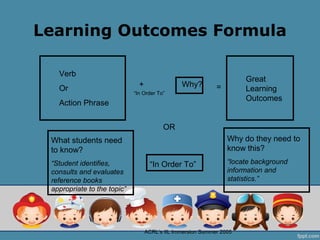
Learning Outcomes Formula

   Verb
                                                                      Great
   Or                          +                Why?         =
                             “In Order To”
                                                                      Learning
                                                                      Outcomes
   Action Phrase


                                         OR
 What students need                                              Why do they need to
 to know?                                                        know this?
 “Student identifies,               “In Order To”                “locate background
 consults and evaluates                                          information and
 reference books                                                 statistics.”
 appropriate to the topic”


                                   ACRL’s IIL Immersion Summer 2005
Importance of Verbs
• Behavioral Outcomes

  – Affective Domain

  – Psychomotor Domain

  – Cognitive Domain
    • Bloom’s Taxonomy
Cognitive Domain

• Involves knowledge and the development
  of intellectual skills

• Bloom’s Taxonomy
  – Hierarchy of objectives according to cognitive
    complexity

  – Higher-level objectives include, and are
    dependant on lower level cognitive skills
Bloom’s Taxonomy

•   Knowledge
•   Comprehension
•   Application
•   Analysis
•   Synthesis
•   Evaluation
Bloom’s – Lower Levels

• Knowledge
  – Recalling previously learned information such
    as facts, terminology, rules, etc.

  – Answers may be memorized or closely
    paraphrased from assigned material.

  – Define, list, name, recall
Bloom’s – Lower Levels

• Comprehension
 – Ability to comprehend the meaning of
   material.

 – Answers must be in the student’s own words
   while still using terminology appropriate to the
   course material.

 – Explain, summarize, distinguish between,
   restate
Bloom’s – Lower Levels

• Demonstrate rote or surface learning

• Declarative or Procedural Knowledge

• Answers found in the assigned materials

• 80% of HS teachers test at these levels
Bloom’s – Higher Levels

• Application
  – Requires recognizing, identifying, or applying a
    concept or principle in a new situation or solving a
    new problem.

  – May require identifying or generating examples not
    found in assigned materials.

  – Demonstrate, arrange, relate, adapt
Bloom’s – Higher Levels
• Analysis
  – Ability to break material down into its component parts and
    to understand its underlying structure

  – May require students to compare and contrast or explain
    how an example illustrates a given concept or principle.

  – Require students to identify logical errors or to differentiate
    among facts, opinions, assumptions, hypotheses and
    conclusions

  – Expected to draw relationships between ideas

  – Differentiate, estimate, infer, diagram
Bloom’s – Higher Levels
• Synthesis
  – Opposite of Analysis

  – Ability to combine parts to form a new whole; to synthesize
    a variety of elements into an original and significant whole.

  – Produce something unique or original

  – Solve some unfamiliar problem in a unique way

  – Combine, create, formulate, construct
Bloom’s – Higher Levels

• Evaluation
  – Ability to evaluate a total situation, to judge the value
    of material for a certain purpose, combining elements
    of all the other categories and also value judgments
    based on defined, fixed criteria.

  – The most important part of the answer is the
    justification and rationale for the conclusion

  – Judge, critique, justify, discriminate
Bloom’s – Higher Levels
• Meaningful or deep learning

• Go beyond textual material in that they must be inferred
  or extrapolated from the material in the assigned
  material.

• Students’ creativity, originality and critical thinking is
  required at higher levels

• More authentic than lower levels
   – Thinking at this level is more likely to represent types of
     performances required in the real world
Activity
• Break into groups. You will each be assigned a
  level of Bloom’s taxonomy.

• Develop an activity to teach the rest of us the
  topic on the next slide using techniques
  common to your assigned level in Blooms.

• You have 5-7 minutes to prepare your
  lesson/activity, and then you will present it to
  the rest of us.
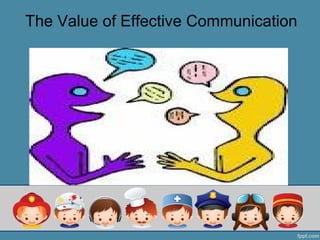
The Value of Effective Communication
Theory Into Practice
5 Questions for Instructional Design

1. What do you want the student to be able to do?
   (Outcome)
2. What does the student need to know in order to
   do this well? (Curriculum)
3. What activity will facilitate the learning?
   (Pedagogy)
4. How will the student demonstrate the learning?
   (Assessment)
5. How will I know the student has done this well?
   (Criteria)

                      ACRL’s IIL Immersion Summer 2005
Characteristics of Good Learning
               Outcomes
• Measurable/Assessable
• Clear to the student & instructor
• Integrated, developmental, transferable
• Use discipline-specific competencies/standards
  as a basis not an end
• Similar scope and scale
• “In order to” gets to the uniqueness and real
  world application of the learning
• Use a variety of Bloom’s Taxonomy levels


                      ACRL’s IIL Immersion Summer 2005
Example 1
• Bad Outcome
  – Students will name the three types of rock in
    order to differentiate among the three.
Example 1
• Good Learning Outcome
  – Students will compare and contrast the
    characteristics of the three types of rocks in
    order to differentiate among the three.
Example 2
• Bad Learning Outcome
  – Discover that Pasig Catholic College offers an
    evangelized evangelizing community which
    can fulfill their students’ educational, cultural
    and social needs in order to recognize the
    school’s role in lifelong learning and
    Catholicity.
Example 3
• Good Outcome
  – Utilize retrieval services in order to obtain
    materials not owned by PCC Library.
Example 4

• Bad Outcome
  – Students will construct bibliographies and in-
    text references using discipline appropriate
    styles in order to contribute to academic
    discourse in their discipline.
Example 5

• Good Outcome
  – Construct bibliographies and in-text
    references using discipline appropriate styles
    in order to correctly attribute others' work and
    ideas.
Let’s Write a Learning Outcome

• We’re taking the class to an art exhibit of
  Filipino artists.
• What do they need to know?
Let’s Write a Learning Outcome

• We’ll concentrate on being nationalistic.
• Why do we want the students to be
  nationalistic?
Let’s Write a Learning Outcome

• Now let’s write the learning outcome
• What is our verb (use Bloom’s)?
• Why?
Let’s Write an Assignment-Specific
          Learning Outcome
• Choose a topic based on your major. Write
  learning outcomes (refer to Bloom’s
  Taxonomy of Objectives), covering the 3
  domains of learning.
• What does the student need to know?
• Why do they need to know this?
A Look Into the Future
5 Questions for Instructional Design

1.   What do you want the student to be able to do?
     (Outcome)
2.   What does the student need to know in
     order to do this well? (Curriculum)
3.   What activity will facilitate the learning?
     (Pedagogy)
4.   How will the student demonstrate the
     learning? (Assessment)
5.   How will I know the student has done this
     well? (Criteria)
Remember:
• Assessment is a very important obligation
  of the teacher.
• This will gauge how well the student
  learned and how well the teacher taught!

Learning outcomes

  • 1.
  • 2.
    What are learningoutcomes? • Formal statements that articulate: – What students are able to do after instruction – Why students need to do this • Objectives vs. Outcomes
  • 3.
    Why assess? • Itbuilds evidence for accountability, accreditation and improvement. – Show evidence of how well our students learn. – Use evidence for continuous improvement.
  • 4.
    In short, teachersmust: • Know what you are doing • Know why you are doing it • Know what students are learning as a result • Encourage students to change because of that information
  • 5.
    Some benefits oflearning outcomes • select content • develop of instructional strategy • develop and select instructional materials • construct tests and other instruments for assessing and evaluating • improve you as a teacher, and your overall program
  • 6.
    Writing Learning Outcomes •Learning Outcomes Formula • Bloom’s Taxonomy • Characteristics of Good Learning Outcomes • Learning Outcomes Exercise • Write Your Learning Outcomes
  • 7.
    Theory Into Practice 5Questions for Instructional Design 1. What do you want the student to be able to do? (Outcome) 2. What does the student need to know in order to do this well? (Curriculum) 3. What activity will facilitate the learning? (Pedagogy) 4. How will the student demonstrate the learning? (Assessment) 5. How will I know the student has done this well? (Criteria) ACRL’s IIL Immersion Summer 2005
  • 8.
    1. What doyou want the student to be able to do? This question asks you to develop the outcome. For Example: Student identifies, consults and evaluates reference books appropriate to the topic in order to locate background information and statistics. ACRL’s IIL Immersion Summer 2005
  • 9.
    Learning Outcomes Formula Verb Great Or + Why? = “In Order To” Learning Outcomes Action Phrase OR What students need Why do they need to to know? know this? “Student identifies, “In Order To” “locate background consults and evaluates information and reference books statistics.” appropriate to the topic” ACRL’s IIL Immersion Summer 2005
  • 10.
    Importance of Verbs •Behavioral Outcomes – Affective Domain – Psychomotor Domain – Cognitive Domain • Bloom’s Taxonomy
  • 11.
    Cognitive Domain • Involvesknowledge and the development of intellectual skills • Bloom’s Taxonomy – Hierarchy of objectives according to cognitive complexity – Higher-level objectives include, and are dependant on lower level cognitive skills
  • 12.
    Bloom’s Taxonomy • Knowledge • Comprehension • Application • Analysis • Synthesis • Evaluation
  • 13.
    Bloom’s – LowerLevels • Knowledge – Recalling previously learned information such as facts, terminology, rules, etc. – Answers may be memorized or closely paraphrased from assigned material. – Define, list, name, recall
  • 14.
    Bloom’s – LowerLevels • Comprehension – Ability to comprehend the meaning of material. – Answers must be in the student’s own words while still using terminology appropriate to the course material. – Explain, summarize, distinguish between, restate
  • 15.
    Bloom’s – LowerLevels • Demonstrate rote or surface learning • Declarative or Procedural Knowledge • Answers found in the assigned materials • 80% of HS teachers test at these levels
  • 16.
    Bloom’s – HigherLevels • Application – Requires recognizing, identifying, or applying a concept or principle in a new situation or solving a new problem. – May require identifying or generating examples not found in assigned materials. – Demonstrate, arrange, relate, adapt
  • 17.
    Bloom’s – HigherLevels • Analysis – Ability to break material down into its component parts and to understand its underlying structure – May require students to compare and contrast or explain how an example illustrates a given concept or principle. – Require students to identify logical errors or to differentiate among facts, opinions, assumptions, hypotheses and conclusions – Expected to draw relationships between ideas – Differentiate, estimate, infer, diagram
  • 18.
    Bloom’s – HigherLevels • Synthesis – Opposite of Analysis – Ability to combine parts to form a new whole; to synthesize a variety of elements into an original and significant whole. – Produce something unique or original – Solve some unfamiliar problem in a unique way – Combine, create, formulate, construct
  • 19.
    Bloom’s – HigherLevels • Evaluation – Ability to evaluate a total situation, to judge the value of material for a certain purpose, combining elements of all the other categories and also value judgments based on defined, fixed criteria. – The most important part of the answer is the justification and rationale for the conclusion – Judge, critique, justify, discriminate
  • 20.
    Bloom’s – HigherLevels • Meaningful or deep learning • Go beyond textual material in that they must be inferred or extrapolated from the material in the assigned material. • Students’ creativity, originality and critical thinking is required at higher levels • More authentic than lower levels – Thinking at this level is more likely to represent types of performances required in the real world
  • 21.
    Activity • Break intogroups. You will each be assigned a level of Bloom’s taxonomy. • Develop an activity to teach the rest of us the topic on the next slide using techniques common to your assigned level in Blooms. • You have 5-7 minutes to prepare your lesson/activity, and then you will present it to the rest of us.
  • 22.
    The Value ofEffective Communication
  • 23.
    Theory Into Practice 5Questions for Instructional Design 1. What do you want the student to be able to do? (Outcome) 2. What does the student need to know in order to do this well? (Curriculum) 3. What activity will facilitate the learning? (Pedagogy) 4. How will the student demonstrate the learning? (Assessment) 5. How will I know the student has done this well? (Criteria) ACRL’s IIL Immersion Summer 2005
  • 24.
    Characteristics of GoodLearning Outcomes • Measurable/Assessable • Clear to the student & instructor • Integrated, developmental, transferable • Use discipline-specific competencies/standards as a basis not an end • Similar scope and scale • “In order to” gets to the uniqueness and real world application of the learning • Use a variety of Bloom’s Taxonomy levels ACRL’s IIL Immersion Summer 2005
  • 25.
    Example 1 • BadOutcome – Students will name the three types of rock in order to differentiate among the three.
  • 26.
    Example 1 • GoodLearning Outcome – Students will compare and contrast the characteristics of the three types of rocks in order to differentiate among the three.
  • 27.
    Example 2 • BadLearning Outcome – Discover that Pasig Catholic College offers an evangelized evangelizing community which can fulfill their students’ educational, cultural and social needs in order to recognize the school’s role in lifelong learning and Catholicity.
  • 28.
    Example 3 • GoodOutcome – Utilize retrieval services in order to obtain materials not owned by PCC Library.
  • 29.
    Example 4 • BadOutcome – Students will construct bibliographies and in- text references using discipline appropriate styles in order to contribute to academic discourse in their discipline.
  • 30.
    Example 5 • GoodOutcome – Construct bibliographies and in-text references using discipline appropriate styles in order to correctly attribute others' work and ideas.
  • 31.
    Let’s Write aLearning Outcome • We’re taking the class to an art exhibit of Filipino artists. • What do they need to know?
  • 32.
    Let’s Write aLearning Outcome • We’ll concentrate on being nationalistic. • Why do we want the students to be nationalistic?
  • 33.
    Let’s Write aLearning Outcome • Now let’s write the learning outcome • What is our verb (use Bloom’s)? • Why?
  • 34.
    Let’s Write anAssignment-Specific Learning Outcome • Choose a topic based on your major. Write learning outcomes (refer to Bloom’s Taxonomy of Objectives), covering the 3 domains of learning. • What does the student need to know? • Why do they need to know this?
  • 35.
    A Look Intothe Future 5 Questions for Instructional Design 1. What do you want the student to be able to do? (Outcome) 2. What does the student need to know in order to do this well? (Curriculum) 3. What activity will facilitate the learning? (Pedagogy) 4. How will the student demonstrate the learning? (Assessment) 5. How will I know the student has done this well? (Criteria)
  • 36.
    Remember: • Assessment isa very important obligation of the teacher. • This will gauge how well the student learned and how well the teacher taught!