Coccidioidomycosis during
           pregnancy
              Neil M. Ampel, M.D.
Professor of Medicine, Immunobiology and Public
                     Health
              University of Arizona
             November 13, 2010
Background
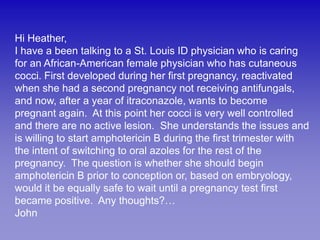
Hi Heather,
I have a been talking to a St. Louis ID physician who is caring
for an African-American female physician who has cutaneous
cocci. First developed during her first pregnancy, reactivated
when she had a second pregnancy not receiving antifungals,
and now, after a year of itraconazole, wants to become
pregnant again. At this point her cocci is very well controlled
and there are no active lesion. She understands the issues and
is willing to start amphotericin B during the first trimester with
the intent of switching to oral azoles for the rest of the
pregnancy. The question is whether she should begin
amphotericin B prior to conception or, based on embryology,
would it be equally safe to wait until a pregnancy test first
became positive. Any thoughts?…
John
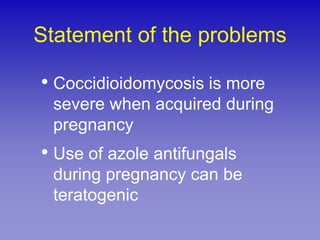
Statement of the problems

• Coccidioidomycosis is more
 severe when acquired during
 pregnancy
• Use of azole antifungals
 during pregnancy can be
 teratogenic
History
•   In 1941, Farness reported the first case of severe
    coccidioidomycosis resulting in death in a pregnant
    women in Tucson
•   Vaughn & Ramirez (1951) observed that the risk of
    severe coccidioidomycosis increased with trimester
    - Among 28 cases in Kern County, CA
      •   all 5 who developed disease prior to pregnancy did well
      •   1 of 12 women died with coccidioidomycosis during the
          1st trimester
      •   1 developed meningitis and 1 died among 5 in the 2nd
          trimester
      •   7 of 11 died during the 3rd trimester
      •   In all cases, the newborns did well
More recent descriptions
• Recent surveys have suggested that the prevalence of
    severe coccidioidomycosis during pregnancy has
    decreased
•   Wack et al (1988) identified only 10 cases among
    47,120 pregnancies in Tucson
    - all 7 in the 1st & 2nd trimester did well
    - 3 were diagnosed post-partum
      • 2 developed disseminated disease
•   Caldwell et al (2000) reported on 32 cases occurring
    during the 1993 epidemic in California
    - 3 cases disseminated
    - no fetal deaths
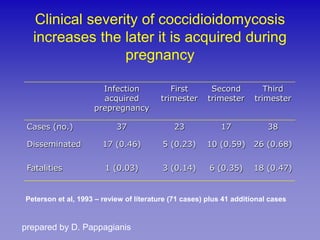
Clinical severity of coccidioidomycosis
  increases the later it is acquired during
                  pregnancy

                      Infection             First       Second          Third
                      acquired           trimester     trimester     trimester
                    prepregnancy

 Cases (no.)               37                23            17            38

 Disseminated          17 (0.46)         5 (0.23)     10 (0.59)      26 (0.68)

 Fatalities             1 (0.03)         3 (0.14)      6 (0.35)      18 (0.47)


Peterson et al, 1993 – review of literature (71 cases) plus 41 additional cases


prepared by D. Pappagianis
Pregnancy and immunity
• Pregnancy is considered to be a state of
    relative immunodeficiency
    -   rheumatoid arthritis improves
    -   DTH & in vitro measures of immunity decline
• However, most women are healthy during
    pregnancy
•   Some infectious diseases have been reported
    to be more frequent during pregnancy
    -   Tuberculosis
    -   Listeriosis
    -   Influenza
    -   Coccidioidomycosis
Coccidioidomycosis is unique among
fungal diseases in being more severe
          during pregnancy
 • No evidence for other endemic
   mycoses
   -   histoplasmosis
   -   blastomycosis
   -   cryptococcosis
   -   paracoccidioidomycosis
   -   sporotrichosis
Effect of sex hormones on coccidioidal
                      growth
       • 17 β-estradiol increased spherule growth
           & maturation and mycelial growth
          -   Coccidioides binds to 17 β-estradiol,
              progesterone, & dihydrotestosterone
              • No binding by Paracoccidioides, Blastomyces,
                Cryptococcus, or Candida
          -   no effect of 17 α-estradiol, cholesterol, &
              ergosterol
       • No growth effects on Cryptococcus,
           Candida, Pseudallesheria
Drutz et al. Infect Immun 1981; 32:897
Drutz et al. J Infect Dis 1983; 147:372
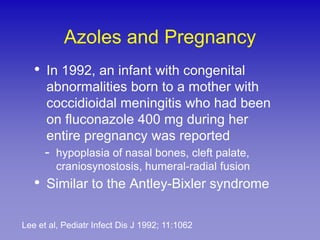
Azoles and Pregnancy
   •   In 1992, an infant with congenital
       abnormalities born to a mother with
       coccidioidal meningitis who had been
       on fluconazole 400 mg during her
       entire pregnancy was reported
       - hypoplasia of nasal bones, cleft palate,
         craniosynostosis, humeral-radial fusion
   •   Similar to the Antley-Bixler syndrome

Lee et al, Pediatr Infect Dis J 1992; 11:1062
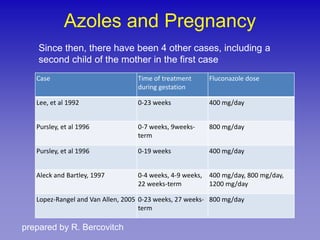
Azoles and Pregnancy
    Since then, there have been 4 other cases, including a
    second child of the mother in the first case
   Case                           Time of treatment      Fluconazole dose
                                  during gestation

   Lee, et al 1992                0-23 weeks             400 mg/day


   Pursley, et al 1996            0-7 weeks, 9weeks-     800 mg/day
                                  term

   Pursley, et al 1996            0-19 weeks             400 mg/day


   Aleck and Bartley, 1997        0-4 weeks, 4-9 weeks, 400 mg/day, 800 mg/day,
                                  22 weeks-term         1200 mg/day

   Lopez-Rangel and Van Allen, 2005 0-23 weeks, 27 weeks- 800 mg/day
                                    term

prepared by R. Bercovitch
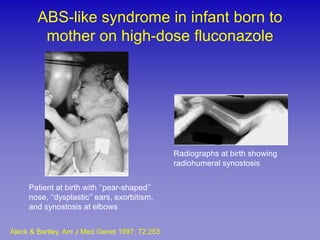
ABS-like syndrome in infant born to
         mother on high-dose fluconazole


                                               Radiographs at birth showing
                                               radiohumeral synostosis


     Patient at birth with ‘‘pear-shaped’’
     nose, ‘‘dysplastic’’ ears, exorbitism,
     and synostosis at elbows


Aleck & Bartley, Am J Med Genet 1997; 72:253
Azoles and pregnancy
•   Experimental administration of fluconazole
    to rodents results in congenital
    abnormalities when given early in gestation
    -   Rat embryos 9.5 days of age were incubated in
        fluconazole 62.5 - 500 µM & examined after 48
        hr
        • Abnormalities occurred in the branchial arches
           - Menegola et al. Repro Tox 2001; 15:421
    -   50% of fetuses from CD1 pregnant mice given
        700 mg/kg fluconazole on gestational day 10
        developed cleft palate
           - Tiboni & Giampietro, Ped Res 2005; 58:94
Azoles other than fluconazole
•   Similar abnormalities in rodent models
    have been observed with itraconazole,
    posaconazole and voriconazole
•   There is no reason to consider them as
    less risky than fluconazole
•   Voriconazole may be more teratogenic
    as it causes fetal abnormalities at less
    than therapeutic doses
    -   assigned FDA Pregnancy Class D
Antley-Bixler Syndrome (ABS)

•   Described in 1975
    - cranial synostosis, mid-face hypoplasia,
      proptosis, frontal bossing, dyplastic ears,
      radial-humeral synostosis, choanal atresia
•   Most cases are sporadic, some of
    autosomal recessive inheritance
•   Some cases associated with mutations
    in cytochrome P450 oxidoreductases
    (POR)
    - leads to abnormalities in sterol metabolism
Postulate
• Fluconazole, and other azole antifungals, inhibit
  fungal 14 α-demethylase in the ergosterol pathway
• They also may inhibit similar enzymes in the
  mammalian cholesterol pathway
• When given early in pregnancy at high dose, azole
  antifungals may induce an Antley-Bixler syndrome
  -   Aleck & Bartley, Am J Med Genet 1997; 72:253

• Alternatively, mothers with POR mutations may
  not appropriately metabolize azole antifungals and
  so develop teratogenic levels
  -   Flück et al, Nat Genet 2004; 36:228
Are azole antifungals safe after the
           1st trimester?
• Krcmery et al reported no fetal abnormalities in a
  pregnancy where the mother received 600 mg
  daily fluconazole for 21 days starting week 14
  -   Pediatr Infect Dis J 1996; 15:841
• Campomori & Bonati found no congenital
  abnormalities among 16 women receiving a
  median of 291 mg fluconazole during the 2nd
  trimester
  -   Ann Pharmacother 1997; 31:118
• Several papers have described lower dose
  fluconazole given during the 1st trimester without
  evidence of increase risk of congenital
  abnormalities
Management issues
Questions
• Should azoles be used at all during
    pregnancy?
    - Are they safe after the 1st trimester?
• What do we advise women with
    coccidioidomycosis about
    pregnancy?
•   What is the best way to manage
    coccidioidal meningitis during
    pregnancy?
Three scenarios
•   Women with prior coccidioidomycosis not
    requiring antifungal therapy who become
    pregnant
•   Women with prior coccidioidomycosis requiring
    antifungal therapy who wish or are pregnant
    - non-meningeal
    - meningeal
•   Women who develop coccidioidomycosis
    during pregnancy
    - first trimester vs second or third trimester
    - meningeal vs non-meningeal
Recommendations
Scenario #1
• Women with a history of prior
 coccidioidomycosis not currently
 requiring therapy
 - They are at low risk for developing
     problems during pregnancy
 -   Close follow-up is advised
     • clinical and serologic evaluation every 6-8 weeks
     • treatment is not recommended
Scenario #2 - A
• Women of child-bearing potential on azole
    therapy for non-meningeal coccidioidomycosis
•   They should be advised of the risks of
    continuing azole therapy if they become
    pregnant
    -   they should advised to consider birth-control
        measures
    -   if they are planning on becoming pregnant, the azole
        therapy should be discontinued prior to conception
        •   observe without therapy
            -   clinical and serological evaluation every 6 weeks
        •   or use IV amphotericin B
Scenario #2 - B

• If a woman on azole therapy for
 coccidioidal meningitis becomes
 pregnant
 - azole therapy should be stopped
   • start intrathecal (IT) amphotericin B
   • or observe without therapy
     - clinical and serological evaluation every 6
       weeks
What about after the first
      trimester?
•   After the 1st trimester, it appears
    reasonable to restart azole
    antifungal therapy in cases that
    require therapy
    -   voriconazole should be avoided
Scenario #3 - A

• A woman develops non-meningeal
 coccidioidomycosis during the first
 trimester
 - observe
 - or start IV amphotericin B if disease is
   severe or disseminated
Scenario #3 - B


• A woman develops coccidioidal
 meningitis during the first trimester
 - consider IT amphotericin B
After the first trimester


• It is reasonable to use an azole
 antifungal
 - voriconazole should be avoided
Advice on case presented
• Woman with cutaneous
 coccidioidomycosis on itraconazole
 who wishes to become pregnant
 - Stop itraconazole prior to conception
 - Observe without therapy
   • follow every 6 weeks for clinical and serological
     evidence of disease
   • if disease recurs, start IV amphotericin B
 - after the 1st trimester, restart itraconazole

Coccidioidomycosis in pregnancy

  • 1.
    Coccidioidomycosis during pregnancy Neil M. Ampel, M.D. Professor of Medicine, Immunobiology and Public Health University of Arizona November 13, 2010
  • 2.
  • 3.
    Hi Heather, I havea been talking to a St. Louis ID physician who is caring for an African-American female physician who has cutaneous cocci. First developed during her first pregnancy, reactivated when she had a second pregnancy not receiving antifungals, and now, after a year of itraconazole, wants to become pregnant again. At this point her cocci is very well controlled and there are no active lesion. She understands the issues and is willing to start amphotericin B during the first trimester with the intent of switching to oral azoles for the rest of the pregnancy. The question is whether she should begin amphotericin B prior to conception or, based on embryology, would it be equally safe to wait until a pregnancy test first became positive. Any thoughts?… John
  • 4.
    Statement of theproblems • Coccidioidomycosis is more severe when acquired during pregnancy • Use of azole antifungals during pregnancy can be teratogenic
  • 5.
    History • In 1941, Farness reported the first case of severe coccidioidomycosis resulting in death in a pregnant women in Tucson • Vaughn & Ramirez (1951) observed that the risk of severe coccidioidomycosis increased with trimester - Among 28 cases in Kern County, CA • all 5 who developed disease prior to pregnancy did well • 1 of 12 women died with coccidioidomycosis during the 1st trimester • 1 developed meningitis and 1 died among 5 in the 2nd trimester • 7 of 11 died during the 3rd trimester • In all cases, the newborns did well
  • 6.
    More recent descriptions •Recent surveys have suggested that the prevalence of severe coccidioidomycosis during pregnancy has decreased • Wack et al (1988) identified only 10 cases among 47,120 pregnancies in Tucson - all 7 in the 1st & 2nd trimester did well - 3 were diagnosed post-partum • 2 developed disseminated disease • Caldwell et al (2000) reported on 32 cases occurring during the 1993 epidemic in California - 3 cases disseminated - no fetal deaths
  • 7.
    Clinical severity ofcoccidioidomycosis increases the later it is acquired during pregnancy Infection First Second Third acquired trimester trimester trimester prepregnancy Cases (no.) 37 23 17 38 Disseminated 17 (0.46) 5 (0.23) 10 (0.59) 26 (0.68) Fatalities 1 (0.03) 3 (0.14) 6 (0.35) 18 (0.47) Peterson et al, 1993 – review of literature (71 cases) plus 41 additional cases prepared by D. Pappagianis
  • 8.
    Pregnancy and immunity •Pregnancy is considered to be a state of relative immunodeficiency - rheumatoid arthritis improves - DTH & in vitro measures of immunity decline • However, most women are healthy during pregnancy • Some infectious diseases have been reported to be more frequent during pregnancy - Tuberculosis - Listeriosis - Influenza - Coccidioidomycosis
  • 9.
    Coccidioidomycosis is uniqueamong fungal diseases in being more severe during pregnancy • No evidence for other endemic mycoses - histoplasmosis - blastomycosis - cryptococcosis - paracoccidioidomycosis - sporotrichosis
  • 10.
    Effect of sexhormones on coccidioidal growth • 17 β-estradiol increased spherule growth & maturation and mycelial growth - Coccidioides binds to 17 β-estradiol, progesterone, & dihydrotestosterone • No binding by Paracoccidioides, Blastomyces, Cryptococcus, or Candida - no effect of 17 α-estradiol, cholesterol, & ergosterol • No growth effects on Cryptococcus, Candida, Pseudallesheria Drutz et al. Infect Immun 1981; 32:897 Drutz et al. J Infect Dis 1983; 147:372
  • 11.
  • 12.
    Azoles and Pregnancy • In 1992, an infant with congenital abnormalities born to a mother with coccidioidal meningitis who had been on fluconazole 400 mg during her entire pregnancy was reported - hypoplasia of nasal bones, cleft palate, craniosynostosis, humeral-radial fusion • Similar to the Antley-Bixler syndrome Lee et al, Pediatr Infect Dis J 1992; 11:1062
  • 13.
    Azoles and Pregnancy Since then, there have been 4 other cases, including a second child of the mother in the first case Case Time of treatment Fluconazole dose during gestation Lee, et al 1992 0-23 weeks 400 mg/day Pursley, et al 1996 0-7 weeks, 9weeks- 800 mg/day term Pursley, et al 1996 0-19 weeks 400 mg/day Aleck and Bartley, 1997 0-4 weeks, 4-9 weeks, 400 mg/day, 800 mg/day, 22 weeks-term 1200 mg/day Lopez-Rangel and Van Allen, 2005 0-23 weeks, 27 weeks- 800 mg/day term prepared by R. Bercovitch
  • 14.
    ABS-like syndrome ininfant born to mother on high-dose fluconazole Radiographs at birth showing radiohumeral synostosis Patient at birth with ‘‘pear-shaped’’ nose, ‘‘dysplastic’’ ears, exorbitism, and synostosis at elbows Aleck & Bartley, Am J Med Genet 1997; 72:253
  • 15.
    Azoles and pregnancy • Experimental administration of fluconazole to rodents results in congenital abnormalities when given early in gestation - Rat embryos 9.5 days of age were incubated in fluconazole 62.5 - 500 µM & examined after 48 hr • Abnormalities occurred in the branchial arches - Menegola et al. Repro Tox 2001; 15:421 - 50% of fetuses from CD1 pregnant mice given 700 mg/kg fluconazole on gestational day 10 developed cleft palate - Tiboni & Giampietro, Ped Res 2005; 58:94
  • 16.
    Azoles other thanfluconazole • Similar abnormalities in rodent models have been observed with itraconazole, posaconazole and voriconazole • There is no reason to consider them as less risky than fluconazole • Voriconazole may be more teratogenic as it causes fetal abnormalities at less than therapeutic doses - assigned FDA Pregnancy Class D
  • 17.
    Antley-Bixler Syndrome (ABS) • Described in 1975 - cranial synostosis, mid-face hypoplasia, proptosis, frontal bossing, dyplastic ears, radial-humeral synostosis, choanal atresia • Most cases are sporadic, some of autosomal recessive inheritance • Some cases associated with mutations in cytochrome P450 oxidoreductases (POR) - leads to abnormalities in sterol metabolism
  • 18.
    Postulate • Fluconazole, andother azole antifungals, inhibit fungal 14 α-demethylase in the ergosterol pathway • They also may inhibit similar enzymes in the mammalian cholesterol pathway • When given early in pregnancy at high dose, azole antifungals may induce an Antley-Bixler syndrome - Aleck & Bartley, Am J Med Genet 1997; 72:253 • Alternatively, mothers with POR mutations may not appropriately metabolize azole antifungals and so develop teratogenic levels - Flück et al, Nat Genet 2004; 36:228
  • 19.
    Are azole antifungalssafe after the 1st trimester? • Krcmery et al reported no fetal abnormalities in a pregnancy where the mother received 600 mg daily fluconazole for 21 days starting week 14 - Pediatr Infect Dis J 1996; 15:841 • Campomori & Bonati found no congenital abnormalities among 16 women receiving a median of 291 mg fluconazole during the 2nd trimester - Ann Pharmacother 1997; 31:118 • Several papers have described lower dose fluconazole given during the 1st trimester without evidence of increase risk of congenital abnormalities
  • 20.
  • 21.
    Questions • Should azolesbe used at all during pregnancy? - Are they safe after the 1st trimester? • What do we advise women with coccidioidomycosis about pregnancy? • What is the best way to manage coccidioidal meningitis during pregnancy?
  • 22.
    Three scenarios • Women with prior coccidioidomycosis not requiring antifungal therapy who become pregnant • Women with prior coccidioidomycosis requiring antifungal therapy who wish or are pregnant - non-meningeal - meningeal • Women who develop coccidioidomycosis during pregnancy - first trimester vs second or third trimester - meningeal vs non-meningeal
  • 23.
  • 24.
    Scenario #1 • Womenwith a history of prior coccidioidomycosis not currently requiring therapy - They are at low risk for developing problems during pregnancy - Close follow-up is advised • clinical and serologic evaluation every 6-8 weeks • treatment is not recommended
  • 25.
    Scenario #2 -A • Women of child-bearing potential on azole therapy for non-meningeal coccidioidomycosis • They should be advised of the risks of continuing azole therapy if they become pregnant - they should advised to consider birth-control measures - if they are planning on becoming pregnant, the azole therapy should be discontinued prior to conception • observe without therapy - clinical and serological evaluation every 6 weeks • or use IV amphotericin B
  • 26.
    Scenario #2 -B • If a woman on azole therapy for coccidioidal meningitis becomes pregnant - azole therapy should be stopped • start intrathecal (IT) amphotericin B • or observe without therapy - clinical and serological evaluation every 6 weeks
  • 27.
    What about afterthe first trimester? • After the 1st trimester, it appears reasonable to restart azole antifungal therapy in cases that require therapy - voriconazole should be avoided
  • 28.
    Scenario #3 -A • A woman develops non-meningeal coccidioidomycosis during the first trimester - observe - or start IV amphotericin B if disease is severe or disseminated
  • 29.
    Scenario #3 -B • A woman develops coccidioidal meningitis during the first trimester - consider IT amphotericin B
  • 30.
    After the firsttrimester • It is reasonable to use an azole antifungal - voriconazole should be avoided
  • 31.
    Advice on casepresented • Woman with cutaneous coccidioidomycosis on itraconazole who wishes to become pregnant - Stop itraconazole prior to conception - Observe without therapy • follow every 6 weeks for clinical and serological evidence of disease • if disease recurs, start IV amphotericin B - after the 1st trimester, restart itraconazole