INSTRUCTION FOR DIVERSE
LEARNERS
Bartholomew, University of New England
“Eighty percent of differentiation is mind-set; the rest
  is craft”

                                 (Wormeli, 2007)
A mistake we often make in education is to plan
  the curriculum materials very carefully, arrange
  all the instructional materials wall to wall, open
  the doors of the school, and then find to our
  dismay that they’ve sent us the wrong kids.
Characteristics of good instruction
   How do we get students to achieve the objectives?
     Explicit

     Research-based

     Engaging

     Informed

     Ready      for the “what ifs”
Explicit Instruction
   Also known as direct instruction
   “I do, we do, you do”
   Lesson Plan structure:
     Modeling

     Guided practice
     Independent practice
Strategy Instruction
   A type of explicit instruction
   Provides students with a strategy to completing
    academic tasks
     Reading

     Writing

     Math

     Studying

     Test
         taking
     Working together
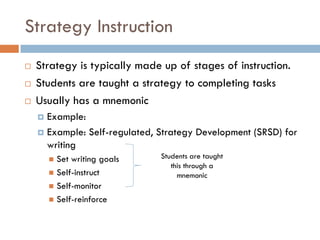
Strategy Instruction
   Strategy is typically made up of stages of instruction.
   Students are taught a strategy to completing tasks
   Usually has a mnemonic
     Example:
     Example: Self-regulated, Strategy Development (SRSD) for
      writing
         Set writing goals    Students are taught
                                  this through a
         Self-instruct             mnemonic
         Self-monitor
         Self-reinforce
Strategy Instruction
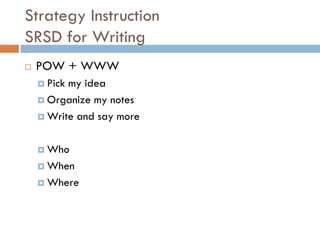
SRSD for Writing
   POW + WWW
     Pickmy idea
     Organize my notes

     Write and say more


     Who

     When

     Where
Strategy Instruction
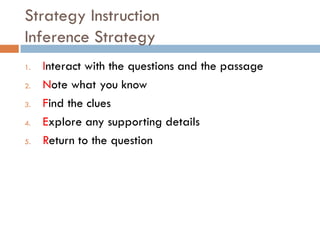
Inference Strategy
1.   Interact with the questions and the passage
2.   Note what you know
3.   Find the clues
4.   Explore any supporting details
5.   Return to the question
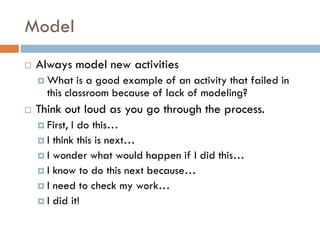
Model
   Always model new activities
     What    is a good example of an activity that failed in
      this classroom because of lack of modeling?
   Think out loud as you go through the process.
     First, I do this…
     I think this is next…
     I wonder what would happen if I did this…
     I know to do this next because…
     I need to check my work…
     I did it!
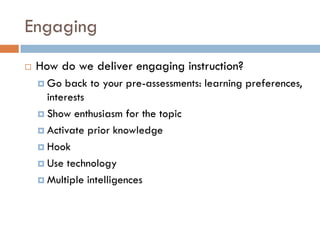
Engaging
   How do we deliver engaging instruction?
     Go  back to your pre-assessments: learning preferences,
      interests
     Show enthusiasm for the topic

     Activate prior knowledge

     Hook

     Use technology

     Multiple intelligences
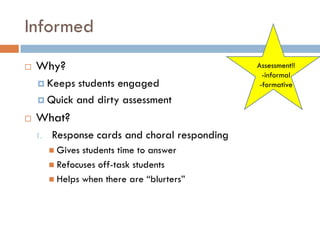
Informed
   Why?                                        Assessment!!
                                                  -informal
     Keeps students engaged                     -formative

     Quick and dirty assessment

   What?
    1.   Response cards and choral responding
          Gives students time to answer
          Refocuses off-task students
          Helps when there are “blurters”
Active student responding: when to
use…
   Choral responding
     Short and same answers
     Facts
     Repetition


   Response cards
     Short and different or same kind of answer
     Opinions OR facts
     Different modes
         Color cards
         Fingers
         Head nods
What about small groups?
   Cooperative learning
   Stations/centers
   Independent work
     Review  activities
     Practicing new skills (after guided practice)
       Flashcards
       Games
       Computer

   Students may not always be working with you but
    you will always be working with students
What ifs?
   Always be prepared for the idea that a student
    might not “get it” at first.
     What   prompting can you provide?
     How can you help them get there while still maintaining
      the class?
     How can you anticipate these issues and provide some
      universally-designed instruction to avoid them?
Review
   To sum up…
     Your   lessons should:
       Be  explicit-teach students what they need to do the activity.
        Don’t make it a puzzle!
       Be engaging-use active student responding, BE FUN!
       Be informed-use formative assessment techniques, check for
        understanding
       Be ready for what if? How can you help the student who
        just doesn’t get it?

Crash course in instruction

  • 1.
  • 2.
    “Eighty percent ofdifferentiation is mind-set; the rest is craft” (Wormeli, 2007)
  • 3.
    A mistake weoften make in education is to plan the curriculum materials very carefully, arrange all the instructional materials wall to wall, open the doors of the school, and then find to our dismay that they’ve sent us the wrong kids.
  • 4.
    Characteristics of goodinstruction  How do we get students to achieve the objectives?  Explicit  Research-based  Engaging  Informed  Ready for the “what ifs”
  • 5.
    Explicit Instruction  Also known as direct instruction  “I do, we do, you do”  Lesson Plan structure:  Modeling  Guided practice  Independent practice
  • 6.
    Strategy Instruction  A type of explicit instruction  Provides students with a strategy to completing academic tasks  Reading  Writing  Math  Studying  Test taking  Working together
  • 7.
    Strategy Instruction  Strategy is typically made up of stages of instruction.  Students are taught a strategy to completing tasks  Usually has a mnemonic  Example:  Example: Self-regulated, Strategy Development (SRSD) for writing  Set writing goals Students are taught this through a  Self-instruct mnemonic  Self-monitor  Self-reinforce
  • 8.
    Strategy Instruction SRSD forWriting  POW + WWW  Pickmy idea  Organize my notes  Write and say more  Who  When  Where
  • 9.
    Strategy Instruction Inference Strategy 1. Interact with the questions and the passage 2. Note what you know 3. Find the clues 4. Explore any supporting details 5. Return to the question
  • 10.
    Model  Always model new activities  What is a good example of an activity that failed in this classroom because of lack of modeling?  Think out loud as you go through the process.  First, I do this…  I think this is next…  I wonder what would happen if I did this…  I know to do this next because…  I need to check my work…  I did it!
  • 11.
    Engaging  How do we deliver engaging instruction?  Go back to your pre-assessments: learning preferences, interests  Show enthusiasm for the topic  Activate prior knowledge  Hook  Use technology  Multiple intelligences
  • 12.
    Informed  Why? Assessment!! -informal  Keeps students engaged -formative  Quick and dirty assessment  What? 1. Response cards and choral responding  Gives students time to answer  Refocuses off-task students  Helps when there are “blurters”
  • 13.
    Active student responding:when to use…  Choral responding  Short and same answers  Facts  Repetition  Response cards  Short and different or same kind of answer  Opinions OR facts  Different modes  Color cards  Fingers  Head nods
  • 14.
    What about smallgroups?  Cooperative learning  Stations/centers  Independent work  Review activities  Practicing new skills (after guided practice)  Flashcards  Games  Computer  Students may not always be working with you but you will always be working with students
  • 15.
    What ifs?  Always be prepared for the idea that a student might not “get it” at first.  What prompting can you provide?  How can you help them get there while still maintaining the class?  How can you anticipate these issues and provide some universally-designed instruction to avoid them?
  • 16.
    Review  To sum up…  Your lessons should:  Be explicit-teach students what they need to do the activity. Don’t make it a puzzle!  Be engaging-use active student responding, BE FUN!  Be informed-use formative assessment techniques, check for understanding  Be ready for what if? How can you help the student who just doesn’t get it?

Editor's Notes

  • #14 Short and sameShort and differentCHORALChemical formula for water is 2+2 isThe first president of the United states isRESP CARDTell me your favorite bookWhat is one item you recycled this weekend