

MEDA 5700
The Instructional Role of Educational Media
  and Educational Technology – Week 2
                   Michelle Childress, M.S. Ed.


  ―WHY DO PEOPLE FALL ASLEEP IN CLASS? IT HAS NOTHING TO DO
  WITH HOW MUCH SLEEP THEY GOT THE NIGHT BEFORE, WHETHER
  OR NOT THEY ARE SICK, OR IF THEY ARE HUNG OVER. THE
  ANSWER CAN BE SUMMED UP IN TWO WORDS. PERCEIVED
  MEANINGLESSNESS. THIS IS A KEY TO DESIGNING ENGAGING
  LEARNING EXPERIENCES.‖
OBJECTIVES FOR THE COURSE
    Possess a working vocabulary and
     comprehension of Instructional Design (ID) terms
    Learn how to design instruction for classrooms,
     businesses, and many other organizations
    Shape Instructional Design materials through an
     understanding of design principles and the
     development of appropriate practices
    Critique current literature in the field of
     Instructional Design
    Develop, follow, and assess your personal model
     for Instructional Design
OVERVIEW FOR WEEK 2
1)   Review this PowerPoint (PPT) presentation and read
     Chapter 1 in your text.
2)   Read Attachment #1 – Design Models (found on D2L)
3)   Print and complete Attachment #2 – Your Designer
     Competencies (found in D2L) and put with your files/notes
     from this class. It is not necessary to submit this to me.
4)   Complete Activity #1 and #2 (directions found in this PPT;
     slide 22 and 24) and submit to the D2L Dropbox by the due
     date on your course calendar.
5)   Questions? Contact me via email. I check my email on a
     daily basis (often multiple times each day).
THE BIG PICTURE
OVERALL QUESTIONS TO CONSIDER AS AN
INSTRUCTIONAL DESIGNER
1)   What will students/participants learn? (Learning Outcomes)

2)   How will you know if students/participants learned?
     (Assessment)

3)   How will you assist students/participants to learn? (Teaching)

4)   How will technology help students/participants learn?
     (Technology)

5)   How will technology use help you reexamine outcomes,
     assessment, and teaching?
                                Teacher Decision Cycle, Shambaugh & Magliaro
GUIDING STANDARDS FOR TEACHING
   The teacher understand the concepts, tools for inquiry, and
    structures for the content being taught and is capable of creating
    meaningful learning experiences.

   The teacher understands how students learn and develop and
    can provide learning opportunities to support intellectual, social,
    and personal development.

   The teacher uses an understanding of both individual and group
    motivation and behavior to create an environment which
    encourages positive social interaction, active engagement in
    learning, and self-motivation.
AN INSTRUCTIONAL DESIGNER’S TOOLKIT

   Definitions and Terms

   Learning Theories

   Design Models
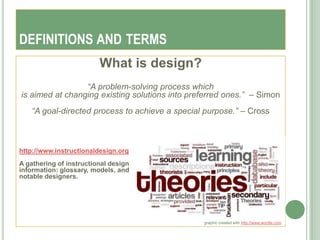
DEFINITIONS AND TERMS
                         What is design?
                 “A problem-solving process which
is aimed at changing existing solutions into preferred ones.” – Simon
   “A goal-directed process to achieve a special purpose.” – Cross


http://www.instructionaldesign.org
A gathering of instructional design
information: glossary, models, and
notable designers.


                                                graphic created with http://www.wordle.com
DEFINITIONS AND TERMS
     What is instructional design?

―An intellectual process to help teachers
systematically analyze learners‘ needs
and construct structured ‗possibilities‘ to
responsively address those needs.‖
              – Shambaugh & Magliaro, 1997
LEARNING THEORIES
 What is learning?   What is teaching?
LEARNING THEORIES
What is learning?
Over the last century, three theoretical approaches have provided
the primary guidance for instructional practice.


   Behaviorism (response acquisition)

   Cognitive psychology (knowledge acquisition)

   Constructivism (knowledge construction)
BEHAVIORAL THEORY
Behavior theory, or response acquisition, dominated the study of
human learning during the first half of the century.

   Behavioral psychology has the perspective that learning is the
    acquisition of responses to features in our environment.

   Learning is achieved through frequent responding and
    immediate reinforcement of appropriate behaviors.

   Humans acquire complex processes over time through
    gradual shaping of desired responses through reinforcement.
BEHAVIORAL THEORY
DESIGN CONSIDERATIONS
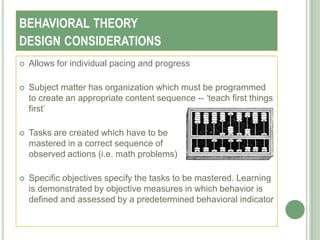
   Allows for individual pacing and progress

   Subject matter has organization which must be programmed
    to create an appropriate content sequence -- ‗teach first things
    first‘

   Tasks are created which have to be
    mastered in a correct sequence of
    observed actions (i.e. math problems)

   Specific objectives specify the tasks to be mastered. Learning
    is demonstrated by objective measures in which behavior is
    defined and assessed by a predetermined behavioral indicator
COGNITIVE THEORY
Beginning in the 1960s, learning was defined as knowledge
acquisition which has been dominated by the information-
processing model of human memory.

   Cognitive learning theory examines mental models and
    processes (i.e. thinking, remembering, and problem-solving).

   Key memory structures and processes were identified—
    comparing the human memory system to way a computer
    processes memory and recall.

   New information is built onto existing knowledge structures
    with internal executive control being required to enable the
    entire system to function efficiently.
COGNITIVE THEORY
DESIGN CONSIDERATIONS
   Instruction is structured and promotes thinking activities to
    support the development of experts

   Learning strategies are taught which help the student
    efficiently process new information or solve a problem

   Organizers and other instructional aids are used as to
    structure conceptual knowledge needed to be acquired

   A conceptual assessment is created which is
    specific to ensure learner efficiency and
    assess learning
CONSTRUCTIVISM THEORY
Since the 1980s, learning has been depicted as knowledge
construction within a constructivist framework, where learning
resides primarily with the learner.

   There is an assumption that all thinking is embedded in
    particular settings and this, along with learning tools and
    tasks, must be considered when designing instruction

   There are different types of constructivism—‘radical‘ views
    understanding as totally individual; ‗Piagetian‘ sees social
    interaction as a catalyst; and ‗social constructivism‘
    emphasizes the social world to define reality and knowledge

   Learning goals and activity are the focus within the teacher-
    student interaction.
CONSTRUCTIVISM THEORY
DESIGN CONSIDERATIONS
 Learners are at the center of the design activity and
  they are taught to organize new knowledge in
  memory
 The curriculum centers around ‗real‘ problems
  which emerge for the learners during the course
 Communities of learners exist; teachers and peers
  assume the role of facilitators
 Teachers help students engage in authentic
  activities which are situated in real practice (i.e.
  reciprocal teaching and cooperative learning)
 Assessment solves real-life problems and promotes
  self-reflection; learner responsibility is maximized
FIVE MAJOR THEMES OF CURRENT
CONCEPTS OF LEARNING
1)   Organizing knowledge in memory (short-term or working
     memory and long-term memory)

2)   Solving problems (develop strategies)

3)   Developing learners (developmental differences)

4)   Learning how to learn (metacognition)

5)   Living and learning in the world (social and cultural context)

6)   Learning principles (based on learning theories)
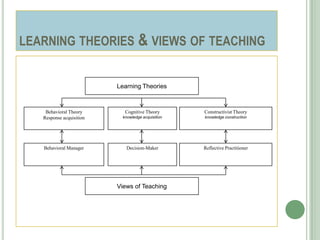
LEARNING THEORIES & VIEWS OF TEACHING


                          Learning Theories


    Behavioral Theory       Cognitive Theory       Constructivist Theory
   Response acquisition    knowledge acquisition   knowledge construction


   Behavioral Manager        Decision-Maker        Reflective Practitioner


                          Views of Teaching
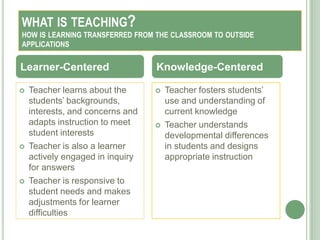
WHAT IS TEACHING?
HOW IS LEARNING TRANSFERRED FROM THE CLASSROOM TO OUTSIDE
APPLICATIONS


Learner-Centered                  Knowledge-Centered

   Teacher learns about the         Teacher fosters students‘
    students‘ backgrounds,            use and understanding of
    interests, and concerns and       current knowledge
    adapts instruction to meet       Teacher understands
    student interests                 developmental differences
   Teacher is also a learner         in students and designs
    actively engaged in inquiry       appropriate instruction
    for answers
   Teacher is responsive to
    student needs and makes
    adjustments for learner
    difficulties
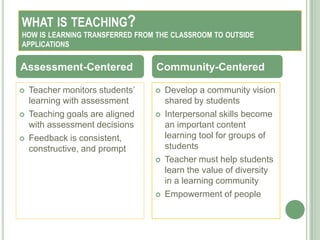
WHAT IS TEACHING?
HOW IS LEARNING TRANSFERRED FROM THE CLASSROOM TO OUTSIDE
APPLICATIONS


Assessment-Centered              Community-Centered

   Teacher monitors students‘      Develop a community vision
    learning with assessment         shared by students
   Teaching goals are aligned      Interpersonal skills become
    with assessment decisions        an important content
   Feedback is consistent,          learning tool for groups of
    constructive, and prompt         students
                                    Teacher must help students
                                     learn the value of diversity
                                     in a learning community
                                    Empowerment of people
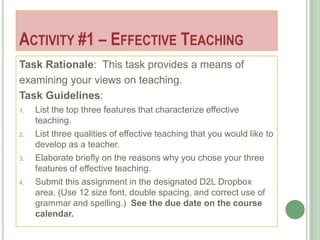
ACTIVITY #1 – EFFECTIVE TEACHING
Task Rationale: This task provides a means of
examining your views on teaching.
Task Guidelines:
1.   List the top three features that characterize effective
     teaching.
2.   List three qualities of effective teaching that you would like to
     develop as a teacher.
3.   Elaborate briefly on the reasons why you chose your three
     features of effective teaching.
4.   Submit this assignment in the designated D2L Dropbox
     area. (Use 12 size font, double spacing, and correct use of
     grammar and spelling.) See the due date on the course
     calendar.
DESIGN MODELS
 Teaching models give teaches a conceptual and
practical technology from which to teach

 Teaching models help to understand the content to
be taught as well as reflect upon one‘s views of
learning, the learner, and the role of the teacher
                                   (Shambaugh & Magliaro)


 A design model helps to serve as a visual
representation of the instructional process
ACTIVITY #2 – DESIGN MODELS
Task Rationale: This task provides an introduction
and evaluation task for different design models.
Task Guidelines:
1.   Review the eight design models from the attachment #1 found on
     D2L (p.31 – 41).
2.   Indicate the similarities and differences within the models.
3.   Indicate the models that are easy or difficult to follow.
4.   Select one model that you could or would use as an Instructional
     Designer and explain your reasons for the selection.
5.   Submit this assignment in the designated D2L Dropbox area. (Use
     12 size font, double spacing, and correct use of grammar and
     spelling.) See the due date on the course calendar.
Credits:

 PowerPoint: Dr. Tammy Barnes and Allyn & Bacon
Publishers, 2006 version of textbook: Instructional Design: A
Systematic Approach for Reflective Practice (Shambaugh and
Magliaro)

Images: Clipart Etc – Florida‘s Educational Technology
Clearing House [http://etc.usf.edu/clipart/sitemap/sitemap.php]

Meda 5700_Ch1

  • 1.
    MEDA 5700 The InstructionalRole of Educational Media and Educational Technology – Week 2 Michelle Childress, M.S. Ed. ―WHY DO PEOPLE FALL ASLEEP IN CLASS? IT HAS NOTHING TO DO WITH HOW MUCH SLEEP THEY GOT THE NIGHT BEFORE, WHETHER OR NOT THEY ARE SICK, OR IF THEY ARE HUNG OVER. THE ANSWER CAN BE SUMMED UP IN TWO WORDS. PERCEIVED MEANINGLESSNESS. THIS IS A KEY TO DESIGNING ENGAGING LEARNING EXPERIENCES.‖
  • 2.
    OBJECTIVES FOR THECOURSE  Possess a working vocabulary and comprehension of Instructional Design (ID) terms  Learn how to design instruction for classrooms, businesses, and many other organizations  Shape Instructional Design materials through an understanding of design principles and the development of appropriate practices  Critique current literature in the field of Instructional Design  Develop, follow, and assess your personal model for Instructional Design
  • 3.
    OVERVIEW FOR WEEK2 1) Review this PowerPoint (PPT) presentation and read Chapter 1 in your text. 2) Read Attachment #1 – Design Models (found on D2L) 3) Print and complete Attachment #2 – Your Designer Competencies (found in D2L) and put with your files/notes from this class. It is not necessary to submit this to me. 4) Complete Activity #1 and #2 (directions found in this PPT; slide 22 and 24) and submit to the D2L Dropbox by the due date on your course calendar. 5) Questions? Contact me via email. I check my email on a daily basis (often multiple times each day).
  • 4.
  • 5.
    OVERALL QUESTIONS TOCONSIDER AS AN INSTRUCTIONAL DESIGNER 1) What will students/participants learn? (Learning Outcomes) 2) How will you know if students/participants learned? (Assessment) 3) How will you assist students/participants to learn? (Teaching) 4) How will technology help students/participants learn? (Technology) 5) How will technology use help you reexamine outcomes, assessment, and teaching? Teacher Decision Cycle, Shambaugh & Magliaro
  • 6.
    GUIDING STANDARDS FORTEACHING  The teacher understand the concepts, tools for inquiry, and structures for the content being taught and is capable of creating meaningful learning experiences.  The teacher understands how students learn and develop and can provide learning opportunities to support intellectual, social, and personal development.  The teacher uses an understanding of both individual and group motivation and behavior to create an environment which encourages positive social interaction, active engagement in learning, and self-motivation.
  • 7.
    AN INSTRUCTIONAL DESIGNER’STOOLKIT  Definitions and Terms  Learning Theories  Design Models
  • 8.
    DEFINITIONS AND TERMS What is design? “A problem-solving process which is aimed at changing existing solutions into preferred ones.” – Simon “A goal-directed process to achieve a special purpose.” – Cross http://www.instructionaldesign.org A gathering of instructional design information: glossary, models, and notable designers. graphic created with http://www.wordle.com
  • 9.
    DEFINITIONS AND TERMS What is instructional design? ―An intellectual process to help teachers systematically analyze learners‘ needs and construct structured ‗possibilities‘ to responsively address those needs.‖ – Shambaugh & Magliaro, 1997
  • 10.
    LEARNING THEORIES Whatis learning? What is teaching?
  • 11.
    LEARNING THEORIES What islearning? Over the last century, three theoretical approaches have provided the primary guidance for instructional practice.  Behaviorism (response acquisition)  Cognitive psychology (knowledge acquisition)  Constructivism (knowledge construction)
  • 12.
    BEHAVIORAL THEORY Behavior theory,or response acquisition, dominated the study of human learning during the first half of the century.  Behavioral psychology has the perspective that learning is the acquisition of responses to features in our environment.  Learning is achieved through frequent responding and immediate reinforcement of appropriate behaviors.  Humans acquire complex processes over time through gradual shaping of desired responses through reinforcement.
  • 13.
    BEHAVIORAL THEORY DESIGN CONSIDERATIONS  Allows for individual pacing and progress  Subject matter has organization which must be programmed to create an appropriate content sequence -- ‗teach first things first‘  Tasks are created which have to be mastered in a correct sequence of observed actions (i.e. math problems)  Specific objectives specify the tasks to be mastered. Learning is demonstrated by objective measures in which behavior is defined and assessed by a predetermined behavioral indicator
  • 14.
    COGNITIVE THEORY Beginning inthe 1960s, learning was defined as knowledge acquisition which has been dominated by the information- processing model of human memory.  Cognitive learning theory examines mental models and processes (i.e. thinking, remembering, and problem-solving).  Key memory structures and processes were identified— comparing the human memory system to way a computer processes memory and recall.  New information is built onto existing knowledge structures with internal executive control being required to enable the entire system to function efficiently.
  • 15.
    COGNITIVE THEORY DESIGN CONSIDERATIONS  Instruction is structured and promotes thinking activities to support the development of experts  Learning strategies are taught which help the student efficiently process new information or solve a problem  Organizers and other instructional aids are used as to structure conceptual knowledge needed to be acquired  A conceptual assessment is created which is specific to ensure learner efficiency and assess learning
  • 16.
    CONSTRUCTIVISM THEORY Since the1980s, learning has been depicted as knowledge construction within a constructivist framework, where learning resides primarily with the learner.  There is an assumption that all thinking is embedded in particular settings and this, along with learning tools and tasks, must be considered when designing instruction  There are different types of constructivism—‘radical‘ views understanding as totally individual; ‗Piagetian‘ sees social interaction as a catalyst; and ‗social constructivism‘ emphasizes the social world to define reality and knowledge  Learning goals and activity are the focus within the teacher- student interaction.
  • 17.
    CONSTRUCTIVISM THEORY DESIGN CONSIDERATIONS Learners are at the center of the design activity and they are taught to organize new knowledge in memory  The curriculum centers around ‗real‘ problems which emerge for the learners during the course  Communities of learners exist; teachers and peers assume the role of facilitators  Teachers help students engage in authentic activities which are situated in real practice (i.e. reciprocal teaching and cooperative learning)  Assessment solves real-life problems and promotes self-reflection; learner responsibility is maximized
  • 18.
    FIVE MAJOR THEMESOF CURRENT CONCEPTS OF LEARNING 1) Organizing knowledge in memory (short-term or working memory and long-term memory) 2) Solving problems (develop strategies) 3) Developing learners (developmental differences) 4) Learning how to learn (metacognition) 5) Living and learning in the world (social and cultural context) 6) Learning principles (based on learning theories)
  • 19.
    LEARNING THEORIES &VIEWS OF TEACHING Learning Theories Behavioral Theory Cognitive Theory Constructivist Theory Response acquisition knowledge acquisition knowledge construction Behavioral Manager Decision-Maker Reflective Practitioner Views of Teaching
  • 20.
    WHAT IS TEACHING? HOWIS LEARNING TRANSFERRED FROM THE CLASSROOM TO OUTSIDE APPLICATIONS Learner-Centered Knowledge-Centered  Teacher learns about the  Teacher fosters students‘ students‘ backgrounds, use and understanding of interests, and concerns and current knowledge adapts instruction to meet  Teacher understands student interests developmental differences  Teacher is also a learner in students and designs actively engaged in inquiry appropriate instruction for answers  Teacher is responsive to student needs and makes adjustments for learner difficulties
  • 21.
    WHAT IS TEACHING? HOWIS LEARNING TRANSFERRED FROM THE CLASSROOM TO OUTSIDE APPLICATIONS Assessment-Centered Community-Centered  Teacher monitors students‘  Develop a community vision learning with assessment shared by students  Teaching goals are aligned  Interpersonal skills become with assessment decisions an important content  Feedback is consistent, learning tool for groups of constructive, and prompt students  Teacher must help students learn the value of diversity in a learning community  Empowerment of people
  • 22.
    ACTIVITY #1 –EFFECTIVE TEACHING Task Rationale: This task provides a means of examining your views on teaching. Task Guidelines: 1. List the top three features that characterize effective teaching. 2. List three qualities of effective teaching that you would like to develop as a teacher. 3. Elaborate briefly on the reasons why you chose your three features of effective teaching. 4. Submit this assignment in the designated D2L Dropbox area. (Use 12 size font, double spacing, and correct use of grammar and spelling.) See the due date on the course calendar.
  • 23.
    DESIGN MODELS  Teachingmodels give teaches a conceptual and practical technology from which to teach  Teaching models help to understand the content to be taught as well as reflect upon one‘s views of learning, the learner, and the role of the teacher (Shambaugh & Magliaro)  A design model helps to serve as a visual representation of the instructional process
  • 24.
    ACTIVITY #2 –DESIGN MODELS Task Rationale: This task provides an introduction and evaluation task for different design models. Task Guidelines: 1. Review the eight design models from the attachment #1 found on D2L (p.31 – 41). 2. Indicate the similarities and differences within the models. 3. Indicate the models that are easy or difficult to follow. 4. Select one model that you could or would use as an Instructional Designer and explain your reasons for the selection. 5. Submit this assignment in the designated D2L Dropbox area. (Use 12 size font, double spacing, and correct use of grammar and spelling.) See the due date on the course calendar.
  • 25.
    Credits:  PowerPoint: Dr.Tammy Barnes and Allyn & Bacon Publishers, 2006 version of textbook: Instructional Design: A Systematic Approach for Reflective Practice (Shambaugh and Magliaro) Images: Clipart Etc – Florida‘s Educational Technology Clearing House [http://etc.usf.edu/clipart/sitemap/sitemap.php]