Experiential, problem-based
and simulated learning :
    The role(s) of adult facilitators


                     Philip Viana
                     4F32 Facilitating Adult Learning
                     Session 6
Experiential Approach / Problem-Based / Simulation Approach to
           Instruction
AGENDA
AND
OVERVIEW       –   Methods and principles
               –   Examine the theorists
               –   Applications
               –   Drawbacks
               –   See examples of these approaches
EXPERIENTIAL APPROACH TO INSTRUCTION


                How is this approach different?


          Learner’s experiences are part of learning goals

                       Real World feedback

                  Social Constructivist approach
EXPERIENTIAL APPROACH TO INSTRUCTION

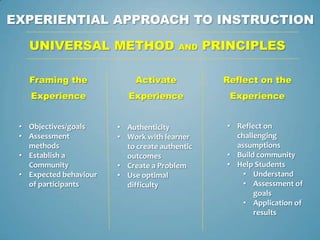
   UNIVERSAL METHOD                      AND    PRINCIPLES

   Framing the               Activate             Reflect on the
    Experience             Experience              Experience


 • Objectives/goals     • Authenticity             • Reflect on
 • Assessment           • Work with learner          challenging
   methods                to create authentic        assumptions
 • Establish a            outcomes                 • Build community
   Community            • Create a Problem         • Help Students
 • Expected behaviour   • Use optimal                  • Understand
   of participants        difficulty                   • Assessment of
                                                          goals
                                                       • Application of
                                                          results
EXPERIENTIAL APPROACH TO INSTRUCTION

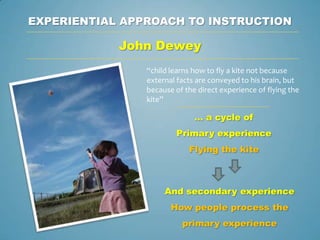
            John Dewey
                “child learns how to fly a kite not because
                external facts are conveyed to his brain, but
                because of the direct experience of flying the
                kite”

                              … a cycle of
                        Primary experience
                            Flying the kite


                     And secondary experience
                       How people process the
                          primary experience
EXPERIENTIAL APPROACH TO INSTRUCTION

                       John Dewey


 “Experience and education cannot be directly equated, because
 in fact some experiences are “miseducative” in that they arrest or
 distort the growth of future experience (Dewey, 1938)"


        What is your interpretation of this
                   statement?
EXPERIENTIAL APPROACH TO INSTRUCTION

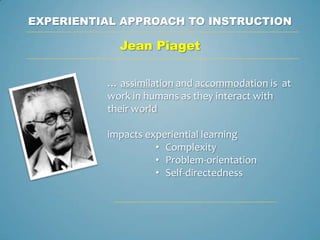
            Jean Piaget

          … assimilation and accommodation is at
          work in humans as they interact with
          their world

          impacts experiential learning
                    • Complexity
                    • Problem-orientation
                    • Self-directedness
EXPERIENTIAL APPROACH TO INSTRUCTION

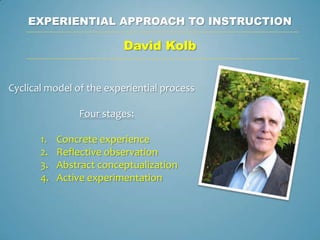
                          David Kolb


Cyclical model of the experiential process

                Four stages:

       1.   Concrete experience
       2.   Reflective observation
       3.   Abstract conceptualization
       4.   Active experimentation
EXPERIENTIAL APPROACH TO INSTRUCTION

                     DRAWBACKS


 “…Many people have learned to probe the underlying meaning of
 their experiences, but such cognitive ability is not characteristic of
 all learners”
                                             David Kolb (1984)
EXPERIENTIAL APPROACH TO INSTRUCTION

                     DRAWBACKS


 “not all experience leads to the growth of ever-widening and deeper
 experiences”

 “… even for those experiences that offer the potential to be good
 learning opportunities, the individual’s interpretation of the experience
 may be misguided.“

                                                 Merriam (1994)
Soldiers hold live-fire exercise in Gagetown

REAL WORLD
EXPERIENTIAL
LEARNING

                    http://goo.gl/cE9ks
Soldiers hold live-fire exercise in Gagetown


REAL WORLD
EXPERIENTIAL
LEARNING
               “Learning is promoted when learners activate
               relevant cognitive structures by being
               directed to recall, relate, describe, or
               demonstrate relevant prior knowledge or
               experience“
                                            Merrill (1984)
PROBLEM-BASED APPROACH TO INSTRUCTION


 How is this approach different?


     • facilitated problem solving
• organized around a complex problem
• does not have a single correct answer
PROBLEM-BASED APPROACH TO INSTRUCTION

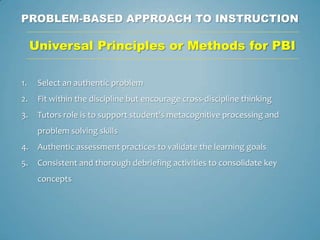
     Universal Principles or Methods for PBI

1.    Select an authentic problem
2.    Fit within the discipline but encourage cross-discipline thinking
3.    Tutors role is to support student’s metacognitive processing and
      problem solving skills
4.    Authentic assessment practices to validate the learning goals
5.    Consistent and thorough debriefing activities to consolidate key
      concepts
PROBLEM-BASED APPROACH TO INSTRUCTION

           Howard Barrows
              One of the innovators of PBI in medical education

                      …suggested that the conventional
                      methods of teaching probably inhibit,
                      if not destroy, any clinical reasoning …
                      And that students had forgotten their
                      freshman [course content] by the time
                      they reached their clinical course as
                      juniors…. [This] led to my design of a
                      method stressing development of the
                      clinical reasoning or problem-solving
                      process.
PROBLEM-BASED APPROACH TO INSTRUCTION

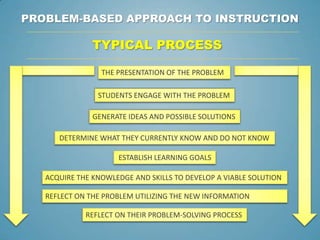
               TYPICAL PROCESS

                 THE PRESENTATION OF THE PROBLEM

                STUDENTS ENGAGE WITH THE PROBLEM

               GENERATE IDEAS AND POSSIBLE SOLUTIONS

      DETERMINE WHAT THEY CURRENTLY KNOW AND DO NOT KNOW

                     ESTABLISH LEARNING GOALS

   ACQUIRE THE KNOWLEDGE AND SKILLS TO DEVELOP A VIABLE SOLUTION

   REFLECT ON THE PROBLEM UTILIZING THE NEW INFORMATION

             REFLECT ON THEIR PROBLEM-SOLVING PROCESS
PROBLEM-BASED APPROACH TO INSTRUCTION

    DIFFERENCE FROM A CASE STUDY?


• With most case studies there
  is one right answer (and
  some close answers)

• The learning task for the
  student is to pick up on all
  the clues that are important
  (and avoid the red herrings)
PROBLEM-BASED APPROACH TO INSTRUCTION

         PROBLEM SHOULD BE …


   1.   Grounded in by the curriculum
   2.   Engaging
   3.   Relevant
   4.   Using same knowledge, skills, and attitudes as a real-world
   5.   Challenging enough to require contributions from all learners
   6.   Misleading and loose framework
   7.   Prepared to offer learners supplies and content to start the
        activity
PROBLEM-BASED APPROACH TO INSTRUCTION

         POSSIBLE HURDLES


            • Lack of Prior Experience with PBI
            • Large Class Sizes
            • Commitment of the instructor and the
              organization
            • Commitment to the complete PBI process
            • Shift of teachers’ pedagogical beliefs
SIMULATION APPROACH TO INSTRUCTION


             How is this approach different?

    •      Dynamic models of physical or conceptual systems…
•   Engaging interactions with effecting state changes to models
                        •    Nonlinear logic
•       One or more designed augmenting instructional functions…
                •    One or more instructional goals.
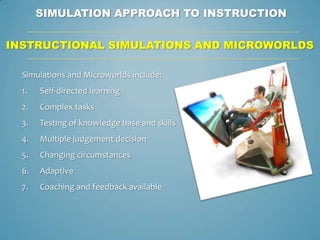
SIMULATION APPROACH TO INSTRUCTION

INSTRUCTIONAL SIMULATIONS AND MICROWORLDS

  Simulations and Microworlds include:
  1.   Self-directed learning
  2.   Complex tasks
  3.   Testing of knowledge base and skills
  4.   Multiple judgement decision
  5.   Changing circumstances
  6.   Adaptive
  7.   Coaching and feedback available
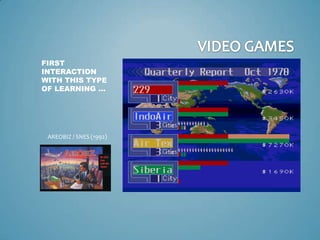
FIRST
INTERACTION
WITH THIS TYPE
OF LEARNING …


 AREOBIZ / SNES (1992)
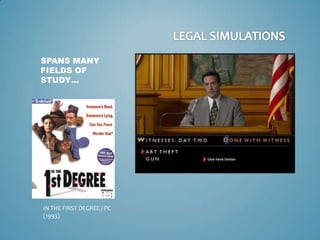
SPANS MANY
FIELDS OF
STUDY…


IN THE FIRST DEGREE / PC
(1993)
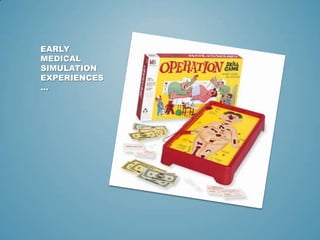
EARLY
MEDICAL
SIMULATION
EXPERIENCES
…
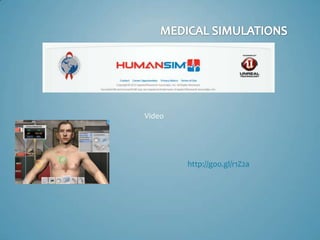
Video


        http://goo.gl/r1Z2a
SIMULATION APPROACH TO INSTRUCTION

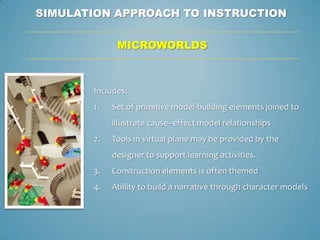
             MICROWORLDS


       Includes:
       1.   Set of primitive model-building elements joined to
            illustrate cause–effect model relationships
       2.   Tools in virtual plane may be provided by the
            designer to support learning activities.
       3.   Construction elements is often themed
       4.   Ability to build a narrative through character models
SIMULATION APPROACH TO INSTRUCTION

               MICROWORLDS


   Includes:
   1. Nonlinear interactions in constructing models and
        carrying out interactions within a specific range
   2. Actions are constrained by operational commands
        created by designer.
   3. Guided Exploration
MICROWORLD
EXAMPLE


             Alice 3.x © 2008-2013,
             Carnegie Mellon University
SIMULATION APPROACH TO INSTRUCTION

                   MICROWORLDS

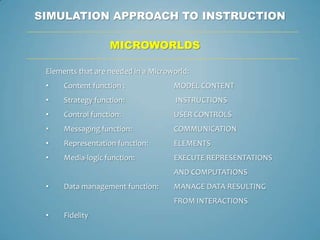
 Elements that are needed in a Microworld:
 •    Content function :             MODEL CONTENT
 •    Strategy function:              INSTRUCTIONS
 •    Control function:              USER CONTROLS
 •    Messaging function:            COMMUNICATION
 •    Representation function:       ELEMENTS
 •    Media-logic function:          EXECUTE REPRESENTATIONS
                                     AND COMPUTATIONS
 •    Data management function:      MANAGE DATA RESULTING
                                     FROM INTERACTIONS
 •    Fidelity

Simulated learning v3

  • 1.
    Experiential, problem-based and simulatedlearning : The role(s) of adult facilitators Philip Viana 4F32 Facilitating Adult Learning Session 6
  • 2.
    Experiential Approach /Problem-Based / Simulation Approach to Instruction AGENDA AND OVERVIEW – Methods and principles – Examine the theorists – Applications – Drawbacks – See examples of these approaches
  • 3.
    EXPERIENTIAL APPROACH TOINSTRUCTION How is this approach different? Learner’s experiences are part of learning goals Real World feedback Social Constructivist approach
  • 4.
    EXPERIENTIAL APPROACH TOINSTRUCTION UNIVERSAL METHOD AND PRINCIPLES Framing the Activate Reflect on the Experience Experience Experience • Objectives/goals • Authenticity • Reflect on • Assessment • Work with learner challenging methods to create authentic assumptions • Establish a outcomes • Build community Community • Create a Problem • Help Students • Expected behaviour • Use optimal • Understand of participants difficulty • Assessment of goals • Application of results
  • 5.
    EXPERIENTIAL APPROACH TOINSTRUCTION John Dewey “child learns how to fly a kite not because external facts are conveyed to his brain, but because of the direct experience of flying the kite” … a cycle of Primary experience Flying the kite And secondary experience How people process the primary experience
  • 6.
    EXPERIENTIAL APPROACH TOINSTRUCTION John Dewey “Experience and education cannot be directly equated, because in fact some experiences are “miseducative” in that they arrest or distort the growth of future experience (Dewey, 1938)" What is your interpretation of this statement?
  • 7.
    EXPERIENTIAL APPROACH TOINSTRUCTION Jean Piaget … assimilation and accommodation is at work in humans as they interact with their world impacts experiential learning • Complexity • Problem-orientation • Self-directedness
  • 8.
    EXPERIENTIAL APPROACH TOINSTRUCTION David Kolb Cyclical model of the experiential process Four stages: 1. Concrete experience 2. Reflective observation 3. Abstract conceptualization 4. Active experimentation
  • 9.
    EXPERIENTIAL APPROACH TOINSTRUCTION DRAWBACKS “…Many people have learned to probe the underlying meaning of their experiences, but such cognitive ability is not characteristic of all learners” David Kolb (1984)
  • 10.
    EXPERIENTIAL APPROACH TOINSTRUCTION DRAWBACKS “not all experience leads to the growth of ever-widening and deeper experiences” “… even for those experiences that offer the potential to be good learning opportunities, the individual’s interpretation of the experience may be misguided.“ Merriam (1994)
  • 11.
    Soldiers hold live-fireexercise in Gagetown REAL WORLD EXPERIENTIAL LEARNING http://goo.gl/cE9ks
  • 12.
    Soldiers hold live-fireexercise in Gagetown REAL WORLD EXPERIENTIAL LEARNING “Learning is promoted when learners activate relevant cognitive structures by being directed to recall, relate, describe, or demonstrate relevant prior knowledge or experience“ Merrill (1984)
  • 13.
  • 14.
    PROBLEM-BASED APPROACH TOINSTRUCTION How is this approach different? • facilitated problem solving • organized around a complex problem • does not have a single correct answer
  • 15.
    PROBLEM-BASED APPROACH TOINSTRUCTION Universal Principles or Methods for PBI 1. Select an authentic problem 2. Fit within the discipline but encourage cross-discipline thinking 3. Tutors role is to support student’s metacognitive processing and problem solving skills 4. Authentic assessment practices to validate the learning goals 5. Consistent and thorough debriefing activities to consolidate key concepts
  • 16.
    PROBLEM-BASED APPROACH TOINSTRUCTION Howard Barrows One of the innovators of PBI in medical education …suggested that the conventional methods of teaching probably inhibit, if not destroy, any clinical reasoning … And that students had forgotten their freshman [course content] by the time they reached their clinical course as juniors…. [This] led to my design of a method stressing development of the clinical reasoning or problem-solving process.
  • 17.
    PROBLEM-BASED APPROACH TOINSTRUCTION TYPICAL PROCESS THE PRESENTATION OF THE PROBLEM STUDENTS ENGAGE WITH THE PROBLEM GENERATE IDEAS AND POSSIBLE SOLUTIONS DETERMINE WHAT THEY CURRENTLY KNOW AND DO NOT KNOW ESTABLISH LEARNING GOALS ACQUIRE THE KNOWLEDGE AND SKILLS TO DEVELOP A VIABLE SOLUTION REFLECT ON THE PROBLEM UTILIZING THE NEW INFORMATION REFLECT ON THEIR PROBLEM-SOLVING PROCESS
  • 18.
    PROBLEM-BASED APPROACH TOINSTRUCTION DIFFERENCE FROM A CASE STUDY? • With most case studies there is one right answer (and some close answers) • The learning task for the student is to pick up on all the clues that are important (and avoid the red herrings)
  • 19.
    PROBLEM-BASED APPROACH TOINSTRUCTION PROBLEM SHOULD BE … 1. Grounded in by the curriculum 2. Engaging 3. Relevant 4. Using same knowledge, skills, and attitudes as a real-world 5. Challenging enough to require contributions from all learners 6. Misleading and loose framework 7. Prepared to offer learners supplies and content to start the activity
  • 20.
    PROBLEM-BASED APPROACH TOINSTRUCTION POSSIBLE HURDLES • Lack of Prior Experience with PBI • Large Class Sizes • Commitment of the instructor and the organization • Commitment to the complete PBI process • Shift of teachers’ pedagogical beliefs
  • 21.
  • 22.
    SIMULATION APPROACH TOINSTRUCTION How is this approach different? • Dynamic models of physical or conceptual systems… • Engaging interactions with effecting state changes to models • Nonlinear logic • One or more designed augmenting instructional functions… • One or more instructional goals.
  • 23.
    SIMULATION APPROACH TOINSTRUCTION INSTRUCTIONAL SIMULATIONS AND MICROWORLDS Simulations and Microworlds include: 1. Self-directed learning 2. Complex tasks 3. Testing of knowledge base and skills 4. Multiple judgement decision 5. Changing circumstances 6. Adaptive 7. Coaching and feedback available
  • 24.
    FIRST INTERACTION WITH THIS TYPE OFLEARNING … AREOBIZ / SNES (1992)
  • 25.
    SPANS MANY FIELDS OF STUDY… INTHE FIRST DEGREE / PC (1993)
  • 26.
  • 27.
    Video http://goo.gl/r1Z2a
  • 28.
    SIMULATION APPROACH TOINSTRUCTION MICROWORLDS Includes: 1. Set of primitive model-building elements joined to illustrate cause–effect model relationships 2. Tools in virtual plane may be provided by the designer to support learning activities. 3. Construction elements is often themed 4. Ability to build a narrative through character models
  • 29.
    SIMULATION APPROACH TOINSTRUCTION MICROWORLDS Includes: 1. Nonlinear interactions in constructing models and carrying out interactions within a specific range 2. Actions are constrained by operational commands created by designer. 3. Guided Exploration
  • 30.
    MICROWORLD EXAMPLE Alice 3.x © 2008-2013, Carnegie Mellon University
  • 31.
    SIMULATION APPROACH TOINSTRUCTION MICROWORLDS Elements that are needed in a Microworld: • Content function : MODEL CONTENT • Strategy function: INSTRUCTIONS • Control function: USER CONTROLS • Messaging function: COMMUNICATION • Representation function: ELEMENTS • Media-logic function: EXECUTE REPRESENTATIONS AND COMPUTATIONS • Data management function: MANAGE DATA RESULTING FROM INTERACTIONS • Fidelity