3
OBJECTIVES
By the endof this session, we will be able to:
Understand what is Activity Based Learning (ABL)?
Identify Interactive Learning
Explain Communicative Approach
Promote use of ABL in Teaching Learning Process
Step by step learning with the help of a Model lesson
plan.
Identify hurdles in implementation of interactive
learning.
Overcome the fear of unknown
4.
4
CONTENTS
Introduction
ActivityBased Learning
Interactive Teaching
Sample Activities – Grade II
Communicative Approach
Sample Activities – Grade VII
Lesson Plan
Stages of a Lesson
Activities of a Lesson
Sample Activities – Grade V
Impediments in Implementation of ABL
Recommendations
Questions / Answers
Conclusion
5.
5
QUOTATION
Arrow goes forwardonly after pulling into backwards.
Bullet goes forward only after pressing the trigger
backward. Every human being will get happy only after
facing the difficulties in their life path……So do not
afraid to face your difficulties. They will push you
forward.
“Tell me & I forget. Teach me & I remember. Involve
me I learn”.
A good teacher can inspire hope, ignite the
imagination and instill a love of learning. (Brad
Henry)
6.
6
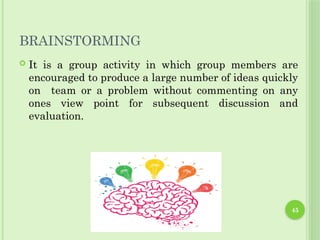
WHY ACTIVITY BASEDLEARNING
(ABL)?
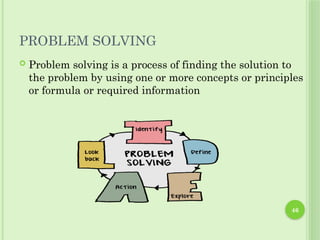
The information processing theory in psychology
views learners as active investigators of their
environment
In the process of learning, Students experience,
memorize and understand
It requires active problem solving by students in
finding patterns in the information through
their own investigation and analysis. Students
learn not the content of the lesson but also
develop many other skills.
7.
7
WHY ACTIVITY BASEDLEARNING
(ABL)?
It enhances creative aspect of experience.
It gives reality for learning.
Uses all available resources.
Provides varied experiences to the students to facilitate the
acquisition of knowledge, experience, skills and values.
Builds the student’s self-confidence and develops
understanding through work in his/her group.
8.
8
WHY ACTIVITY BASEDLEARNING (ABL)? . . .
Gets experiences, develop interest, enriches
vocabulary and provides stimulus for reading.
Develops happy relationship between students and
students, teachers and students.
An activity is said to be the language of the child.
Subjects of all kind can be taught through activity.
Social relation provides opportunity to mix with
others.
9.
9
ACTIVITY
The qualityor state of being active.
The behavior or actions of a particular kind
Something that is done as work or for a particular
purpose.
Something that is done for pleasure and that usually
involves a group of people.
10.
10
EXAMPLE FOR ACTIVITY
Acting
Performing
Demonstration
Playing a game
Writing
Thinking
Questioning
Operating something etc…
11.
11
ACTIVITY BASED LEARNING
An activity or activities used in an
educational process to make student learn
Activity based learning is the methodology
where the children of different ages are
grouped together in one class and learn at
their own pace through teacher- facilitated
exercises.
12.
12
CONTINUES…
Learning throughand from activities.
Activity based learning means that the teacher
incorporates activities of some type in teaching to
make students learn.
Using an activity or activities as a base for learning.
13.
13
ACTIVITY BASED LEARNING
Activity-based learning or ABL describes a range of
pedagogical approaches in teaching. Its core premises
include the requirement that learning should be based
on doing some hands-on experiments and activities.
The idea of activity-based learning is rooted in the
common notion that children are active learners rather
than passive recipients of information. If child is
provided the opportunity to explore by their own and
provided an optimum learning environment then the
learning becomes joyful and long-lasting.
15
HISTORY OF ACTIVITY-BASED
LEARNING
Activity-based learning started sometime in 1944
around World War II when a British man David
Horsburgh came to India and finally decided to
settle down there. He was an innovative thinker
and charismatic leader. He started teaching in
Rishi Valley School. He joined the British Council
and worked in Chennai and Bangalore for many
years. After his voluntary retirement, he located a
7-acre site in Kolar District and opened his school,
Neel Bagh. Neel Bagh was based on an innovative
idea of Horsburgh and known for its creative
methods in teaching well-planned learning
materials.
16.
16
With hiswife Doreen and his son Nicholas,
Horsburgh developed a diverse curriculum, which
included music, carpentry, sewing, masonry,
gardening, as well as the usual school subjects,
English, mathematics, Sanskrit, and Telugu.
These pedagogic materials were systematically
planned, with sketches and drawings and an
occasional touch of humour. Later Horsburgh
created a magnificent library in Neel Baugh that
was accessible to teachers and students. This
initiative of Horsburgh was later proved to be one
of the pioneer and milestones in ABL. In modern
time ABL is the method of education followed in
the Corporation schools of Chennai, from 2003, as
an effort to provide special schools for children
who had been freed from bonded labour.
17.
17
PHILOSOPHY
The philosophyof ABL finds its antecedents in the
common notion that learning can be best when it
is initiated by the surrounding environment and
motivated by providing optimum opportunities
to learn.
A fearless and freedom to express environment
always adds to best learning outcomes.
18.
18
TYPES OF ACTIVITYBASED
LEARNING
Dramatization
Quizzes
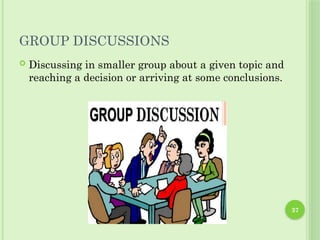
Group discussion
Role play
Educational game
Brainstorming
Problem solving
Field work
Experimentation
Concept mapping
Debates
Discovery learning
Project
20
DRAMATIZATION
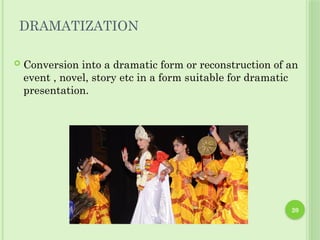
Conversion intoa dramatic form or reconstruction of an
event , novel, story etc in a form suitable for dramatic
presentation.
21.
21
DRAMATIZATION
One ofthe teaching techniques which teach students
how to behave in which situation by living it
Physical environment/costumes/ accessories are
important.
Affects the concentration of students.
Students use their own imagination thus improve
their creativeness.
22.
OBJECTIVES
Students willbe able to recognize and practice
individual skills
Students will be able to communicate with other
group members, easily
Students will be able to gain an understanding of the
feeling of others
Students will be able to learn to use body
language/Expression
22
23.
The dramatization teachingmethod refers to a collection of
teaching tools that include traditional drama teaching, such
as improvisation, storytelling, role-playing and games.
A lot of emphasis is placed on engaging students through
interactive activities. Dramatic teaching is integrated into
many different types of curriculum.
23
24.
A means childrencan use to understand or interpret a
story or book by acting out the action, either with each
other or with toys and props.
Dramatization is a great way to cement learning. If
you make a skit in your class showing how
photosynthesis works, you are much more likely to
remember it.
24
25.
ADVANTAGES;
It isfun
Provides direct involvement in learning on the part of
all students
Improves language using
Communicating/speaking and listening skills are
improved
Allows for exploration on solutions
25
26.
DISADVANTAGES:
Needs toomuch time
Costumes, decors and preparation of physical
environment may create difficulties
If students be limited, it may be boring
Students may be too self-conscious
Not appropriate for large groups
Students may feel threatened
26
27.
GAMES/ QUIZ ASA CREATIVE
METHOD IN TEACHING AND
LEARNING
27
28.
28
QUIZZES
Competitive activityin which participants should
give the answers to the question in a prescribed span
of time following some pre- determined rules.
29.
QUIZ
A testof knowledge, specially as a
competition between individuals or teams as a
form of entertainment.
You'll get the most information from students
if you don't bombard them with too many
questions.
Quizzes should include three to five questions
and take no longer then ten minutes to
complete.
The ideal is to ask students two questions
about the concept currently being taught.
29
30.
• Remember, themost important goal in assessing your
teaching with a quiz is to think about how students are
learning and associate that with an evaluation of your
instruction. When you do that, you help your students and
improve your pedagogy simultaneously.
30
31.
31
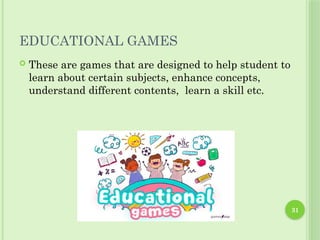
EDUCATIONAL GAMES
Theseare games that are designed to help student to
learn about certain subjects, enhance concepts,
understand different contents, learn a skill etc.
32.
• A formof competitive activity or sports played
according to rules.
• An activity that engages in for amusement.
• Games are a regular part of students' lives, no
matter what their grade level.
• Students play games throughout the day on
their computers, the Internet, and their cell
phones.
• One of the few places they don't regularly play
games is in their classrooms.
GAMES
32
33.
GAMES
Although some teachersuse
games as a part of their
instructional repertoire, most
teachers do not, and those who
do include them may not be
using them to their potential.
33
34.
Making learning funmotivates students and helps
them pay attention and stay focused on the subject.
One reason to promote educational games is to
encourage students to learn outside of class.
Classrooms can address even the most difficult
content in a light-hearted, engaging way.
Games are a powerful and useful tool to this end.
Teacher-conducted research indicates that games
can have a significant effect on student achievement
when teachers use them purposefully and
thoughtfully.
34
35.
ROLE OF TEACHER
•Teacher must be a good planner
• The teacher should act as Innovator
• The teacher should give more and more
opportunity to the child while performing co-
curricular activities
35
DEFINITION OF GROUPDISCUSSION
Group discussion is a modern method of
assessing students personality.
It is both a technique and an art and a
comprehensive tool to judge the
worthiness of the students and his
appropriateness for the job.
38
39.
Group discussionhelps to create a positive social climate
in that it discourages an self-centered behavior in the
classroom.
Mutual appreciation helps to elicit the best in students.
Organizing small science clubs, giving group projects,
experiments and other socializing activities are effective in
climate-building.
It reduces the restlessness of the students in the classroom
as well as in school.
39
41
ROLE PLAY
Enactingsome situation or playing the role of things,
person, characters etc.
42.
ROLE PLAY
Definition ofrole play-
The acting out or performance of a particular
role, either consciously (as a technique in
psychotherapy or training) or unconsciously,
in accordance with the perceived expectations
of society as regards a person's behavior in a
particular context.
42
43.
The problem withteaching pure,
undiluted information is that
afterwards, the students, if they
paid attention, will be left asking
"What is it for? What does it
mean?" Role-playing enables them
to start answering these questions
and to start expanding them.
Why Use Role-Playing???
43
44.
There are manyadvantages for learning science through
role play.
Role-play
1. Encourages students to create their own reality.
2. Develops the ability to interact to other people.
3. Increases students motivation.
4. Engages shy students in class activities.
5. Makes students self confident.
6. Helps students to identify and correct misunderstandings.
7. Is agreeable and fun.
8. Shows students that the real world is complex and problems
that appear in the real world cannot be solved by simply
memorizing information.
9. Underlines the simultaneous use of different skills.
44
45.
45
BRAINSTORMING
It isa group activity in which group members are
encouraged to produce a large number of ideas quickly
on team or a problem without commenting on any
ones view point for subsequent discussion and
evaluation.
46.
46
PROBLEM SOLVING
Problemsolving is a process of finding the solution to
the problem by using one or more concepts or principles
or formula or required information
47.
47
FIELD WORK
Goingto the real life situation for observing the
phenomenon, collect relevant data, process and analyze
the data and arrive at conclusions.
49
DEBATES
Arguments betweentwo groups in which one group
argues to defend the controversial issue or team and
other group puts up the arguments against the team .
51
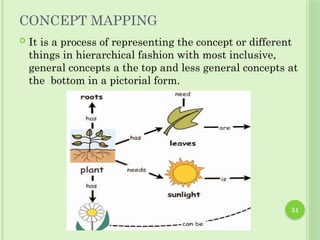
CONCEPT MAPPING
Itis a process of representing the concept or different
things in hierarchical fashion with most inclusive,
general concepts a the top and less general concepts at
the bottom in a pictorial form.
52.
52
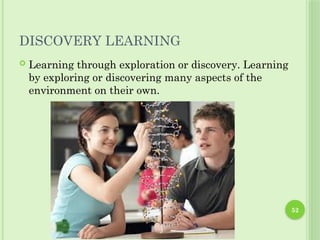
DISCOVERY LEARNING
Learningthrough exploration or discovery. Learning
by exploring or discovering many aspects of the
environment on their own.
53.
53
• The Word“Simulation” may be defined as
Role playing in which process teaching is
Enacted Artificially.
• Under this, the student Simulates a
particular role & tries to develop an
identity with the Actual Class
Environment.
“Simulation is an accurate Representation
of Realistic situation.”
- by R.Wynn (1964)
54.
54
SIMULATION IN EDUCATION
Theinternational Educational
Dictionary defines Simulation as
‘Teaching Technique used
particularly in Education & Training
in which Simulated Substitutes
displays similar in Characteristics
with REAL LIFE SITUATION’ .
55.
55
USE OF SIMULATIONTECHNIQUES
• It Introduces Particular Situation.
• It Provides Information &
Opportunity to Solve the problems to
Beginning Teachers.
• It gives the Opportunity of
Observation of the Results about
line of Action chosen by the Student
Teacher.
56.
Simulation can bea valuable tool in the science
classroom. They can represent scientific concepts
and situations thereby allowing students to
explore the nature of things .
Issue such as cost,saftey,scope,time and scale
can be overcome by the use of scientific
simulation.
Simulation based on scientific theory help to
provide a set of interrelated experiences that
challenge students in formal understanding of the
science.
56
57.
57
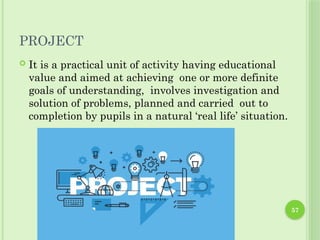
PROJECT
It isa practical unit of activity having educational
value and aimed at achieving one or more definite
goals of understanding, involves investigation and
solution of problems, planned and carried out to
completion by pupils in a natural ‘real life’ situation.
58.
58
NEEDS OF ACTIVITYBASED
LEARNING
Children can learn more when they learn in
their surrounding environment.
Activity based learning helps students learn and
retain information.
Its encourage students to get physically and
mentally involved in the learning process.
It used to learn on their own.
It used for actively participate and involve in
learning.
59.
59
HOW TO ORGANIZEOF ACTIVITY
BASED LEARNING
Decide Instructional Goals
Understand the learners cognitive level and
characteristics.
Consider the nature of the subject.
Know the time available for achieving the
instructional goals.
Availability of human and non human resources.
Select or design the suitable activities.
60.
60
CONTINUOUS…
Prepare forimplementing that in the class.
Provide for link between different activities and
previous knowledge.
Implement it in the classroom.
Follow it up and bring about required changes in
the activities for better use.
61.
61
USES OF ABL
Reinforces important material, concepts and
skills.
Provide more frequent and immediate feedback
to student.
Provides students with an opportunity to think
about, talk about and process course material.
Create personal connection to the material for
students, which increases their motivation to
learn.
62.
62
INTERACTIVE TEACHING
Thefirst thing to realize about interactive teaching is
that it is NOT something new or mysterious. If you are
a teacher and you ask questions in class, assign and
check homework, or hold class or group discussions,
then you already teach interactively.
Basically then interactive teaching is just giving
students something to do, getting back what they
have done, and then assimilating it yourself, so
that you can decide what would be best to do
next.
63.
63
THREE DISTINCT REASONSFOR
INTERACTIVE TEACHING
SUMMATIVE :For interactive teaching it is an attempt
to see what actually exists in the brains of your
students. This is the "summative" aspect. It is the easiest
aspect to understand and it is well described in the
literature. But, it is far from being the only perspective!
FORMATIVE : The second reason is "formative", where
the teacher aims through the assigned task to direct
students' mental processing along an appropriate
path in "concept-space". The intent is that, as students
think through the issues necessary in traversing the path,
the resulting mental construction that is developed in the
student's head will possess those properties that the
teacher is trying to teach. As Socrates discovered, a good
question can accomplish this result better than, just
telling the answer.
64.
64
THREE DISTINCT REASONSFOR
INTERACTIVE TEACHING
MOTIVATIONAL : The third may be termed "motivational".
Learning is hard work, and an injection of motivation at the
right moment can make all the difference. One motivating factor
provided by the interactive teacher is the requirement of a
response to a live classroom task. This serves to jolt the
student into action, to get his brain off the couch, so to
speak. Additional more subtle and pleasant events follow
immediately capitalizing on the momentum created by this
initial burst. One of these is a result of our human social
tendencies. When teachers ask students to work together in
small groups to solve a problem, a discussion ensues that not
only serves in itself to build more robust knowledge structures,
but also to motivate. The anticipation of immediate feedback in
the form of reaction from their peers, or from the teacher is a
very strong motivator..
70
Communicative Approach
Communicativelanguage teaching originated in the
late 60s
English Teaching methods reform of the mid-70s to be
further developed.
U.S. linguist D. Hymes proposed the theory of
communicative competence
It should not only have the language knowledge,
but also has the ability to use language, with
particular attention to linguistic appropriateness
Krashen language acquisition theory of language
learning stressed the use of free verbal
communication, rather than through training,
language skills.
71.
71
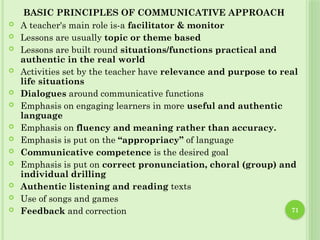
BASIC PRINCIPLES OFCOMMUNICATIVE APPROACH
A teacher's main role is-a facilitator & monitor
Lessons are usually topic or theme based
Lessons are built round situations/functions practical and
authentic in the real world
Activities set by the teacher have relevance and purpose to real
life situations
Dialogues around communicative functions
Emphasis on engaging learners in more useful and authentic
language
Emphasis on fluency and meaning rather than accuracy.
Emphasis is put on the “appropriacy” of language
Communicative competence is the desired goal
Emphasis is put on correct pronunciation, choral (group) and
individual drilling
Authentic listening and reading texts
Use of songs and games
Feedback and correction
74
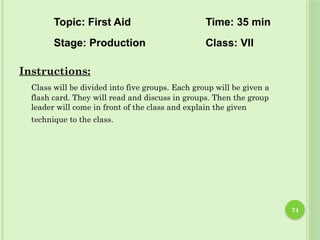
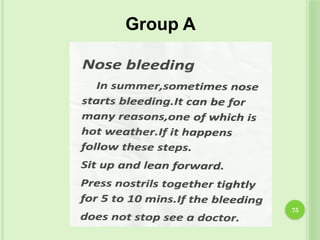
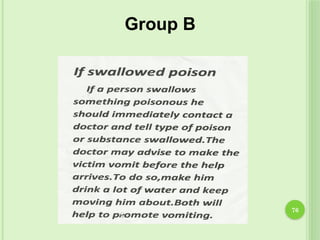
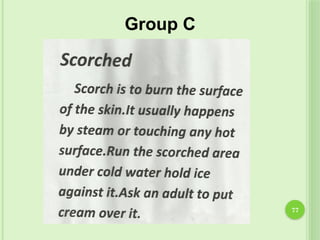
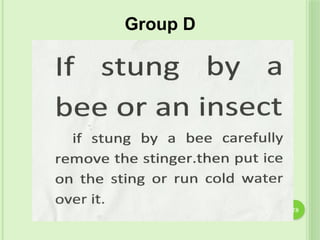
Instructions:
Class will bedivided into five groups. Each group will be given a
flash card. They will read and discuss in groups. Then the group
leader will come in front of the class and explain the given
technique to the class.
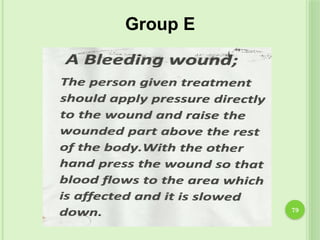
Topic: First Aid Time: 35 min
Stage: Production Class: VII
80
WHAT IS ALESSON PLAN ?
It is the framework for my lesson.
It is the map I follow during class.
It is a pain in the neck.
It is the product of my thoughts about the
class to give and what I hope to achieve.
81.
81
Why planning?
Planninghelps you to reduce uncertainty or panic and
gives you confidence and clarity.
It reminds you to prepare materials beforehand, and
makes it easier for you to organize the time and activities
flow in classes.
For students, evidence of a plan shows them the teacher has
devoted time to thinking about the class.
It is a way to help gain the respect of your students.
It suggests professionalism and commitment.
Planning ensures that the class you are teaching gets a
balanced mixture of different materials, content and
interaction types.
Planning helps you to develop a personal style.
82.
82
What to Consider?
Engage: get the students interested in the class and hopefully
enjoying what they are doing.
Study: It is a focus of language, such as grammar or
vocabulary and pronunciation. It does not have to be NEW
language input.
Activate: The students do writing and or speaking activities
which require them to use not only the language they are
studying that day, but also other language that they have learnt.
83.
83
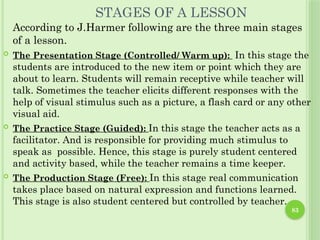
STAGES OF ALESSON
According to J.Harmer following are the three main stages
of a lesson.
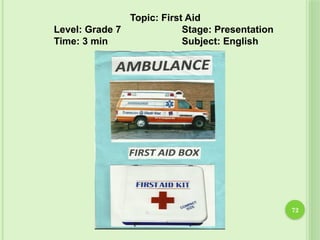
The Presentation Stage (Controlled/ Warm up): In this stage the
students are introduced to the new item or point which they are
about to learn. Students will remain receptive while teacher will
talk. Sometimes the teacher elicits different responses with the
help of visual stimulus such as a picture, a flash card or any other
visual aid.
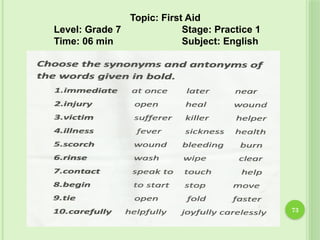
The Practice Stage (Guided): In this stage the teacher acts as a
facilitator. And is responsible for providing much stimulus to
speak as possible. Hence, this stage is purely student centered
and activity based, while the teacher remains a time keeper.
The Production Stage (Free): In this stage real communication
takes place based on natural expression and functions learned.
This stage is also student centered but controlled by teacher.
84.
84
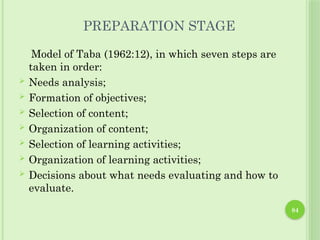
PREPARATION STAGE
Model ofTaba (1962:12), in which seven steps are
taken in order:
Needs analysis;
Formation of objectives;
Selection of content;
Organization of content;
Selection of learning activities;
Organization of learning activities;
Decisions about what needs evaluating and how to
evaluate.
85.
85
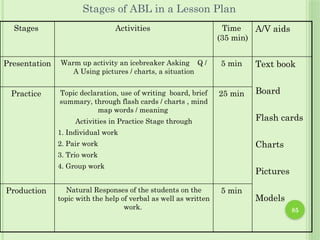
Stages of ABLin a Lesson Plan
Stages Activities Time
(35 min)
A/V aids
Presentation Warm up activity an icebreaker Asking Q /
A Using pictures / charts, a situation
5 min Text book
Board
Flash cards
Charts
Pictures
Models
Practice Topic declaration, use of writing board, brief
summary, through flash cards / charts , mind
map words / meaning
Activities in Practice Stage through
1. Individual work
2. Pair work
3. Trio work
4. Group work
25 min
Production Natural Responses of the students on the
topic with the help of verbal as well as written
work.
5 min
86.
86
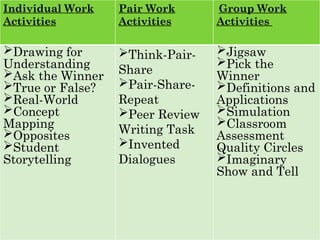
Individual Work
Activities
Pair Work
Activities
GroupWork
Activities
Drawing for
Understanding
Ask the Winner
True or False?
Real-World
Concept
Mapping
Opposites
Student
Storytelling
Think-Pair-
Share
Pair-Share-
Repeat
Peer Review
Writing Task
Invented
Dialogues
Jigsaw
Pick the
Winner
Definitions and
Applications
Simulation
Classroom
Assessment
Quality Circles
Imaginary
Show and Tell
87.
87
IMPEDIMENTS IN IMPLEMENTATIONOF ABL
Almost all the teachers are the product of traditional
lecture method.
By nature they don’t want to work extra.
They have fear of unknown.
They are free in whimsical approach i.e, time tested
lecture method and don’t want to change it into
Communicative Approach.
They have the fear of time constraints and believe
that syllabus cannot be covered with the help of any
new activity based trend.
They don’t have any resources in the shape of cash or
kind, while in their opinion new trends require
maximum resources in the shape of money.
88.
88
IMPEDIMENTS IN IMPLEMENTATIONOF ABL
They are afraid of challenging situations being faced
with the implementation of ABL.
They believe that they will lack control over the class
since lot of noise will be there in the class.
They have the fear of being caught by the authorities
concerned since the new trends are highly timed.
The math and science teachers consider this trend as
highly illogical.
The old teachers are deadly against these ever
changing trends.
The teachers have developed the sense of being
commanders while new trends make them facilitators.
Class rooms are not spacious.
89.
89
RECOMMENDATIONS
In servicetraining course be run to make ABL
viable.
The teachers so trained should train the other
teachers of the institution.
At trial basis ABL may be implemented from Nur to
class 5th
.
Academic heads should encourage the teachers to
take this task.
Reasonable amount to be given to the institutions to
meet the expenditure of resources (Budget for ABL).
Incentives in the shape of cash or kind be awarded to
the best teachers in the field of implementation of
ABL.
91
CONCLUSION
The various methodologiesserve one purpose i.e. to
facilitate the learner to evince a more satisfactory
response from a student/learner in a classroom. Though
in practice one finds out that even the best of us cannot
consistently and perfectly do all the things that are
defined in various methodologies, what suffice is a deep
interest and an unfailing commitment coupled with a
willingness to change that would lead to further
innovations and endeavors in the field of teaching. So far
we have tasted and tested very many methods, let us
taste and test this method also. We want something
better for ourselves, for our children, and we look to a
present and future source of improvement.