
REMOTE SENSING SENSORS
Anurag Ghosh
UID NO-2103542
P.R.M.S. Mahavidyalaya
Bankura University
Introduction of Remote
Sensing
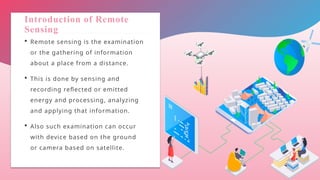
 Remote sensing is the examination
or the gathering of information
about a place from a distance.
 This is done by sensing and
recording reflected or emitted
energy and processing, analyzing
and applying that information.
 Also such examination can occur
with device based on the ground
or camera based on satellite.
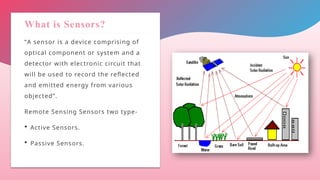
What is Sensors?
“A sensor is a device comprising of
optical component or system and a
detector with electronic circuit that
will be used to record the reflected
and emitted energy from various
objected”.
Remote Sensing Sensors two type-
 Active Sensors.
 Passive Sensors.
Active Sensors
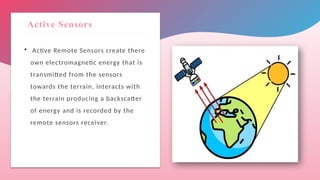
 Active Remote Sensors create there
own electromagnetic energy that is
transmitted from the sensors
towards the terrain, interacts with
the terrain producing a backscatter
of energy and is recorded by the
remote sensors receiver.
Active Sensors examples
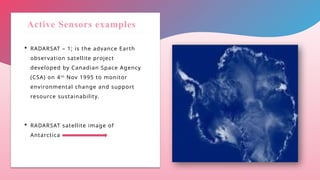
 RADARSAT – 1; is the advance Earth
observation satellite project
developed by Canadian Space Agency
(CSA) on 4t h
Nov 1995 to monitor
environmental change and support
resource sustainability.
 RADARSAT satellite image of
Antarctica
Passive Sensors
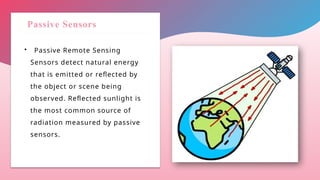
 Passive Remote Sensing
Sensors detect natural energy
that is emitted or reflected by
the object or scene being
observed. Reflected sunlight is
the most common source of
radiation measured by passive
sensors.
Passive Sensors examples
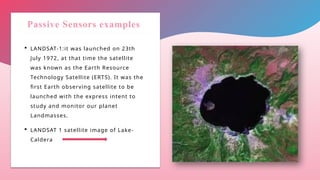
 LANDSAT-1:it was launched on 23th
July 1972, at that time the satellite
was known as the Earth Resource
Technology Satellite (ERTS). It was the
first Earth observing satellite to be
launched with the express intent to
study and monitor our planet
Landmasses.
 LANDSAT 1 satellite image of Lake-
Caldera
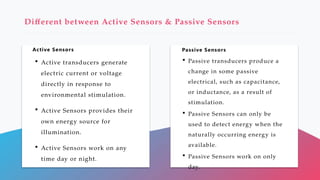
Active Sensors Passive Sensors
Different between Active Sensors & Passive Sensors
 Active transducers generate
electric current or voltage
directly in response to
environmental stimulation.
 Active Sensors provides their
own energy source for
illumination.
 Active Sensors work on any
time day or night.
 Passive transducers produce a
change in some passive
electrical, such as capacitance,
or inductance, as a result of
stimulation.
 Passive Sensors can only be
used to detect energy when the
naturally occurring energy is
available.
 Passive Sensors work on only
day.
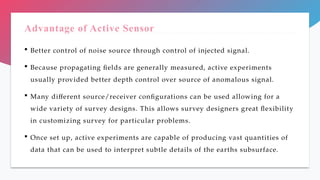
Advantage of Active Sensor
 Better control of noise source through control of injected signal.
 Because propagating fields are generally measured, active experiments
usually provided better depth control over source of anomalous signal.
 Many different source/receiver configurations can be used allowing for a
wide variety of survey designs. This allows survey designers great flexibility
in customizing survey for particular problems.
 Once set up, active experiments are capable of producing vast quantities of
data that can be used to interpret subtle details of the earths subsurface.
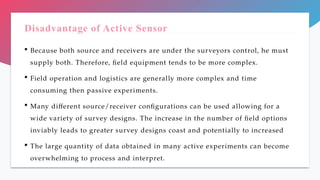
Disadvantage of Active Sensor
 Because both source and receivers are under the surveyors control, he must
supply both. Therefore, field equipment tends to be more complex.
 Field operation and logistics are generally more complex and time
consuming then passive experiments.
 Many different source/receiver configurations can be used allowing for a
wide variety of survey designs. The increase in the number of field options
inviably leads to greater survey designs coast and potentially to increased
 The large quantity of data obtained in many active experiments can become
overwhelming to process and interpret.
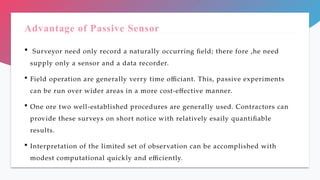
Advantage of Passive Sensor
 Surveyor need only record a naturally occurring field; there fore ,he need
supply only a sensor and a data recorder.
 Field operation are generally verry time officiant. This, passive experiments
can be run over wider areas in a more cost-effective manner.
 One ore two well-established procedures are generally used. Contractors can
provide these surveys on short notice with relatively esaily quantifiable
results.
 Interpretation of the limited set of observation can be accomplished with
modest computational quickly and efficiently.
Disadvantage of Passive Sensor
 Less control of noise because source of the signal is out of the control of the
surveyor.
 Because passive fields are generally the result of integrating anomalous geologic
contribution over wide areas, identification of the source of an anomalous
reading can be difficult.
 one or two well-established field procedures is generally used. This limits the
amount of customization that can be done for specific problems.
 The data sets collected in passive experiments are smaller then those collected in
active experiments and usually do not allow for as detailed an interpretation.
Application of Active Sensor
 Vegetation:-Radar signals interacts with the vegetation in a very complex ways
and penetration level of signal depends on it’s strength and water content of
the vegetation. Return radar signal may include of trunks, stems and leaves as
well ground surface. This type detail information about the vegetation can only
be captured using this type of sensor, SAR data are used all over the world
nowadays for vegetation studies.
 Water Bodies:- Fresh water is important for human civilization and maintaining
it is very important. Hydrologist seeks to understand the movement,
distribution and quality of water on Earth. Active remote sensing like airborne
or spaceborne can be used to measure the water in its various forms.
Application of Passive Sensor
 Landsat mission is the longest running mission till the date, earth is
observed with the help of it. Tons of information and documentation about
changing earth is collected thanks to LANDSAT mission. This mission has
been running since 40 years now. Knowing this, one can understand that
remote sensing must be throwing some benefits for entire globe. And
definitely, that is true. Following is a list of most common applications of
passive remote sensing technology.
 Agriculture, Disaster, Forest, Energy, Fire, Growth of urban areas, etc.
Conclusion
 Sensors is a device comprising of optical component or system and a
detector electronic circuitry used to record.
 It is a very important component in remote sensing.
 Active sensors are more advantageous then passive sensors.
Thank You!

Active Sensor & Passive Sensor in remote sensing

  • 1.
    REMOTE SENSING SENSORS AnuragGhosh UID NO-2103542 P.R.M.S. Mahavidyalaya Bankura University
  • 2.
    Introduction of Remote Sensing Remote sensing is the examination or the gathering of information about a place from a distance.  This is done by sensing and recording reflected or emitted energy and processing, analyzing and applying that information.  Also such examination can occur with device based on the ground or camera based on satellite.
  • 3.
    What is Sensors? “Asensor is a device comprising of optical component or system and a detector with electronic circuit that will be used to record the reflected and emitted energy from various objected”. Remote Sensing Sensors two type-  Active Sensors.  Passive Sensors.
  • 4.
    Active Sensors  ActiveRemote Sensors create there own electromagnetic energy that is transmitted from the sensors towards the terrain, interacts with the terrain producing a backscatter of energy and is recorded by the remote sensors receiver.
  • 5.
    Active Sensors examples RADARSAT – 1; is the advance Earth observation satellite project developed by Canadian Space Agency (CSA) on 4t h Nov 1995 to monitor environmental change and support resource sustainability.  RADARSAT satellite image of Antarctica
  • 6.
    Passive Sensors  PassiveRemote Sensing Sensors detect natural energy that is emitted or reflected by the object or scene being observed. Reflected sunlight is the most common source of radiation measured by passive sensors.
  • 7.
    Passive Sensors examples LANDSAT-1:it was launched on 23th July 1972, at that time the satellite was known as the Earth Resource Technology Satellite (ERTS). It was the first Earth observing satellite to be launched with the express intent to study and monitor our planet Landmasses.  LANDSAT 1 satellite image of Lake- Caldera
  • 8.
    Active Sensors PassiveSensors Different between Active Sensors & Passive Sensors  Active transducers generate electric current or voltage directly in response to environmental stimulation.  Active Sensors provides their own energy source for illumination.  Active Sensors work on any time day or night.  Passive transducers produce a change in some passive electrical, such as capacitance, or inductance, as a result of stimulation.  Passive Sensors can only be used to detect energy when the naturally occurring energy is available.  Passive Sensors work on only day.
  • 9.
    Advantage of ActiveSensor  Better control of noise source through control of injected signal.  Because propagating fields are generally measured, active experiments usually provided better depth control over source of anomalous signal.  Many different source/receiver configurations can be used allowing for a wide variety of survey designs. This allows survey designers great flexibility in customizing survey for particular problems.  Once set up, active experiments are capable of producing vast quantities of data that can be used to interpret subtle details of the earths subsurface.
  • 10.
    Disadvantage of ActiveSensor  Because both source and receivers are under the surveyors control, he must supply both. Therefore, field equipment tends to be more complex.  Field operation and logistics are generally more complex and time consuming then passive experiments.  Many different source/receiver configurations can be used allowing for a wide variety of survey designs. The increase in the number of field options inviably leads to greater survey designs coast and potentially to increased  The large quantity of data obtained in many active experiments can become overwhelming to process and interpret.
  • 11.
    Advantage of PassiveSensor  Surveyor need only record a naturally occurring field; there fore ,he need supply only a sensor and a data recorder.  Field operation are generally verry time officiant. This, passive experiments can be run over wider areas in a more cost-effective manner.  One ore two well-established procedures are generally used. Contractors can provide these surveys on short notice with relatively esaily quantifiable results.  Interpretation of the limited set of observation can be accomplished with modest computational quickly and efficiently.
  • 12.
    Disadvantage of PassiveSensor  Less control of noise because source of the signal is out of the control of the surveyor.  Because passive fields are generally the result of integrating anomalous geologic contribution over wide areas, identification of the source of an anomalous reading can be difficult.  one or two well-established field procedures is generally used. This limits the amount of customization that can be done for specific problems.  The data sets collected in passive experiments are smaller then those collected in active experiments and usually do not allow for as detailed an interpretation.
  • 13.
    Application of ActiveSensor  Vegetation:-Radar signals interacts with the vegetation in a very complex ways and penetration level of signal depends on it’s strength and water content of the vegetation. Return radar signal may include of trunks, stems and leaves as well ground surface. This type detail information about the vegetation can only be captured using this type of sensor, SAR data are used all over the world nowadays for vegetation studies.  Water Bodies:- Fresh water is important for human civilization and maintaining it is very important. Hydrologist seeks to understand the movement, distribution and quality of water on Earth. Active remote sensing like airborne or spaceborne can be used to measure the water in its various forms.
  • 14.
    Application of PassiveSensor  Landsat mission is the longest running mission till the date, earth is observed with the help of it. Tons of information and documentation about changing earth is collected thanks to LANDSAT mission. This mission has been running since 40 years now. Knowing this, one can understand that remote sensing must be throwing some benefits for entire globe. And definitely, that is true. Following is a list of most common applications of passive remote sensing technology.  Agriculture, Disaster, Forest, Energy, Fire, Growth of urban areas, etc.
  • 15.
    Conclusion  Sensors isa device comprising of optical component or system and a detector electronic circuitry used to record.  It is a very important component in remote sensing.  Active sensors are more advantageous then passive sensors.
  • 16.