1
-Submitted By…… BULBUL ALI SARKAR (Student Unit)
UID: 21143031035
M.SC. in GEO-INFORMATICS (SEM-II)
PANDIT RAGHUNATH MURMU SMRITI MAHAVIDYALAYA
BANKURA UNIVERSITY
Date-18/07/2022
ROL of UAV in DIGITAL PHOTOGRAMMETRY
2  Introduction to Photogrammetry
 Basics & concept of photogrammetry
 Characteristics of Digital Data , Data Acquisition
 Computer Generations and Photogrammetric Discipline
 Hardware for Digital Photogrammetry
 Software Requirements for DP
 UNNAMED AERIAL VEHICLE (UAV)
 Types of Drones and Their Uses & Some INDIAN UAV
 USE OF UAV
 What you should know about the types of drone data ?
Contents
3
Introduction to Photogrammetry
Photogrammetry is a simple technique that uses photographs for surveying and
mapmaking. That helps to get information about the physical objects and
environment through the process of recording, interpreting, and measuring the
photographic images.
In 1851, a French inventor namely Aimé Laussedat had a theoretical idea of the
camera that could help in mapping.
After 50 years later, photogrammetry was invented and appeared simultaneously
with the appearance of photography A french surveyor namely Dominique F.
Arago proposed the use of photographs to create a topographic map.
4 Basics of Photogrammetry
The word photogrammetry, There 'Photo' means light, 'gram' means drawing and 'metry' means
measurement. Photogrammetry could be described as the 3-dimensional coordinate measuring
technique that uses the photographs as the fundamental object for measurements. Photogrammetry
generally revolves around the idea of gathering information from the photos which are collections of
the object.
The fundamental concept of photogrammetry
Photogrammetry is a triangulation method in which multiple photos are taken (At least two) to
create a line of sight that will point on the object. The photos are taken from different angles and
locations which helps in making accurate calculations that will help gather the data a person is
looking for. The line of sight that was created because of the data that was collected can now be
mathematically inserted to produce the 3-dimensional coordinates of the points of interest.
Photogrammetry helps in creating 3 d models and maps of the real world. During World War II, the
use of photogrammetry increased. During World War II, special aircraft were built that were designed
to carry powerful cameras which were designed for aerial photography and better camera
positioning. Photogrammetry during that time was extensively used to monitor the enemy countries
territory. During the Apollo mission, photogrammetry also helped in mapping the surface of the
moon.Types of Photogrammetry can be classified into two types based on the splitting the field on
which the camera is located during photography. On the basis of this approach, we have Aerial
photogrammetry and Close range or terrestrial photogrammetry.
5
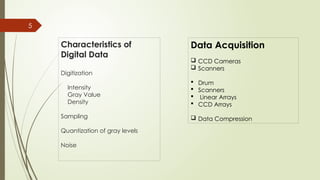
Characteristics of
Digital Data
Digitization
Intensity
Gray Value
Density
Sampling
Quantization of gray levels
Noise
Data Acquisition
 CCD Cameras
 Scanners
 Drum
 Scanners
 Linear Arrays
 CCD Arrays
 Data Compression
6
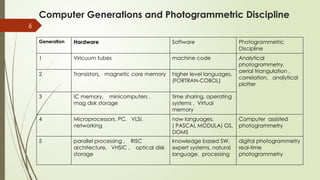
Computer Generations and Photogrammetric Discipline
Generation Hardware Software Photogrammetric
Discipline
1 Viricuum tubes machine code Analytical
photogrammetry,
aerial triangulation ,
correlation, analytical
plotter
2 Transistors, magnetic core memory higher level languages,
(FORTRAN-COBOL)
3 IC memory, minicomputers ,
mag disk storage
time sharing, operating
systems , Virtual
memory
4 Microprocessors, PC, VLSI,
networking
now languages,
( PASCAL MODULA) GS,
DOMS
Computer assisted
photogrammetry
5 parallel processing , RISC
architecture, VHSIC , optical disk
storage
knowledge based SW,
expert systems, natural
language, processing
digital photogrammetry
real-time
photogrammetry
7
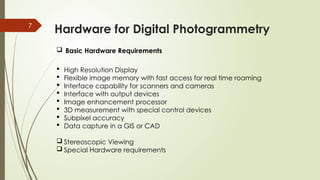
Hardware for Digital Photogrammetry
 Basic Hardware Requirements
 High Resolution Display
 Flexible image memory with fast access for real time roaming
 Interface capability for scanners and cameras
 Interface with output devices
 Image enhancement processor
 3D measurement with special control devices
 Subpixel accuracy
 Data capture in a GIS or CAD
 Stereoscopic Viewing
 Special Hardware requirements
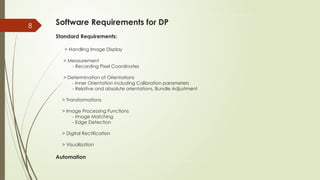
8 Software Requirements for DP
Standard Requirements:
> Handling Image Display
> Measurement
- Recording Pixel Coordinates
> Determination of Orientations
- Inner Orientation including Calibration parameters
- Relative and absolute orientations, Bundle Adjustment
> Transformations
> Image Processing Functions
- Image Matching
- Edge Detection
> Digital Rectification
> Visualization
Automation
9 UNNAMED AERIAL VEHICLE (UAV)
An unmanned aerial vehicle, commonly known as a drone, is an aircraft
without any human pilot, crew, or passengers on board. UAVs are a
component of an unmanned aircraft system, which includes adding a ground-
based controller and a system of communications with the UAV.
ADVANTAGES DISADVANTAGES
Cheap and cost effective
High spatial resolution
High accuracy
Easier to deploy
No hindrances from clouds
A great tool for surveillance
Limited capabilities and coverages
Care required to use in populated areas
Chances of misuse due to easy operation
10
Types of Drones and
Their Uses
Multirotor Flying:
height Up to: 500 m
Flying time: 20-30 mins.
Coverage: 0.4-0.8 km² per flight
Range: 5 km
Fixed-wing:
Flying height : Up to 1,000 m
Flying time: 50-60 mins.
Coverage: 10-40 km² per flight.
Wingspan: 1-2 m
Range: 30-60 km.
Some INDIAN UAV
•DRDO Abhyas.
•DRDO Ghatak (Stealth UCAV under
development)
•DRDO Archer.
•India-U.S Joint ALUAV target drone.
•RUAV 200.
•ADE Nishant.
•Adani Hermes 900 : Adani Groups
manufactures Israeli Hermes 900 drones.
•Trinetra UAV.
11
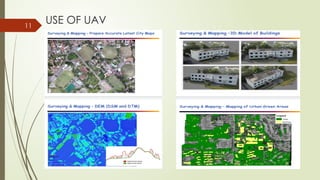
USE OF UAV
12
13
What you should know about the types of drone data ?
Information received via sensors
We generally use many types of sensors in our daily lives. Today, companies have started
installing sensors in UAV technology to diversify drone applications. A drone can have many types of
sensors to collect information, such as changes in speed, distance, temperature, wind, chemical signals,
light, sound, and can even identify the presence of magnetic objects.
Images
Aerial photography is one of the interesting drone applications that has been helpful for many
organisations and industries. A farmer can use drones with thermal, infrared, or HD imaging capabilities
to capture clear images of his crops. Similarly, filmmakers can use drones to shoot stunning images for
filmography. Public institutions find it useful for planning a city’s infrastructure. Drones with cameras are
also proving to be very helpful to study the behaviour of wildlife and marine animals.
Voice and video communications
Voice and video communications are the next points of focus to power up many activities in the
operations sector. For first responders, emergency services, and search and rescue missions,
uninterrupted communications are important. However, low coverage or damaged network
infrastructure impacts efficiency and slows down response time. Drones that use automated voice
technology for the transfer of information and routine communication play a crucial role in the success
and safety of missions.
14
Location and navigation
Drones equipped with GPS trackers and radar are used for navigation and
location-sensing during mapping, surveillance, geospatial exploration, etc. With this
significant drone application, unmanned aerial vehicles can be tracked to reduce the
chances of losing them due to unforeseen circumstances. Whether remotely operated or
autonomous, UAVs with GPS systems play an important role in collecting and sharing
precise information.
Conclusion
Drones are not bound by physical limits and continue to undergo many changes
and advancements. In hard-to-reach areas and places where some one cannot be present
physically, drone technology has stepped up to share real-time insights like never before
and has completely transformed the way decisions are made today.
In the recent past, information storage, analysis, and optimisation have been made easier
with edge and cloud computing. With the data received from drones, there are many new
platforms and systems that help businesses reap benefits for their operations and goals
in everyday life.
15 References
■T. Schenk," Digital Photogrammetry", Terra Science,
1999
■M. Kasser and W. Egels, " DigitalPhotogrammetry",
Taylor and Francis, 2002 .
■ H. Ebadi," Advanced Analytical AerialTriangulation",
Lecture Note, K.N.Toosi University of Technology, 1999.
■ T.C.Tang, "Digital Image Correlation", UCSEm Report,
1988
16
THANK YOU
FOR
YOUR KIND ATTENTION

Digital Photogrammetry, UAV, Lidar, Drone Image processing.

  • 1.
    1 -Submitted By…… BULBULALI SARKAR (Student Unit) UID: 21143031035 M.SC. in GEO-INFORMATICS (SEM-II) PANDIT RAGHUNATH MURMU SMRITI MAHAVIDYALAYA BANKURA UNIVERSITY Date-18/07/2022 ROL of UAV in DIGITAL PHOTOGRAMMETRY
  • 2.
    2  Introductionto Photogrammetry  Basics & concept of photogrammetry  Characteristics of Digital Data , Data Acquisition  Computer Generations and Photogrammetric Discipline  Hardware for Digital Photogrammetry  Software Requirements for DP  UNNAMED AERIAL VEHICLE (UAV)  Types of Drones and Their Uses & Some INDIAN UAV  USE OF UAV  What you should know about the types of drone data ? Contents
  • 3.
    3 Introduction to Photogrammetry Photogrammetryis a simple technique that uses photographs for surveying and mapmaking. That helps to get information about the physical objects and environment through the process of recording, interpreting, and measuring the photographic images. In 1851, a French inventor namely Aimé Laussedat had a theoretical idea of the camera that could help in mapping. After 50 years later, photogrammetry was invented and appeared simultaneously with the appearance of photography A french surveyor namely Dominique F. Arago proposed the use of photographs to create a topographic map.
  • 4.
    4 Basics ofPhotogrammetry The word photogrammetry, There 'Photo' means light, 'gram' means drawing and 'metry' means measurement. Photogrammetry could be described as the 3-dimensional coordinate measuring technique that uses the photographs as the fundamental object for measurements. Photogrammetry generally revolves around the idea of gathering information from the photos which are collections of the object. The fundamental concept of photogrammetry Photogrammetry is a triangulation method in which multiple photos are taken (At least two) to create a line of sight that will point on the object. The photos are taken from different angles and locations which helps in making accurate calculations that will help gather the data a person is looking for. The line of sight that was created because of the data that was collected can now be mathematically inserted to produce the 3-dimensional coordinates of the points of interest. Photogrammetry helps in creating 3 d models and maps of the real world. During World War II, the use of photogrammetry increased. During World War II, special aircraft were built that were designed to carry powerful cameras which were designed for aerial photography and better camera positioning. Photogrammetry during that time was extensively used to monitor the enemy countries territory. During the Apollo mission, photogrammetry also helped in mapping the surface of the moon.Types of Photogrammetry can be classified into two types based on the splitting the field on which the camera is located during photography. On the basis of this approach, we have Aerial photogrammetry and Close range or terrestrial photogrammetry.
  • 5.
    5 Characteristics of Digital Data Digitization Intensity GrayValue Density Sampling Quantization of gray levels Noise Data Acquisition  CCD Cameras  Scanners  Drum  Scanners  Linear Arrays  CCD Arrays  Data Compression
  • 6.
    6 Computer Generations andPhotogrammetric Discipline Generation Hardware Software Photogrammetric Discipline 1 Viricuum tubes machine code Analytical photogrammetry, aerial triangulation , correlation, analytical plotter 2 Transistors, magnetic core memory higher level languages, (FORTRAN-COBOL) 3 IC memory, minicomputers , mag disk storage time sharing, operating systems , Virtual memory 4 Microprocessors, PC, VLSI, networking now languages, ( PASCAL MODULA) GS, DOMS Computer assisted photogrammetry 5 parallel processing , RISC architecture, VHSIC , optical disk storage knowledge based SW, expert systems, natural language, processing digital photogrammetry real-time photogrammetry
  • 7.
    7 Hardware for DigitalPhotogrammetry  Basic Hardware Requirements  High Resolution Display  Flexible image memory with fast access for real time roaming  Interface capability for scanners and cameras  Interface with output devices  Image enhancement processor  3D measurement with special control devices  Subpixel accuracy  Data capture in a GIS or CAD  Stereoscopic Viewing  Special Hardware requirements
  • 8.
    8 Software Requirementsfor DP Standard Requirements: > Handling Image Display > Measurement - Recording Pixel Coordinates > Determination of Orientations - Inner Orientation including Calibration parameters - Relative and absolute orientations, Bundle Adjustment > Transformations > Image Processing Functions - Image Matching - Edge Detection > Digital Rectification > Visualization Automation
  • 9.
    9 UNNAMED AERIALVEHICLE (UAV) An unmanned aerial vehicle, commonly known as a drone, is an aircraft without any human pilot, crew, or passengers on board. UAVs are a component of an unmanned aircraft system, which includes adding a ground- based controller and a system of communications with the UAV. ADVANTAGES DISADVANTAGES Cheap and cost effective High spatial resolution High accuracy Easier to deploy No hindrances from clouds A great tool for surveillance Limited capabilities and coverages Care required to use in populated areas Chances of misuse due to easy operation
  • 10.
    10 Types of Dronesand Their Uses Multirotor Flying: height Up to: 500 m Flying time: 20-30 mins. Coverage: 0.4-0.8 km² per flight Range: 5 km Fixed-wing: Flying height : Up to 1,000 m Flying time: 50-60 mins. Coverage: 10-40 km² per flight. Wingspan: 1-2 m Range: 30-60 km. Some INDIAN UAV •DRDO Abhyas. •DRDO Ghatak (Stealth UCAV under development) •DRDO Archer. •India-U.S Joint ALUAV target drone. •RUAV 200. •ADE Nishant. •Adani Hermes 900 : Adani Groups manufactures Israeli Hermes 900 drones. •Trinetra UAV.
  • 11.
  • 12.
  • 13.
    13 What you shouldknow about the types of drone data ? Information received via sensors We generally use many types of sensors in our daily lives. Today, companies have started installing sensors in UAV technology to diversify drone applications. A drone can have many types of sensors to collect information, such as changes in speed, distance, temperature, wind, chemical signals, light, sound, and can even identify the presence of magnetic objects. Images Aerial photography is one of the interesting drone applications that has been helpful for many organisations and industries. A farmer can use drones with thermal, infrared, or HD imaging capabilities to capture clear images of his crops. Similarly, filmmakers can use drones to shoot stunning images for filmography. Public institutions find it useful for planning a city’s infrastructure. Drones with cameras are also proving to be very helpful to study the behaviour of wildlife and marine animals. Voice and video communications Voice and video communications are the next points of focus to power up many activities in the operations sector. For first responders, emergency services, and search and rescue missions, uninterrupted communications are important. However, low coverage or damaged network infrastructure impacts efficiency and slows down response time. Drones that use automated voice technology for the transfer of information and routine communication play a crucial role in the success and safety of missions.
  • 14.
    14 Location and navigation Dronesequipped with GPS trackers and radar are used for navigation and location-sensing during mapping, surveillance, geospatial exploration, etc. With this significant drone application, unmanned aerial vehicles can be tracked to reduce the chances of losing them due to unforeseen circumstances. Whether remotely operated or autonomous, UAVs with GPS systems play an important role in collecting and sharing precise information. Conclusion Drones are not bound by physical limits and continue to undergo many changes and advancements. In hard-to-reach areas and places where some one cannot be present physically, drone technology has stepped up to share real-time insights like never before and has completely transformed the way decisions are made today. In the recent past, information storage, analysis, and optimisation have been made easier with edge and cloud computing. With the data received from drones, there are many new platforms and systems that help businesses reap benefits for their operations and goals in everyday life.
  • 15.
    15 References ■T. Schenk,"Digital Photogrammetry", Terra Science, 1999 ■M. Kasser and W. Egels, " DigitalPhotogrammetry", Taylor and Francis, 2002 . ■ H. Ebadi," Advanced Analytical AerialTriangulation", Lecture Note, K.N.Toosi University of Technology, 1999. ■ T.C.Tang, "Digital Image Correlation", UCSEm Report, 1988
  • 16.