ACT
Safety, Health, Security,
Environment Induction
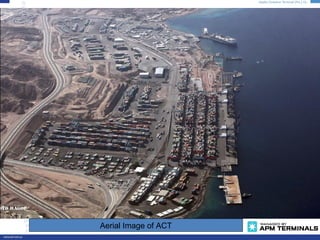
Aerial Image of ACT
Contents
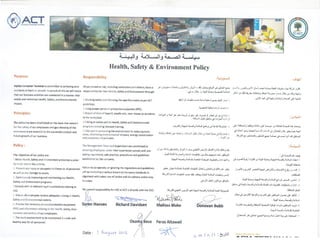
• HSE Policy
• Terminal Layout
• Hazards in the Terminal
• Basic elements for employees/subcontractors
safety
• Safety issues
• Environment
• Security
Objectives
 To provide a holistic overview for the terminal and its safety
rules and regulations which is assisting in preventing accidents.
In addition, it will provide the attendee with our procedures with
Subcontractors.
 Simple overview about Security, Environment and
occupational health.
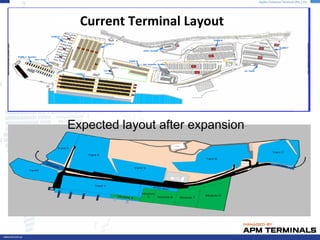
Current Terminal Layout
Expected layout after expansion
Hazards in the Terminal
All employees/contractors should be familiar with the existing
hazards in the terminal and they should communicate these hazards
to help others to be aware about it and avoiding it respectively.
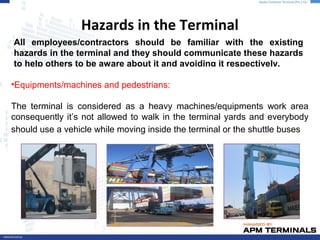
•Equipments/machines and pedestrians:
The terminal is considered as a heavy machines/equipments work area
consequently it’s not allowed to walk in the terminal yards and everybody
should use a vehicle while moving inside the terminal or the shuttle buses
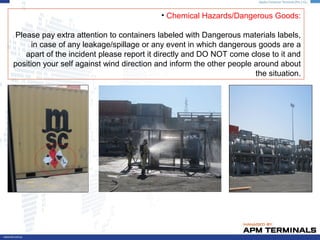
• Chemical Hazards/Dangerous Goods:
Please pay extra attention to containers labeled with Dangerous materials labels,
in case of any leakage/spillage or any event in which dangerous goods are a
apart of the incident please report it directly and DO NOT come close to it and
position your self against wind direction and inform the other people around about
the situation.
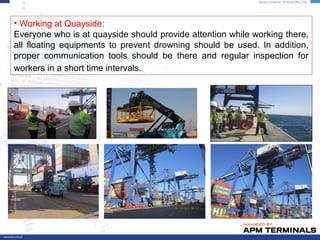
• Working at Quayside:
Everyone who is at quayside should provide attention while working there,
all floating equipments to prevent drowning should be used. In addition,
proper communication tools should be there and regular inspection for
workers in a short time intervals.
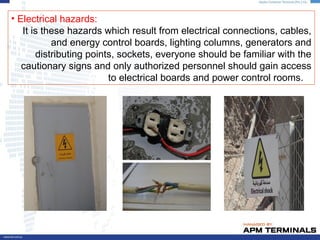
• Electrical hazards:
It is these hazards which result from electrical connections, cables,
and energy control boards, lighting columns, generators and
distributing points, sockets, everyone should be familiar with the
cautionary signs and only authorized personnel should gain access
to electrical boards and power control rooms.
Risky locations in the Terminal
All locations and spot are considered risky and all protective measures
should be taken firstly. But, there are some locations are considered
very high in risk. Like:
• Quayside:
The presence of vessels and the continuous work in this location make it one of the most
dangerous places in the terminal. Many loading and unloading activities are carried out
permanently and there are hazards of falling objects from heights. In addition, the
equipments movement at the berth and working next to water with it drowning hazard.
• Yard (3)/inspection yard:
at this yard some of inspection activities are carried out and there are many labors
working to take the contents of the containers out and occasionally equipments are
used. The hazard of falling object is there and falling objects and some of the contents
are hazardous due to its components; paints and chemical materials which are
flammable materials.
• Yard (7):
This yard contains very risky materials in its containers like Bromine, air planes fuel. All
safety instructions should be followed carefully at this yard.
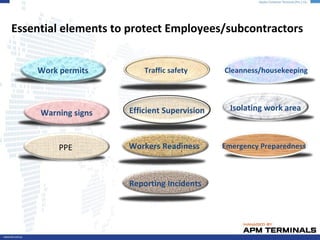
Essential elements to protect Employees/subcontractors
PPE
Warning signs
Workers Readiness Emergency Preparedness
Isolating work areaEfficient Supervision
Cleanness/housekeepingTraffic safetyWork permits
Reporting Incidents
Cleanness and work place housekeeping
Cleanness and Housekeeping at the workplace are
basics in regard to safety. So, everyone should insure
that his/her workplace is organized and all tools and
equipments should be organized properly and removed
directly after performing the job to avoid any risk
imposed by these conditions.
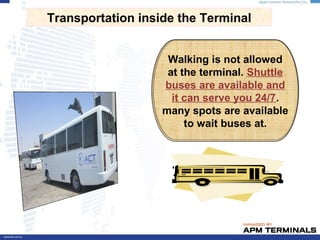
Walking is not allowed
at the terminal. Shuttle
buses are available and
it can serve you 24/7.
many spots are available
to wait buses at.
Transportation inside the Terminal
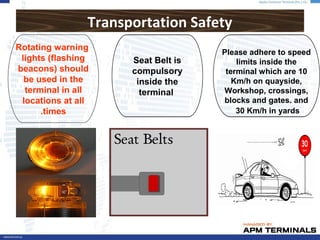
Transportation Safety
Please adhere to speed
limits inside the
terminal which are 10
Km/h on quayside,
Workshop, crossings,
blocks and gates. and
30 Km/h in yards
Seat Belt is
compulsory
inside the
terminal
Rotating warning
lights (flashing
beacons) should
be used in the
terminal in all
locations at all
times.
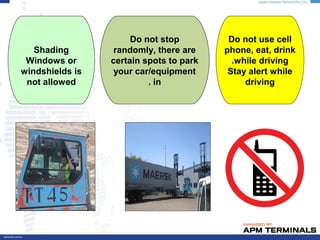
Do not use cell
phone, eat, drink
while driving.
Stay alert while
driving
Do not stop
randomly, there are
certain spots to park
your car/equipment
in.
Shading
Windows or
windshields is
not allowed
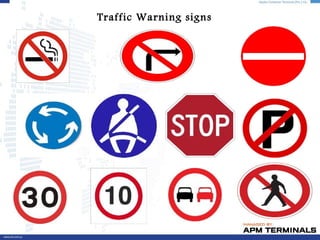
Traffic Warning signs
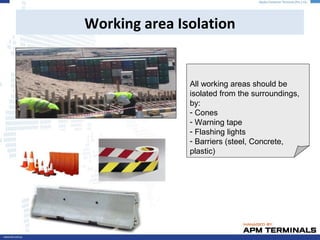
Working area Isolation
All working areas should be
isolated from the surroundings,
by:
- Cones
- Warning tape
- Flashing lights
- Barriers (steel, Concrete,
plastic)
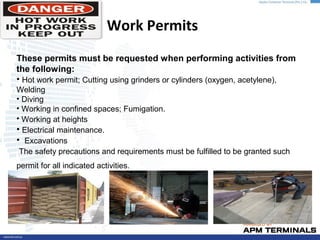
Work Permits
These permits must be requested when performing activities from
the following:
• Hot work permit; Cutting using grinders or cylinders (oxygen, acetylene),
Welding
• Diving
• Working in confined spaces; Fumigation.
• Working at heights
• Electrical maintenance.
• Excavations
The safety precautions and requirements must be fulfilled to be granted such
permit for all indicated activities.
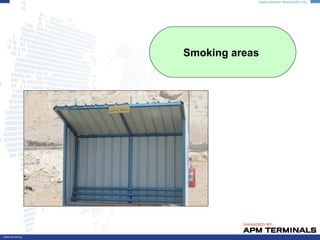
Smoking areas
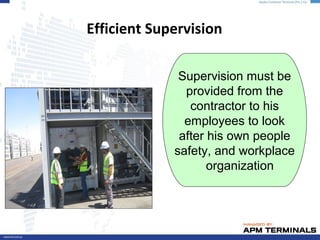
Efficient Supervision
Supervision must be
provided from the
contractor to his
employees to look
after his own people
safety, and workplace
organization
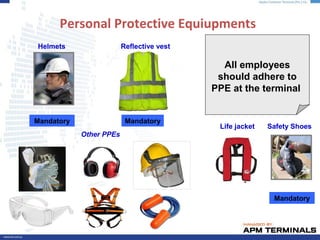
Personal Protective Equiupments
All employees
should adhere to
PPE at the terminal
Helmets
Safety Shoes
Reflective vest
Other PPEs
Life jacket
MandatoryMandatory
Mandatory
HSSE relevant Matters which are
Important to all of us here at ACT
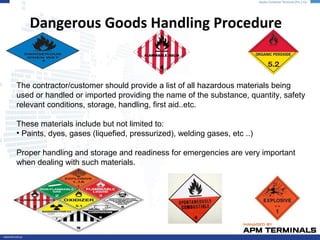
Dangerous Goods Handling Procedure
The contractor/customer should provide a list of all hazardous materials being
used or handled or imported providing the name of the substance, quantity, safety
relevant conditions, storage, handling, first aid..etc.
These materials include but not limited to:
• Paints, dyes, gases (liquefied, pressurized), welding gases, etc ..)
Proper handling and storage and readiness for emergencies are very important
when dealing with such materials.
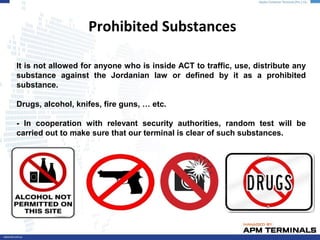
Prohibited Substances
It is not allowed for anyone who is inside ACT to traffic, use, distribute any
substance against the Jordanian law or defined by it as a prohibited
substance.
Drugs, alcohol, knifes, fire guns, … etc.
- In cooperation with relevant security authorities, random test will be
carried out to make sure that our terminal is clear of such substances.
Contractors/Customers
The contractor/customer should provide the following if
requested:
• Valid work permits from relevant authorities from ACT or outside
ACT.
• Valid Work permits from HSSE according to the intended work to
be performed.
• Valid health certificates from relevant authorities in Jordan.
• It worth mentioning that employees’ readiness physically and
mentally are very important aspects and it is considered of the most
important terms according to Jordanian law.
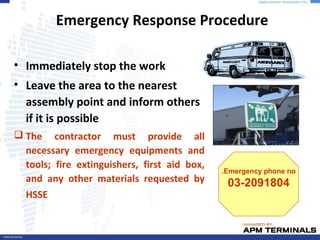
• Immediately stop the work
• Leave the area to the nearest
assembly point and inform others
if it is possible
 The contractor must provide all
necessary emergency equipments and
tools; fire extinguishers, first aid box,
and any other materials requested by
HSSE
Emergency Response Procedure
Emergency phone no.
03-2091804
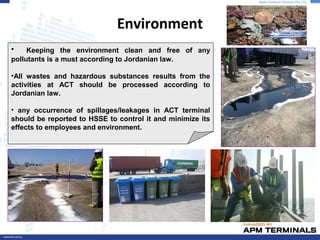
Environment
• Keeping the environment clean and free of any
pollutants is a must according to Jordanian law.
•All wastes and hazardous substances results from the
activities at ACT should be processed according to
Jordanian law.
• any occurrence of spillages/leakages in ACT terminal
should be reported to HSSE to control it and minimize its
effects to employees and environment.
Accidents Reporting
It’s very important to report any unsafe condition, accident,
violation, near-miss or unsafe behaviour to HSSE personnel on
duty for the following reasons:
Define root causes and providing corrective actions
Control & Reduce risks
Avoid recurrence of such incident in the future
Emergency
Ph. number
032091804
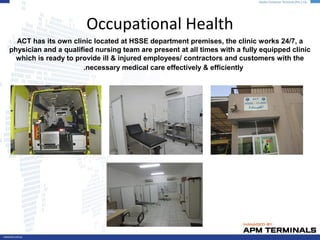
Occupational Health
ACT has its own clinic located at HSSE department premises, the clinic works 24/7, a
physician and a qualified nursing team are present at all times with a fully equipped clinic
which is ready to provide ill & injured employees/ contractors and customers with the
necessary medical care effectively & efficiently.
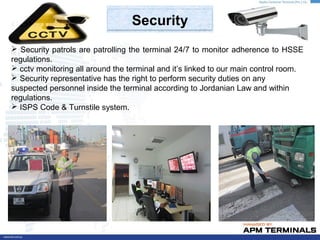
Security
 Security patrols are patrolling the terminal 24/7 to monitor adherence to HSSE
regulations.
 cctv monitoring all around the terminal and it’s linked to our main control room.
 Security representative has the right to perform security duties on any
suspected personnel inside the terminal according to Jordanian Law and within
regulations.
 ISPS Code & Turnstile system.
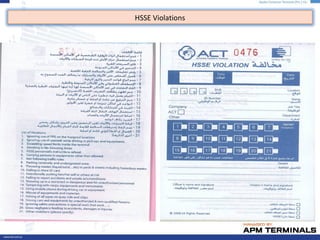
HSSE Violations
Thanks for attending & listening
Wishing you a safe and secure time here
at ACT

ACT Environment Induction

  • 1.
  • 2.
  • 3.
    Contents • HSE Policy •Terminal Layout • Hazards in the Terminal • Basic elements for employees/subcontractors safety • Safety issues • Environment • Security
  • 4.
    Objectives  To providea holistic overview for the terminal and its safety rules and regulations which is assisting in preventing accidents. In addition, it will provide the attendee with our procedures with Subcontractors.  Simple overview about Security, Environment and occupational health.
  • 6.
    Current Terminal Layout Expectedlayout after expansion
  • 7.
    Hazards in theTerminal All employees/contractors should be familiar with the existing hazards in the terminal and they should communicate these hazards to help others to be aware about it and avoiding it respectively. •Equipments/machines and pedestrians: The terminal is considered as a heavy machines/equipments work area consequently it’s not allowed to walk in the terminal yards and everybody should use a vehicle while moving inside the terminal or the shuttle buses
  • 8.
    • Chemical Hazards/DangerousGoods: Please pay extra attention to containers labeled with Dangerous materials labels, in case of any leakage/spillage or any event in which dangerous goods are a apart of the incident please report it directly and DO NOT come close to it and position your self against wind direction and inform the other people around about the situation.
  • 9.
    • Working atQuayside: Everyone who is at quayside should provide attention while working there, all floating equipments to prevent drowning should be used. In addition, proper communication tools should be there and regular inspection for workers in a short time intervals.
  • 10.
    • Electrical hazards: Itis these hazards which result from electrical connections, cables, and energy control boards, lighting columns, generators and distributing points, sockets, everyone should be familiar with the cautionary signs and only authorized personnel should gain access to electrical boards and power control rooms.
  • 11.
    Risky locations inthe Terminal All locations and spot are considered risky and all protective measures should be taken firstly. But, there are some locations are considered very high in risk. Like: • Quayside: The presence of vessels and the continuous work in this location make it one of the most dangerous places in the terminal. Many loading and unloading activities are carried out permanently and there are hazards of falling objects from heights. In addition, the equipments movement at the berth and working next to water with it drowning hazard. • Yard (3)/inspection yard: at this yard some of inspection activities are carried out and there are many labors working to take the contents of the containers out and occasionally equipments are used. The hazard of falling object is there and falling objects and some of the contents are hazardous due to its components; paints and chemical materials which are flammable materials. • Yard (7): This yard contains very risky materials in its containers like Bromine, air planes fuel. All safety instructions should be followed carefully at this yard.
  • 12.
    Essential elements toprotect Employees/subcontractors PPE Warning signs Workers Readiness Emergency Preparedness Isolating work areaEfficient Supervision Cleanness/housekeepingTraffic safetyWork permits Reporting Incidents
  • 13.
    Cleanness and workplace housekeeping Cleanness and Housekeeping at the workplace are basics in regard to safety. So, everyone should insure that his/her workplace is organized and all tools and equipments should be organized properly and removed directly after performing the job to avoid any risk imposed by these conditions.
  • 14.
    Walking is notallowed at the terminal. Shuttle buses are available and it can serve you 24/7. many spots are available to wait buses at. Transportation inside the Terminal
  • 15.
    Transportation Safety Please adhereto speed limits inside the terminal which are 10 Km/h on quayside, Workshop, crossings, blocks and gates. and 30 Km/h in yards Seat Belt is compulsory inside the terminal Rotating warning lights (flashing beacons) should be used in the terminal in all locations at all times.
  • 16.
    Do not usecell phone, eat, drink while driving. Stay alert while driving Do not stop randomly, there are certain spots to park your car/equipment in. Shading Windows or windshields is not allowed
  • 17.
  • 18.
    Working area Isolation Allworking areas should be isolated from the surroundings, by: - Cones - Warning tape - Flashing lights - Barriers (steel, Concrete, plastic)
  • 19.
    Work Permits These permitsmust be requested when performing activities from the following: • Hot work permit; Cutting using grinders or cylinders (oxygen, acetylene), Welding • Diving • Working in confined spaces; Fumigation. • Working at heights • Electrical maintenance. • Excavations The safety precautions and requirements must be fulfilled to be granted such permit for all indicated activities.
  • 20.
  • 21.
    Efficient Supervision Supervision mustbe provided from the contractor to his employees to look after his own people safety, and workplace organization
  • 22.
    Personal Protective Equiupments Allemployees should adhere to PPE at the terminal Helmets Safety Shoes Reflective vest Other PPEs Life jacket MandatoryMandatory Mandatory
  • 23.
    HSSE relevant Matterswhich are Important to all of us here at ACT
  • 24.
    Dangerous Goods HandlingProcedure The contractor/customer should provide a list of all hazardous materials being used or handled or imported providing the name of the substance, quantity, safety relevant conditions, storage, handling, first aid..etc. These materials include but not limited to: • Paints, dyes, gases (liquefied, pressurized), welding gases, etc ..) Proper handling and storage and readiness for emergencies are very important when dealing with such materials.
  • 25.
    Prohibited Substances It isnot allowed for anyone who is inside ACT to traffic, use, distribute any substance against the Jordanian law or defined by it as a prohibited substance. Drugs, alcohol, knifes, fire guns, … etc. - In cooperation with relevant security authorities, random test will be carried out to make sure that our terminal is clear of such substances.
  • 26.
    Contractors/Customers The contractor/customer shouldprovide the following if requested: • Valid work permits from relevant authorities from ACT or outside ACT. • Valid Work permits from HSSE according to the intended work to be performed. • Valid health certificates from relevant authorities in Jordan. • It worth mentioning that employees’ readiness physically and mentally are very important aspects and it is considered of the most important terms according to Jordanian law.
  • 27.
    • Immediately stopthe work • Leave the area to the nearest assembly point and inform others if it is possible  The contractor must provide all necessary emergency equipments and tools; fire extinguishers, first aid box, and any other materials requested by HSSE Emergency Response Procedure Emergency phone no. 03-2091804
  • 28.
    Environment • Keeping theenvironment clean and free of any pollutants is a must according to Jordanian law. •All wastes and hazardous substances results from the activities at ACT should be processed according to Jordanian law. • any occurrence of spillages/leakages in ACT terminal should be reported to HSSE to control it and minimize its effects to employees and environment.
  • 29.
    Accidents Reporting It’s veryimportant to report any unsafe condition, accident, violation, near-miss or unsafe behaviour to HSSE personnel on duty for the following reasons: Define root causes and providing corrective actions Control & Reduce risks Avoid recurrence of such incident in the future Emergency Ph. number 032091804
  • 30.
    Occupational Health ACT hasits own clinic located at HSSE department premises, the clinic works 24/7, a physician and a qualified nursing team are present at all times with a fully equipped clinic which is ready to provide ill & injured employees/ contractors and customers with the necessary medical care effectively & efficiently.
  • 31.
    Security  Security patrolsare patrolling the terminal 24/7 to monitor adherence to HSSE regulations.  cctv monitoring all around the terminal and it’s linked to our main control room.  Security representative has the right to perform security duties on any suspected personnel inside the terminal according to Jordanian Law and within regulations.  ISPS Code & Turnstile system.
  • 33.
  • 34.
    Thanks for attending& listening Wishing you a safe and secure time here at ACT