















H.S.E PLAN FORCRUDE OIL STORAGE TANKS
Supervisor: Marmanis Dimitrios
EASTERN MACEDONIA ANDTHRACE INSTITUTE OF TECHNOLOGY
FACULTY OF ENGINEERING
By Efstathios Kanios
DEPARTMENT OF PETROLEUMANDNATURAL GAS TECHNOLOGY
Presentation
ABSTRACT
This MSc Thesis is about Health & Safety Engineering and environmental protection
issues. It defines the most important theoretical parts about workin oil refineries, and
in particular the erection of new construction, through extensive research on Greek
legislation. It illustrates ways to avoid an accident or how to manage it in case it
happens. It refers to basic concepts of health and safety, and how work should be
applied in order to avoid incidents and accidents. A questionnaire was formed
regarding various factors that affect employees, equipment, damages, accidents and
procedures, their environmental impacts and pollution. It acts as a template for future
projects on the industry eitheron the bidding orfinal stage forHSE professionals.
ChaperOne
Introduction
INTRODUCTION
Why HSE is important?
DEFINITION OF SAFETY
Safety can be defined as the actions taken to define hazards that affect men or material
goods and the processes used to achieve an acceptable level of risk
DEFINITION OF HEALTH
health is the level of functional or metabolic efficiency of a living organism, and for the case
of humans, its ability to adapt and self-manage in the face of social, physical, spiritual and
emotional challenges
DEFINITION OF ENVIRONMENT
environment can be described as the sum of all external conditions affecting the life,
development and survival of an organism
CAUSES OF ACCIDENTS
•Equipment
•Machinery
•Man
•Weather conditions
•Materials
Section Two
Theoretical Background
Theoretical Background 06
Implications of an
accident
•Personnel,
•Facilities,
•Local flaura and fauna
•Material losses
•Financial losses
Preparation of
equipment and staff
•Abidding to legislation
•Experienced personnel
•Equipment and processes
•monitoring
Impotant factors
•Communication
•Efficiency
Chapter2
Theoretical
Background
Obligations
•Contractor
•Owner
•personnel
Theoretical Background 07
Causes of accidents
•Risk management plan
•Faulty equipment
•Workers
•Rules and legislation
•Safety management
system
Pollution
Can be described as the
unfavorable alteration of
the environment from direct
or indirect effects such as
radiation levels, chemical
constitution etc.
Common causes of death
•Gas Leaks
•Human Error
•Unsafe Working Conditions
•Falling Objects
•Toxic Chemical Exposure
•Malfunctioning Equipment
•Inadequate Training of Workers
Chapter2
Theoretical
Background
In spesific
•Burns
•Chemical exposure
•Injuries from explosions
Section Three
HSE Plan
Introduction
HSE Policy
GMgoals:
Area Classification
The concept of the project is to follow the guidelines used in legislation and with external consultation, to create a
HSE study for the erection of a theoretical new crude storage oil tank in the refinery of Kavala oil in order to use it as
reference for further HSE projects in the oil and gas industry. The author is taking the part of the HSE consultant hired
by the contractor (usually a consortium of different companies). Greek and International legislation is followed in order
to come up with the satisfactory outcome.
•Information, training and qualification
•Developing a culture for a continuous improvement
•Conformity to the adopted system with the rules of
reference
•The area classification of hazardous locations will be in accordance with ATEX directive 1999/92/EC while the
equipment under the ATEX directive 94/9/EC
•Periodical evaluation of the obtained results
•Satisfaction of personnel
•Involvement of Suppliers.
Chapter3
HSE Plan
About Safety Rules 10
About
Safety Rules
Contractor, subcontractors and employees need to comply with the owners safety rules
Contractor shall be fully responsible for all safety related work and must protect property,
and the work force as well as be responsible for the recovery of loss and damages, and
ensure that all employees are notified of and abide safety and hygiene procedures as
specified by the applicable legislation.
The Contractor shall furthermore comply with laws and statutory legislation applicable to
work and defend, indemnify and hold harmless the owner, from any liability or penalty
which may arise by reason of any alleged violation of laws and safety rules by the
contractor or his subcontractors, claims, suits or proceedings that may be brought
against the owner with respect to violation of laws and safety rules.
 
Contractor shall ensure that all construction tools, equipment and temporary facilities
and other items used whether rented, purchased or provided are in a safe, sound and
good condition and capable of performing the functions for which they are intended.
 
Prior to commencement of any work activity, contractor shall submit to the owner all
safety documents and regulations. As well as a detailed safety procedure concerning
protection measures against
CONTRACTORRESPONSIBILITIES
About Us 11
About
Safety Rules
•The wearing of safety helmets, safety footwear and highly visible safety clothes is
mandatory on site. Suitable Personal protective equipment for the works performed shall
be provided by the employer and shall be used by the employee acc. to the instructions
given.
•complying with the site H&S requirements e.g. site H&S plan
•using the personal protective equipment
•notifying hazards, accidents, incidents, deficiencies etc. to the site supervisor
•awareness, that everybody is responsible for his/her own safety and the safety of all
others
•Application of the required safety measures
•Proper use of the working means, tools, etc.
•Appropriate use of the Personal Protective Equipment (PPE)
•Avoid endangering of himself and other persons by alcohol, medicine and drugs
•Reporting of accidents, near misses
•Reporting of serious and immediate danger for health and safety
•Reporting of defects on Personal Protective Equipment and safety devices
•Removal of defects as appropriate according to information, instructions and technical
means available
GENERAL RSPONSIBILITIESGENERAL RESPONSIBILITIES
About Us 12
About
Safety Rules
Responsibilities of the HSE Engineer
•Training and instructions of sub-contractors’ safety personnel
•Implementation of site safety co-ordination and co-operation
•ensuring that the site personnel carries out the work on site in a safe manner and acc.
to the H&S instructions and requirements of the contract
•supervise sub-contractors to ensure that equipment and materials are in good and safe
working conditions
•co-ordination of H&S aspects and participating in H&S meetings
•Reporting of accidents, incidents and deficiencies from the SMS elements
Responsibilities of erection Managers:
•co-ordination of working tasks to be carried out in a safe manner and in safe time
sequence
Responsibilities of Supervisors/Safety Engineers and Advisors:
•ensuring that the site safety rules and requirements are observed by the sub-
contractor’s personnel (implementation of the H&S plan acc. to the scope incurred)
co-operation with the General Site Manager, the Contractor, HSE Site Advisor and the
safety engineers, supervisors of other companies on site in H&S matters
•reporting of accidents/incidents to the General Site Manager
•ensuring that equipment and materials are in good safe working conditions
HSE ADVISORRESPONSIBILITIES
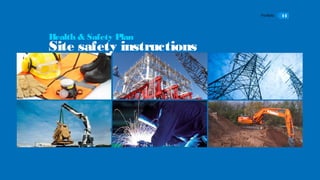
Health & Safety Plan
Site safety instructions
•The safety instructions for the site serve among others to ensure safe conditions for
work. They are the key basic elements for site safety (e.g. work at elevated places,
electrical works, earth works etc.)
•The following rules apply:
•safety instructions have to be observed by everybody
•safety instructions shall be communicated before work starts
•safety instructions shall be updated for good reasons (e.g. accidents) and
communicated before work starts
•additional safety instructions from the contract and/or for other reasons shall be
appended
•Sub-contractors shall apply their own safety instructions or can use these ones at
their own responsibility.
Portfolio 14
Health & Safety Plan
Site safety instructions
Health & Safety Plan 14
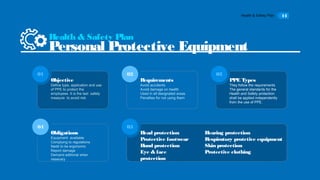
Objective
Define type, application and use
of PPE to protect the
employees. It is the last safety
measure to avoid risk.
01
Requirements
Avoid accidents
Avoid damage on health
Used in all designated areas
Penalties for not using them
02
PPE Types
They follow the requirements
The general standards for the
Health and Safety protection
shall be applied independently
from the use of PPE.
03
Obligations
Equipment available
Complying to regulations
Nedd to be ergonomic
Report damage
Demand aditional when
nesecary
04
Head protection
Protective footwear
Hand protection
Eye & face
protection
05
Health & Safety Plan
Personal Protective Equipment
Hearing protection
Respiratory protctive equipment
Skin protection
Protective clothing
Health & Safety Plan 16
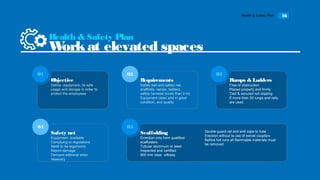
Objective
Define equipment, its safe
usage and storage in order to
protect the employeee
01
Requirements
Safety belt and safety net,
scaffolds, ramps, ladders,
safety harness (more than 2 m)
Equipment clean and in good
condition, and quality
02
Ramps & Ladders
Free of obstruction
Placed properly and firmly
Tied & secured not slipping
If more than 30 rungs and rails
are used.
03
Safety net
Equipment available
Complying to regulations
Nedd to be ergonomic
Report damage
Demand aditional when
nesecary
04
Scaffolding
Errection only from qualified
scaffolders
Tubular aluminum or steel
Inspected and certified
900 mm clear wlkway
05
Health & Safety Plan
Workat elevated spaces
Double guard rail and end caps to tube
Erection without te use of swivel couplers
Before hot runs all flammable materials must
be removed
Health & Safety Plan 16
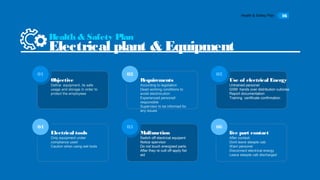
Objective
Define equipment, its safe
usage and storage in order to
protect the employeee
01
Requirements
According to legislation
Dead working conditions to
avoid electrocution
Experienced personell
responsible
Supervisor to be informed for
any issues
02
Use of electrical Energy
Untrained personel
GSM hands over distribution cubicles
Report documentation
Training certificate confirmation
03
Electrical tools
Only equipment under
compliance used
Caution when using wet tools
04
Malfunction
Switch off electrical equipent
Notice spervisor
Do not touch energized parts
After they re cutt off apply fist
aid
05
Health & Safety Plan
Electrical plant & Equipment
06
live part contact
After contaxt:
Dont leave steeple cab
Warn personel
Disconnect electrical energy
Leave steeple cab discharged
Health & Safety Plan 18
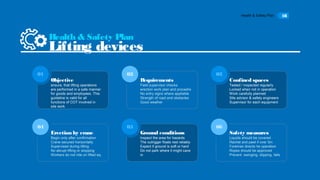
Objective
ensure, that lifting operations
are performed in a safe manner
for goods and employees. This
guideline is valid for all
functions of COT involved in
site work
01
Requirements
Field supervisor checks
erection work plan and procedre
No entry signs where appliable
Strength of road and obstacles
Good weather
02
Confined spaces
Tested / inspected regularly
Locked when not in operation
Work carefully planned
Site advisor & safety engineers
Supervisor for each equipment
03
Erection by crane
Begin only after confirmation
Crane secured horizontally
Supervised during lifting
No abrupt lifting or stopping
Workers do not ride on lifted eq.
04
Ground conditions
Inspect the area for hazards
The outrigger floats rest reliably
Expect if ground is soft or hard
Do not park where it might cave
in
05
Health & Safety Plan
Lifting devices
06
Safety measures
Liquids should be covered
Rachet and pawl if over 5m
Foreman directs he operation
Ropes should be approved
Prevent swinging, slipping, falls
Health & Safety Plan 19
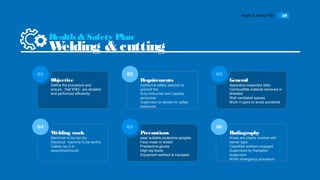
Objective
Define the procedure and
ensure, that W&C are dictated
and performed efficiently
01
Requirements
Additional safety easures to
prevent fire.
Duly instructed and capable
personnel
Supervisor to decide for safety
measures
02
General
Apparatus inspected daily
Combustible material removed or
shielded
Well ventilated spaces
Work in pairs to avoid accidents
03
Welding work
Machines to be kpt dry
Electrical machine to be earths.
Cables lay 2 m
away(shortcircuit)
04
Precautions
wear suitable protective googles
Face mask or shield.
Preotective gloves
High top boots
Equipment earthed & insulated
05
Health & Safety Plan
Welding & cutting
06
Radiography
Areas are clearly marked with
barrier tape
Classified workers engaged
Supervised by Radiation
Supervisor
Writtn emergency procedure
Health & Safety Plan 20
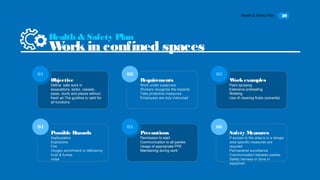
Objective
Define safe work in
excavations, tanks, vessels,
pipes, ducts and places without
fresh air.The guidline is valid for
all functions
01
Requirements
Work under supervisor
Workers recognize the hazards
Take protective measures
Employees are duly instructed
02
Workexamples
Paint spraying
Extensive preheating
Welding
Use of cleaning fluids (solvents)
03
Possible Hazards
Asphyxiation
Explosions
Fire
Oxygen enrichment or deficiency
Dust & fumes
noise
04
Precautions
Permission to start
Communication to all parties
Usage of appropriate PPE
Maintaining during work
05
Health & Safety Plan
Workin confined spaces
06
Safety Measures
If access to the area is in a danger
area specific measures are
required
Permanenet surveilance
Communication between parties
Safety harness or drive in
equipmen
Health & Safety Plan 21
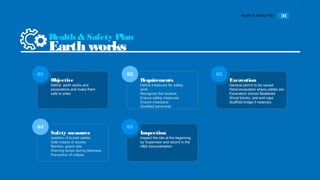
Objective
Define earth works and
excavations and make them
safe to enter.
01
Requirements
Define measures for safety
work
Recognise the hazards
Ensure safety measures
Ensure insections
Qualified personnel
02
Excavation
General permit to be issued
Hand excavation where cables are
Excavation shored &battered
Wood blocks, and end caps
Scaffold bridge if nesecary
03
Safety measures
Isolation of buried cables
Safe means of access
Barriers, guard rails
Warning lamps during darkness
Prevention of collpse
04
Inspection
Inspect the site at the beginning
by Supervisor and record in the
H&S documentation
05
Health & Safety Plan
Earth works
Health & Safety Plan 22
Health & Safety Plan
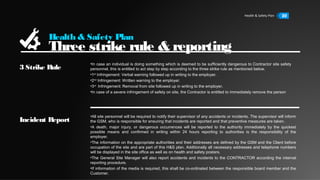
Three strike rule & reporting
3 Strike Rule
Incident Report
•In case an individual is doing something which is deemed to be sufficiently dangerous to Contractor site safety
personnel, this is entitled to act step by step according to the three strike rule as mentioned below.
•1st
Infringement: Verbal warning followed up in writing to the employer.
•2nd
Infringement: Written warning to the employer.
•3rd
Infringement: Removal from site followed up in writing to the employer.
•In case of a severe infringement of safety on site, the Contractor is entitled to immediately remove the person
•All site personnel will be required to notify their supervisor of any accidents or incidents. The supervisor will inform
the GSM, who is responsible for ensuring that incidents are reported and that preventive measures are taken.
•A death, major injury, or dangerous occurrences will be reported to the authority immediately by the quickest
possible means and confirmed in writing within 24 hours reporting to authorities is the responsibility of the
employer.
•The information on the appropriate authorities and their addresses are defined by the GSM and the Client before
occupation of the site and are part of this H&S plan. Additionally all necessary addresses and telephone numbers
will be displayed in the site office as well as on health and safety posters.
•The General Site Manager will also report accidents and incidents to the CONTRACTOR according the internal
reporting procedure.
•If information of the media is required, this shall be co-ordinated between the responsible board member and the
Customer.
Health & Safety Plan 23
Αn area within the job site where Contractor can install his own temporary field
facilities, store equipment, materials, perform, prefabrication WORK, etc. The
location and the extent of this area shall be defined during Kick-Off meeting, after
Contract Award
Ownerneeds to
provide:
Health & Safety Plan
Services
Potable water (only for drinking)
Water from the fire-fighting network for hydraulic tests.
Any temporary piping and/ or equipment (such as pumps etc) required
Αn area for the temporary storage of any pre-existing materials that have to be
dismantled and/or removed. The responsibility for the transportation to the final
destination
Work area shall be divided in parts, Part Α of work area shall be far enough from
the owner’s existing equipment. Part Β of work area shall be near the owner’s
existing equipment.
Health & Safety Plan 24
Design, drawings, materials, labour, supervision, and any other services not
specifically provided by the owner.
Superviser
needs to provide:
Health & Safety Plan
Services
Facilities for his personnel (such as offices, sanitary installations, change rooms,
canteen, First Aid facilities), as well as offices and cars for the Supervisors.
Storage facilities for his material, equipment and tools.
Workshop for field fabrication activities
All necessary tools such as cranes, trucks, scaffolding etc.
Utilities during the construction work
Access roads and al nesecary facilities for all his labour, plant and equipment
during the whole construction period.
Health & Safety Plan 25
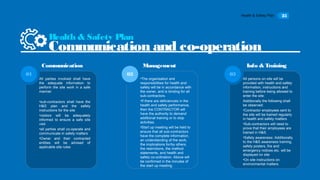
All parties involved shall have
the adequate information to
perform the site work in a safe
manner.
•sub-contractors shall have the
H&S plan and the safety
instructions for the site
•visitors will be adequately
informed to ensure a safe site
visit
•all parties shall co-operate and
communicate in safety matters
•Owner and their contracted
entities will be advised of
applicable site rules
01
•The organisation and
responsibilities for health and
safety will be in accordance with
the owner, and is binding for all
sub-contractors.
•If there are deficiencies in the
health and safety performance,
then the CONTRACTOR will
have the authority to demand
additional training or to stop
activities.
•Start up meeting will be held to
ensure that all sub-contractors
have the complete information,
an understanding of the work,
the implications for/by others,
the restrictions, the method
statements, and health and
safety co-ordination. Above will
be confirmed in the minutes of
the start up meeting.
02
All persons on site will be
provided with health and safety
information, instructions and
training before being allowed to
enter the site:
Additionally the following shall
be observed:
•Contractor employees sent to
the site will be trained regularly
in health and safety matters
•Sub-contractors will need to
prove that their employees are
trained in H&S.
•Safety awareness: Additionally
to the H&S awareness training,
safety posters, fire and
emergency notices etc. will be
displayed on site
•On site instructions on
environmental matters.
03
Health & Safety Plan
Communication and co-operation
Communication Management Info & Training
Health & Safety Plan 26
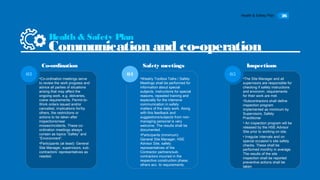
•Co-ordination meetings serve
to review the work progress and
advice all parties of situations
arising that may affect the
ongoing work, e.g. deliveries,
crane requirements, Permit-to-
Work orders issued and/or
cancelled, implications for/by
others, the restrictions or
actions to be taken after
inspections/near
misses/incidents. These co-
ordination meetings always
contain as topics “Safety” and
“Environment”.
•Participants (at least): General
Site Manager, supervisors, sub-
contractors’ representatives as
needed.
03
•Weekly Toolbox Talks / Safety
Meetings shall be performed for
information about special
subjects, instructions for special
reasons, repeated training and
especially for the intensive
communication in safety
matters of the daily work. Along
with this feedback and
suggestions/subjects from non-
managing personal is very
welcome. The results shall be
documented.
•Participants (minimum):
General Site Manager, HSE
Advisor Site, safety
representatives of the
Contractor partners/sub-
contractors incurred in the
respective construction phase,
others acc. to requirements.
04
•The Site Manager and all
supervisors are responsible for
checking if safety instructions
and environm. requirements
for their work are met.
•Subcontractors shall define
inspection program
implemented as minimum by
Supervisors, Safety
Practitioner
• An inspection program will be
released by the HSE Advisor
Site prior to working on site.
• Irregular intervals and on
special occasion’s site safety
checks. These shall be
performed monthly in average.
The results of the site
inspection shall be reported
preventive actions shall be
taken
05
Health & Safety Plan
Communication and co-operation
Co-ordination Safety meetings Inspections
Environmental Plan 27
•Fuel oil is used as a backup fuel, which will be addressed
•Water treatment requires chemical substances which, besides their effects on human health,
may affect the environment and will be addressed
•The risks during the construction of the tank itself can be defined as normal risk for such
procedure (e. g. hazardous substances like hydraulic oil, grease, transformer oil, diesel,
cleaning and painting chemicals, noise caused by piling, boiler blow out, dust, dirt to the roads,
waste etc.) and will be addressed
•Dust production during construction work shall be suppressed
•Noise shall be limited according to the requirements
•Environmental impacts due to heavy load transport shall be addressed in the relevant
procedures (e. g. cutting of tree parts etc.)
•Contaminated soil may be found during excavation works
and will be addressed.
Risks
Environmental Plan
Risks
•Oil spill during tank loading
•Failure of tank, pipe, fitting
•Failure of charging pump
•Minor leakage of equipment
Possible causes
•Immediate stop of leakage and spill (shut
supply valve, erect barriers, stop pumps, etc.)
•Build up barriers to restrict area if required
•Pump oil into barrels
•Collected oil shall be treated as hazardous
waste and disposed acc.
•Soak minor soil quantities with sand and treat
as hazardous waste
•Clean floors if spillage occurs in rooms
•Remove contaminated soil and treat as
hazardous waste
•In case of spillage to the water: prepare oil
barriers and inform fire brigade
Environmental Plan 28
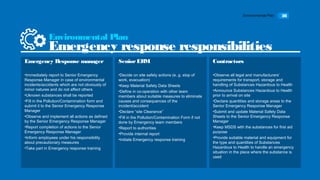
•Immediately report to Senior Emergency
Response Manager in case of environmental
incidents/accidents which are not obviously of
minor natures and do not affect others
•Uknown substances shall be reported
•Fill in the Pollution/Contamination form and
submit it to the Senior Emergency Response
Manager
•Observe and implement all actions as defined
by the Senior Emergency Response Manager
•Report completion of actions to the Senior
Emergency Response Manager
•Inform employees under his responsibility
about precautionary measures
•Take part in Emergency response training
Emergency Response manager
Environmental Plan
Emergency response responsibilities
•Decide on site safety actions (e. g. stop of
work, evacuation)
•Keep Material Safety Data Sheets
•Define in co-operation with other team
members about suitable measures to eliminate
causes and consequences of the
incident/accident
•Declare “site Clearance”
•Fill in the Pollution/Contamination Form if not
done by Emergency team members
•Report to authorities
•Provide internal report
•Initiate Emergency response training
SeniorERM
•Observe all legal and manufacturers’
requirements for transport, storage and
handling of Substances Hazardous to Health
•Announce Substances Hazardous to Health
prior to arrival on site
•Declare quantities and storage areas to the
Senior Emergency Response Manager
•Submit and update Material Safety Data
Sheets to the Senior Emergency Response
Manager
•Keep MSDS with the substances for first aid
purpose
•Provide suitable material and equipment for
the type and quantities of Substances
Hazardous to Health to handle an emergency
situation in the place where the substance is
used
Contractors
Environmental Plan 29
•For all environmental incidents information shall be available.
•Minor incidents/accidents shall be reported through the contamination / pollution form
sheet according to the reports issued by ERM.
•Effectiveness of measures taken shall be verified by SER.
•For all major environmental incidents causing either the stop of the work or an evacuation
a Non-conformity report shall be issued. This shall be accompanied by adequate
information. This report shall be issued by the GSM, who normally is also the Senior
Emergency preparedness manager.
Environmental Plan
Reporting and Legalities
Reporting
•In general the Environmental Management system follows the principles as outlined in the
EN ISO 14001/1996
•Furthermore all national, regional and local laws and requirements applicable to the
project shall be observed as seen on the reference list.
Legal requirements and standards
Environmental Plan 30
•The following elements apply in this subject:
•General environmental protection regarding pollution of air, water, contamination of soil,
noise prevention
•Transport, handling and storage of substances hazardous to health and the environment
•Removal and disposal of waste materials
•Treatment of hazardous materials and waste
•The Contractor shall assess the risks of these elements and take adequate provisions to
avoid detrimental impact on the environment. If required by GSM the environmental
procedures shall be provided by the contractor.
Environmental Plan
Risks to environment
Areas, activities and substances
•Essentially the following conditions shall be regarded:
•normal operations
•abnormal operations
•construction period: incidents, accidents and emergency situations
•In case of pollution/contamination the form can be found at the appendix.
Environmental Plan 31
• For all normal working procedures during
construction only noise and dust will be
expected in the air.
• Noise shall be limited by the use of
properly silenced plant and equipment
acc. to the accepted standards and their
use shall be limited to the normal working
hours (i. e. between 8.00 and 18:00 from
Monday until Friday and between 8.00
and 16.00 on Saturdays excluding
holidays).
• Excessive dust production shall be
suppressed by water spraying in suitable
intervals.
Airpollution
• To avoid oil from trucks, cranes and other
equipment contaminating soil, especially during
long-term parking, drip trays or sheets will be
placed under critical points (e. g. gearbox, hydraulic
connections etc)
• During handling hazardous or polluting liquids,
special care shall be taken and emergency
equipment shall be available as required.
• Waste water from the canteen will be collected in
cress tanks and waste water from the toilets’
collection chambers (pre-fabricated) will be
disposed in regular intervals by road tankers to an
approved water treatment works.
• Surface water is directed to a settlement tank,
removed by tank trucks and disposed according to
the legal requirements.
Liquids
• Preventive measures include the
immediate collection after its
occurrence and its proper storage until
disposal.
• Good housekeeping is also of essential
importance to prevent environmental
problems with waste.
Solid waste
Environmental Plan
Preventive measures
Environmental Plan 32
All waste material shall be collected, stored and disposed in
accordance with relevant laws, regulations, the Environmental Plan
and the Site Rules. The separation of the different types of waste shall
be in accordance with all laws and regulations. The collection of the
waste shall be in a way that it is not spread throughout the site and risk
of spillage can occur.
Environmental Plan
Removal & Disposal of waste
Areas, activities and substances
Each contractor and sub-supplier is responsible for the treatment of
waste material as a result of their activities
Proof that there is no residual contamination in long-term storage areas
shall be presented by the contractor to the General Site Manager at the
end of contract if requested.
The burning of waste is not permitted.
All non permanent facilities, shall be dismantled and removed from site.
•After site cleaning, but before site restoration evidence shall be
gathered by the sub-contractor to prove that no contamination is
remaining. Special attendance shall be given to areas like parking
areas, intermediate storage areas, and parking areas for work
machines. These areas shall be evaluated by the General Site
Manager and If indications direct to contamination a site investigation
shall be performed by an independent consultant, engineer, ordered by
the contractor.
•If contamination has occurred, remedial measures shall be employed
to remove it, this shall be performed by contractor to ensure
compliance with all statutory rules and regulations. The result of any
site investigation and any decontamination shall be documented.
Residual contamination
Environmental Plan 33
Environmental Plan
Site emergency procedures
•In the event of any emergency or potential emergency in environmental aspects the
Emergency Response Procedure will be active. This program defines the steps to be taken
once an environmental incident/accident occurs.
•In case of danger for the site personnel the Emergency/Evacuation plan shall be active upon
decision of the GSM. Important information is displayed on site.
•Every Environmental Accident/incident has to be reported to the HSE Site Advisor that shall
collect the reports and entertain a register for the incidents.
•Every contractor using substances hazardous to environment and/or health shall entertain a
suitable storage for materials and equipment necessary to remove every impact on the
environment caused by such substances (e. g. sand, binding agents, protective clothes,
gloves, acid resistant barrels, containers, etc.). These materials and equipment shall be stored
close to the areas where the substances are used and/or handled.
•Every sub-contractor is responsible for the proper transportation, handling, storage, use and
removal of its substances hazardous to health and environment.
Procedures
Environmental Plan 34
Environmental Plan
Info & training forpeople on site
•The documentation related to the Environmental Plan shall be proof
of compliance with relevant statutory rules and regulations.
•All pollution and contamination shall be reported by using forms as
provided by the sub-contractors and accepted by the contractor. In
case of accidents please refer to the H&S plan, “Reporting of
accidents”. Incidents shall be immediately reported to the GSM or the
HSE Advisor Site of the contractor.
•Regular monthly reports shall be disclosed to the home office
together with H&S reports. If information for the media is required, this
shall be coordinated between the responsible Contractor board
members and the Client.
•All persons on site will be provided with information suitable for the
fulfilment of the Environmental Plan according to their work.
•Site managers and/or supervisors of the construction companies will
receive the Environmental plan together with H&S plan and site rules.
•employees sent to the site will have been trained regularly in
environmental matters
•In case of changes/amendments to the Environmental Plan, these
changes shall be relayed to the environmental co-ordinator for action.
•Environmental awareness: Awareness training shall be given in
general and especially in cases of deviations from the Environmental
Management system.
•Statutory notices will be displayed in the office, workshop and
canteen as necessary.
•All contractors shall train their employees in environmental matters
and ensure that the project requirements are met,. Most important are
the trainings on the behaviour in emergency cases, the proper
handling of substances and equipment containing hazardous
substances .
•Toolbox talks are also suitable means to communicate
environmental matters to the employees.
Documentation & Reporting
Environmental Plan 35
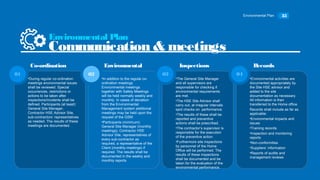
•During regular co-ordination
meetings environmental issues
shall be reviewed. Special
occurrences, restrictions or
actions to be taken after
inspections/incidents shall be
defined. Participants (at least):
General Site Manager,
Contractor HSE Advisor Site,
sub-contractors’ representatives
as needed. The results of these
meetings are documented.
01
•In addition to the regular co-
ordination meetings
Environmental meetings
together with Safety Meetings
will be held normally weekly and
monthly. In cases of deviation
from the Environmental
Management system additional
meetings may be held upon the
request of the GSM.
•Participants (minimum):
General Site Manager (monthly
meetings), Contractor HSE
Advisor Site, representatives of
every sub-contractor as
required, a representative of the
Client (monthly meetings) if
required. The results shall be
documented in the weekly and
monthly reports.
02
•The General Site Manager
and all supervisors are
responsible for checking if
environmental requirements
are met.
•The HSE Site Advisor shall
carry out, at irregular intervals
spot checks on performance.
•The results of these shall be
reported and preventive
actions shall be prescribed.
•The contractor’s supervisor is
responsible for the execution
of the preventive action.
•Furthermore site inspections
by personnel of the Home
Office will be performed. The
results of these inspections
shall be documented and be
taken for the evaluation of the
environmental performance.
03
Environmental Plan
Communication & meetings
Co-ordination Environmental Inspections
•Environmental activities are
documented appropriately by
the Site HSE advisor and
added to the site
documentation as necessary.
All information is then
transferred to the Home office.
Records shall include as far as
applicable:
•Environmental impacts and
issues
•Training records
•Inspection and monitoring
reports
•Non-conformities
•Suppliers’ information
•Reports of audits and
management reviews
04
Records
Section Four
Conclusions
Multiple factors such as experience and knowledge needed, the ability to plan ahead, and the
experience shared with the consultants it is easy to see the complexity of each project. Location
of the work and in our case refineries and plants is one of the main reasons for accidents. When
there is work with contact to machinery parts of the process can be dangerous or even fatal,
with financial implications.
Some of the reasons can be falling from heights, environmental conditions such as heat, or even
contact with moving parts and electrocution as many other risks. Risk assesments are crusial and
scores can give an indication to make a project viable. All potential risks need to be thought of
and taken care of or planned accordingly.
In order to achieve this purpose, proper and uninterrupted information to the employees about
all of the potential risks they may be facing and to create the appropriate assessment and
analysis of the issue to handle it efficiently. Strict legislation and years of experience led to
continuous improvement. Most companies are required to have a specialized safety engineer,
either in house or as an external contractor, as is the case of this work.
Consulting people in the field, it has been noticed that questionnaires are rarely used due to the
success of weekly, monthly reports and audits. The results of the questionnaire used, show that
indeed companies do their best to keep personnel and equipment safe in order for the work to
be as efficient and safe as possible.
Safety costs and audits can bring obstacles, that can lead to unfavorable results, working
conditions, or even lives lost. Safety, Health and Environment will always improve in order to
improve the quality and quantity of safe work and ensure the best possible results.
+30 6949119368 Stathis Kanios kastarts@gmail.com
Efstathios Kanios
MSc Oil & Gas Technology
MSc Architecture & Design
BSc Engineering Technician

presentation thesis kanios hse 0.5

  • 1.
    H.S.E PLAN FORCRUDEOIL STORAGE TANKS Supervisor: Marmanis Dimitrios EASTERN MACEDONIA ANDTHRACE INSTITUTE OF TECHNOLOGY FACULTY OF ENGINEERING By Efstathios Kanios DEPARTMENT OF PETROLEUMANDNATURAL GAS TECHNOLOGY
  • 2.
    Presentation ABSTRACT This MSc Thesisis about Health & Safety Engineering and environmental protection issues. It defines the most important theoretical parts about workin oil refineries, and in particular the erection of new construction, through extensive research on Greek legislation. It illustrates ways to avoid an accident or how to manage it in case it happens. It refers to basic concepts of health and safety, and how work should be applied in order to avoid incidents and accidents. A questionnaire was formed regarding various factors that affect employees, equipment, damages, accidents and procedures, their environmental impacts and pollution. It acts as a template for future projects on the industry eitheron the bidding orfinal stage forHSE professionals.
  • 3.
  • 4.
    INTRODUCTION Why HSE isimportant? DEFINITION OF SAFETY Safety can be defined as the actions taken to define hazards that affect men or material goods and the processes used to achieve an acceptable level of risk DEFINITION OF HEALTH health is the level of functional or metabolic efficiency of a living organism, and for the case of humans, its ability to adapt and self-manage in the face of social, physical, spiritual and emotional challenges DEFINITION OF ENVIRONMENT environment can be described as the sum of all external conditions affecting the life, development and survival of an organism CAUSES OF ACCIDENTS •Equipment •Machinery •Man •Weather conditions •Materials
  • 5.
  • 6.
    Theoretical Background 06 Implicationsof an accident •Personnel, •Facilities, •Local flaura and fauna •Material losses •Financial losses Preparation of equipment and staff •Abidding to legislation •Experienced personnel •Equipment and processes •monitoring Impotant factors •Communication •Efficiency Chapter2 Theoretical Background Obligations •Contractor •Owner •personnel
  • 7.
    Theoretical Background 07 Causesof accidents •Risk management plan •Faulty equipment •Workers •Rules and legislation •Safety management system Pollution Can be described as the unfavorable alteration of the environment from direct or indirect effects such as radiation levels, chemical constitution etc. Common causes of death •Gas Leaks •Human Error •Unsafe Working Conditions •Falling Objects •Toxic Chemical Exposure •Malfunctioning Equipment •Inadequate Training of Workers Chapter2 Theoretical Background In spesific •Burns •Chemical exposure •Injuries from explosions
  • 8.
  • 9.
    Introduction HSE Policy GMgoals: Area Classification Theconcept of the project is to follow the guidelines used in legislation and with external consultation, to create a HSE study for the erection of a theoretical new crude storage oil tank in the refinery of Kavala oil in order to use it as reference for further HSE projects in the oil and gas industry. The author is taking the part of the HSE consultant hired by the contractor (usually a consortium of different companies). Greek and International legislation is followed in order to come up with the satisfactory outcome. •Information, training and qualification •Developing a culture for a continuous improvement •Conformity to the adopted system with the rules of reference •The area classification of hazardous locations will be in accordance with ATEX directive 1999/92/EC while the equipment under the ATEX directive 94/9/EC •Periodical evaluation of the obtained results •Satisfaction of personnel •Involvement of Suppliers. Chapter3 HSE Plan
  • 10.
    About Safety Rules10 About Safety Rules Contractor, subcontractors and employees need to comply with the owners safety rules Contractor shall be fully responsible for all safety related work and must protect property, and the work force as well as be responsible for the recovery of loss and damages, and ensure that all employees are notified of and abide safety and hygiene procedures as specified by the applicable legislation. The Contractor shall furthermore comply with laws and statutory legislation applicable to work and defend, indemnify and hold harmless the owner, from any liability or penalty which may arise by reason of any alleged violation of laws and safety rules by the contractor or his subcontractors, claims, suits or proceedings that may be brought against the owner with respect to violation of laws and safety rules.   Contractor shall ensure that all construction tools, equipment and temporary facilities and other items used whether rented, purchased or provided are in a safe, sound and good condition and capable of performing the functions for which they are intended.   Prior to commencement of any work activity, contractor shall submit to the owner all safety documents and regulations. As well as a detailed safety procedure concerning protection measures against CONTRACTORRESPONSIBILITIES
  • 11.
    About Us 11 About SafetyRules •The wearing of safety helmets, safety footwear and highly visible safety clothes is mandatory on site. Suitable Personal protective equipment for the works performed shall be provided by the employer and shall be used by the employee acc. to the instructions given. •complying with the site H&S requirements e.g. site H&S plan •using the personal protective equipment •notifying hazards, accidents, incidents, deficiencies etc. to the site supervisor •awareness, that everybody is responsible for his/her own safety and the safety of all others •Application of the required safety measures •Proper use of the working means, tools, etc. •Appropriate use of the Personal Protective Equipment (PPE) •Avoid endangering of himself and other persons by alcohol, medicine and drugs •Reporting of accidents, near misses •Reporting of serious and immediate danger for health and safety •Reporting of defects on Personal Protective Equipment and safety devices •Removal of defects as appropriate according to information, instructions and technical means available GENERAL RSPONSIBILITIESGENERAL RESPONSIBILITIES
  • 12.
    About Us 12 About SafetyRules Responsibilities of the HSE Engineer •Training and instructions of sub-contractors’ safety personnel •Implementation of site safety co-ordination and co-operation •ensuring that the site personnel carries out the work on site in a safe manner and acc. to the H&S instructions and requirements of the contract •supervise sub-contractors to ensure that equipment and materials are in good and safe working conditions •co-ordination of H&S aspects and participating in H&S meetings •Reporting of accidents, incidents and deficiencies from the SMS elements Responsibilities of erection Managers: •co-ordination of working tasks to be carried out in a safe manner and in safe time sequence Responsibilities of Supervisors/Safety Engineers and Advisors: •ensuring that the site safety rules and requirements are observed by the sub- contractor’s personnel (implementation of the H&S plan acc. to the scope incurred) co-operation with the General Site Manager, the Contractor, HSE Site Advisor and the safety engineers, supervisors of other companies on site in H&S matters •reporting of accidents/incidents to the General Site Manager •ensuring that equipment and materials are in good safe working conditions HSE ADVISORRESPONSIBILITIES
  • 13.
    Health & SafetyPlan Site safety instructions •The safety instructions for the site serve among others to ensure safe conditions for work. They are the key basic elements for site safety (e.g. work at elevated places, electrical works, earth works etc.) •The following rules apply: •safety instructions have to be observed by everybody •safety instructions shall be communicated before work starts •safety instructions shall be updated for good reasons (e.g. accidents) and communicated before work starts •additional safety instructions from the contract and/or for other reasons shall be appended •Sub-contractors shall apply their own safety instructions or can use these ones at their own responsibility.
  • 14.
    Portfolio 14 Health &Safety Plan Site safety instructions
  • 15.
    Health & SafetyPlan 14 Objective Define type, application and use of PPE to protect the employees. It is the last safety measure to avoid risk. 01 Requirements Avoid accidents Avoid damage on health Used in all designated areas Penalties for not using them 02 PPE Types They follow the requirements The general standards for the Health and Safety protection shall be applied independently from the use of PPE. 03 Obligations Equipment available Complying to regulations Nedd to be ergonomic Report damage Demand aditional when nesecary 04 Head protection Protective footwear Hand protection Eye & face protection 05 Health & Safety Plan Personal Protective Equipment Hearing protection Respiratory protctive equipment Skin protection Protective clothing
  • 16.
    Health & SafetyPlan 16 Objective Define equipment, its safe usage and storage in order to protect the employeee 01 Requirements Safety belt and safety net, scaffolds, ramps, ladders, safety harness (more than 2 m) Equipment clean and in good condition, and quality 02 Ramps & Ladders Free of obstruction Placed properly and firmly Tied & secured not slipping If more than 30 rungs and rails are used. 03 Safety net Equipment available Complying to regulations Nedd to be ergonomic Report damage Demand aditional when nesecary 04 Scaffolding Errection only from qualified scaffolders Tubular aluminum or steel Inspected and certified 900 mm clear wlkway 05 Health & Safety Plan Workat elevated spaces Double guard rail and end caps to tube Erection without te use of swivel couplers Before hot runs all flammable materials must be removed
  • 17.
    Health & SafetyPlan 16 Objective Define equipment, its safe usage and storage in order to protect the employeee 01 Requirements According to legislation Dead working conditions to avoid electrocution Experienced personell responsible Supervisor to be informed for any issues 02 Use of electrical Energy Untrained personel GSM hands over distribution cubicles Report documentation Training certificate confirmation 03 Electrical tools Only equipment under compliance used Caution when using wet tools 04 Malfunction Switch off electrical equipent Notice spervisor Do not touch energized parts After they re cutt off apply fist aid 05 Health & Safety Plan Electrical plant & Equipment 06 live part contact After contaxt: Dont leave steeple cab Warn personel Disconnect electrical energy Leave steeple cab discharged
  • 18.
    Health & SafetyPlan 18 Objective ensure, that lifting operations are performed in a safe manner for goods and employees. This guideline is valid for all functions of COT involved in site work 01 Requirements Field supervisor checks erection work plan and procedre No entry signs where appliable Strength of road and obstacles Good weather 02 Confined spaces Tested / inspected regularly Locked when not in operation Work carefully planned Site advisor & safety engineers Supervisor for each equipment 03 Erection by crane Begin only after confirmation Crane secured horizontally Supervised during lifting No abrupt lifting or stopping Workers do not ride on lifted eq. 04 Ground conditions Inspect the area for hazards The outrigger floats rest reliably Expect if ground is soft or hard Do not park where it might cave in 05 Health & Safety Plan Lifting devices 06 Safety measures Liquids should be covered Rachet and pawl if over 5m Foreman directs he operation Ropes should be approved Prevent swinging, slipping, falls
  • 19.
    Health & SafetyPlan 19 Objective Define the procedure and ensure, that W&C are dictated and performed efficiently 01 Requirements Additional safety easures to prevent fire. Duly instructed and capable personnel Supervisor to decide for safety measures 02 General Apparatus inspected daily Combustible material removed or shielded Well ventilated spaces Work in pairs to avoid accidents 03 Welding work Machines to be kpt dry Electrical machine to be earths. Cables lay 2 m away(shortcircuit) 04 Precautions wear suitable protective googles Face mask or shield. Preotective gloves High top boots Equipment earthed & insulated 05 Health & Safety Plan Welding & cutting 06 Radiography Areas are clearly marked with barrier tape Classified workers engaged Supervised by Radiation Supervisor Writtn emergency procedure
  • 20.
    Health & SafetyPlan 20 Objective Define safe work in excavations, tanks, vessels, pipes, ducts and places without fresh air.The guidline is valid for all functions 01 Requirements Work under supervisor Workers recognize the hazards Take protective measures Employees are duly instructed 02 Workexamples Paint spraying Extensive preheating Welding Use of cleaning fluids (solvents) 03 Possible Hazards Asphyxiation Explosions Fire Oxygen enrichment or deficiency Dust & fumes noise 04 Precautions Permission to start Communication to all parties Usage of appropriate PPE Maintaining during work 05 Health & Safety Plan Workin confined spaces 06 Safety Measures If access to the area is in a danger area specific measures are required Permanenet surveilance Communication between parties Safety harness or drive in equipmen
  • 21.
    Health & SafetyPlan 21 Objective Define earth works and excavations and make them safe to enter. 01 Requirements Define measures for safety work Recognise the hazards Ensure safety measures Ensure insections Qualified personnel 02 Excavation General permit to be issued Hand excavation where cables are Excavation shored &battered Wood blocks, and end caps Scaffold bridge if nesecary 03 Safety measures Isolation of buried cables Safe means of access Barriers, guard rails Warning lamps during darkness Prevention of collpse 04 Inspection Inspect the site at the beginning by Supervisor and record in the H&S documentation 05 Health & Safety Plan Earth works
  • 22.
    Health & SafetyPlan 22 Health & Safety Plan Three strike rule & reporting 3 Strike Rule Incident Report •In case an individual is doing something which is deemed to be sufficiently dangerous to Contractor site safety personnel, this is entitled to act step by step according to the three strike rule as mentioned below. •1st Infringement: Verbal warning followed up in writing to the employer. •2nd Infringement: Written warning to the employer. •3rd Infringement: Removal from site followed up in writing to the employer. •In case of a severe infringement of safety on site, the Contractor is entitled to immediately remove the person •All site personnel will be required to notify their supervisor of any accidents or incidents. The supervisor will inform the GSM, who is responsible for ensuring that incidents are reported and that preventive measures are taken. •A death, major injury, or dangerous occurrences will be reported to the authority immediately by the quickest possible means and confirmed in writing within 24 hours reporting to authorities is the responsibility of the employer. •The information on the appropriate authorities and their addresses are defined by the GSM and the Client before occupation of the site and are part of this H&S plan. Additionally all necessary addresses and telephone numbers will be displayed in the site office as well as on health and safety posters. •The General Site Manager will also report accidents and incidents to the CONTRACTOR according the internal reporting procedure. •If information of the media is required, this shall be co-ordinated between the responsible board member and the Customer.
  • 23.
    Health & SafetyPlan 23 Αn area within the job site where Contractor can install his own temporary field facilities, store equipment, materials, perform, prefabrication WORK, etc. The location and the extent of this area shall be defined during Kick-Off meeting, after Contract Award Ownerneeds to provide: Health & Safety Plan Services Potable water (only for drinking) Water from the fire-fighting network for hydraulic tests. Any temporary piping and/ or equipment (such as pumps etc) required Αn area for the temporary storage of any pre-existing materials that have to be dismantled and/or removed. The responsibility for the transportation to the final destination Work area shall be divided in parts, Part Α of work area shall be far enough from the owner’s existing equipment. Part Β of work area shall be near the owner’s existing equipment.
  • 24.
    Health & SafetyPlan 24 Design, drawings, materials, labour, supervision, and any other services not specifically provided by the owner. Superviser needs to provide: Health & Safety Plan Services Facilities for his personnel (such as offices, sanitary installations, change rooms, canteen, First Aid facilities), as well as offices and cars for the Supervisors. Storage facilities for his material, equipment and tools. Workshop for field fabrication activities All necessary tools such as cranes, trucks, scaffolding etc. Utilities during the construction work Access roads and al nesecary facilities for all his labour, plant and equipment during the whole construction period.
  • 25.
    Health & SafetyPlan 25 All parties involved shall have the adequate information to perform the site work in a safe manner. •sub-contractors shall have the H&S plan and the safety instructions for the site •visitors will be adequately informed to ensure a safe site visit •all parties shall co-operate and communicate in safety matters •Owner and their contracted entities will be advised of applicable site rules 01 •The organisation and responsibilities for health and safety will be in accordance with the owner, and is binding for all sub-contractors. •If there are deficiencies in the health and safety performance, then the CONTRACTOR will have the authority to demand additional training or to stop activities. •Start up meeting will be held to ensure that all sub-contractors have the complete information, an understanding of the work, the implications for/by others, the restrictions, the method statements, and health and safety co-ordination. Above will be confirmed in the minutes of the start up meeting. 02 All persons on site will be provided with health and safety information, instructions and training before being allowed to enter the site: Additionally the following shall be observed: •Contractor employees sent to the site will be trained regularly in health and safety matters •Sub-contractors will need to prove that their employees are trained in H&S. •Safety awareness: Additionally to the H&S awareness training, safety posters, fire and emergency notices etc. will be displayed on site •On site instructions on environmental matters. 03 Health & Safety Plan Communication and co-operation Communication Management Info & Training
  • 26.
    Health & SafetyPlan 26 •Co-ordination meetings serve to review the work progress and advice all parties of situations arising that may affect the ongoing work, e.g. deliveries, crane requirements, Permit-to- Work orders issued and/or cancelled, implications for/by others, the restrictions or actions to be taken after inspections/near misses/incidents. These co- ordination meetings always contain as topics “Safety” and “Environment”. •Participants (at least): General Site Manager, supervisors, sub- contractors’ representatives as needed. 03 •Weekly Toolbox Talks / Safety Meetings shall be performed for information about special subjects, instructions for special reasons, repeated training and especially for the intensive communication in safety matters of the daily work. Along with this feedback and suggestions/subjects from non- managing personal is very welcome. The results shall be documented. •Participants (minimum): General Site Manager, HSE Advisor Site, safety representatives of the Contractor partners/sub- contractors incurred in the respective construction phase, others acc. to requirements. 04 •The Site Manager and all supervisors are responsible for checking if safety instructions and environm. requirements for their work are met. •Subcontractors shall define inspection program implemented as minimum by Supervisors, Safety Practitioner • An inspection program will be released by the HSE Advisor Site prior to working on site. • Irregular intervals and on special occasion’s site safety checks. These shall be performed monthly in average. The results of the site inspection shall be reported preventive actions shall be taken 05 Health & Safety Plan Communication and co-operation Co-ordination Safety meetings Inspections
  • 27.
    Environmental Plan 27 •Fueloil is used as a backup fuel, which will be addressed •Water treatment requires chemical substances which, besides their effects on human health, may affect the environment and will be addressed •The risks during the construction of the tank itself can be defined as normal risk for such procedure (e. g. hazardous substances like hydraulic oil, grease, transformer oil, diesel, cleaning and painting chemicals, noise caused by piling, boiler blow out, dust, dirt to the roads, waste etc.) and will be addressed •Dust production during construction work shall be suppressed •Noise shall be limited according to the requirements •Environmental impacts due to heavy load transport shall be addressed in the relevant procedures (e. g. cutting of tree parts etc.) •Contaminated soil may be found during excavation works and will be addressed. Risks Environmental Plan Risks •Oil spill during tank loading •Failure of tank, pipe, fitting •Failure of charging pump •Minor leakage of equipment Possible causes •Immediate stop of leakage and spill (shut supply valve, erect barriers, stop pumps, etc.) •Build up barriers to restrict area if required •Pump oil into barrels •Collected oil shall be treated as hazardous waste and disposed acc. •Soak minor soil quantities with sand and treat as hazardous waste •Clean floors if spillage occurs in rooms •Remove contaminated soil and treat as hazardous waste •In case of spillage to the water: prepare oil barriers and inform fire brigade
  • 28.
    Environmental Plan 28 •Immediatelyreport to Senior Emergency Response Manager in case of environmental incidents/accidents which are not obviously of minor natures and do not affect others •Uknown substances shall be reported •Fill in the Pollution/Contamination form and submit it to the Senior Emergency Response Manager •Observe and implement all actions as defined by the Senior Emergency Response Manager •Report completion of actions to the Senior Emergency Response Manager •Inform employees under his responsibility about precautionary measures •Take part in Emergency response training Emergency Response manager Environmental Plan Emergency response responsibilities •Decide on site safety actions (e. g. stop of work, evacuation) •Keep Material Safety Data Sheets •Define in co-operation with other team members about suitable measures to eliminate causes and consequences of the incident/accident •Declare “site Clearance” •Fill in the Pollution/Contamination Form if not done by Emergency team members •Report to authorities •Provide internal report •Initiate Emergency response training SeniorERM •Observe all legal and manufacturers’ requirements for transport, storage and handling of Substances Hazardous to Health •Announce Substances Hazardous to Health prior to arrival on site •Declare quantities and storage areas to the Senior Emergency Response Manager •Submit and update Material Safety Data Sheets to the Senior Emergency Response Manager •Keep MSDS with the substances for first aid purpose •Provide suitable material and equipment for the type and quantities of Substances Hazardous to Health to handle an emergency situation in the place where the substance is used Contractors
  • 29.
    Environmental Plan 29 •Forall environmental incidents information shall be available. •Minor incidents/accidents shall be reported through the contamination / pollution form sheet according to the reports issued by ERM. •Effectiveness of measures taken shall be verified by SER. •For all major environmental incidents causing either the stop of the work or an evacuation a Non-conformity report shall be issued. This shall be accompanied by adequate information. This report shall be issued by the GSM, who normally is also the Senior Emergency preparedness manager. Environmental Plan Reporting and Legalities Reporting •In general the Environmental Management system follows the principles as outlined in the EN ISO 14001/1996 •Furthermore all national, regional and local laws and requirements applicable to the project shall be observed as seen on the reference list. Legal requirements and standards
  • 30.
    Environmental Plan 30 •Thefollowing elements apply in this subject: •General environmental protection regarding pollution of air, water, contamination of soil, noise prevention •Transport, handling and storage of substances hazardous to health and the environment •Removal and disposal of waste materials •Treatment of hazardous materials and waste •The Contractor shall assess the risks of these elements and take adequate provisions to avoid detrimental impact on the environment. If required by GSM the environmental procedures shall be provided by the contractor. Environmental Plan Risks to environment Areas, activities and substances •Essentially the following conditions shall be regarded: •normal operations •abnormal operations •construction period: incidents, accidents and emergency situations •In case of pollution/contamination the form can be found at the appendix.
  • 31.
    Environmental Plan 31 •For all normal working procedures during construction only noise and dust will be expected in the air. • Noise shall be limited by the use of properly silenced plant and equipment acc. to the accepted standards and their use shall be limited to the normal working hours (i. e. between 8.00 and 18:00 from Monday until Friday and between 8.00 and 16.00 on Saturdays excluding holidays). • Excessive dust production shall be suppressed by water spraying in suitable intervals. Airpollution • To avoid oil from trucks, cranes and other equipment contaminating soil, especially during long-term parking, drip trays or sheets will be placed under critical points (e. g. gearbox, hydraulic connections etc) • During handling hazardous or polluting liquids, special care shall be taken and emergency equipment shall be available as required. • Waste water from the canteen will be collected in cress tanks and waste water from the toilets’ collection chambers (pre-fabricated) will be disposed in regular intervals by road tankers to an approved water treatment works. • Surface water is directed to a settlement tank, removed by tank trucks and disposed according to the legal requirements. Liquids • Preventive measures include the immediate collection after its occurrence and its proper storage until disposal. • Good housekeeping is also of essential importance to prevent environmental problems with waste. Solid waste Environmental Plan Preventive measures
  • 32.
    Environmental Plan 32 Allwaste material shall be collected, stored and disposed in accordance with relevant laws, regulations, the Environmental Plan and the Site Rules. The separation of the different types of waste shall be in accordance with all laws and regulations. The collection of the waste shall be in a way that it is not spread throughout the site and risk of spillage can occur. Environmental Plan Removal & Disposal of waste Areas, activities and substances Each contractor and sub-supplier is responsible for the treatment of waste material as a result of their activities Proof that there is no residual contamination in long-term storage areas shall be presented by the contractor to the General Site Manager at the end of contract if requested. The burning of waste is not permitted. All non permanent facilities, shall be dismantled and removed from site. •After site cleaning, but before site restoration evidence shall be gathered by the sub-contractor to prove that no contamination is remaining. Special attendance shall be given to areas like parking areas, intermediate storage areas, and parking areas for work machines. These areas shall be evaluated by the General Site Manager and If indications direct to contamination a site investigation shall be performed by an independent consultant, engineer, ordered by the contractor. •If contamination has occurred, remedial measures shall be employed to remove it, this shall be performed by contractor to ensure compliance with all statutory rules and regulations. The result of any site investigation and any decontamination shall be documented. Residual contamination
  • 33.
    Environmental Plan 33 EnvironmentalPlan Site emergency procedures •In the event of any emergency or potential emergency in environmental aspects the Emergency Response Procedure will be active. This program defines the steps to be taken once an environmental incident/accident occurs. •In case of danger for the site personnel the Emergency/Evacuation plan shall be active upon decision of the GSM. Important information is displayed on site. •Every Environmental Accident/incident has to be reported to the HSE Site Advisor that shall collect the reports and entertain a register for the incidents. •Every contractor using substances hazardous to environment and/or health shall entertain a suitable storage for materials and equipment necessary to remove every impact on the environment caused by such substances (e. g. sand, binding agents, protective clothes, gloves, acid resistant barrels, containers, etc.). These materials and equipment shall be stored close to the areas where the substances are used and/or handled. •Every sub-contractor is responsible for the proper transportation, handling, storage, use and removal of its substances hazardous to health and environment. Procedures
  • 34.
    Environmental Plan 34 EnvironmentalPlan Info & training forpeople on site •The documentation related to the Environmental Plan shall be proof of compliance with relevant statutory rules and regulations. •All pollution and contamination shall be reported by using forms as provided by the sub-contractors and accepted by the contractor. In case of accidents please refer to the H&S plan, “Reporting of accidents”. Incidents shall be immediately reported to the GSM or the HSE Advisor Site of the contractor. •Regular monthly reports shall be disclosed to the home office together with H&S reports. If information for the media is required, this shall be coordinated between the responsible Contractor board members and the Client. •All persons on site will be provided with information suitable for the fulfilment of the Environmental Plan according to their work. •Site managers and/or supervisors of the construction companies will receive the Environmental plan together with H&S plan and site rules. •employees sent to the site will have been trained regularly in environmental matters •In case of changes/amendments to the Environmental Plan, these changes shall be relayed to the environmental co-ordinator for action. •Environmental awareness: Awareness training shall be given in general and especially in cases of deviations from the Environmental Management system. •Statutory notices will be displayed in the office, workshop and canteen as necessary. •All contractors shall train their employees in environmental matters and ensure that the project requirements are met,. Most important are the trainings on the behaviour in emergency cases, the proper handling of substances and equipment containing hazardous substances . •Toolbox talks are also suitable means to communicate environmental matters to the employees. Documentation & Reporting
  • 35.
    Environmental Plan 35 •Duringregular co-ordination meetings environmental issues shall be reviewed. Special occurrences, restrictions or actions to be taken after inspections/incidents shall be defined. Participants (at least): General Site Manager, Contractor HSE Advisor Site, sub-contractors’ representatives as needed. The results of these meetings are documented. 01 •In addition to the regular co- ordination meetings Environmental meetings together with Safety Meetings will be held normally weekly and monthly. In cases of deviation from the Environmental Management system additional meetings may be held upon the request of the GSM. •Participants (minimum): General Site Manager (monthly meetings), Contractor HSE Advisor Site, representatives of every sub-contractor as required, a representative of the Client (monthly meetings) if required. The results shall be documented in the weekly and monthly reports. 02 •The General Site Manager and all supervisors are responsible for checking if environmental requirements are met. •The HSE Site Advisor shall carry out, at irregular intervals spot checks on performance. •The results of these shall be reported and preventive actions shall be prescribed. •The contractor’s supervisor is responsible for the execution of the preventive action. •Furthermore site inspections by personnel of the Home Office will be performed. The results of these inspections shall be documented and be taken for the evaluation of the environmental performance. 03 Environmental Plan Communication & meetings Co-ordination Environmental Inspections •Environmental activities are documented appropriately by the Site HSE advisor and added to the site documentation as necessary. All information is then transferred to the Home office. Records shall include as far as applicable: •Environmental impacts and issues •Training records •Inspection and monitoring reports •Non-conformities •Suppliers’ information •Reports of audits and management reviews 04 Records
  • 36.
    Section Four Conclusions Multiple factorssuch as experience and knowledge needed, the ability to plan ahead, and the experience shared with the consultants it is easy to see the complexity of each project. Location of the work and in our case refineries and plants is one of the main reasons for accidents. When there is work with contact to machinery parts of the process can be dangerous or even fatal, with financial implications. Some of the reasons can be falling from heights, environmental conditions such as heat, or even contact with moving parts and electrocution as many other risks. Risk assesments are crusial and scores can give an indication to make a project viable. All potential risks need to be thought of and taken care of or planned accordingly. In order to achieve this purpose, proper and uninterrupted information to the employees about all of the potential risks they may be facing and to create the appropriate assessment and analysis of the issue to handle it efficiently. Strict legislation and years of experience led to continuous improvement. Most companies are required to have a specialized safety engineer, either in house or as an external contractor, as is the case of this work. Consulting people in the field, it has been noticed that questionnaires are rarely used due to the success of weekly, monthly reports and audits. The results of the questionnaire used, show that indeed companies do their best to keep personnel and equipment safe in order for the work to be as efficient and safe as possible. Safety costs and audits can bring obstacles, that can lead to unfavorable results, working conditions, or even lives lost. Safety, Health and Environment will always improve in order to improve the quality and quantity of safe work and ensure the best possible results.
  • 37.
    +30 6949119368 StathisKanios kastarts@gmail.com Efstathios Kanios MSc Oil & Gas Technology MSc Architecture & Design BSc Engineering Technician