Excellent
Engineering
Solutions
Weir Services Division
1
NATT7029 R0
CONFINED
SPACE
ENTRY
Excellent
Engineering
Solutions
Weir Services Division
2
NATT7029 R0
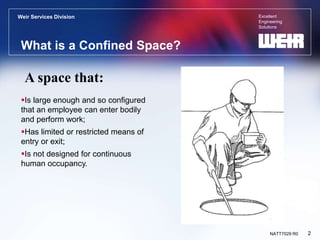
What is a Confined Space?
Is large enough and so configured
that an employee can enter bodily
and perform work;
Has limited or restricted means of
entry or exit;
Is not designed for continuous
human occupancy.
A space that:
Excellent
Engineering
Solutions
Weir Services Division
3
NATT7029 R0
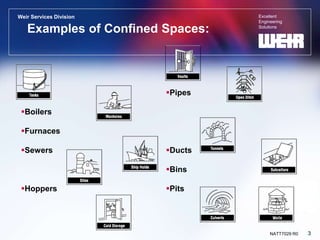
Examples of Confined Spaces:
Boilers
Furnaces
Sewers
Hoppers
Pipes
Ducts
Bins
Pits
Excellent
Engineering
Solutions
Weir Services Division
4
NATT7029 R0
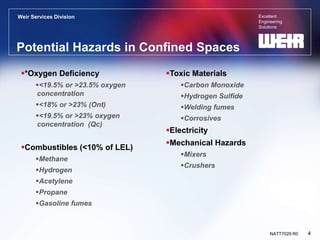
Potential Hazards in Confined Spaces
*Oxygen Deficiency
<19.5% or >23.5% oxygen
concentration
<18% or >23% (Ont)
<19.5% or >23% oxygen
concentration (Qc)
Combustibles (<10% of LEL)
Methane
Hydrogen
Acetylene
Propane
Gasoline fumes
Toxic Materials
Carbon Monoxide
Hydrogen Sulfide
Welding fumes
Corrosives
Electricity
Mechanical Hazards
Mixers
Crushers
Excellent
Engineering
Solutions
Weir Services Division
5
NATT7029 R0
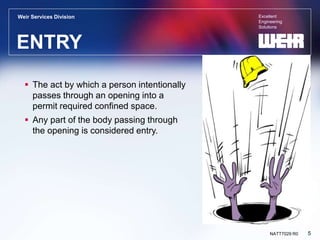
ENTRY
 The act by which a person intentionally
passes through an opening into a
permit required confined space.
 Any part of the body passing through
the opening is considered entry.
Excellent
Engineering
Solutions
Weir Services Division
6
NATT7029 R0
Remember the First Rule of
Emergency Response:
I Am Going Home Tonight.
Excellent
Engineering
Solutions
Weir Services Division
7
NATT7029 R0
Confined Space Entry
Definitions:
The entrant is the person who enters a confined space.
The attendant is the person who stays with the entrant
outside the confined space, and is responsible for assisting
the entrant in exiting the confined space, and calling for
emergency assistance when required.
The safety representative/competent person is the qualified
person who evaluates the hazards, prescribes required
equipment and precautions and issues the Confined Space
Entry Permit and is supported by the supervisor.
Excellent
Engineering
Solutions
Weir Services Division
8
NATT7029 R0
Entrant Responsibilities
 To assure that the space has been adequately ventilated,
isolated, emptied, or otherwise made safe for entry.
 To immediately exit a space, without question, upon word of
the attendant, no matter what the reason.
 To follow all safety rules and procedures that apply to the job.
 To be familiar with the work to be performed and the
procedures that apply to the job.
 To use the appropriate PPE whenever necessary.
Excellent
Engineering
Solutions
Weir Services Division
9
NATT7029 R0
Attendant Responsibilities
 To monitor entrants during the job and during entry & exit to help
insure their safety.
 The attendant may not abandon his post for any reason while personnel are in
the space unless relieved by another qualified attendant.
 To monitor atmospheric conditions in the space prior to and during
entry.
 To control access to the confined space.
 To summon emergency assistance as needed.
 To assess hazards in and around the space, and take action on the
same.
 To keep records of confined space work, such as air test results,
personnel entry/exit, etc.
Excellent
Engineering
Solutions
Weir Services Division
10
NATT7029 R0
Supervisor Responsibilities
 To assure adequate protection is provided to the entrants by
verifying adequate lockout/tagout and that all hazards are
securely isolated.
 To support the attendant’s authority in controlling access to a
confined space.
 To verify that all personnel have exited prior to closing the
space.
 To assure that all personnel involved are aware of the
hazards associated with the space.
 To assure that rescue services are available prior to entry.
Excellent
Engineering
Solutions
Weir Services Division
11
NATT7029 R0
Confined Space Entry - Hazards
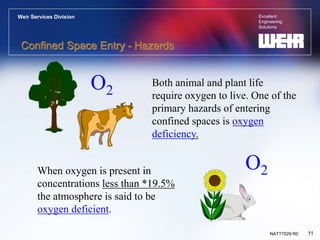
Both animal and plant life
require oxygen to live. One of the
primary hazards of entering
confined spaces is oxygen
deficiency.
When oxygen is present in
concentrations less than *19.5%
the atmosphere is said to be
oxygen deficient.
O2
O2
Excellent
Engineering
Solutions
Weir Services Division
12
NATT7029 R0
Confined Space Entry - Hazards
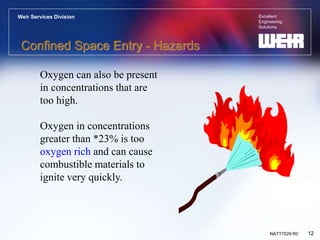
Oxygen can also be present
in concentrations that are
too high.
Oxygen in concentrations
greater than *23% is too
oxygen rich and can cause
combustible materials to
ignite very quickly.
Excellent
Engineering
Solutions
Weir Services Division
13
NATT7029 R0
Confined Space Entry - Hazards
CO2
O2
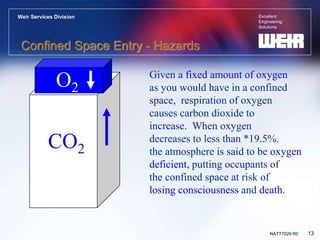
Given a fixed amount of oxygen
as you would have in a confined
space, respiration of oxygen
causes carbon dioxide to
increase. When oxygen
decreases to less than *19.5%.
the atmosphere is said to be oxygen
deficient, putting occupants of
the confined space at risk of
losing consciousness and death.
Excellent
Engineering
Solutions
Weir Services Division
14
NATT7029 R0
Confined Space Entry - Hazards
Processes which operate by the
principle of combustion use up
oxygen much faster than the
human respiration.
Products of combustion vary
with the fuel that is present and
the temperature of the combustion
reaction. Welding, burning natural
gas, propane, gasoline, and diesel
engines are examples of combustion
processes.
CO2
H20
NOx
CO
O2
fuel
Excellent
Engineering
Solutions
Weir Services Division
15
NATT7029 R0
Why do so many fatalities result from
emergency rescues?
Are overcome by their emotions.
Take unnecessary chances.
Do not know the hazards involved.
Lack confined space rescue training.
Rescuers:
Excellent
Engineering
Solutions
Weir Services Division
16
NATT7029 R0
IDLH
 IMMEDIATELY DANGEROUS TO LIFE OR HEALTH
 Any condition which poses an immediate threat to the health
of life on an entrant, or;
 Would cause irreversible adverse health effects, or;
 Would interfere with an individual’s ability to escape unaided
from a permit space.
Bottom Line:
Confined Space Operations require specialized training and
equipment. Know your limitations!
Don’t make a bad situation worse by becoming a victim
yourself.
Excellent
Engineering
Solutions
Weir Services Division
17
NATT7029 R0
Two Options for Entering
Confined Spaces:
Permit-required confined
space entry
Contains or has the
potential to contain a
hazardous atmosphere;
Contains a material that
has the potential for
engulfing an entrant;
Has an internal
configuration such that
an entrant could become
trapped or asphyxiated;
or
Contains any other
serious safety or health
hazard.
Non-permit confined
space entry
For non-hazardous
confined space work
Excellent
Engineering
Solutions
Weir Services Division
18
NATT7029 R0
Confined Space Entry Procedure
 Isolate the space
 Ventilate the space
 Conduct Meeting
 Complete permit
 Test the atmosphere
 Enter the space
Excellent
Engineering
Solutions
Weir Services Division
19
NATT7029 R0
Isolate the Space
from all hazards
 Close Valves
 Double block & bleed, or
 Blank flange
 Empty the Space
 Depressurize, vent & drain
 Lockout/Tagout Equipment
 Electrical sources
 Rotating/reciprocating parts
 Hazardous materials
 Clean residue from the space
Excellent
Engineering
Solutions
Weir Services Division
20
NATT7029 R0
Ventilate the Space
 Use mechanical ventilation
 Fans
 Air horns
 Ventilate at the rate of at least four (4)
volumes per hour
 Larger spaces require more ventilation
 Make sure air supply is not contaminated
 Ventilation air supply must be from fresh air
uncontaminated with flammables, toxins, etc.
Excellent
Engineering
Solutions
Weir Services Division
21
NATT7029 R0
Conduct a Briefing
 Entire crew must attend
 Attendants, entrants, entry supervisor
 Review hazards of entry and work
 Review PPE
 Review procedure for contacting rescue
 verify rescue available
 Complete permit
Excellent
Engineering
Solutions
Weir Services Division
22
NATT7029 R0
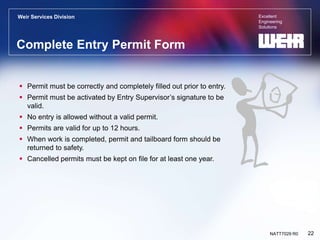
Complete Entry Permit Form
 Permit must be correctly and completely filled out prior to entry.
 Permit must be activated by Entry Supervisor’s signature to be
valid.
 No entry is allowed without a valid permit.
 Permits are valid for up to 12 hours.
 When work is completed, permit and tailboard form should be
returned to safety.
 Cancelled permits must be kept on file for at least one year.
Excellent
Engineering
Solutions
Weir Services Division
23
NATT7029 R0
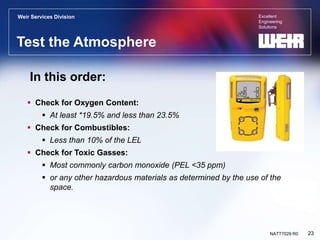
Test the Atmosphere
 Check for Oxygen Content:
 At least *19.5% and less than 23.5%
 Check for Combustibles:
 Less than 10% of the LEL
 Check for Toxic Gasses:
 Most commonly carbon monoxide (PEL <35 ppm)
 or any other hazardous materials as determined by the use of the
space.
In this order:
Excellent
Engineering
Solutions
Weir Services Division
24
NATT7029 R0
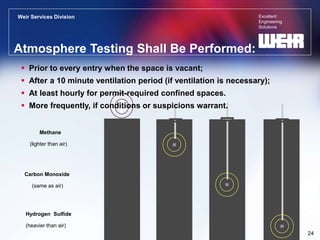
Hydrogen Sulfide
(heavier than air)
Carbon Monoxide
(same as air)
Methane
(lighter than air)
Atmosphere Testing Shall Be Performed:
 Prior to every entry when the space is vacant;
 After a 10 minute ventilation period (if ventilation is necessary);
 At least hourly for permit-required confined spaces.
 More frequently, if conditions or suspicions warrant.
Excellent
Engineering
Solutions
Weir Services Division
25
NATT7029 R0
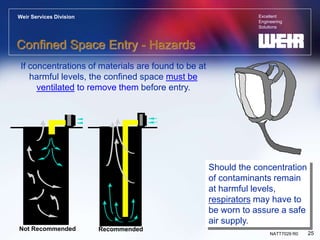
Confined Space Entry - Hazards
Not Recommended Recommended
If concentrations of materials are found to be at
harmful levels, the confined space must be
ventilated to remove them before entry.
Should the concentration
of contaminants remain
at harmful levels,
respirators may have to
be worn to assure a safe
air supply.
??
Excellent
Engineering
Solutions
Weir Services Division
26
NATT7029 R0
Confined Space Entry
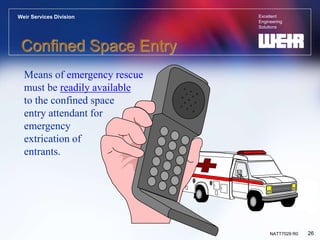
Means of emergency rescue
must be readily available
to the confined space
entry attendant for
emergency
extrication of
entrants.
Excellent
Engineering
Solutions
Weir Services Division
27
NATT7029 R0
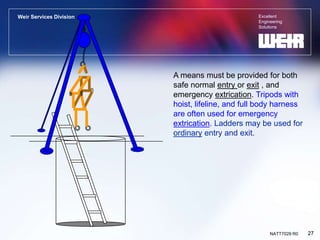
A means must be provided for both
safe normal entry or exit , and
emergency extrication. Tripods with
hoist, lifeline, and full body harness
are often used for emergency
extrication. Ladders may be used for
ordinary entry and exit.
Excellent
Engineering
Solutions
Weir Services Division
28
NATT7029 R0
Confined Space
Entry
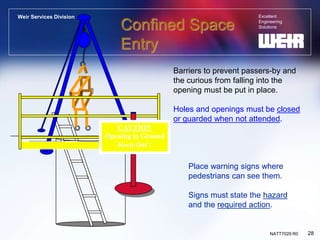
Place warning signs where
pedestrians can see them.
Signs must state the hazard
and the required action.
CAUTION
Opening in Ground
Keep Out !
Barriers to prevent passers-by and
the curious from falling into the
opening must be put in place.
Holes and openings must be closed
or guarded when not attended.
Excellent
Engineering
Solutions
Weir Services Division
29
NATT7029 R0
Enter the Space and Proceed with work:
 An attendant shall be posted near the entrance for the duration of
the work. He shall be in constant communication with the entrants
while the job is in progress.
 The attendant shall maintain the permit for the duration of the work.
When the Job is Done:
 Remove all personnel, tools, and debris from the space.
 Close the space.
 Cancel the permit.
 Review the job with the host employer (hazards, problems, other
employers, etc.)
Excellent
Engineering
Solutions
Weir Services Division
30
NATT7029 R0
So it might be a confined space,
but you went in anyway…..
Now What?
Excellent
Engineering
Solutions
Weir Services Division
31
NATT7029 R0
Self-Rescue
Remember the signs of
Oxygen Starvation…..
Headache
Nausea
Dizziness
If you begin to exhibit these symptoms…
Leave the area at once!
Excellent
Engineering
Solutions
Weir Services Division
32
NATT7029 R0
Confined Space Hazards
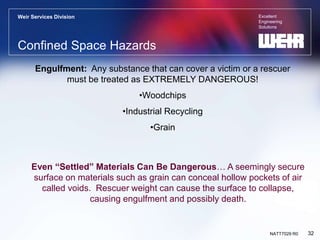
Engulfment: Any substance that can cover a victim or a rescuer
must be treated as EXTREMELY DANGEROUS!
•Woodchips
•Industrial Recycling
•Grain
Even “Settled” Materials Can Be Dangerous… A seemingly secure
surface on materials such as grain can conceal hollow pockets of air
called voids. Rescuer weight can cause the surface to collapse,
causing engulfment and possibly death.
Excellent
Engineering
Solutions
Weir Services Division
33
NATT7029 R0
The hard fact about any confined
space emergency…
If the victim has been without oxygen
for more than 10 minutes, it isn’t a
rescue, it’s a recovery.
Excellent
Engineering
Solutions
Weir Services Division
34
NATT7029 R0
Confined Space Entry - Summary
Confined space entry hazards can include:
- the presence of toxic substances
- insufficient oxygen, or too much oxygen
- engulfment
- presence of combustible gases and liquids
- process or equipment related hazards.
- conditions changing from nonhazardous
to hazardous.
Excellent
Engineering
Solutions
Weir Services Division
35
NATT7029 R0
Confined Space Entry -Summary
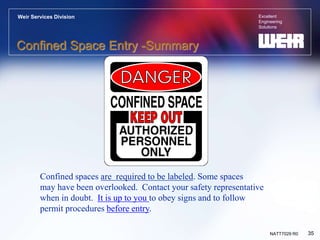
Confined spaces are required to be labeled. Some spaces
may have been overlooked. Contact your safety representative
when in doubt. It is up to you to obey signs and to follow
permit procedures before entry.
Excellent
Engineering
Solutions
Weir Services Division
36
NATT7029 R0

Confined space entry natt7029

  • 1.
  • 2.
    Excellent Engineering Solutions Weir Services Division 2 NATT7029R0 What is a Confined Space? Is large enough and so configured that an employee can enter bodily and perform work; Has limited or restricted means of entry or exit; Is not designed for continuous human occupancy. A space that:
  • 3.
    Excellent Engineering Solutions Weir Services Division 3 NATT7029R0 Examples of Confined Spaces: Boilers Furnaces Sewers Hoppers Pipes Ducts Bins Pits
  • 4.
    Excellent Engineering Solutions Weir Services Division 4 NATT7029R0 Potential Hazards in Confined Spaces *Oxygen Deficiency <19.5% or >23.5% oxygen concentration <18% or >23% (Ont) <19.5% or >23% oxygen concentration (Qc) Combustibles (<10% of LEL) Methane Hydrogen Acetylene Propane Gasoline fumes Toxic Materials Carbon Monoxide Hydrogen Sulfide Welding fumes Corrosives Electricity Mechanical Hazards Mixers Crushers
  • 5.
    Excellent Engineering Solutions Weir Services Division 5 NATT7029R0 ENTRY  The act by which a person intentionally passes through an opening into a permit required confined space.  Any part of the body passing through the opening is considered entry.
  • 6.
    Excellent Engineering Solutions Weir Services Division 6 NATT7029R0 Remember the First Rule of Emergency Response: I Am Going Home Tonight.
  • 7.
    Excellent Engineering Solutions Weir Services Division 7 NATT7029R0 Confined Space Entry Definitions: The entrant is the person who enters a confined space. The attendant is the person who stays with the entrant outside the confined space, and is responsible for assisting the entrant in exiting the confined space, and calling for emergency assistance when required. The safety representative/competent person is the qualified person who evaluates the hazards, prescribes required equipment and precautions and issues the Confined Space Entry Permit and is supported by the supervisor.
  • 8.
    Excellent Engineering Solutions Weir Services Division 8 NATT7029R0 Entrant Responsibilities  To assure that the space has been adequately ventilated, isolated, emptied, or otherwise made safe for entry.  To immediately exit a space, without question, upon word of the attendant, no matter what the reason.  To follow all safety rules and procedures that apply to the job.  To be familiar with the work to be performed and the procedures that apply to the job.  To use the appropriate PPE whenever necessary.
  • 9.
    Excellent Engineering Solutions Weir Services Division 9 NATT7029R0 Attendant Responsibilities  To monitor entrants during the job and during entry & exit to help insure their safety.  The attendant may not abandon his post for any reason while personnel are in the space unless relieved by another qualified attendant.  To monitor atmospheric conditions in the space prior to and during entry.  To control access to the confined space.  To summon emergency assistance as needed.  To assess hazards in and around the space, and take action on the same.  To keep records of confined space work, such as air test results, personnel entry/exit, etc.
  • 10.
    Excellent Engineering Solutions Weir Services Division 10 NATT7029R0 Supervisor Responsibilities  To assure adequate protection is provided to the entrants by verifying adequate lockout/tagout and that all hazards are securely isolated.  To support the attendant’s authority in controlling access to a confined space.  To verify that all personnel have exited prior to closing the space.  To assure that all personnel involved are aware of the hazards associated with the space.  To assure that rescue services are available prior to entry.
  • 11.
    Excellent Engineering Solutions Weir Services Division 11 NATT7029R0 Confined Space Entry - Hazards Both animal and plant life require oxygen to live. One of the primary hazards of entering confined spaces is oxygen deficiency. When oxygen is present in concentrations less than *19.5% the atmosphere is said to be oxygen deficient. O2 O2
  • 12.
    Excellent Engineering Solutions Weir Services Division 12 NATT7029R0 Confined Space Entry - Hazards Oxygen can also be present in concentrations that are too high. Oxygen in concentrations greater than *23% is too oxygen rich and can cause combustible materials to ignite very quickly.
  • 13.
    Excellent Engineering Solutions Weir Services Division 13 NATT7029R0 Confined Space Entry - Hazards CO2 O2 Given a fixed amount of oxygen as you would have in a confined space, respiration of oxygen causes carbon dioxide to increase. When oxygen decreases to less than *19.5%. the atmosphere is said to be oxygen deficient, putting occupants of the confined space at risk of losing consciousness and death.
  • 14.
    Excellent Engineering Solutions Weir Services Division 14 NATT7029R0 Confined Space Entry - Hazards Processes which operate by the principle of combustion use up oxygen much faster than the human respiration. Products of combustion vary with the fuel that is present and the temperature of the combustion reaction. Welding, burning natural gas, propane, gasoline, and diesel engines are examples of combustion processes. CO2 H20 NOx CO O2 fuel
  • 15.
    Excellent Engineering Solutions Weir Services Division 15 NATT7029R0 Why do so many fatalities result from emergency rescues? Are overcome by their emotions. Take unnecessary chances. Do not know the hazards involved. Lack confined space rescue training. Rescuers:
  • 16.
    Excellent Engineering Solutions Weir Services Division 16 NATT7029R0 IDLH  IMMEDIATELY DANGEROUS TO LIFE OR HEALTH  Any condition which poses an immediate threat to the health of life on an entrant, or;  Would cause irreversible adverse health effects, or;  Would interfere with an individual’s ability to escape unaided from a permit space. Bottom Line: Confined Space Operations require specialized training and equipment. Know your limitations! Don’t make a bad situation worse by becoming a victim yourself.
  • 17.
    Excellent Engineering Solutions Weir Services Division 17 NATT7029R0 Two Options for Entering Confined Spaces: Permit-required confined space entry Contains or has the potential to contain a hazardous atmosphere; Contains a material that has the potential for engulfing an entrant; Has an internal configuration such that an entrant could become trapped or asphyxiated; or Contains any other serious safety or health hazard. Non-permit confined space entry For non-hazardous confined space work
  • 18.
    Excellent Engineering Solutions Weir Services Division 18 NATT7029R0 Confined Space Entry Procedure  Isolate the space  Ventilate the space  Conduct Meeting  Complete permit  Test the atmosphere  Enter the space
  • 19.
    Excellent Engineering Solutions Weir Services Division 19 NATT7029R0 Isolate the Space from all hazards  Close Valves  Double block & bleed, or  Blank flange  Empty the Space  Depressurize, vent & drain  Lockout/Tagout Equipment  Electrical sources  Rotating/reciprocating parts  Hazardous materials  Clean residue from the space
  • 20.
    Excellent Engineering Solutions Weir Services Division 20 NATT7029R0 Ventilate the Space  Use mechanical ventilation  Fans  Air horns  Ventilate at the rate of at least four (4) volumes per hour  Larger spaces require more ventilation  Make sure air supply is not contaminated  Ventilation air supply must be from fresh air uncontaminated with flammables, toxins, etc.
  • 21.
    Excellent Engineering Solutions Weir Services Division 21 NATT7029R0 Conduct a Briefing  Entire crew must attend  Attendants, entrants, entry supervisor  Review hazards of entry and work  Review PPE  Review procedure for contacting rescue  verify rescue available  Complete permit
  • 22.
    Excellent Engineering Solutions Weir Services Division 22 NATT7029R0 Complete Entry Permit Form  Permit must be correctly and completely filled out prior to entry.  Permit must be activated by Entry Supervisor’s signature to be valid.  No entry is allowed without a valid permit.  Permits are valid for up to 12 hours.  When work is completed, permit and tailboard form should be returned to safety.  Cancelled permits must be kept on file for at least one year.
  • 23.
    Excellent Engineering Solutions Weir Services Division 23 NATT7029R0 Test the Atmosphere  Check for Oxygen Content:  At least *19.5% and less than 23.5%  Check for Combustibles:  Less than 10% of the LEL  Check for Toxic Gasses:  Most commonly carbon monoxide (PEL <35 ppm)  or any other hazardous materials as determined by the use of the space. In this order:
  • 24.
    Excellent Engineering Solutions Weir Services Division 24 NATT7029R0 Hydrogen Sulfide (heavier than air) Carbon Monoxide (same as air) Methane (lighter than air) Atmosphere Testing Shall Be Performed:  Prior to every entry when the space is vacant;  After a 10 minute ventilation period (if ventilation is necessary);  At least hourly for permit-required confined spaces.  More frequently, if conditions or suspicions warrant.
  • 25.
    Excellent Engineering Solutions Weir Services Division 25 NATT7029R0 Confined Space Entry - Hazards Not Recommended Recommended If concentrations of materials are found to be at harmful levels, the confined space must be ventilated to remove them before entry. Should the concentration of contaminants remain at harmful levels, respirators may have to be worn to assure a safe air supply. ??
  • 26.
    Excellent Engineering Solutions Weir Services Division 26 NATT7029R0 Confined Space Entry Means of emergency rescue must be readily available to the confined space entry attendant for emergency extrication of entrants.
  • 27.
    Excellent Engineering Solutions Weir Services Division 27 NATT7029R0 A means must be provided for both safe normal entry or exit , and emergency extrication. Tripods with hoist, lifeline, and full body harness are often used for emergency extrication. Ladders may be used for ordinary entry and exit.
  • 28.
    Excellent Engineering Solutions Weir Services Division 28 NATT7029R0 Confined Space Entry Place warning signs where pedestrians can see them. Signs must state the hazard and the required action. CAUTION Opening in Ground Keep Out ! Barriers to prevent passers-by and the curious from falling into the opening must be put in place. Holes and openings must be closed or guarded when not attended.
  • 29.
    Excellent Engineering Solutions Weir Services Division 29 NATT7029R0 Enter the Space and Proceed with work:  An attendant shall be posted near the entrance for the duration of the work. He shall be in constant communication with the entrants while the job is in progress.  The attendant shall maintain the permit for the duration of the work. When the Job is Done:  Remove all personnel, tools, and debris from the space.  Close the space.  Cancel the permit.  Review the job with the host employer (hazards, problems, other employers, etc.)
  • 30.
    Excellent Engineering Solutions Weir Services Division 30 NATT7029R0 So it might be a confined space, but you went in anyway….. Now What?
  • 31.
    Excellent Engineering Solutions Weir Services Division 31 NATT7029R0 Self-Rescue Remember the signs of Oxygen Starvation….. Headache Nausea Dizziness If you begin to exhibit these symptoms… Leave the area at once!
  • 32.
    Excellent Engineering Solutions Weir Services Division 32 NATT7029R0 Confined Space Hazards Engulfment: Any substance that can cover a victim or a rescuer must be treated as EXTREMELY DANGEROUS! •Woodchips •Industrial Recycling •Grain Even “Settled” Materials Can Be Dangerous… A seemingly secure surface on materials such as grain can conceal hollow pockets of air called voids. Rescuer weight can cause the surface to collapse, causing engulfment and possibly death.
  • 33.
    Excellent Engineering Solutions Weir Services Division 33 NATT7029R0 The hard fact about any confined space emergency… If the victim has been without oxygen for more than 10 minutes, it isn’t a rescue, it’s a recovery.
  • 34.
    Excellent Engineering Solutions Weir Services Division 34 NATT7029R0 Confined Space Entry - Summary Confined space entry hazards can include: - the presence of toxic substances - insufficient oxygen, or too much oxygen - engulfment - presence of combustible gases and liquids - process or equipment related hazards. - conditions changing from nonhazardous to hazardous.
  • 35.
    Excellent Engineering Solutions Weir Services Division 35 NATT7029R0 Confined Space Entry -Summary Confined spaces are required to be labeled. Some spaces may have been overlooked. Contact your safety representative when in doubt. It is up to you to obey signs and to follow permit procedures before entry.
  • 36.

Editor's Notes

  • #3 All jurisdictions have regulations governing entry into confined spaces. Generally, OHS Codes define the term confined space to mean an enclosed or partially enclosed space that is not designed or intended for continuous human occupancy, that has a restricted means of entry or exit, and that can become hazardous to a worker entering it because of its design, construction, location or atmosphere; or the work activities, materials or substances in it; and because the provision of first aid, evacuation, rescue or other emergency response service is compromised; or there are other hazards relating to it.
  • #18 The basic requirements for entry into confined space are that the space must be tested for hazardous gases and fumes before entry and, if dangerous or flammable fumes are present, the space must be purged and provided with ventilation to prevent the accumulation of harmful gases. All pipelines containing hazardous substances leading into a confined space must be blocked off or disconnected. Where purging or ventilation is impracticable, workers must wear proper respiratory equipment. All workers entering confined spaces must be equipped with life belts and lifelines and must be watched by another worker outside the space who is capable of rescuing them from the confined spaces. In Ontario, under subsection 62(4) of the Construction Projects Regulation, R.R.O. 1990, Reg. 213/91, a person trained in artificial respiration and equipped and able to perform rescue operations must be readily available outside the confined space while a worker is inside it. In the federal jurisdiction, the OHS Regulations require a consultation with the safety and health committee (or appropriate representative) during the development of safe entry procedures, and requirements for hazard assessments prior to the development of procedures (OHS Regs. ss. 11.2; 11.3).
  • #25 Always test the air at various levels to be sure that the entire space is safe. Good air near the opening does NOT mean there is good air at the bottom!
  • #30 Any time a limit is exceeded, no matter what the reason, all personnel shall immediately exit the space, and no others shall enter until atmospheric conditions are returned to safe levels. THERE ARE NO EXCEPTIONS TO THIS!
  • #31 Of course, if you aren’t equipped to go in to a suspect space, you should stay out, but some spaces don’t have signs. Sometimes we act first and don’t properly assess the scene. Whatever happened, you’re in – now what?
  • #32 Judgment is one of the first elements to be effected by oxygen deprivation. If you get in a situation where you may become unconscious, you MUST evacuate immediately. Due to the nature of confined spaces, even a conscious victim may not be able to negotiate an exit like a manhole or an access hatch, may not be able to climb a ladder.