Starter
• Answer these questions, you can use p.149 to prompt
your memory.
• A solution of NaOH has a concentration of 0.15 mol
dm-3. What is the pH?
• A solution of Ca(OH)2 has a concentration of 2 mol
dm-3. What is the pH?
• A solution of KOH has a concentration of 0.5 mol dm-3.
What is the pH?
Titrations
•What happens during a titration?
•Titrations measure the volume of one
solution that reacts exactly with a known
volume of the other solutions.
Key Terms
•When you carry out a simple acid-base titration,
you use an indicator to tell you when you have
the acid and alkali mixed in exactly the right
proportions to "neutralize" each other.
•When the indicator changes color, this is often
described as the end point of the titration.
Key Terms
•In an ideal world, the color change would
happen when you mix the two solutions
together in exactly equation proportions.
•That particular mixture is known as
the equivalence point. This does not always
happen at the end point.
Key Terms
•The neutral point of a reaction, is when
the pH is 7.
•However, not all salts have a pH of 7 so
this expression should be avoided.
Titration Curves
•The pH is measured successively after the
addition of small volumes from the burette,
using a pH meter.
•Alternatively the pH can be data logged
continuously and a titration curve plotted by a
computer.
Titration Curves
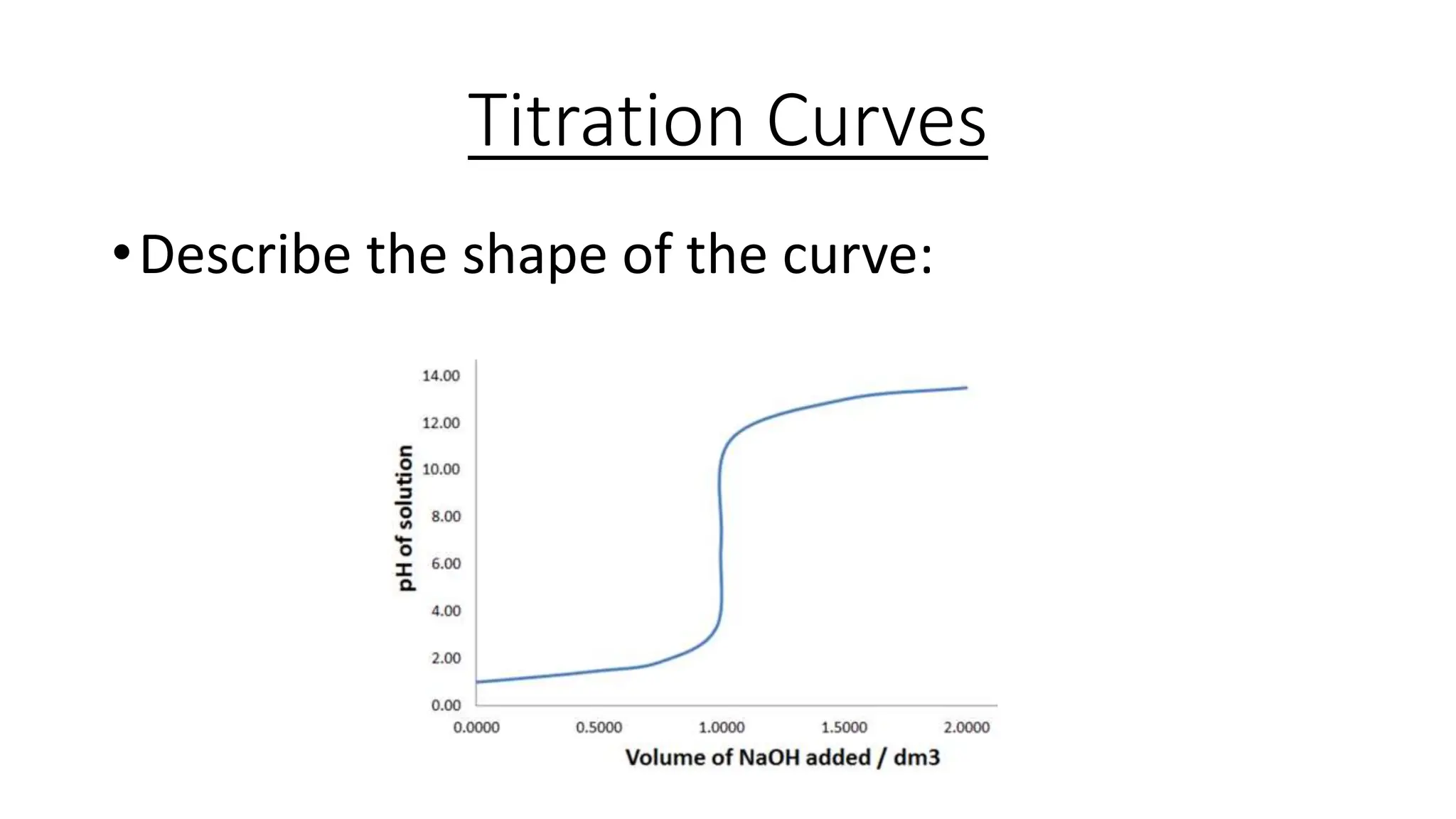
•Describe the shape of the curve:
Titration Curves
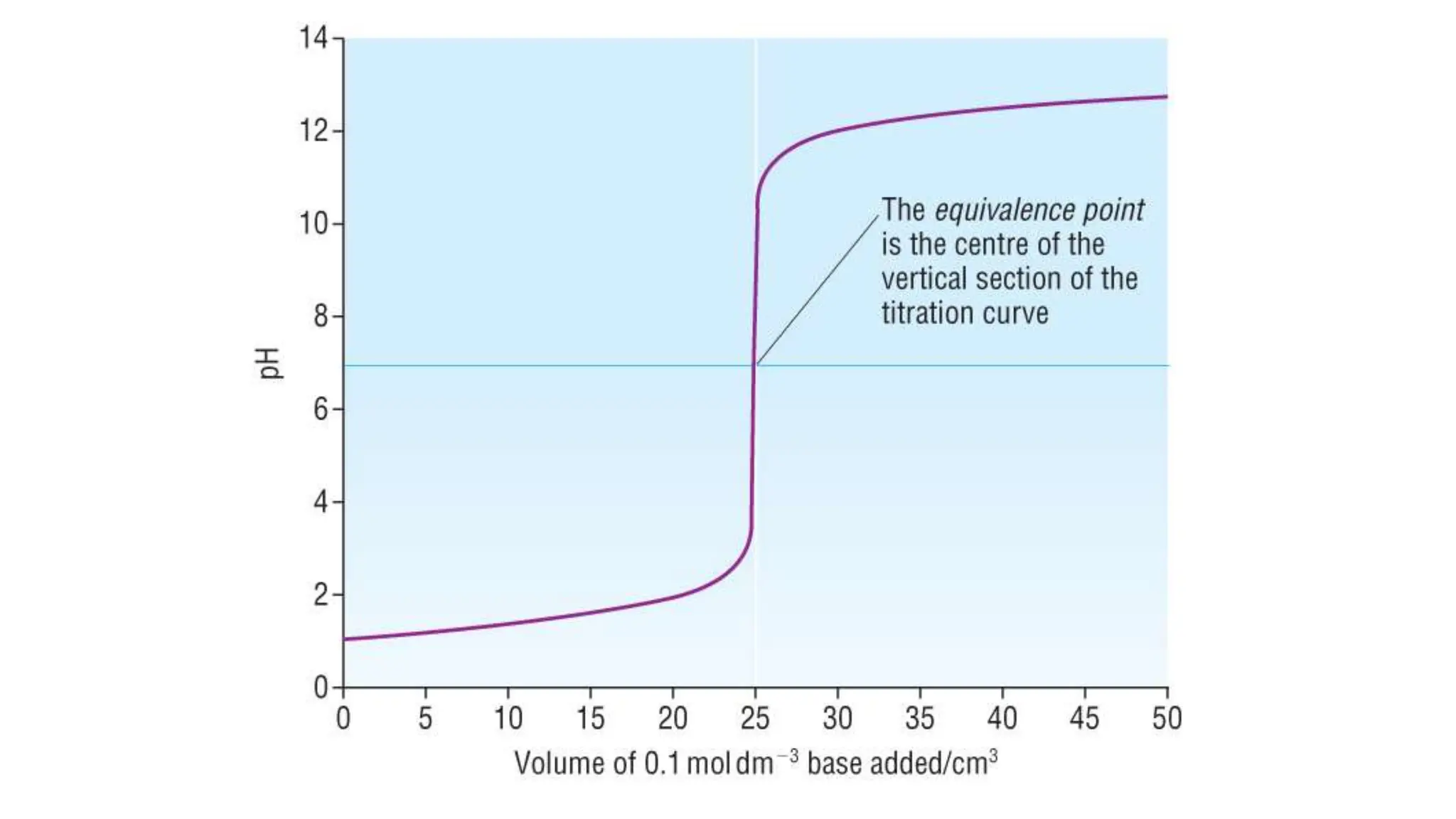
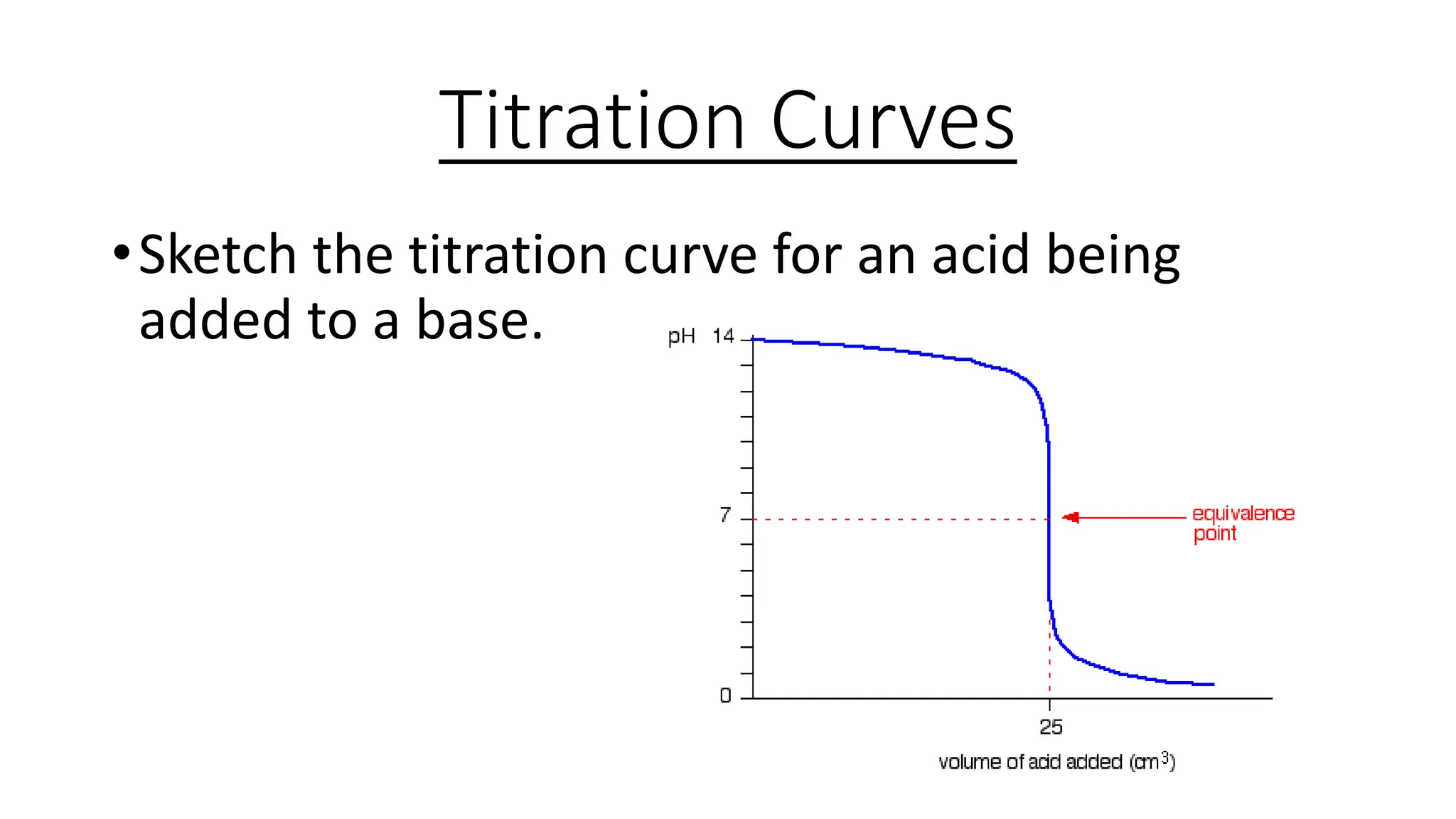
• Slight rise in pH: When the base is first added, the pH
increases very slightly as the acid is in great excess.
• Sharp rise in pH: Within 1-2cm3 of the equivalence point the
pH starts to increase more quickly. Only small excess of acid.
Eventually there is a very sharp increase in pH brought about
by a very small addition of base (1 drop). This shows as a
vertical section. The equivalence point is at the center of the
vertical section.
• Slight rise in pH: As further base is added, there is little
additional change in pH as the base is in great excess.
Titration Curves
•Sketch the titration curve for an acid being
added to a base.
Titration Curves
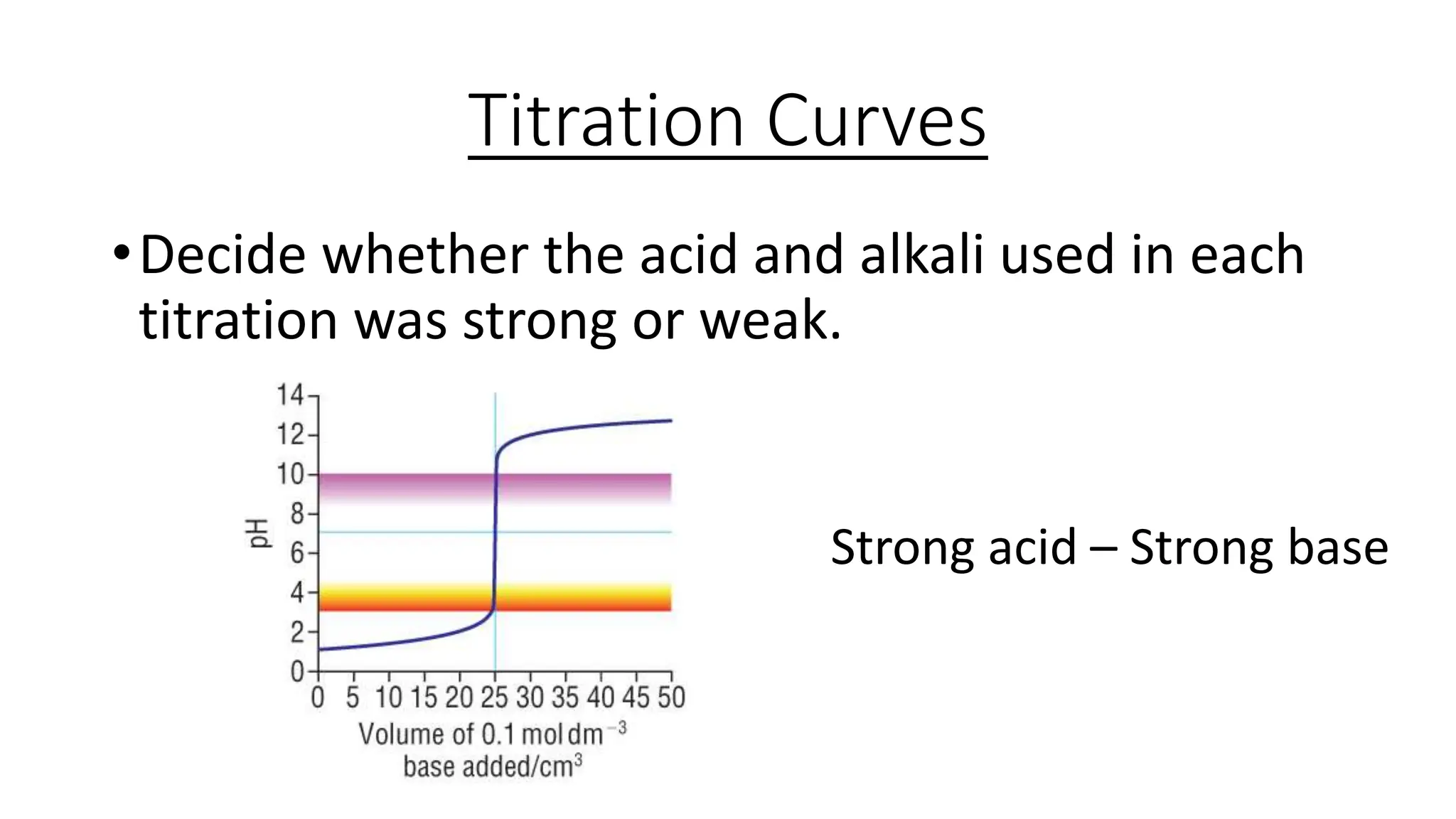
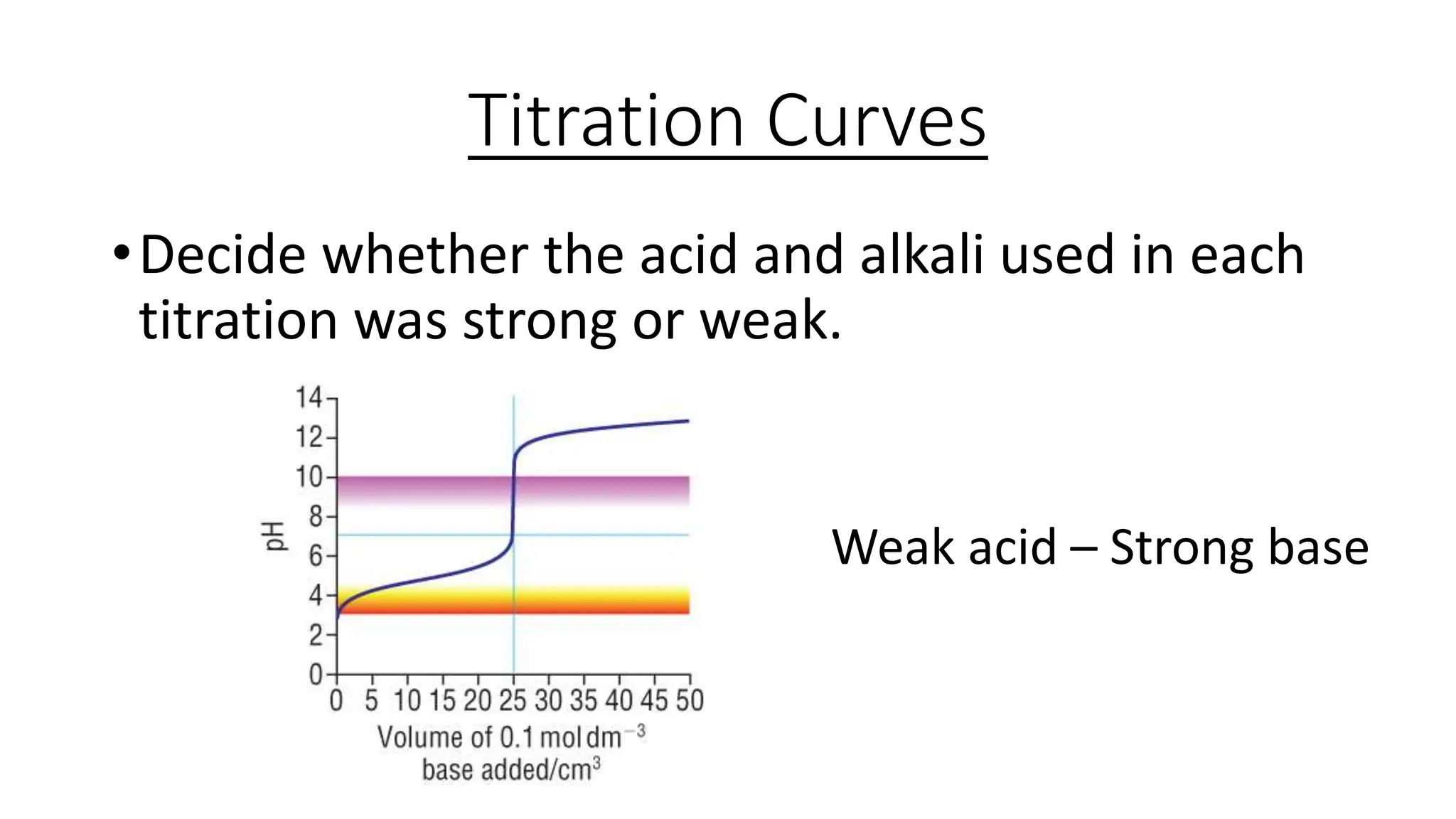
•Decide whether the acid and alkali used in each
titration was strong or weak.
Weak acid – Strong base
Titration Curves
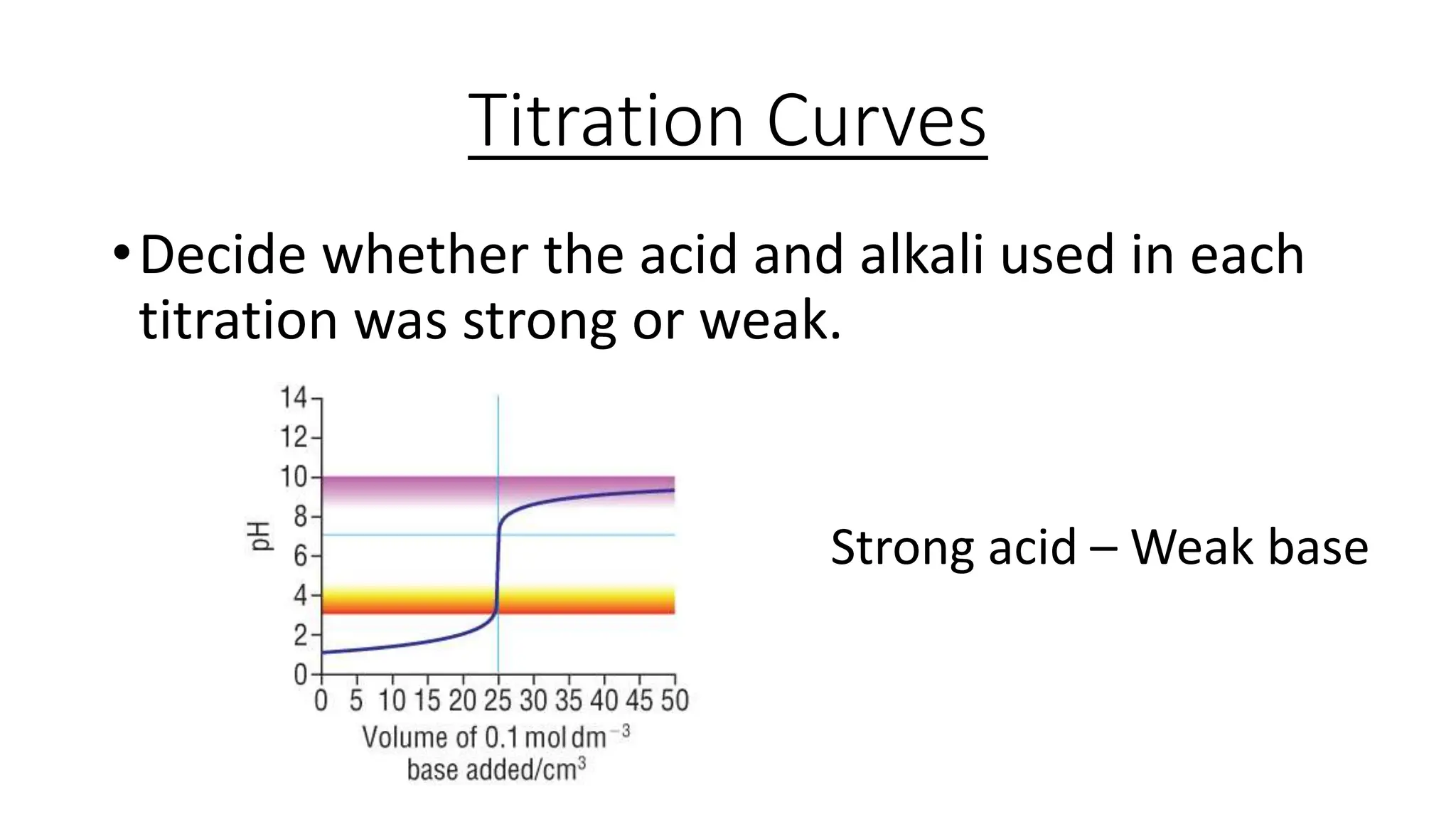
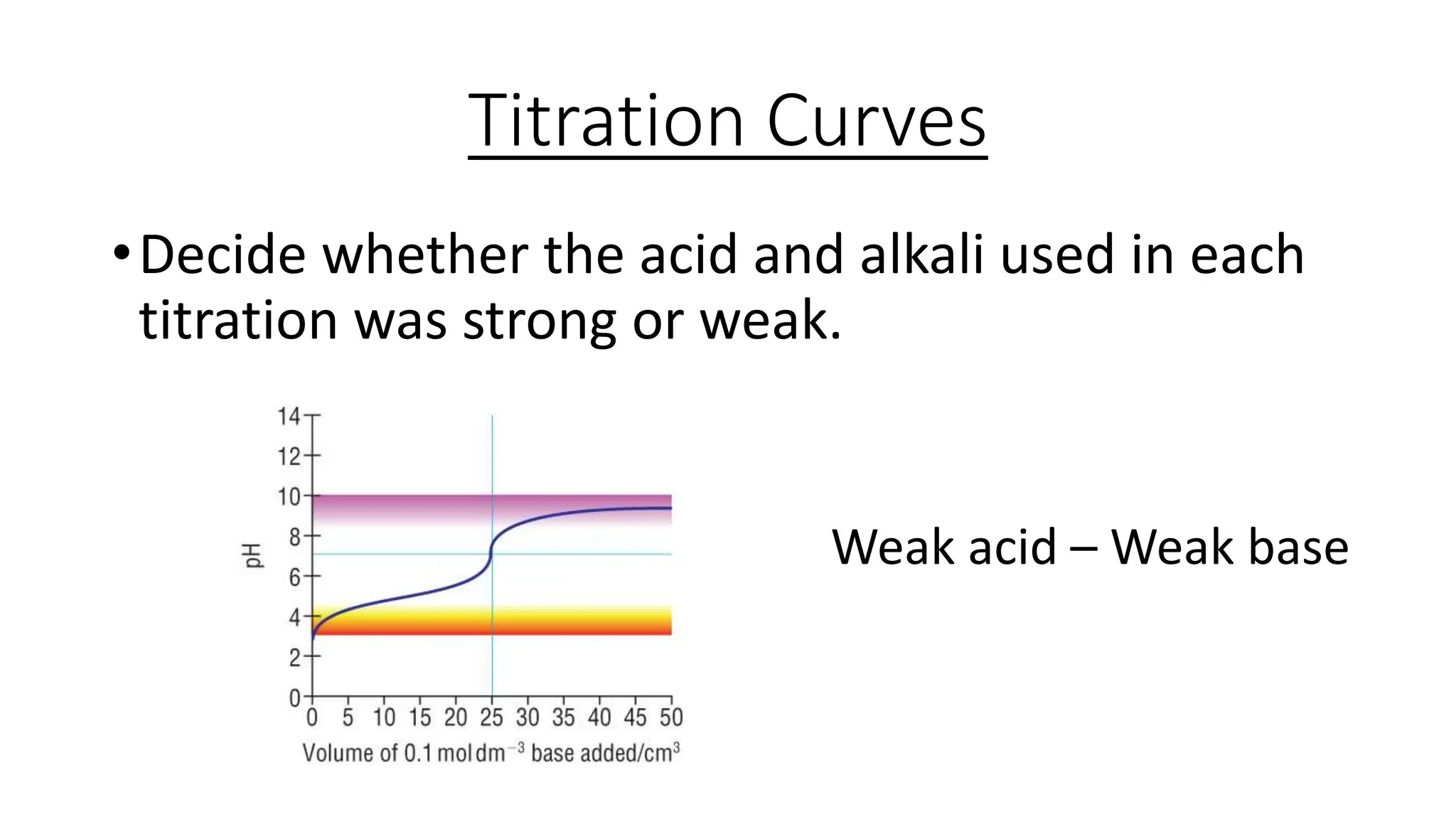
•Decide whether the acid and alkali used in each
titration was strong or weak.
Weak acid – Weak base
Titration Curves
•Decide whether the acid and alkali used in each
titration was strong or weak.
Strong acid – Strong base
Titration Curves
•Decide whether the acid and alkali used in each
titration was strong or weak.
Strong acid – Weak base
Indicators
•An acid-base indicator is a weak acid, often
represented as HIn. An indicator has one color in
its acid form (HIn) and a different color in its
conjugate base form (In-)
Indicators
•For methyl orange, HIn is red and In- is yellow:
H+ +
•When there are equal amounts of the weak
acid and the conjugate base present:
•[HIn] = [In-] The indicator is at its end point.
Indicators
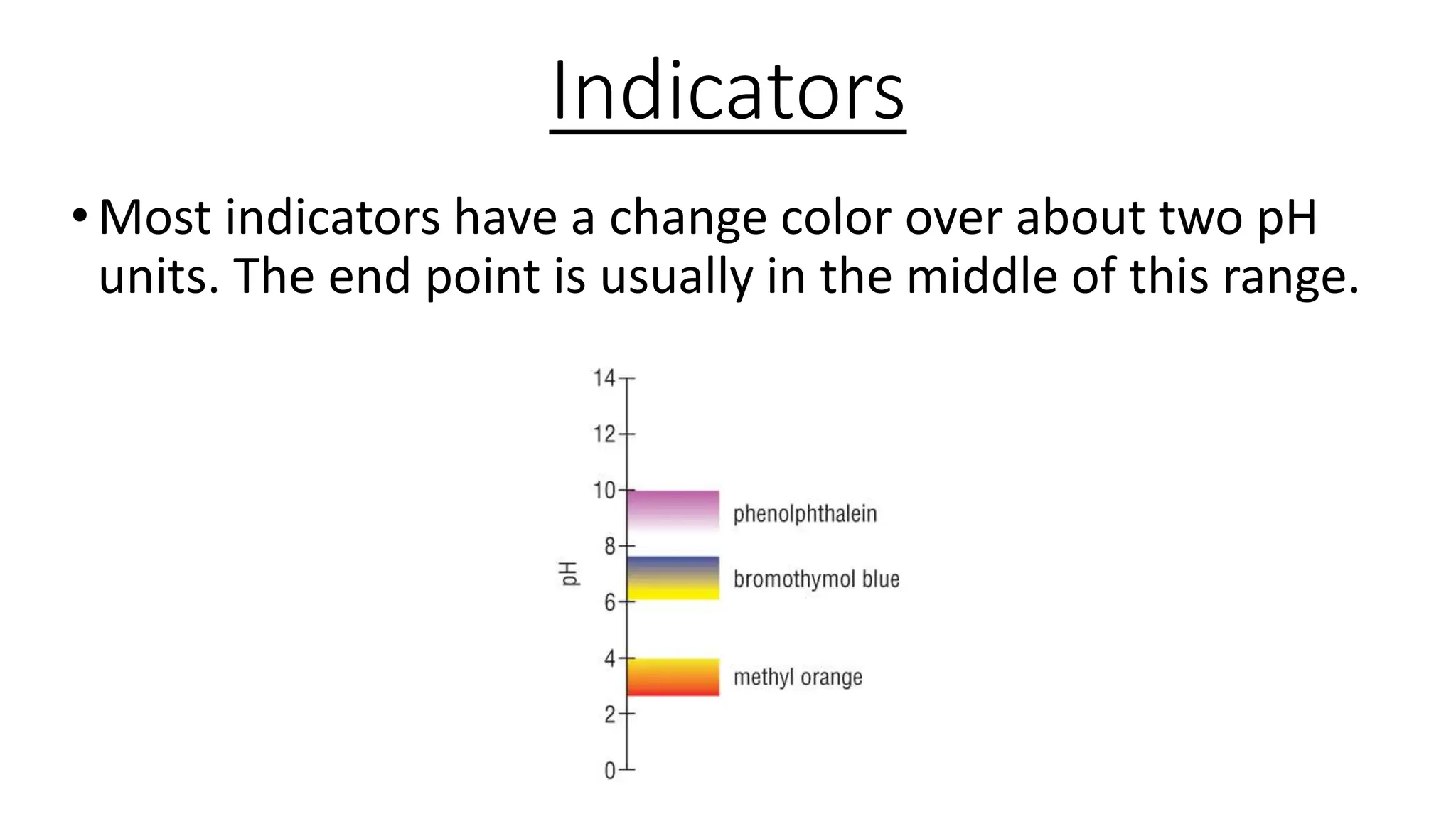
•Most indicators have a change color over about two pH
units. The end point is usually in the middle of this range.
Choosing an Indicator
•Indicators are chosen so that the pH value of the
end point is as close as possible to the pH value
of the titration’s equivalence point.
•A suitable pH indicator changes color within the
pH range of the vertical section of the titration
curve, often with just a single drop of the base.
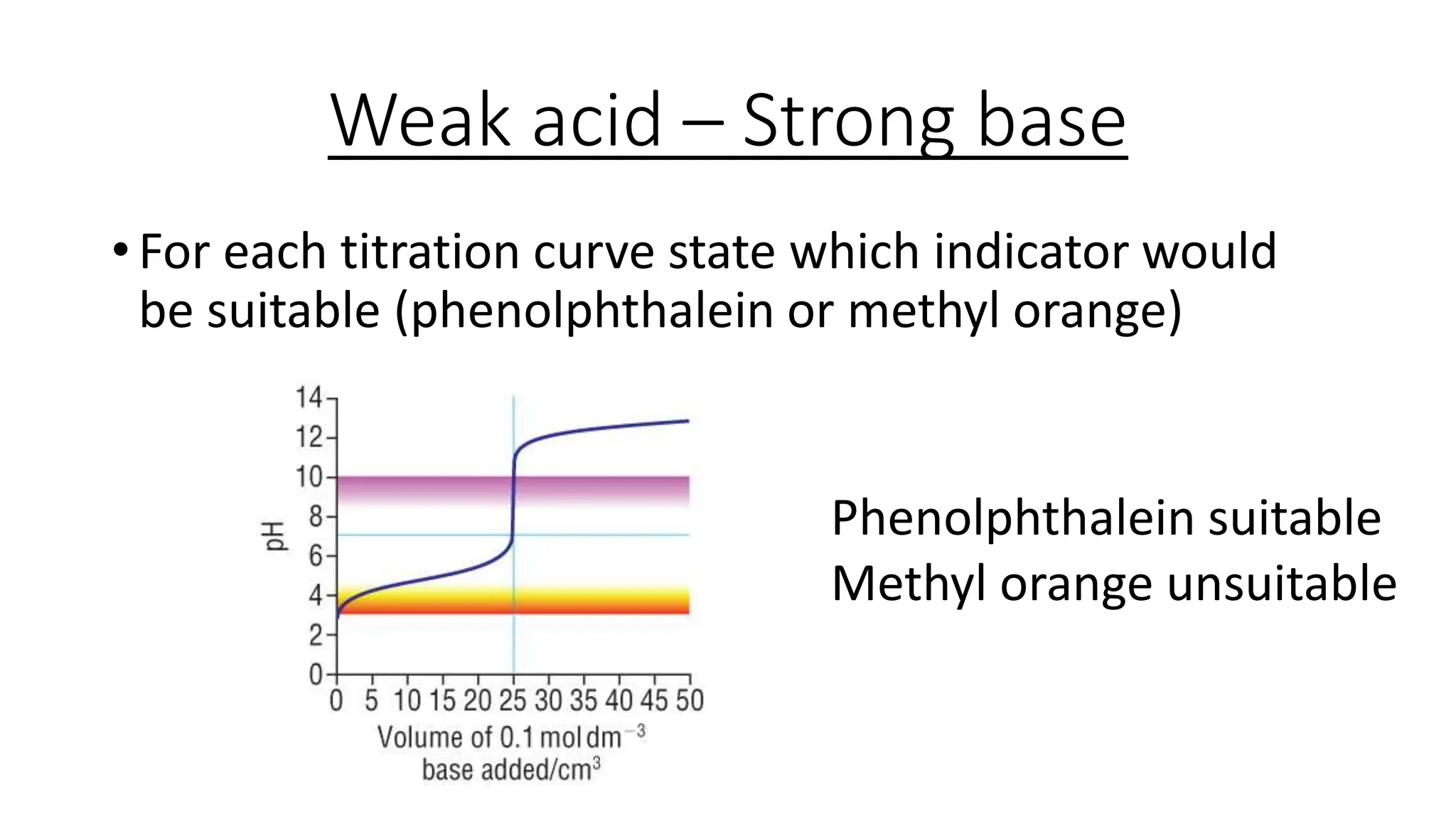
Weak acid – Strong base
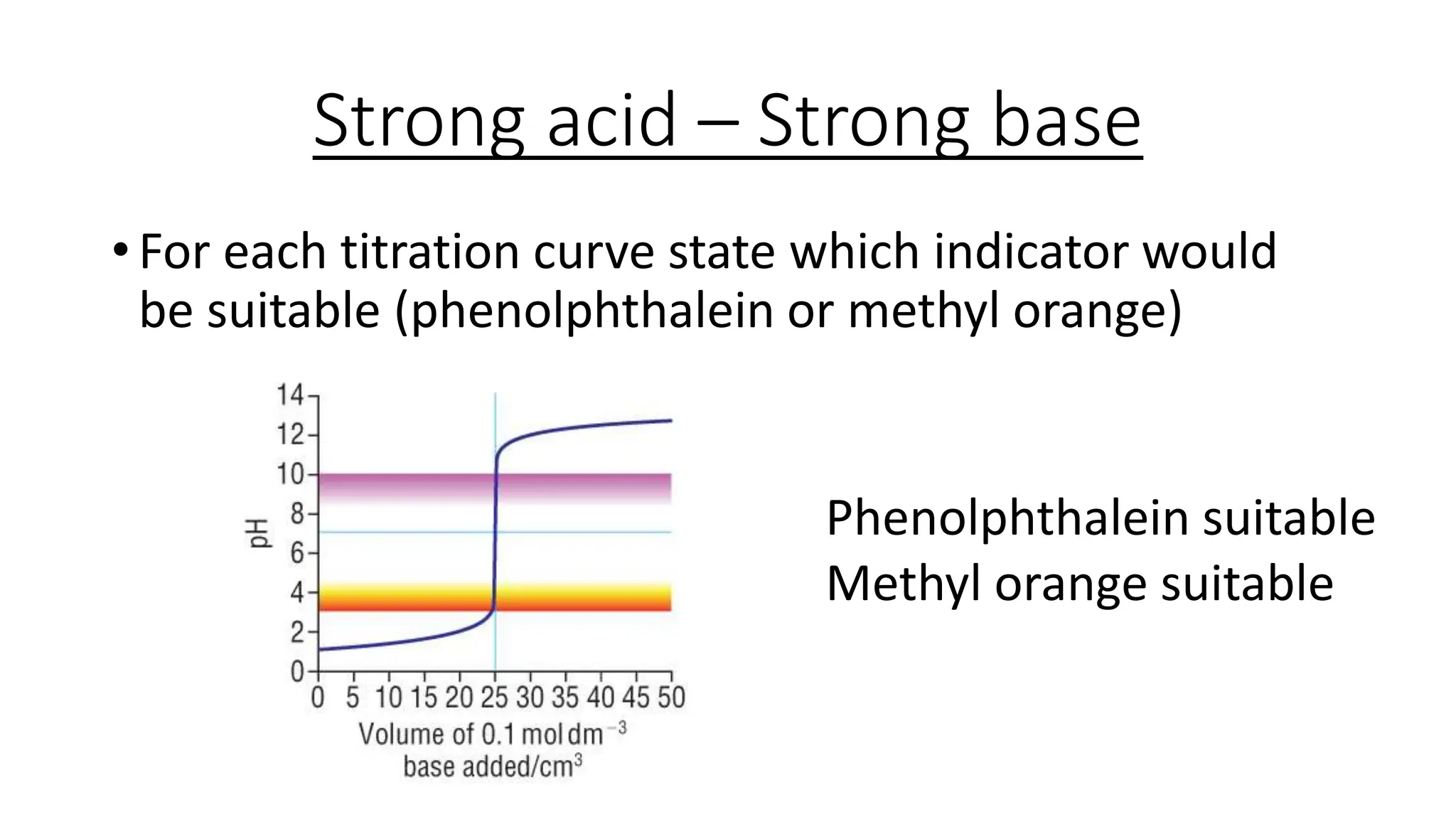
• For each titration curve state which indicator would
be suitable (phenolphthalein or methyl orange)
Phenolphthalein suitable
Methyl orange unsuitable
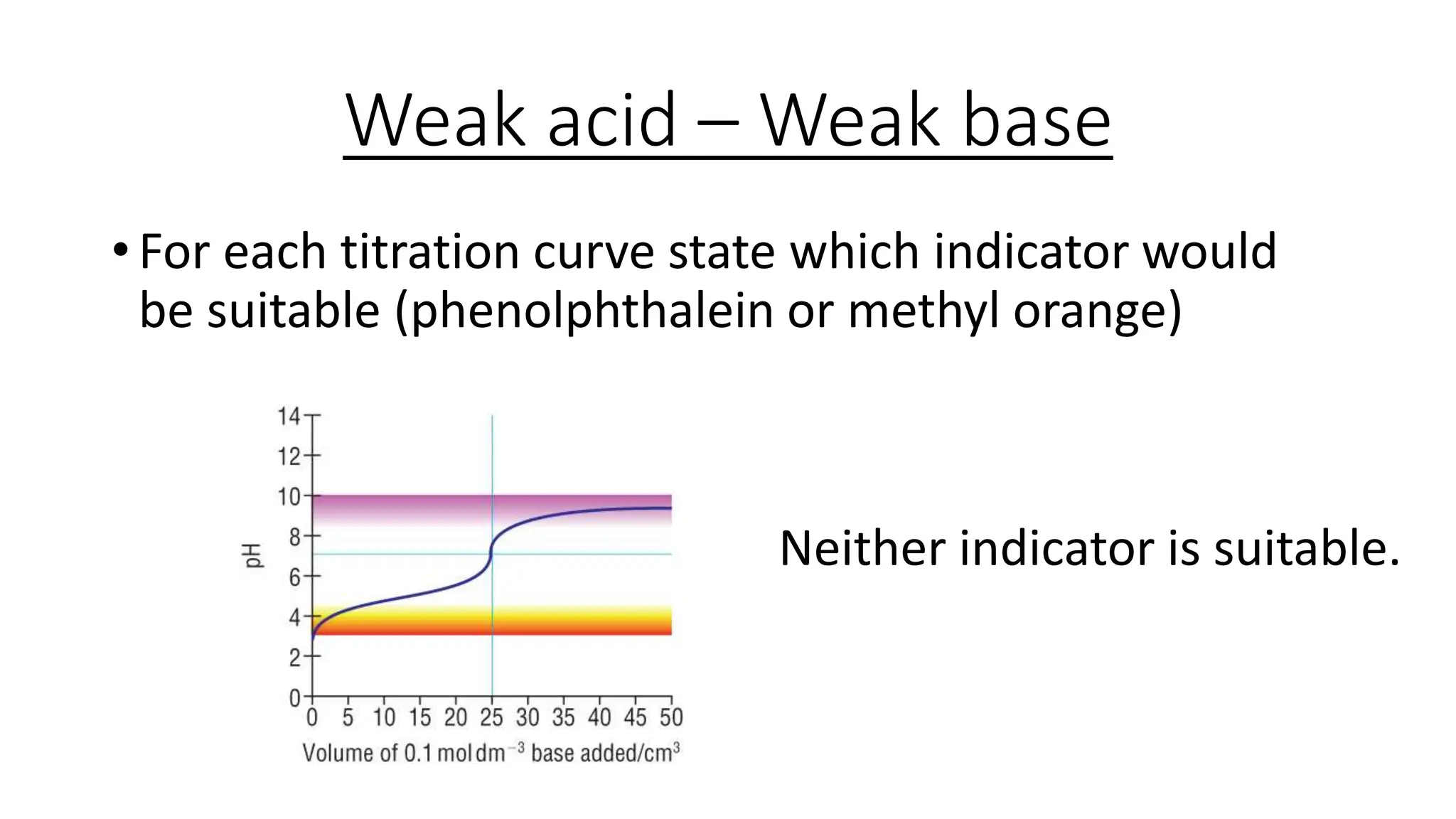
Weak acid – Weak base
• For each titration curve state which indicator would
be suitable (phenolphthalein or methyl orange)
Neither indicator is suitable.
Strong acid – Strong base
• For each titration curve state which indicator would
be suitable (phenolphthalein or methyl orange)
Phenolphthalein suitable
Methyl orange suitable
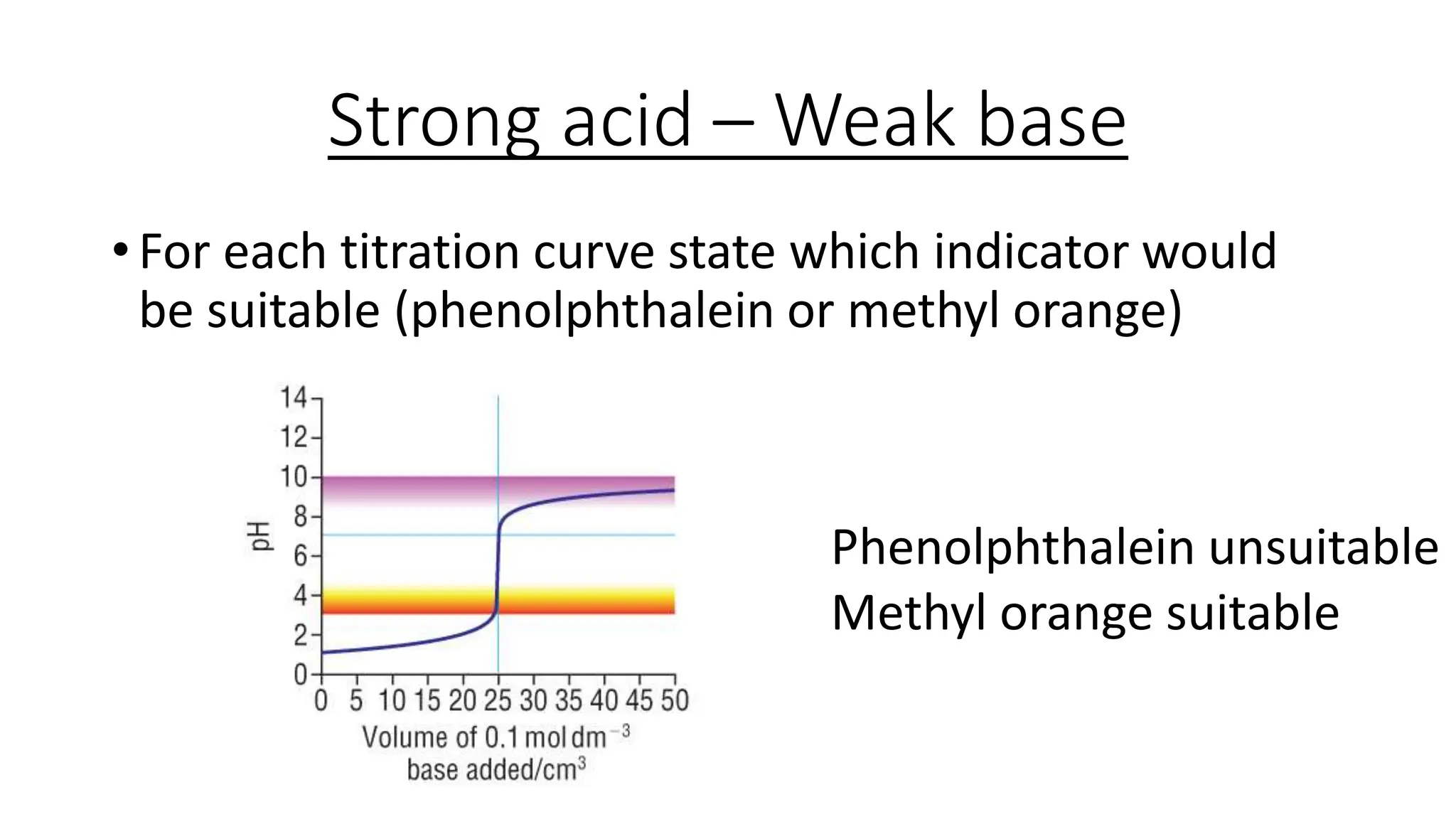
Strong acid – Weak base
• For each titration curve state which indicator would
be suitable (phenolphthalein or methyl orange)
Phenolphthalein unsuitable
Methyl orange suitable

Titration-curves.pptx

  • 1.
    Starter • Answer thesequestions, you can use p.149 to prompt your memory. • A solution of NaOH has a concentration of 0.15 mol dm-3. What is the pH? • A solution of Ca(OH)2 has a concentration of 2 mol dm-3. What is the pH? • A solution of KOH has a concentration of 0.5 mol dm-3. What is the pH?
  • 2.
    Titrations •What happens duringa titration? •Titrations measure the volume of one solution that reacts exactly with a known volume of the other solutions.
  • 3.
    Key Terms •When youcarry out a simple acid-base titration, you use an indicator to tell you when you have the acid and alkali mixed in exactly the right proportions to "neutralize" each other. •When the indicator changes color, this is often described as the end point of the titration.
  • 4.
    Key Terms •In anideal world, the color change would happen when you mix the two solutions together in exactly equation proportions. •That particular mixture is known as the equivalence point. This does not always happen at the end point.
  • 5.
    Key Terms •The neutralpoint of a reaction, is when the pH is 7. •However, not all salts have a pH of 7 so this expression should be avoided.
  • 6.
    Titration Curves •The pHis measured successively after the addition of small volumes from the burette, using a pH meter. •Alternatively the pH can be data logged continuously and a titration curve plotted by a computer.
  • 7.
  • 8.
    Titration Curves • Slightrise in pH: When the base is first added, the pH increases very slightly as the acid is in great excess. • Sharp rise in pH: Within 1-2cm3 of the equivalence point the pH starts to increase more quickly. Only small excess of acid. Eventually there is a very sharp increase in pH brought about by a very small addition of base (1 drop). This shows as a vertical section. The equivalence point is at the center of the vertical section. • Slight rise in pH: As further base is added, there is little additional change in pH as the base is in great excess.
  • 10.
    Titration Curves •Sketch thetitration curve for an acid being added to a base.
  • 11.
    Titration Curves •Decide whetherthe acid and alkali used in each titration was strong or weak. Weak acid – Strong base
  • 12.
    Titration Curves •Decide whetherthe acid and alkali used in each titration was strong or weak. Weak acid – Weak base
  • 13.
    Titration Curves •Decide whetherthe acid and alkali used in each titration was strong or weak. Strong acid – Strong base
  • 14.
    Titration Curves •Decide whetherthe acid and alkali used in each titration was strong or weak. Strong acid – Weak base
  • 15.
    Indicators •An acid-base indicatoris a weak acid, often represented as HIn. An indicator has one color in its acid form (HIn) and a different color in its conjugate base form (In-)
  • 16.
    Indicators •For methyl orange,HIn is red and In- is yellow: H+ + •When there are equal amounts of the weak acid and the conjugate base present: •[HIn] = [In-] The indicator is at its end point.
  • 17.
    Indicators •Most indicators havea change color over about two pH units. The end point is usually in the middle of this range.
  • 18.
    Choosing an Indicator •Indicatorsare chosen so that the pH value of the end point is as close as possible to the pH value of the titration’s equivalence point. •A suitable pH indicator changes color within the pH range of the vertical section of the titration curve, often with just a single drop of the base.
  • 19.
    Weak acid –Strong base • For each titration curve state which indicator would be suitable (phenolphthalein or methyl orange) Phenolphthalein suitable Methyl orange unsuitable
  • 20.
    Weak acid –Weak base • For each titration curve state which indicator would be suitable (phenolphthalein or methyl orange) Neither indicator is suitable.
  • 21.
    Strong acid –Strong base • For each titration curve state which indicator would be suitable (phenolphthalein or methyl orange) Phenolphthalein suitable Methyl orange suitable
  • 22.
    Strong acid –Weak base • For each titration curve state which indicator would be suitable (phenolphthalein or methyl orange) Phenolphthalein unsuitable Methyl orange suitable