UNIT - ONE
INTRODUCTION TO
ELECTROCHEMISTRY
By Brhane Amha
ELECTROCHEMISTRY
• Electrochemistry is the branch of chemistry concerned with the interrelation of
electrical and chemical effects.
• A large part of this field deals with the study of chemical changes caused by the
passage of an electric current and the production of electrical energy by
chemical reactions.
• The study of the inter-conversion of chemical energy and electrical energy
• The study of redox reactions (transfer of electrons from one substance to another)
• In fact, the field of electrochemistry encompasses a huge array of different
phenomena (e.g., electrophoresis and corrosion), devices (electrochromic
displays, electro analytical sensors, batteries, and fuel cells), and technologies
(the electroplating of metals and the large-scale production of aluminum and
chlorine).
ELECTROCHEMISTRY
Electrolytic cells  those in which electrical energy
from an external source causes non-spontaneous
chemical reactions to occur
voltaic or galvanic cells  those in which
spontaneous chemical reactions produce electricity
and supply it to an external circuit
Electrical current represents transfer of charge
Positively charged ions migrate toward the negative
electrode while negatively charged ions move toward
the positive electrode
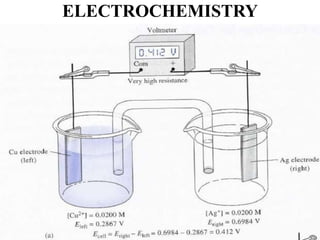
(a) A galvanic cell at open circuit
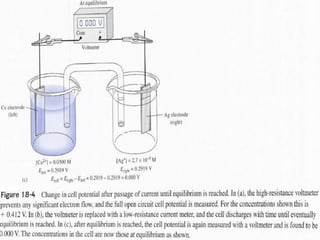
 In Figure -b, the cell is connected so that electrons can pass
through a low resistance external circuit.
 The potential energy of the cell is now converted to electrical
energy to light a lamp, run a motor, or do some other type of
electrical work.
 In the cell in Figure-b, metallic copper is oxidized at the left-hand
electrode, silver ions are reduced at the right-hand electrode, and
electrons flow through the external circuit to the silver electrode.
 As the reaction goes on, the cell potential, initially 0.412 V when
the circuit is open, decreases continuously and approaches zero as
the overall reaction approaches equilibrium.
 When the cell is at equilibrium, both cell half-reactions occur at the
same rate, and the cell voltage is zero.
 A cell with zero voltage does not perform work, as anyone who has
found a "dead“ battery in a flashlight or in a laptop computer can
attest.
(b) A galvanic cell doing work
(c) An electrolytic cell
1. ELECTROCHEMICAL CELLS;
• An electrochemical cell consists of two conductors called electrodes,
each of which is immersed in an electrolyte solution.
• The electrode surface serves as a junction between an ionic conductor
and an electronic conductor.
• In most of the cells that will be of interest to us, the solutions
surrounding the two electrodes are different and must be separated to
avoid direct reaction between the reactants.
• The most common way of avoiding mixing is to insert a salt bridge
between the solutions.
• Salt bridges are widely used in electrochemistry to prevent mixing of the
contents of the two electrolyte solutions making up electrochemical cells.
ELECTROCHEMISTRY
• Ordinarily, the two ends of the bridge are fitted with sintered glass disks or
other porous materials to prevent liquid from siphoning from one part
of the cell to the other.
• Conduction of electricity from one electrolyte solution to the other then
occurs by migration of potassium ions in the bridge in one direction and
chloride ions in the other.
• However, direct contact between copper metal and silver ions is prevented.
 the salt bridge has 3 functions:
1. allows electrical contact between the 2 solutions
2. prevents mixing of the electrode solutions
3. maintains the electrical neutrality in each half-cell as ions flow in and out
the salt bridge.
ELECTROCHEMISTRY
• Oxidation of a cation at an anode or reduction of an anion at a cathode
is a relatively common process.
• Charge (q) of an electron = - 1.602 x 10⁻¹⁹ C
• Charge (q) of a proton = + 1.602 x 10⁻¹⁹ C(coulombs)
• Charge of one mole of electrons = (1.602 x 10⁻¹⁹ C)(6.022 x 10²³/mol)
= 96,485 C/mol = Faraday constant (F)
• The charge (q) transferred in a redox reaction is given by q = n x F
• Current (i); The quantity of charge flowing past a point in an electric
circuit per second; I = q/time, Units; Ampere (A) = coulomb per
second (C/s). 1A = 1C/s
• Voltage or Potential Difference (E); The amount of energy required to
move charged electrons between two points
• Work done by or on electrons when they move from one point to
another W = E x q or E = w/q
Units: volts (V or J/C); 1V = 1J/C
• Ohm’s Law; I = E/R R = resistance = Units Ω (ohm) or V/A
ELECTROCHEMISTRY
Types of Electrochemical Cells;
• Electrochemical cells are either galvanic or electrolytic.
• They can also be classified as reversible or irreversible.
• A galvanic cell is one in which this current flows (and the redox reaction proceeds)
spontaneously because of the strong tendency for the chemical species involved to
give and take electrons.
• An electrolytic cell is one in which the current is not a spontaneous current, but
rather is the result of incorporating an external power source, such as a battery, in
the circuit to drive the reaction in one direction or the other.
• Potentiometric methods involve galvanic cells, and voltammetric and
amperometric methods involve electrolytic cells.
ELECTROCHEMISTRY
• The cell in Figure a-c is an example of a reversible cell, in which the
direction of the electrochemical reaction is reversed when the
direction of electron flow is changed. (In a reversible cell, reversing
the current reverses the cell reaction.)
• In an irreversible cell, changing the direction of current causes
entirely different half-reactions to occur at one or both electrodes. (In
an irreversible cell, reversing the current causes a different half-
reaction to occur at one or both of the electrodes.)
• The lead-acid storage battery in an automobile is a common
example of a series of reversible cells.
• When the battery is being charged by the generator or an external
charger, its cells are electrolytic.
• When it is used to operate the headlights, the radio, or the ignition, its
cells are galvanic.
ELECTROCHEMISTRY
 Chemists frequently use a shorthand notation to describe electrochemical
cells.
• The cell in Figure-a, for example, is described by
Cu/Cu2+(O.0200M) // Ag+(O.0200M)/Ag
 By convention, a single vertical line indicates a phase boundary, or
interface, at which a potential develops.
 The double vertical line represents two phase boundaries, one at each end of
the salt bridge.
• A liquid-junction potential develops at each of these interfaces.
• The junction potential results from differences in the rates at which the ions
in the cell compartments and the salt bridge migrate across the interfaces.
ELECTROCHEMISTRY
ELECTRODE POTENTIALS
• The potential difference that develops between the electrodes of the cell is
a measure of the tendency for the reaction to proceed from a non-
equilibrium state to the condition of equilibrium.
• The cell potential Ecell is related to the free energy of the reaction ∆G by
∆G = -nFEcell
ELECTROCHEMISTRY
• If the reactants and products are in their standard
states, the resulting cell potential is called the
standard cell potential. This latter quantity is
related to the standard free-energy change for the
reaction and thus to the equilibrium constant by
∆Go= -nFEo
cell = -RTlnKeq where R is the
gas constant and T is the absolute temperature.
Basic Thermodynamics
For electrochemical reactions:
nFEG 
eqInKRTG 
For chemical reactions:
So
Equation)(NerstIn
In
eq
eq
K
nF
RT
E
KRTnFE


ELECTROCHEMISTRY
ELECTROCHEMISTRY
ELECTROCHEMISTRY
ELECTROCHEMISTRY
Half-Cell Potentials;
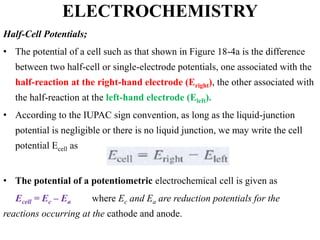
• The potential of a cell such as that shown in Figure 18-4a is the difference
between two half-cell or single-electrode potentials, one associated with the
half-reaction at the right-hand electrode (Eright), the other associated with
the half-reaction at the left-hand electrode (Eleft).
• According to the IUPAC sign convention, as long as the liquid-junction
potential is negligible or there is no liquid junction, we may write the cell
potential Ecell as
• The potential of a potentiometric electrochemical cell is given as
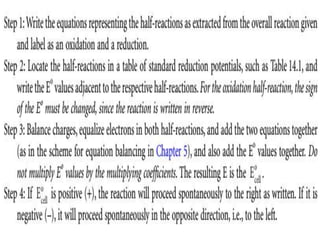
Ecell = Ec – Ea where Ec and Ea are reduction potentials for the
reactions occurring at the cathode and anode.
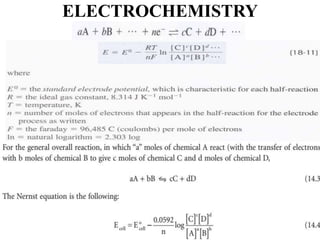
The Nernst equation
• Working in nonstandard conditions
QRTnFEnFE ln 
QRTGG ln 
Q
nF
RTEE ln 
Q
n
EE log0592.0 
ELECTROCHEMISTRY
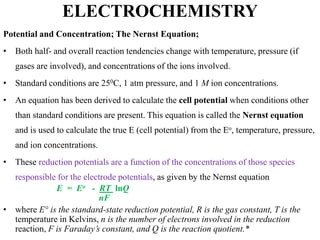
Potential and Concentration; The Nernst Equation;
• Both half- and overall reaction tendencies change with temperature, pressure (if
gases are involved), and concentrations of the ions involved.
• Standard conditions are 250C, 1 atm pressure, and 1 M ion concentrations.
• An equation has been derived to calculate the cell potential when conditions other
than standard conditions are present. This equation is called the Nernst equation
and is used to calculate the true E (cell potential) from the Eo, temperature, pressure,
and ion concentrations.
• These reduction potentials are a function of the concentrations of those species
responsible for the electrode potentials, as given by the Nernst equation
E = Eo - RT lnQ
nF
• where E° is the standard-state reduction potential, R is the gas constant, T is the
temperature in Kelvins, n is the number of electrons involved in the reduction
reaction, F is Faraday’s constant, and Q is the reaction quotient.*
ELECTROCHEMISTRY
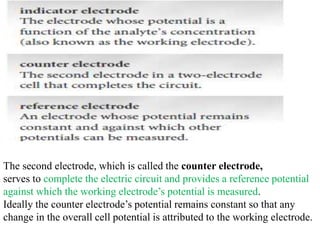
The second electrode, which is called the counter electrode,
serves to complete the electric circuit and provides a reference potential
against which the working electrode’s potential is measured.
Ideally the counter electrode’s potential remains constant so that any
change in the overall cell potential is attributed to the working electrode.
ELECTROCHEMISTRY
Reference Electrodes;
• Potentiometric electrochemical cells are constructed such that one of
the half-cells provides a known reference potential, and the potential
of the other half-cell indicates the analyte’s concentration.
• By convention, the reference electrode is taken to be the anode;
thus, the shorthand notation for a potentiometric electrochemical cell
is Reference || Indicator and the cell potential is Ecell = Eind – Eref
• The ideal reference electrode must provide a stable potential so that
any change in Ecell is attributed to the indicator electrode, and,
therefore, to a change in the analyte’s concentration.
• In addition, the ideal reference electrode should be easy to make and
to use.
ELECTROCHEMISTRY
The Standard Hydrogen Reference Electrode;
• For relative electrode potential data to be widely applicable
and useful, we must have a generally agreed-upon reference
half-cell against which all others are compared.
• Such an electrode must be easy to construct, reversible, and
highly reproducible in its behavior.
• The standard hydrogen electrode (SHE) meets these
specifications and has been used throughout the world for
many years as a universal reference electrode.
• It is a typical gas electrode.
ELECTROCHEMISTRY
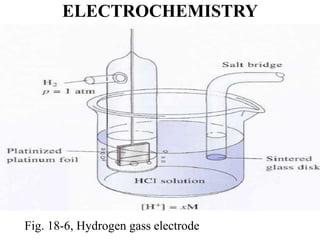
• Figure 18-6 shows how a hydrogen electrode is constructed.
• The metal conductor is a piece of platinum that has been coated, or
platinized, with finely divided platinum (platinum black) to increase
its specific surface area.
• This electrode is immersed in an aqueous acid solution of known,
constant hydrogen ion activity.
• The solution is kept saturated with hydrogen by bubbling the gas at
constant pressure over the surface of the electrode.
• The platinum does not take part in the electrochemical reaction and
serves only as the site where electrons are transferred.
ELECTROCHEMISTRY
Fig. 18-6, Hydrogen gass electrode
ELECTROCHEMISTRY
• The half-reaction responsible for the potential that develops at this
electrode is
• The hydrogen electrode shown in Figure 18-6 can be represented
schematically as
Pt, H2(PH2 = 1.00 atm) / ([H+] = x M) //
• Here, the hydrogen is specified as having a partial pressure of one
atmosphere and the concentration of hydrogen ions in the solution is x M.
• The hydrogen electrode is reversible.
• The potential of a hydrogen electrode depends on temperature and the
activities of hydrogen ion and molecular hydrogen in the solution.
• The latter, in turn, is proportional to the pressure of the gas that is used
to keep the solution saturated in hydrogen.
ELECTROCHEMISTRY
• For the SHE, the activity of hydrogen ions is specified as unity and
the partial pressure of the gas is specified as one atmosphere.
• By convention, the potential of the standard hydrogen electrode is
assigned a value of 0.000V at all temperatures.
• As a consequence of this definition, any potential developed in a
galvanic cell consisting of a standard hydrogen electrode and some
other electrode is attributed entirely to the other electrode.
• Several other reference electrodes that are more convenient for
routine measurements have been developed.
UNIT-ONE
1.2. Kinetics of Electrochemical
Reactions
1.3. Mass transfer in electrochemical
systems
Reactions Kinetics
• Chemical kinetics, also called reaction kinetics, is the study of the rates and
mechanisms of chemical reactions.
• In the industrial synthesis of compounds, reaction rates are as important as
equilibrium constants.
• The thermodynamic equilibrium constant tells us the maximum possible yield of
NH3 obtainable at any given T and P from N2 and H2, but if the reaction rate
between N2 and H2 is too low, the reaction will not be economical to carry out.
• We can, from thermodynamics, address the question; Will the reaction occur?
• We need kinetics, however, answer the question: How fast will the reaction occur?
• In summary, to understand and predict the behavior of a chemical system, one
must consider both thermodynamics and kinetics.
Fuel Cell Reactions Kinetics
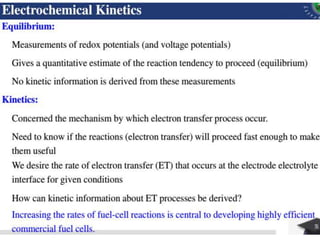
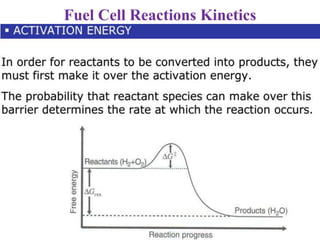
• Applying a potential to an electrode generates an electric field at the
electrode/electrolyte interface that reduces the magnitude of the
activation energy barrier increasing the ET reaction rate, Electrolysis
works on this principle.
• An applied potential acts as a driving force for the ET reaction.
• Expect that current should increase with increasing driving force
• Catalysts act to reduce the magnitude of the activation energy barrier .
Fuel Cell Reactions Kinetics
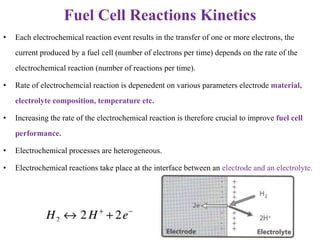
• Each electrochemical reaction event results in the transfer of one or more electrons, the
current produced by a fuel cell (number of electrons per time) depends on the rate of the
electrochemical reaction (number of reactions per time).
• Rate of electrochemcial reaction is depenedent on various parameters electrode material,
electrolyte composition, temperature etc.
• Increasing the rate of the electrochemical reaction is therefore crucial to improve fuel cell
performance.
• Electrochemical processes are heterogeneous.
• Electrochemical reactions take place at the interface between an electrode and an electrolyte.
Fuel Cell Reactions Kinetics
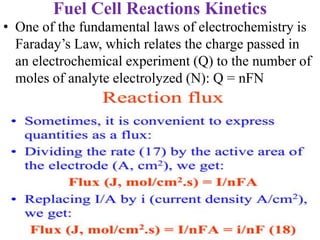
• One of the fundamental laws of electrochemistry is
Faraday’s Law, which relates the charge passed in
an electrochemical experiment (Q) to the number of
moles of analyte electrolyzed (N): Q = nFN
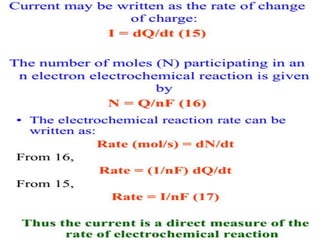
O + ne- ⇄ R
(electrode reaction)
nFA
I
v 
Electric current (I) measured at the
electrode is proportional to the rate (v)
of the electrode reaction!
(q – charge, t – time, F – Faraday constant; A –
electrode surface area; n – number of electrons, n(O)
– number of moles of the reactant O)
Rate of an electrode reaction: the flux
R (reduced species)
O (oxidized species)
- e
electrode|solution Interface
AnF
I
AnFt
q
v
tA
n
v
nFnq
t
q
I




1
d
d
d
)O(d
)O(
d
d Flux (the rate of the
heterogeneous electrode
reaction) is equal to the
amount of reacted
material per unit of time
per unit of electrode
surface area
(mol s -1 cm-2). This
chemical rate is equal to
the ratio of the electric
current, number of
exchanged electrons in a
unit reaction and
electrode surface area.
Fuel Cell Reactions Kinetics
1.3. Mass transfer in electrochemical
systems
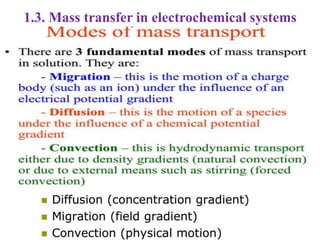
1.3. Mass transfer in electrochemical systems
• .
.

Electrochemistry chapter 1

  • 1.
    UNIT - ONE INTRODUCTIONTO ELECTROCHEMISTRY By Brhane Amha
  • 2.
    ELECTROCHEMISTRY • Electrochemistry isthe branch of chemistry concerned with the interrelation of electrical and chemical effects. • A large part of this field deals with the study of chemical changes caused by the passage of an electric current and the production of electrical energy by chemical reactions. • The study of the inter-conversion of chemical energy and electrical energy • The study of redox reactions (transfer of electrons from one substance to another) • In fact, the field of electrochemistry encompasses a huge array of different phenomena (e.g., electrophoresis and corrosion), devices (electrochromic displays, electro analytical sensors, batteries, and fuel cells), and technologies (the electroplating of metals and the large-scale production of aluminum and chlorine).
  • 4.
    ELECTROCHEMISTRY Electrolytic cells those in which electrical energy from an external source causes non-spontaneous chemical reactions to occur voltaic or galvanic cells  those in which spontaneous chemical reactions produce electricity and supply it to an external circuit Electrical current represents transfer of charge Positively charged ions migrate toward the negative electrode while negatively charged ions move toward the positive electrode
  • 5.
    (a) A galvaniccell at open circuit
  • 6.
     In Figure-b, the cell is connected so that electrons can pass through a low resistance external circuit.  The potential energy of the cell is now converted to electrical energy to light a lamp, run a motor, or do some other type of electrical work.  In the cell in Figure-b, metallic copper is oxidized at the left-hand electrode, silver ions are reduced at the right-hand electrode, and electrons flow through the external circuit to the silver electrode.  As the reaction goes on, the cell potential, initially 0.412 V when the circuit is open, decreases continuously and approaches zero as the overall reaction approaches equilibrium.  When the cell is at equilibrium, both cell half-reactions occur at the same rate, and the cell voltage is zero.  A cell with zero voltage does not perform work, as anyone who has found a "dead“ battery in a flashlight or in a laptop computer can attest.
  • 7.
    (b) A galvaniccell doing work
  • 8.
  • 9.
    1. ELECTROCHEMICAL CELLS; •An electrochemical cell consists of two conductors called electrodes, each of which is immersed in an electrolyte solution. • The electrode surface serves as a junction between an ionic conductor and an electronic conductor. • In most of the cells that will be of interest to us, the solutions surrounding the two electrodes are different and must be separated to avoid direct reaction between the reactants. • The most common way of avoiding mixing is to insert a salt bridge between the solutions. • Salt bridges are widely used in electrochemistry to prevent mixing of the contents of the two electrolyte solutions making up electrochemical cells.
  • 10.
    ELECTROCHEMISTRY • Ordinarily, thetwo ends of the bridge are fitted with sintered glass disks or other porous materials to prevent liquid from siphoning from one part of the cell to the other. • Conduction of electricity from one electrolyte solution to the other then occurs by migration of potassium ions in the bridge in one direction and chloride ions in the other. • However, direct contact between copper metal and silver ions is prevented.  the salt bridge has 3 functions: 1. allows electrical contact between the 2 solutions 2. prevents mixing of the electrode solutions 3. maintains the electrical neutrality in each half-cell as ions flow in and out the salt bridge.
  • 11.
    ELECTROCHEMISTRY • Oxidation ofa cation at an anode or reduction of an anion at a cathode is a relatively common process. • Charge (q) of an electron = - 1.602 x 10⁻¹⁹ C • Charge (q) of a proton = + 1.602 x 10⁻¹⁹ C(coulombs) • Charge of one mole of electrons = (1.602 x 10⁻¹⁹ C)(6.022 x 10²³/mol) = 96,485 C/mol = Faraday constant (F) • The charge (q) transferred in a redox reaction is given by q = n x F • Current (i); The quantity of charge flowing past a point in an electric circuit per second; I = q/time, Units; Ampere (A) = coulomb per second (C/s). 1A = 1C/s • Voltage or Potential Difference (E); The amount of energy required to move charged electrons between two points • Work done by or on electrons when they move from one point to another W = E x q or E = w/q Units: volts (V or J/C); 1V = 1J/C • Ohm’s Law; I = E/R R = resistance = Units Ω (ohm) or V/A
  • 12.
    ELECTROCHEMISTRY Types of ElectrochemicalCells; • Electrochemical cells are either galvanic or electrolytic. • They can also be classified as reversible or irreversible. • A galvanic cell is one in which this current flows (and the redox reaction proceeds) spontaneously because of the strong tendency for the chemical species involved to give and take electrons. • An electrolytic cell is one in which the current is not a spontaneous current, but rather is the result of incorporating an external power source, such as a battery, in the circuit to drive the reaction in one direction or the other. • Potentiometric methods involve galvanic cells, and voltammetric and amperometric methods involve electrolytic cells.
  • 13.
    ELECTROCHEMISTRY • The cellin Figure a-c is an example of a reversible cell, in which the direction of the electrochemical reaction is reversed when the direction of electron flow is changed. (In a reversible cell, reversing the current reverses the cell reaction.) • In an irreversible cell, changing the direction of current causes entirely different half-reactions to occur at one or both electrodes. (In an irreversible cell, reversing the current causes a different half- reaction to occur at one or both of the electrodes.) • The lead-acid storage battery in an automobile is a common example of a series of reversible cells. • When the battery is being charged by the generator or an external charger, its cells are electrolytic. • When it is used to operate the headlights, the radio, or the ignition, its cells are galvanic.
  • 14.
    ELECTROCHEMISTRY  Chemists frequentlyuse a shorthand notation to describe electrochemical cells. • The cell in Figure-a, for example, is described by Cu/Cu2+(O.0200M) // Ag+(O.0200M)/Ag  By convention, a single vertical line indicates a phase boundary, or interface, at which a potential develops.  The double vertical line represents two phase boundaries, one at each end of the salt bridge. • A liquid-junction potential develops at each of these interfaces. • The junction potential results from differences in the rates at which the ions in the cell compartments and the salt bridge migrate across the interfaces.
  • 15.
  • 16.
    ELECTRODE POTENTIALS • Thepotential difference that develops between the electrodes of the cell is a measure of the tendency for the reaction to proceed from a non- equilibrium state to the condition of equilibrium. • The cell potential Ecell is related to the free energy of the reaction ∆G by ∆G = -nFEcell
  • 17.
    ELECTROCHEMISTRY • If thereactants and products are in their standard states, the resulting cell potential is called the standard cell potential. This latter quantity is related to the standard free-energy change for the reaction and thus to the equilibrium constant by ∆Go= -nFEo cell = -RTlnKeq where R is the gas constant and T is the absolute temperature.
  • 18.
    Basic Thermodynamics For electrochemicalreactions: nFEG  eqInKRTG  For chemical reactions: So Equation)(NerstIn In eq eq K nF RT E KRTnFE  
  • 19.
  • 20.
  • 21.
  • 23.
    ELECTROCHEMISTRY Half-Cell Potentials; • Thepotential of a cell such as that shown in Figure 18-4a is the difference between two half-cell or single-electrode potentials, one associated with the half-reaction at the right-hand electrode (Eright), the other associated with the half-reaction at the left-hand electrode (Eleft). • According to the IUPAC sign convention, as long as the liquid-junction potential is negligible or there is no liquid junction, we may write the cell potential Ecell as • The potential of a potentiometric electrochemical cell is given as Ecell = Ec – Ea where Ec and Ea are reduction potentials for the reactions occurring at the cathode and anode.
  • 24.
    The Nernst equation •Working in nonstandard conditions QRTnFEnFE ln  QRTGG ln  Q nF RTEE ln  Q n EE log0592.0 
  • 25.
    ELECTROCHEMISTRY Potential and Concentration;The Nernst Equation; • Both half- and overall reaction tendencies change with temperature, pressure (if gases are involved), and concentrations of the ions involved. • Standard conditions are 250C, 1 atm pressure, and 1 M ion concentrations. • An equation has been derived to calculate the cell potential when conditions other than standard conditions are present. This equation is called the Nernst equation and is used to calculate the true E (cell potential) from the Eo, temperature, pressure, and ion concentrations. • These reduction potentials are a function of the concentrations of those species responsible for the electrode potentials, as given by the Nernst equation E = Eo - RT lnQ nF • where E° is the standard-state reduction potential, R is the gas constant, T is the temperature in Kelvins, n is the number of electrons involved in the reduction reaction, F is Faraday’s constant, and Q is the reaction quotient.*
  • 26.
  • 27.
    The second electrode,which is called the counter electrode, serves to complete the electric circuit and provides a reference potential against which the working electrode’s potential is measured. Ideally the counter electrode’s potential remains constant so that any change in the overall cell potential is attributed to the working electrode.
  • 28.
    ELECTROCHEMISTRY Reference Electrodes; • Potentiometricelectrochemical cells are constructed such that one of the half-cells provides a known reference potential, and the potential of the other half-cell indicates the analyte’s concentration. • By convention, the reference electrode is taken to be the anode; thus, the shorthand notation for a potentiometric electrochemical cell is Reference || Indicator and the cell potential is Ecell = Eind – Eref • The ideal reference electrode must provide a stable potential so that any change in Ecell is attributed to the indicator electrode, and, therefore, to a change in the analyte’s concentration. • In addition, the ideal reference electrode should be easy to make and to use.
  • 29.
    ELECTROCHEMISTRY The Standard HydrogenReference Electrode; • For relative electrode potential data to be widely applicable and useful, we must have a generally agreed-upon reference half-cell against which all others are compared. • Such an electrode must be easy to construct, reversible, and highly reproducible in its behavior. • The standard hydrogen electrode (SHE) meets these specifications and has been used throughout the world for many years as a universal reference electrode. • It is a typical gas electrode.
  • 30.
    ELECTROCHEMISTRY • Figure 18-6shows how a hydrogen electrode is constructed. • The metal conductor is a piece of platinum that has been coated, or platinized, with finely divided platinum (platinum black) to increase its specific surface area. • This electrode is immersed in an aqueous acid solution of known, constant hydrogen ion activity. • The solution is kept saturated with hydrogen by bubbling the gas at constant pressure over the surface of the electrode. • The platinum does not take part in the electrochemical reaction and serves only as the site where electrons are transferred.
  • 31.
  • 32.
    ELECTROCHEMISTRY • The half-reactionresponsible for the potential that develops at this electrode is • The hydrogen electrode shown in Figure 18-6 can be represented schematically as Pt, H2(PH2 = 1.00 atm) / ([H+] = x M) // • Here, the hydrogen is specified as having a partial pressure of one atmosphere and the concentration of hydrogen ions in the solution is x M. • The hydrogen electrode is reversible. • The potential of a hydrogen electrode depends on temperature and the activities of hydrogen ion and molecular hydrogen in the solution. • The latter, in turn, is proportional to the pressure of the gas that is used to keep the solution saturated in hydrogen.
  • 33.
    ELECTROCHEMISTRY • For theSHE, the activity of hydrogen ions is specified as unity and the partial pressure of the gas is specified as one atmosphere. • By convention, the potential of the standard hydrogen electrode is assigned a value of 0.000V at all temperatures. • As a consequence of this definition, any potential developed in a galvanic cell consisting of a standard hydrogen electrode and some other electrode is attributed entirely to the other electrode. • Several other reference electrodes that are more convenient for routine measurements have been developed.
  • 34.
    UNIT-ONE 1.2. Kinetics ofElectrochemical Reactions 1.3. Mass transfer in electrochemical systems
  • 35.
    Reactions Kinetics • Chemicalkinetics, also called reaction kinetics, is the study of the rates and mechanisms of chemical reactions. • In the industrial synthesis of compounds, reaction rates are as important as equilibrium constants. • The thermodynamic equilibrium constant tells us the maximum possible yield of NH3 obtainable at any given T and P from N2 and H2, but if the reaction rate between N2 and H2 is too low, the reaction will not be economical to carry out. • We can, from thermodynamics, address the question; Will the reaction occur? • We need kinetics, however, answer the question: How fast will the reaction occur? • In summary, to understand and predict the behavior of a chemical system, one must consider both thermodynamics and kinetics.
  • 38.
    Fuel Cell ReactionsKinetics • Applying a potential to an electrode generates an electric field at the electrode/electrolyte interface that reduces the magnitude of the activation energy barrier increasing the ET reaction rate, Electrolysis works on this principle. • An applied potential acts as a driving force for the ET reaction. • Expect that current should increase with increasing driving force • Catalysts act to reduce the magnitude of the activation energy barrier .
  • 44.
    Fuel Cell ReactionsKinetics • Each electrochemical reaction event results in the transfer of one or more electrons, the current produced by a fuel cell (number of electrons per time) depends on the rate of the electrochemical reaction (number of reactions per time). • Rate of electrochemcial reaction is depenedent on various parameters electrode material, electrolyte composition, temperature etc. • Increasing the rate of the electrochemical reaction is therefore crucial to improve fuel cell performance. • Electrochemical processes are heterogeneous. • Electrochemical reactions take place at the interface between an electrode and an electrolyte.
  • 47.
    Fuel Cell ReactionsKinetics • One of the fundamental laws of electrochemistry is Faraday’s Law, which relates the charge passed in an electrochemical experiment (Q) to the number of moles of analyte electrolyzed (N): Q = nFN
  • 48.
    O + ne-⇄ R (electrode reaction) nFA I v  Electric current (I) measured at the electrode is proportional to the rate (v) of the electrode reaction! (q – charge, t – time, F – Faraday constant; A – electrode surface area; n – number of electrons, n(O) – number of moles of the reactant O) Rate of an electrode reaction: the flux R (reduced species) O (oxidized species) - e electrode|solution Interface AnF I AnFt q v tA n v nFnq t q I     1 d d d )O(d )O( d d Flux (the rate of the heterogeneous electrode reaction) is equal to the amount of reacted material per unit of time per unit of electrode surface area (mol s -1 cm-2). This chemical rate is equal to the ratio of the electric current, number of exchanged electrons in a unit reaction and electrode surface area.
  • 49.
  • 50.
  • 51.
  • 52.
    1.3. Mass transferin electrochemical systems
  • 53.
    1.3. Mass transferin electrochemical systems
  • 54.