Accommodation and Its
Measurement Techniques ..
Tamalika Biswas
B.Optometry, 3rd Batch,
Institute of Community Ophthalmology,
University of Chittagong,
Bangladesh .
Accommodation
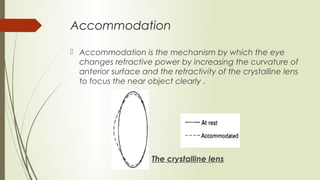
 Accommodation is the mechanism by which the eye
changes refractive power by increasing the curvature of
anterior surface and the refractivity of the crystalline lens
to focus the near object clearly .
The crystalline lens
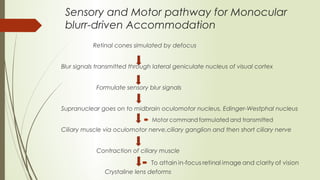
Sensory and Motor pathway for Monocular
blurr-driven Accommodation
Retinal cones simulated by defocus
Blur signals transmitted through lateral geniculate nucleus of visual cortex
Formulate sensory blur signals
Supranuclear goes on to midbrain oculomotor nucleus, Edinger-Westphal nucleus
Ciliary muscle via oculomotor nerve,ciliary ganglion and then short ciliary nerve
Contraction of ciliary muscle
Crystaline lens deforms
When a person looks at a near
object…
 Near triad occurs consist of three responses.
 These are-
1) Accommodation
2) Convergence
3) Miosis
Theories of Accommodation
 Relaxation theory of Helmholtz Gullstrand’s theory of accommodation
based on Helmholtz hypothesis
 Tschering’s theory of increased tension
 Schacha’s theory
 Cotenary (hydraulic suspension) theory
Cotenary Theory
Components of Accommodation
 1) Reflex Acommodation
 2) Vergence Accommodation
 3) Proximal Accommodation
 4) Tonic Accommodation
Reaction Time of Accommodation
 Average reaction time for far to near accommodation is 0.64 seconds .
 Average reaction time for near to far accommodation is 0.54 seconds .
 Reaction time for convergence response is 0.20 seconds .
 Reaction time for accommodation is considerably larger than that for the
contraction of the pupil to light 0.26 -0.30 seconds .
Anomalies of Accommodation
– Diminished or deficient accommodation
 Physiological : Presbyopia
 Pharmacological : Cycloplegia
 Pathological
 Insufficiency of accommodation
 Ill sustained accommodation
 Inertia of accommodation
 Paralysis of accommodation
– Increased accommodation
–
Some Important Terminologies
 Near point or Punctum Proximum
 Far point or Punctum Remotum
 Range of Accommodation
 Amplitude of Accommodation
 Relative Amplitude of Accommodation
 Lead of Accommodation
 Lag of Accommodation
 Facility of Accommodation
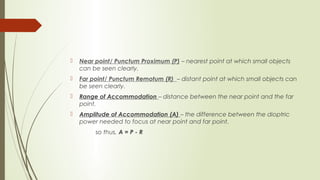
 Near point/ Punctum Proximum (P) – nearest point at which small objects
can be seen clearly.
 Far point/ Punctum Remotum (R) – distant point at which small objects can
be seen clearly.
 Range of Accommodation – distance between the near point and the far
point.
 Amplitude of Accommodation (A) – the difference between the dioptric
power needed to focus at near point and far point.
so thus, A = P - R
 Relative amplitude of accommodation - The total amount of
accommodation which the eye can exert while the convergence of the
eyes is fixed.
 It can be positive (using concave/minus lenses until the image blurs). This is
called positive relative accommodation (PRA).
 It can be negative (using convex/positive lenses until the image blurs). This
is negative relative accommodation (NRA).
 Lead of Accommodation: The amount by which the accommodative
response of the eye is greater than the dioptric stimulus to
accommodation.
 Lag of Accommodation: The amount by which the accommodative
response of the eye is less than the dioptric stimulus to accommodation.
Measurement of Accommodation
 Subjective measures of accommodation
**Reading progressively smaller letters at near
A) Push-Up Technique
1)A near point card and a millimeter ruler
2)RAF (Royal Air Force) Ruler
3)Gulden Accommodation Rule
4)Costenbader Accommodometer
B) Minus Lens Technique
C)Accommodative flipper test using paired +/– lenses
Push-up Method
EQUIPMENT
1. Near point visual acuity card.
2. Scale measure in centimeters.
3. Occluder.
SET-UP
1. The patient is tested wearing his habitual distance correction.
2. Either the patient or the examiner may hold the near point card.
3. The near point card should be well-illuminated.
STEP-BY-STEP PROCEDURE
 Instruct the patient to occlude his left eye to test the right eye.
 Direct the patient’s attention to a row of letters one or two lines larger
than his near VA.
 Instruction the patient to keep the letters clear.
 Slowly move the chart closer to the patient and ask the patient to report
when the letters become and remain blurry.
 Measure the distance from the chart to the patient’s spectacle plane in
centimeters. The linear measurement is referred to as the near point of
accommodation.
 Convert the linear distance into diopters by dividing the near point of
accommodation in centimeters into 100. The resulting dioptrical value
represents the patient’s amplitude of accommodation.
 Occlude the right eye and test the left eye repeating the above steps.
 This procedure may repeat several times to determind the quality of
accommodation.
 An increase in NPA with repeatative test suggest a reduced quality of
accommodation.
 RECORDING 
 Record the method of testing used.
 Record the amplitude of accommodation in diopters (round off to the
nearest half diopter).
 Separately record the results for the right and left eyes.
 EXAMPLES
Amp (push-up)OD 7.0D OS 7.0D
EXPECTED FINDINGS
The expected amplitude of accommodation decreases with age.
The two most commonly used systems for obtaining the expected
amplitude of accommodation are
 A. Hofstetters’ formulas
 Minimum expected amplitude = 15 – 0.25 (age)
 Average expected amplitude = 18.5 – 0.30 (age)
 Maximum expected amplitude = 25 – 0.40 (age)
 The amplitude of accommodation of the two eyes should be within
1D of each eye.
2) Donder’s Table
Age Amplitude Age Amplitude
10 14.00 45 03.50
15 12.00 50 02.50
20 10.00 55 01.75
25 08.50 60 01.00
30 07.00 65 00.50
35 05.50 70 00.25
40 04.50 75 00.00
Donder’s table for age-referenced amplitude
of accommodation
Minus Lens Technique
 The patient seated .
 Wear the distant refractive correction if needed .
 Occlude the left eye .
 A target is just placed on near point at 40cm .
 Minus lenses are added in front of right eye in 0.25D steps until the 1st
sustain blur .
 The amplitude of accommodation is equal to the total amount of the
added minus lens + 2.50D for the working distance .
 Remove occlude from left eye, occlude the right eye and repeat the
procedure for left eye .
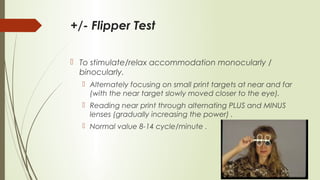
+/- Flipper Test
 To stimulate/relax accommodation monocularly /
binocularly.
 Alternately focusing on small print targets at near and far
(with the near target slowly moved closer to the eye).
 Reading near print through alternating PLUS and MINUS
lenses (gradually increasing the power) .
 Normal value 8-14 cycle/minute .
Objective measures of
Accommodation…
1) Dynamic Retinoscopy
2) Purkinje Image technique
3) Scheiner’s Principle
4) Photorefractometer
References…..
Description and wide elaboration in following
books and pdf ..
 Theory and Practise of Optics and Refraction- A.K.Khurana .
 Anatomy and Physiology of Eye – A.K.Khurana and Indu Khurana .
 Essentials of Ophthalmology – Samar K Basak .
 Ophthalmic Optics – M.A.Matin .
 Borish’s Clinical Refraction by William J Benjamin .
 Clinical Proceedure Optometry .
 Theories of Accommodation and it’s Anomalies.pdf by Dr. Rujuta Gore
Moderator: Dr. Atul Seth,Laxmi Eye Institute .
 Measurement of Accommodation by Prof James S. Wolffsohn
ORG(ophthalmic research group) Aston University, Birminghum .
y
u
Thank

Accommodation presentation by Tamalika

  • 1.
    Accommodation and Its MeasurementTechniques .. Tamalika Biswas B.Optometry, 3rd Batch, Institute of Community Ophthalmology, University of Chittagong, Bangladesh .
  • 2.
    Accommodation  Accommodation isthe mechanism by which the eye changes refractive power by increasing the curvature of anterior surface and the refractivity of the crystalline lens to focus the near object clearly . The crystalline lens
  • 4.
    Sensory and Motorpathway for Monocular blurr-driven Accommodation Retinal cones simulated by defocus Blur signals transmitted through lateral geniculate nucleus of visual cortex Formulate sensory blur signals Supranuclear goes on to midbrain oculomotor nucleus, Edinger-Westphal nucleus Ciliary muscle via oculomotor nerve,ciliary ganglion and then short ciliary nerve Contraction of ciliary muscle Crystaline lens deforms
  • 5.
    When a personlooks at a near object…  Near triad occurs consist of three responses.  These are- 1) Accommodation 2) Convergence 3) Miosis
  • 7.
    Theories of Accommodation Relaxation theory of Helmholtz Gullstrand’s theory of accommodation based on Helmholtz hypothesis  Tschering’s theory of increased tension  Schacha’s theory  Cotenary (hydraulic suspension) theory
  • 9.
  • 10.
    Components of Accommodation 1) Reflex Acommodation  2) Vergence Accommodation  3) Proximal Accommodation  4) Tonic Accommodation
  • 11.
    Reaction Time ofAccommodation  Average reaction time for far to near accommodation is 0.64 seconds .  Average reaction time for near to far accommodation is 0.54 seconds .  Reaction time for convergence response is 0.20 seconds .  Reaction time for accommodation is considerably larger than that for the contraction of the pupil to light 0.26 -0.30 seconds .
  • 12.
    Anomalies of Accommodation –Diminished or deficient accommodation  Physiological : Presbyopia  Pharmacological : Cycloplegia  Pathological  Insufficiency of accommodation  Ill sustained accommodation  Inertia of accommodation  Paralysis of accommodation – Increased accommodation –
  • 13.
    Some Important Terminologies Near point or Punctum Proximum  Far point or Punctum Remotum  Range of Accommodation  Amplitude of Accommodation  Relative Amplitude of Accommodation  Lead of Accommodation  Lag of Accommodation  Facility of Accommodation
  • 14.
     Near point/Punctum Proximum (P) – nearest point at which small objects can be seen clearly.  Far point/ Punctum Remotum (R) – distant point at which small objects can be seen clearly.  Range of Accommodation – distance between the near point and the far point.  Amplitude of Accommodation (A) – the difference between the dioptric power needed to focus at near point and far point. so thus, A = P - R
  • 15.
     Relative amplitudeof accommodation - The total amount of accommodation which the eye can exert while the convergence of the eyes is fixed.  It can be positive (using concave/minus lenses until the image blurs). This is called positive relative accommodation (PRA).  It can be negative (using convex/positive lenses until the image blurs). This is negative relative accommodation (NRA).
  • 16.
     Lead ofAccommodation: The amount by which the accommodative response of the eye is greater than the dioptric stimulus to accommodation.  Lag of Accommodation: The amount by which the accommodative response of the eye is less than the dioptric stimulus to accommodation.
  • 17.
    Measurement of Accommodation Subjective measures of accommodation **Reading progressively smaller letters at near A) Push-Up Technique 1)A near point card and a millimeter ruler 2)RAF (Royal Air Force) Ruler 3)Gulden Accommodation Rule 4)Costenbader Accommodometer B) Minus Lens Technique C)Accommodative flipper test using paired +/– lenses
  • 18.
    Push-up Method EQUIPMENT 1. Nearpoint visual acuity card. 2. Scale measure in centimeters. 3. Occluder. SET-UP 1. The patient is tested wearing his habitual distance correction. 2. Either the patient or the examiner may hold the near point card. 3. The near point card should be well-illuminated.
  • 19.
    STEP-BY-STEP PROCEDURE  Instructthe patient to occlude his left eye to test the right eye.  Direct the patient’s attention to a row of letters one or two lines larger than his near VA.  Instruction the patient to keep the letters clear.  Slowly move the chart closer to the patient and ask the patient to report when the letters become and remain blurry.  Measure the distance from the chart to the patient’s spectacle plane in centimeters. The linear measurement is referred to as the near point of accommodation.  Convert the linear distance into diopters by dividing the near point of accommodation in centimeters into 100. The resulting dioptrical value represents the patient’s amplitude of accommodation.  Occlude the right eye and test the left eye repeating the above steps.
  • 20.
     This proceduremay repeat several times to determind the quality of accommodation.  An increase in NPA with repeatative test suggest a reduced quality of accommodation.  RECORDING   Record the method of testing used.  Record the amplitude of accommodation in diopters (round off to the nearest half diopter).  Separately record the results for the right and left eyes.  EXAMPLES Amp (push-up)OD 7.0D OS 7.0D
  • 21.
    EXPECTED FINDINGS The expectedamplitude of accommodation decreases with age. The two most commonly used systems for obtaining the expected amplitude of accommodation are  A. Hofstetters’ formulas  Minimum expected amplitude = 15 – 0.25 (age)  Average expected amplitude = 18.5 – 0.30 (age)  Maximum expected amplitude = 25 – 0.40 (age)  The amplitude of accommodation of the two eyes should be within 1D of each eye.
  • 22.
    2) Donder’s Table AgeAmplitude Age Amplitude 10 14.00 45 03.50 15 12.00 50 02.50 20 10.00 55 01.75 25 08.50 60 01.00 30 07.00 65 00.50 35 05.50 70 00.25 40 04.50 75 00.00 Donder’s table for age-referenced amplitude of accommodation
  • 23.
    Minus Lens Technique The patient seated .  Wear the distant refractive correction if needed .  Occlude the left eye .  A target is just placed on near point at 40cm .  Minus lenses are added in front of right eye in 0.25D steps until the 1st sustain blur .  The amplitude of accommodation is equal to the total amount of the added minus lens + 2.50D for the working distance .  Remove occlude from left eye, occlude the right eye and repeat the procedure for left eye .
  • 24.
    +/- Flipper Test To stimulate/relax accommodation monocularly / binocularly.  Alternately focusing on small print targets at near and far (with the near target slowly moved closer to the eye).  Reading near print through alternating PLUS and MINUS lenses (gradually increasing the power) .  Normal value 8-14 cycle/minute .
  • 25.
    Objective measures of Accommodation… 1)Dynamic Retinoscopy 2) Purkinje Image technique 3) Scheiner’s Principle 4) Photorefractometer
  • 26.
    References….. Description and wideelaboration in following books and pdf ..  Theory and Practise of Optics and Refraction- A.K.Khurana .  Anatomy and Physiology of Eye – A.K.Khurana and Indu Khurana .  Essentials of Ophthalmology – Samar K Basak .  Ophthalmic Optics – M.A.Matin .  Borish’s Clinical Refraction by William J Benjamin .  Clinical Proceedure Optometry .  Theories of Accommodation and it’s Anomalies.pdf by Dr. Rujuta Gore Moderator: Dr. Atul Seth,Laxmi Eye Institute .  Measurement of Accommodation by Prof James S. Wolffsohn ORG(ophthalmic research group) Aston University, Birminghum .
  • 27.