A Comparative Study to Assess
Accommodation and Vergence
Relationship of Myopia in Indian
Adolescent
- BINOCULAR VISION OJT
PUBLISHED : May 1, 2023
PUBLISHER : Sadiya Ikram.Syeda., et al.
OBJECTIVE : To find out relationship of accommodation & vergence
abnormality among myopic children
JOURNAL : Ethiopian Journal of Health Sciences. Volume 33, pg. 523-
532
INTRODUCTION
– Binocular vision (BV) evaluation is crucial component in children as any abnormality in it
will affect child's cognitive growth & academics
– School children do more close work than anyone, it impairs their accommodative and
binocular activities. Hence this population is more concern and also they will never
complain about it as they are not capable enough to understand it
– Myopia is one of most common rising visual disorders in children worldwide, therefore
understanding how accommodation and convergence function is important in its
foundation.
– Also, it has been stated that NSBVAs (non-strabismic binocular vision abnormalities) are
quite common among children nowadays due to prevalence of mobile phones, computers,
etc
– Estimates of BV abnormalities in school-children will enhance child's quality of life in terms
of vision.
METHOD
– Administration of school was informed about research
pattern
– Parents' oral and written informed consents were taken.
– Total 400 children aged 10-17 yrs. of 7-12th grades in private
school in Chengalpattu district (Tamil Nadu, India)
participated in this study.
– Out of these, 186 students were found to have myopic
refractive error.
– After determining sample unit, 150 were selected from it.
– Selection was based on : best-corrected visual acuity of at
least 6/9 and N6, old enough to respond well
– students which were excluded were having: Strabismus,
Ocular abnormalities, previous squint surgery, self-reported
case of head/ ocular trauma & history of juvenile diabetes.
They were sent to base hospital for treatment of their
amblyopia, strabismus, and other ocular abnormalities
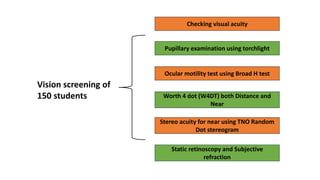
Vision screening of
150 students
Checking visual acuity
Pupillary examination using torchlight
Ocular motility test using Broad H test
Worth 4 dot (W4DT) both Distance and
Near
Stereo acuity for near using TNO Random
Dot stereogram
Static retinoscopy and Subjective
refraction
Using non-cycloplegic refraction's spherical equivalent:
High myopia
≤ 6D
Moderate myopia
≤ 4 D
Low myopia
≤ 2 D
– Then children were again grouped into control and experimental group.
– Vision therapy of 10 sessions was given to children in experimental group
and reassessment of binocular vision has been performed for evaluating
improvement.
Binocular vision assessment protocol:
– room with standardized illumination level (Minimum 480 lux)
– room-length of standard distance of 6 meters.
1.Phoria measurement for distance & near
using modified Thorrington chart (a.k.a Bernell Muscle Imbalance Measure- MIM card), Maddox rod
Or by using prism cover test if we don’t get correct response from MIM card
2. MEM (Monocular estimation method) retinoscope
Used to determine person's accommodative condition during closeup visual activity & measure status of
accommodation as lead or lag.
3. NPA (Near point of accommodation)
For identifying accommodating abnormalities.
2 methods:
• Push-up approach- target is put nearer to eyes until continuous blur is detected. performed binocularly.
• Minus lens method- use near chart & minus lens in 0.25 Ds steps. 1st monocular then binocular.
4. NRA (Negative relative accommodation) and PRA (Positive relative accommodation)
To measure range of accommodation at given distance, from stimulation to relaxation
Done binocularly
• minus lenses were used for PRA
• Plus lenses were used for NRA
Assessing Binocular Vision
5. AF (Accommodation facility)
Use +/- 2.00 D accommodative flipper, to cause variations in accommodation.
Measure dynamic of accommodation.
First monocular then binocular
6. NPC (Near point of Convergence)
Measure convergence insufficiency
Use royal air force (RAF) ruler
7. PFV (“Positive fusional vergence”) and NFV (“Negative fusional vergence”)
Use prism bar to measure fusional vergence amplitudes
First NFV for both near and far then PFV.
8. VF (Vergence Facility)
Use Vergence flippers of 12 Base out/ 3 Base in prisms & IPD (interpupillary distance) measured with IPD
ruler
Used to distinguish symptomatic from normal
AC/A ratio was calculated by formula :
AC/A = IPD + FD x (NP - FP)
where IPD is in centimetre, fixation distance (FD) in meter, far and near phoria (NP, FP) in prism diopters.
one-way ANOVA (ANalysis Of
VAriance) = represented that there
was considerable age difference &
non-cycloplegic refraction for right
eye. Analysis indicated that post-
control and experimental group
shows statistical difference for
phoria measurement for distance &
near, AF, Vergence facility by chi-
square
Two way RM (Repeated
Measures) ANOVA with
Bonferroni t test - multiple
comparisons of mean were
made between experimental
and control group in overall
sample to find effectiveness of
vision therapy in pre and post-
samples.
Factor A was groups
(comparison between
Control and
Experimental)
Factor B was tests
(within group
comparison i.e.,
repetition factor –
Pre-test and Post-
test).
Although it does not reveal considerable difference
between pre-and post-test
AC/A ratio does vary with age group.
Other parameters such as MEM, NPC, Amplitude of
accommodation, NRA-PRA, AF, NFV-PFV, Vergence
facility presented considerable difference between pre-
and post-experimental group
LOW MYOPIA
MODERATE MYOPIA
CONVERGENCE
INSUFFICIENCY
ACCOMMODATION &
CONVERGENCE
INSUFFICIENCY
ACCOMMODATIVE
DYSFUCNTION & BASIC
EXOPHORIA
RESULT
HIGH MYOPIA
CONCLUSION
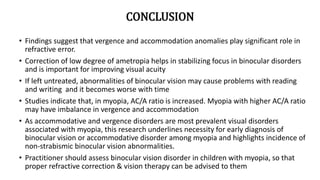
• Findings suggest that vergence and accommodation anomalies play significant role in
refractive error.
• Correction of low degree of ametropia helps in stabilizing focus in binocular disorders
and is important for improving visual acuity
• If left untreated, abnormalities of binocular vision may cause problems with reading
and writing and it becomes worse with time
• Studies indicate that, in myopia, AC/A ratio is increased. Myopia with higher AC/A ratio
may have imbalance in vergence and accommodation
• As accommodative and vergence disorders are most prevalent visual disorders
associated with myopia, this research underlines necessity for early diagnosis of
binocular vision or accommodative disorder among myopia and highlights incidence of
non-strabismic binocular vision abnormalities.
• Practitioner should assess binocular vision disorder in children with myopia, so that
proper refractive correction & vision therapy can be advised to them
THANK YOU
Presented by Sanika Gurav
Roll no. 05

Binocular vision research study.pptx

  • 1.
    A Comparative Studyto Assess Accommodation and Vergence Relationship of Myopia in Indian Adolescent - BINOCULAR VISION OJT PUBLISHED : May 1, 2023 PUBLISHER : Sadiya Ikram.Syeda., et al. OBJECTIVE : To find out relationship of accommodation & vergence abnormality among myopic children JOURNAL : Ethiopian Journal of Health Sciences. Volume 33, pg. 523- 532
  • 2.
    INTRODUCTION – Binocular vision(BV) evaluation is crucial component in children as any abnormality in it will affect child's cognitive growth & academics – School children do more close work than anyone, it impairs their accommodative and binocular activities. Hence this population is more concern and also they will never complain about it as they are not capable enough to understand it – Myopia is one of most common rising visual disorders in children worldwide, therefore understanding how accommodation and convergence function is important in its foundation. – Also, it has been stated that NSBVAs (non-strabismic binocular vision abnormalities) are quite common among children nowadays due to prevalence of mobile phones, computers, etc – Estimates of BV abnormalities in school-children will enhance child's quality of life in terms of vision.
  • 3.
    METHOD – Administration ofschool was informed about research pattern – Parents' oral and written informed consents were taken. – Total 400 children aged 10-17 yrs. of 7-12th grades in private school in Chengalpattu district (Tamil Nadu, India) participated in this study. – Out of these, 186 students were found to have myopic refractive error. – After determining sample unit, 150 were selected from it. – Selection was based on : best-corrected visual acuity of at least 6/9 and N6, old enough to respond well – students which were excluded were having: Strabismus, Ocular abnormalities, previous squint surgery, self-reported case of head/ ocular trauma & history of juvenile diabetes. They were sent to base hospital for treatment of their amblyopia, strabismus, and other ocular abnormalities
  • 4.
    Vision screening of 150students Checking visual acuity Pupillary examination using torchlight Ocular motility test using Broad H test Worth 4 dot (W4DT) both Distance and Near Stereo acuity for near using TNO Random Dot stereogram Static retinoscopy and Subjective refraction
  • 5.
    Using non-cycloplegic refraction'sspherical equivalent: High myopia ≤ 6D Moderate myopia ≤ 4 D Low myopia ≤ 2 D – Then children were again grouped into control and experimental group. – Vision therapy of 10 sessions was given to children in experimental group and reassessment of binocular vision has been performed for evaluating improvement. Binocular vision assessment protocol: – room with standardized illumination level (Minimum 480 lux) – room-length of standard distance of 6 meters.
  • 6.
    1.Phoria measurement fordistance & near using modified Thorrington chart (a.k.a Bernell Muscle Imbalance Measure- MIM card), Maddox rod Or by using prism cover test if we don’t get correct response from MIM card 2. MEM (Monocular estimation method) retinoscope Used to determine person's accommodative condition during closeup visual activity & measure status of accommodation as lead or lag. 3. NPA (Near point of accommodation) For identifying accommodating abnormalities. 2 methods: • Push-up approach- target is put nearer to eyes until continuous blur is detected. performed binocularly. • Minus lens method- use near chart & minus lens in 0.25 Ds steps. 1st monocular then binocular. 4. NRA (Negative relative accommodation) and PRA (Positive relative accommodation) To measure range of accommodation at given distance, from stimulation to relaxation Done binocularly • minus lenses were used for PRA • Plus lenses were used for NRA Assessing Binocular Vision
  • 7.
    5. AF (Accommodationfacility) Use +/- 2.00 D accommodative flipper, to cause variations in accommodation. Measure dynamic of accommodation. First monocular then binocular 6. NPC (Near point of Convergence) Measure convergence insufficiency Use royal air force (RAF) ruler 7. PFV (“Positive fusional vergence”) and NFV (“Negative fusional vergence”) Use prism bar to measure fusional vergence amplitudes First NFV for both near and far then PFV. 8. VF (Vergence Facility) Use Vergence flippers of 12 Base out/ 3 Base in prisms & IPD (interpupillary distance) measured with IPD ruler Used to distinguish symptomatic from normal AC/A ratio was calculated by formula : AC/A = IPD + FD x (NP - FP) where IPD is in centimetre, fixation distance (FD) in meter, far and near phoria (NP, FP) in prism diopters.
  • 8.
    one-way ANOVA (ANalysisOf VAriance) = represented that there was considerable age difference & non-cycloplegic refraction for right eye. Analysis indicated that post- control and experimental group shows statistical difference for phoria measurement for distance & near, AF, Vergence facility by chi- square Two way RM (Repeated Measures) ANOVA with Bonferroni t test - multiple comparisons of mean were made between experimental and control group in overall sample to find effectiveness of vision therapy in pre and post- samples. Factor A was groups (comparison between Control and Experimental) Factor B was tests (within group comparison i.e., repetition factor – Pre-test and Post- test). Although it does not reveal considerable difference between pre-and post-test AC/A ratio does vary with age group. Other parameters such as MEM, NPC, Amplitude of accommodation, NRA-PRA, AF, NFV-PFV, Vergence facility presented considerable difference between pre- and post-experimental group
  • 9.
    LOW MYOPIA MODERATE MYOPIA CONVERGENCE INSUFFICIENCY ACCOMMODATION& CONVERGENCE INSUFFICIENCY ACCOMMODATIVE DYSFUCNTION & BASIC EXOPHORIA RESULT HIGH MYOPIA
  • 10.
    CONCLUSION • Findings suggestthat vergence and accommodation anomalies play significant role in refractive error. • Correction of low degree of ametropia helps in stabilizing focus in binocular disorders and is important for improving visual acuity • If left untreated, abnormalities of binocular vision may cause problems with reading and writing and it becomes worse with time • Studies indicate that, in myopia, AC/A ratio is increased. Myopia with higher AC/A ratio may have imbalance in vergence and accommodation • As accommodative and vergence disorders are most prevalent visual disorders associated with myopia, this research underlines necessity for early diagnosis of binocular vision or accommodative disorder among myopia and highlights incidence of non-strabismic binocular vision abnormalities. • Practitioner should assess binocular vision disorder in children with myopia, so that proper refractive correction & vision therapy can be advised to them
  • 11.
    THANK YOU Presented bySanika Gurav Roll no. 05