Accomodation and its anomalies
vidya
Definition
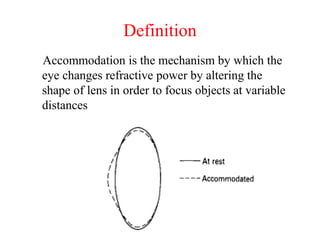
Accommodation is the mechanism by which the
eye changes refractive power by altering the
shape of lens in order to focus objects at variable
distances
Theories of Accomodation
Theories of mechanism of accommodation
 The exact mechanism of accommodation is not known but
the Principal fact is that ACCOMMODATION is a feature of
increase in the curvature of the lens which affects anterior
surface mainly.
 Relaxation theory of HELMHOLTZ “Capsular
Theory”:
 He considered that lens was elastic and in normal state it is
stretched and flattened by tension of the suspensory
ligaments.
 During accommodation, contraction of ciliary muscle
shortens ciliary ring and moves towards the equator of the
lens.
 Relax the suspensory ligaments, relieving strain.
 Lens assumes more spherical form, increasing thickness
and decreasing diameter.
Points in favour of the relaxation
theory
• Imaging technique showed that ciliary muscle move
anteriorly & the equatorial edge of lens move away
from sclera during accommodation.
• Gonio-videography show zonular fibers extending
from ciliary processes to lens equator, are relaxed
during accommodation
GULLSTRAND mechanical model of
accommodation
• It is based on HELMHOLTZ hypothesis
• GULLSTRAND devised a mechanical model to
explain accommodation.
• It shows in unaccommodated state elasticity
of choroid is stronger than lens. When
accommodation comes into play weight i.e
ciliary muscles contract to overcome elasticity
of choroid.
• It helps lens to take accommodated shape.
Points against the theory
• It is not clear how lens alters its shape when tension
in suspensory ligaments is relaxed?
• what is responsible for decline in power of
accommodation with age?
TSCHERNING’S THEORY OF
ACCOMMODATION
increased curvature of capsule to
increasing tension of the zonules.
It states that contraction of ciliary
muscle pulls zonules directly
increases tension of capsule at
equator of lens
bulging of poles.
SCHACHAR’S THEORY OF
ACCOMMODATION
ciliary muscle contracts
equatorial zonular tension is increased
anterior and posterior zonules are simultaneously relaxed
central surfaces of the lens steepen
peripheral surfaces of the lens flatten
COTENARY theory
As ciliary muscle contracts
it forms a pressure gradient, causing anterior
movement of lens zonules diaphragm
increasing anterior central curvature.
Presbyopia is due to increase in lens volume, results
in reduced response to pressure gradient created by
ciliary body contraction
Changes during accomodation
• During accommodation, lens diameter decreases
• Lens thickness increases
• The thickness of the nucleus increases, but without
a change inthickness of the cortex
• central anterior surface curvature and lens
posterior surface moves posteriorly to increase
anterior segment length
• . Anterior chamber depth decreases due to the
forward movement of the anterior lens surface and
• the vitreous chamber depth decreases due to the
posterior movement of the posterior lens surface
• The lens asphericity changes and the pupil
constricts.
• accommodation is accompanied by an increase in
negative spherical aberration of the eye
• the iris constricts during accommodation,to
decrease the optical entrance pupil of the eye
Accommodation Reflex
Near reflex
• The afferent
– Retina (with the retinal ganglion axons in the optic
nerve, chiasm and tract),
– Lateral geniculate body (with axons in the optic
radiations)
– Visual cortex.
• Ocular motor control neurons are interposed
between the afferent and efferent limbs of this
circuit and include the visual association cortex
• It determines the image is "out-of-focus” &
sends corrective signals
|
internal capsule and crus cerebri
|
supraoculomotor nuclei (generates motor control
signals)
|
oculomotor complex.
• The efferent
– Edinger-Westphal nucleus -
oculomotor nerve - ciliary
ganglion - short ciliary nerve -
iris sphincter and the ciliary
muscle/zonules/lens of the
eye
– oculomotor neurons -
oculomotor nerve - medial
rectus, converge the two
eyes.
• (1) The far point of distinct vision is the position of an
object such that its image falls on the retina in
the relaxed eye, i.e. in the absence of accommodation.
The far point of the emmetropic eye is at infinity.
• (2) The near point of distinct vision is the nearest point at
which an object can be clearly seen when
maximum accommodation is used.
• The range of accommodation is the distance between
the far point and the near point,the distance over
which accomodation is effective.
• The amplitude of accommodation is the difference in
dioptric power between the eye at rest with minimal
refrctivityand the fully accommodated eye with
max.refraction.
• The dioptric power of the resting eye is called its
static refraction.
• The dioptric power of the accommodated eye is
called its dynamic refraction.
Types
Physical accomodation is
an expression of actual
physical deformtion of
lens measured in diopters
Physiological
accomodation has a unit
the myodioptre which is
taken as the contractile
power of the ciliary
muscle required to raise
the refractive power of
lens by 1 D
Measurement of accommodation
• Subjective estimation of near
reading distance overestimates
the accommodative response
amplitude, largely due to depth
of field of the eye
• Objective measurement of
accommodation can be done
with autorefractor or an
aberrometer as the eye changes
focus from a distant target to a
near target
FORMULA
• To calculate the accommodative power required to
focus an intermediate point within the range of
accommodation
• A=V-R
• where A is the accommodative power required, in
dioptres;
• V is the dioptric value of the intermediate point;
• R is the dioptric value of the far point (the far point
distance in hypermetropia, being behind the eye,
carries a negative sign).
• Thus, to focus an object at 1 m, the emmetropic eye
must exert one dioptre of accommodative power (A= 1
– 0).
Clinical Assessment
• Reading progressively smaller letters at near
• NPA using RAF rule
• Relative positive accommodation using minus lenses
• Accommodative flipper test using paired +/– lenses
• Dynamic Retinoscopy
Clinical Assessment of NPA
• Measurement of NPA:
– It is the closest point at which an object can be seen clearly
– Also called “near point” or “punctum proximum”
– Measured with the RAF rule
Measurement of amplitude of
accommodation
• Using minus lenses
• Each eye seperately
• Best corrected near vn target at 40 cm
• Till pt reports first blur
Push up test
Assesmentof accomodative response
• Monocular estimation method retinoscopy
• Nott retinoscopy:
• Retinoscopic reflex is neutralized by moving
retinoscope rather than adding the lenses
Interpretation of accomodative
response
• Lead of Accommodation: The amount by
which the accommodative response of the eye
is greater than the dioptric stimulus to
accommodation
• Lag of Accommodation: The amount by which
the accommodative response of the eye is less
than the dioptric stimulus to accommodation
Assesment of dynamic Accomodation
• An accomodative flipper of +2.00ds with -
2.00Ds is used to test accomodative facility
• Difficulty with plus lenses is seen in pts with
accomodative excess
• Difficulty with minus lenses is seen in pts with
prebyopes
In order to view a near object
accommodate to ensure clear
retinal images,
converge to maintain binocular
single vision.
the number of prism dioptres of
convergence which
accompanies each dioptre of
accommodation, ratio (AC/A)
ratio.
The normal range for the AC/A
ratio is 3:1 to 5:1.
Accommodative
Convergence/Accommodation Ratio
Anomalies of Accommodation
Classification
Decreased
Accommodation
Insufficiency
Ill-Sustained
Accommodation
Inertia Paralysis
Increased
Accommodation
Excess Spasm
• Diminished or deficient accommodation
– Physiological : Presbyopia
– Pharmacological : Cycloplegia
– Pathological
» Insufficiency of accommodation
» Ill sustained accommodation
» Inertia of accommodation
» Paralysis of accommodation
• Increased accommodation
Presbyopia
Presbyopia is a condition of physiological
insufficiency of accommodation leading to a
progressive fall in near vision.
Insufficiency of accommodation
• Condition in which accommodative power is
constantly less than lower limit of normal range
according to patient’s age.
Etiology
Premature sclerosis of lens
Weakness of ciliary muscle due to systemic
causes: Debilitating illness, anemia, toxemia,
malnutrition, diabetes mellitus, pregnancy,
stress etc.
Weakness of ciliary muscle due to local
causes: PAOG, mild cyclitis as during onset of
sympathetic ophthalmia.
Clinical features
• Features of eye strain and asthenopia.
• Head ach, fatigue & irritability of the eyes, while
attempting near work.
• Near work is blurred & becomes difficult or
impossible.
• Disturbance of convergence : intermittent diplopia.
• It is stable condition, if due to sclerosis
of lens.
• But is not stable in association with
ciliary muscle weakness.
Treatment
• Identification & treatment of any systemic cause.
• Any refractive error should be corrected & if vision
for near work is seriously blurred then additional
near correction has to be prescribed same as
presbyopia.
• If associated with convergence excess then full
spherical correction.
• Convergence insufficiency is there, then base in
prisms can be added.
• Prismatic correction added should bring near
point of convergence to same distance as near
point of accommodation.
• Weakest convex lenses should be prescribed, so
as to exercise and stimulate accommodation.
• After recovery additional correction should be
made weaker and weaker from time to time.
• Accommodative exercises.
– While do exercises patient should wear
correction for distance.
– Should be done simultaneously in both eyes, even
if associated with convergence insufficiency.
– But with convergence excess then the exercise
should done with one eye alternately.
– Accommodation test card exercise.
– Useless in generalized debility and sclerosis of
lens.
Ill-Sustained accommodation
• Accommodation fatigue.
• It is a situation in which though range of
accommodation is in normal range but it cannot sustain
it for a sufficient period of time.
• Initial stage of insufficiency of accommodation.
• It occurs due to
– Stage of convalescence from debilitating illness
– Stage of generalized tiredness
– When the patient is relaxed in the bed
Clinical features
• These symptoms are most commonly reported
at the end of the day
• Blurred vision after prolonged near work.
• Headaches
• Eyestrain
• Fatigue, sleepiness and a loss of comprehension
with continued reading
• A dull 'pulling' sensation around the eye.
Treatment
• Near work should be curtailed during debilitating
illness.
• General tonic measures should be taken.
• The condition of illumination and posture while
doing near work, should be improved.
Inertia of accommodation
• It is a condition in which patient faces difficulty in
altering the range of accommodation.
• Amplitude of accommodation is normal.
• Ability to make use of this amplitude quickly and for
long periods of time is inadequate.
Clinical features
• Difficulty changing focus from one distance to
another
• Headaches
• Eyestrain
• Fatigue
• Difficulty sustaining near tasks
• Blurred vision
Treatment: correcting any refractive error and
accommodative exercises.
Paralysis of accommodation
– parasympatholytic drugs
– Internal ophthalmoplegia
– Complete third nerve paralysis
– Systemic medications
Clinical features
• Blurred vision at near
• Photophobia or a 'dazzling' effect
• Diplopia
• Micropsia: objects may appear smaller than they
are due to a false sense of distance
• Enlarged pupil.
Treatment
• An effort should be made to find out the cause and
try to eliminate it.
• Self-recovery occurs in drug-induced paralysis and in
diphtheric cases (once systemic disease is treated).
• Dark-glasses effective in reducing glare.
• Convex lenses for near vision, if the paralysis is
permanent.
Excessive accommodation
• Accommodative response is greater than the
accommodative stimulus.
• There is functional increase in tonus of ciliary muscle,
results in a constant accommodative effect.
Causes
• Young hypermetropes frequently uses excessive
accommodation as a physiological adaptation
• Young myopes performing excessive near work,
associated with excessive convergence.
• Astigmatic error in young patients
• Presbyopes in the beginning
• Use of improper and ill fitting spectacles
Precipitating factors
Excessive near
work done,
especially in dim
or excessive
illumination.
General debility,
physical or mental
ill health
Symptoms
• Blurred vision at near is uncommon
• Blurred vision at distance
• Headaches
• Eyestrain
• Photophobia
• Difficulty changing focus from distance to near
• Diplopia
Treatment
• It has a good prognosis.
• Refractive error should be corrected after carefully
performed cycloplegic refraction.
• Near work should be stopped for some time, after
that it should be done with proper illumination
conditions.
Spasm of accommodation
• Spasm of accommodation refers to exertion of
abnormally excessive accommodation.
Causes
• Drug induced spasm of accommodation is
known to occur after use of strong miotics.
• Spontaneous spasm of accommodation: attempt
to compensate for a refractive anomaly.
• Occurs when excessive near work is done with
bad illumination, bad reading position, state of
neurosis, mental stress or anxiety.
Clinical features
• Defective vision: due to induced myopia
• macropsia.
• Asthenopic symptoms
• Precipitating factors like marked degree of
muscular imbalance, trigeminal neuralgia, a
dental lesion, general intoxication.
Treatment
• Relaxation of ciliary muscle by atropine for 4 weeks
or more and
• Prohibition of near work allow prompt recovery from
spasm of accommodation.
• Elimination of the associated causative factors to
prevent the recurrence.

Accomodation

  • 1.
    Accomodation and itsanomalies vidya
  • 2.
    Definition Accommodation is themechanism by which the eye changes refractive power by altering the shape of lens in order to focus objects at variable distances
  • 4.
  • 5.
    Theories of mechanismof accommodation  The exact mechanism of accommodation is not known but the Principal fact is that ACCOMMODATION is a feature of increase in the curvature of the lens which affects anterior surface mainly.  Relaxation theory of HELMHOLTZ “Capsular Theory”:  He considered that lens was elastic and in normal state it is stretched and flattened by tension of the suspensory ligaments.  During accommodation, contraction of ciliary muscle shortens ciliary ring and moves towards the equator of the lens.  Relax the suspensory ligaments, relieving strain.  Lens assumes more spherical form, increasing thickness and decreasing diameter.
  • 8.
    Points in favourof the relaxation theory • Imaging technique showed that ciliary muscle move anteriorly & the equatorial edge of lens move away from sclera during accommodation. • Gonio-videography show zonular fibers extending from ciliary processes to lens equator, are relaxed during accommodation
  • 9.
    GULLSTRAND mechanical modelof accommodation • It is based on HELMHOLTZ hypothesis • GULLSTRAND devised a mechanical model to explain accommodation. • It shows in unaccommodated state elasticity of choroid is stronger than lens. When accommodation comes into play weight i.e ciliary muscles contract to overcome elasticity of choroid. • It helps lens to take accommodated shape.
  • 11.
    Points against thetheory • It is not clear how lens alters its shape when tension in suspensory ligaments is relaxed? • what is responsible for decline in power of accommodation with age?
  • 12.
    TSCHERNING’S THEORY OF ACCOMMODATION increasedcurvature of capsule to increasing tension of the zonules. It states that contraction of ciliary muscle pulls zonules directly increases tension of capsule at equator of lens bulging of poles.
  • 14.
    SCHACHAR’S THEORY OF ACCOMMODATION ciliarymuscle contracts equatorial zonular tension is increased anterior and posterior zonules are simultaneously relaxed central surfaces of the lens steepen peripheral surfaces of the lens flatten
  • 16.
    COTENARY theory As ciliarymuscle contracts it forms a pressure gradient, causing anterior movement of lens zonules diaphragm increasing anterior central curvature. Presbyopia is due to increase in lens volume, results in reduced response to pressure gradient created by ciliary body contraction
  • 17.
    Changes during accomodation •During accommodation, lens diameter decreases • Lens thickness increases • The thickness of the nucleus increases, but without a change inthickness of the cortex • central anterior surface curvature and lens posterior surface moves posteriorly to increase anterior segment length • . Anterior chamber depth decreases due to the forward movement of the anterior lens surface and • the vitreous chamber depth decreases due to the posterior movement of the posterior lens surface
  • 18.
    • The lensasphericity changes and the pupil constricts. • accommodation is accompanied by an increase in negative spherical aberration of the eye • the iris constricts during accommodation,to decrease the optical entrance pupil of the eye
  • 19.
  • 20.
    Near reflex • Theafferent – Retina (with the retinal ganglion axons in the optic nerve, chiasm and tract), – Lateral geniculate body (with axons in the optic radiations) – Visual cortex. • Ocular motor control neurons are interposed between the afferent and efferent limbs of this circuit and include the visual association cortex
  • 21.
    • It determinesthe image is "out-of-focus” & sends corrective signals | internal capsule and crus cerebri | supraoculomotor nuclei (generates motor control signals) | oculomotor complex.
  • 22.
    • The efferent –Edinger-Westphal nucleus - oculomotor nerve - ciliary ganglion - short ciliary nerve - iris sphincter and the ciliary muscle/zonules/lens of the eye – oculomotor neurons - oculomotor nerve - medial rectus, converge the two eyes.
  • 23.
    • (1) Thefar point of distinct vision is the position of an object such that its image falls on the retina in the relaxed eye, i.e. in the absence of accommodation. The far point of the emmetropic eye is at infinity. • (2) The near point of distinct vision is the nearest point at which an object can be clearly seen when maximum accommodation is used.
  • 24.
    • The rangeof accommodation is the distance between the far point and the near point,the distance over which accomodation is effective. • The amplitude of accommodation is the difference in dioptric power between the eye at rest with minimal refrctivityand the fully accommodated eye with max.refraction. • The dioptric power of the resting eye is called its static refraction. • The dioptric power of the accommodated eye is called its dynamic refraction.
  • 25.
    Types Physical accomodation is anexpression of actual physical deformtion of lens measured in diopters Physiological accomodation has a unit the myodioptre which is taken as the contractile power of the ciliary muscle required to raise the refractive power of lens by 1 D
  • 26.
    Measurement of accommodation •Subjective estimation of near reading distance overestimates the accommodative response amplitude, largely due to depth of field of the eye • Objective measurement of accommodation can be done with autorefractor or an aberrometer as the eye changes focus from a distant target to a near target
  • 27.
    FORMULA • To calculatethe accommodative power required to focus an intermediate point within the range of accommodation • A=V-R • where A is the accommodative power required, in dioptres; • V is the dioptric value of the intermediate point; • R is the dioptric value of the far point (the far point distance in hypermetropia, being behind the eye, carries a negative sign). • Thus, to focus an object at 1 m, the emmetropic eye must exert one dioptre of accommodative power (A= 1 – 0).
  • 28.
    Clinical Assessment • Readingprogressively smaller letters at near • NPA using RAF rule • Relative positive accommodation using minus lenses • Accommodative flipper test using paired +/– lenses • Dynamic Retinoscopy
  • 29.
    Clinical Assessment ofNPA • Measurement of NPA: – It is the closest point at which an object can be seen clearly – Also called “near point” or “punctum proximum” – Measured with the RAF rule
  • 30.
    Measurement of amplitudeof accommodation • Using minus lenses • Each eye seperately • Best corrected near vn target at 40 cm • Till pt reports first blur Push up test
  • 31.
    Assesmentof accomodative response •Monocular estimation method retinoscopy • Nott retinoscopy: • Retinoscopic reflex is neutralized by moving retinoscope rather than adding the lenses
  • 32.
    Interpretation of accomodative response •Lead of Accommodation: The amount by which the accommodative response of the eye is greater than the dioptric stimulus to accommodation • Lag of Accommodation: The amount by which the accommodative response of the eye is less than the dioptric stimulus to accommodation
  • 33.
    Assesment of dynamicAccomodation • An accomodative flipper of +2.00ds with - 2.00Ds is used to test accomodative facility • Difficulty with plus lenses is seen in pts with accomodative excess • Difficulty with minus lenses is seen in pts with prebyopes
  • 34.
    In order toview a near object accommodate to ensure clear retinal images, converge to maintain binocular single vision. the number of prism dioptres of convergence which accompanies each dioptre of accommodation, ratio (AC/A) ratio. The normal range for the AC/A ratio is 3:1 to 5:1. Accommodative Convergence/Accommodation Ratio
  • 35.
  • 36.
    • Diminished ordeficient accommodation – Physiological : Presbyopia – Pharmacological : Cycloplegia – Pathological » Insufficiency of accommodation » Ill sustained accommodation » Inertia of accommodation » Paralysis of accommodation • Increased accommodation
  • 37.
    Presbyopia Presbyopia is acondition of physiological insufficiency of accommodation leading to a progressive fall in near vision.
  • 39.
    Insufficiency of accommodation •Condition in which accommodative power is constantly less than lower limit of normal range according to patient’s age.
  • 40.
    Etiology Premature sclerosis oflens Weakness of ciliary muscle due to systemic causes: Debilitating illness, anemia, toxemia, malnutrition, diabetes mellitus, pregnancy, stress etc. Weakness of ciliary muscle due to local causes: PAOG, mild cyclitis as during onset of sympathetic ophthalmia.
  • 41.
    Clinical features • Featuresof eye strain and asthenopia. • Head ach, fatigue & irritability of the eyes, while attempting near work. • Near work is blurred & becomes difficult or impossible. • Disturbance of convergence : intermittent diplopia. • It is stable condition, if due to sclerosis of lens. • But is not stable in association with ciliary muscle weakness.
  • 42.
    Treatment • Identification &treatment of any systemic cause. • Any refractive error should be corrected & if vision for near work is seriously blurred then additional near correction has to be prescribed same as presbyopia. • If associated with convergence excess then full spherical correction.
  • 43.
    • Convergence insufficiencyis there, then base in prisms can be added. • Prismatic correction added should bring near point of convergence to same distance as near point of accommodation. • Weakest convex lenses should be prescribed, so as to exercise and stimulate accommodation. • After recovery additional correction should be made weaker and weaker from time to time.
  • 44.
    • Accommodative exercises. –While do exercises patient should wear correction for distance. – Should be done simultaneously in both eyes, even if associated with convergence insufficiency. – But with convergence excess then the exercise should done with one eye alternately. – Accommodation test card exercise. – Useless in generalized debility and sclerosis of lens.
  • 45.
    Ill-Sustained accommodation • Accommodationfatigue. • It is a situation in which though range of accommodation is in normal range but it cannot sustain it for a sufficient period of time. • Initial stage of insufficiency of accommodation. • It occurs due to – Stage of convalescence from debilitating illness – Stage of generalized tiredness – When the patient is relaxed in the bed
  • 46.
    Clinical features • Thesesymptoms are most commonly reported at the end of the day • Blurred vision after prolonged near work. • Headaches • Eyestrain • Fatigue, sleepiness and a loss of comprehension with continued reading • A dull 'pulling' sensation around the eye.
  • 47.
    Treatment • Near workshould be curtailed during debilitating illness. • General tonic measures should be taken. • The condition of illumination and posture while doing near work, should be improved.
  • 48.
    Inertia of accommodation •It is a condition in which patient faces difficulty in altering the range of accommodation. • Amplitude of accommodation is normal. • Ability to make use of this amplitude quickly and for long periods of time is inadequate.
  • 49.
    Clinical features • Difficultychanging focus from one distance to another • Headaches • Eyestrain • Fatigue • Difficulty sustaining near tasks • Blurred vision Treatment: correcting any refractive error and accommodative exercises.
  • 50.
    Paralysis of accommodation –parasympatholytic drugs – Internal ophthalmoplegia – Complete third nerve paralysis – Systemic medications
  • 51.
    Clinical features • Blurredvision at near • Photophobia or a 'dazzling' effect • Diplopia • Micropsia: objects may appear smaller than they are due to a false sense of distance • Enlarged pupil.
  • 52.
    Treatment • An effortshould be made to find out the cause and try to eliminate it. • Self-recovery occurs in drug-induced paralysis and in diphtheric cases (once systemic disease is treated). • Dark-glasses effective in reducing glare. • Convex lenses for near vision, if the paralysis is permanent.
  • 53.
    Excessive accommodation • Accommodativeresponse is greater than the accommodative stimulus. • There is functional increase in tonus of ciliary muscle, results in a constant accommodative effect.
  • 54.
    Causes • Young hypermetropesfrequently uses excessive accommodation as a physiological adaptation • Young myopes performing excessive near work, associated with excessive convergence. • Astigmatic error in young patients • Presbyopes in the beginning • Use of improper and ill fitting spectacles
  • 55.
    Precipitating factors Excessive near workdone, especially in dim or excessive illumination. General debility, physical or mental ill health
  • 56.
    Symptoms • Blurred visionat near is uncommon • Blurred vision at distance • Headaches • Eyestrain • Photophobia • Difficulty changing focus from distance to near • Diplopia
  • 57.
    Treatment • It hasa good prognosis. • Refractive error should be corrected after carefully performed cycloplegic refraction. • Near work should be stopped for some time, after that it should be done with proper illumination conditions.
  • 58.
    Spasm of accommodation •Spasm of accommodation refers to exertion of abnormally excessive accommodation.
  • 59.
    Causes • Drug inducedspasm of accommodation is known to occur after use of strong miotics. • Spontaneous spasm of accommodation: attempt to compensate for a refractive anomaly. • Occurs when excessive near work is done with bad illumination, bad reading position, state of neurosis, mental stress or anxiety.
  • 60.
    Clinical features • Defectivevision: due to induced myopia • macropsia. • Asthenopic symptoms • Precipitating factors like marked degree of muscular imbalance, trigeminal neuralgia, a dental lesion, general intoxication.
  • 61.
    Treatment • Relaxation ofciliary muscle by atropine for 4 weeks or more and • Prohibition of near work allow prompt recovery from spasm of accommodation. • Elimination of the associated causative factors to prevent the recurrence.