P: 555.123.4568 F: 555.123.4567
123 West Main Street, New York,
NY 10001
www.rightcare.com|
Low Vision:
Developed by:
Julie Garden-Robinson, Ph.D., R.D., L.R.D., Food and Nutrition Specialist
Sherri Stastny, Ph.D., R.D., C.S.S.D., L.R.D., Assistant Professor, Health, Nutrition and Exercise Sciences
Casey Kjera, R.D., Program Assistant (former)
Krystle McNeal, R.D., Program Assistant (former)
Stacy Wang, R.D., L.R.D., Extension Associate
A Guide for Educators
P: 555.123.4568 F: 555.123.4567
123 West Main Street, New York,
NY 10001
www.rightcare.com|
Support and review of this project was provided by:
• A Healthy Vision Community Grant from the
National Eye Institute in collaboration with the
North Dakota Optometric Association
• Dr. Michael Ranum,
Low-vision Specialist, Dakota Eye Institute
• Susan Ray-Deggs,
NDSU College of Human Development and
Education
P: 555.123.4568 F: 555.123.4567
123 West Main Street, New York,
NY 10001
www.rightcare.com|
What is low vision?
Adapting the
environment
Overview
P: 555.123.4568 F: 555.123.4567
123 West Main Street, New York,
NY 10001
www.rightcare.com|
What is low vision?
P: 555.123.4568 F: 555.123.4567
123 West Main Street, New York,
NY 10001
www.rightcare.com|
20/70 to 20/400
Cannot be corrected with
glasses, contact lenses or surgery
Interferes with daily activities
Low Vision
P: 555.123.4568 F: 555.123.4567
123 West Main Street, New York,
NY 10001
www.rightcare.com|
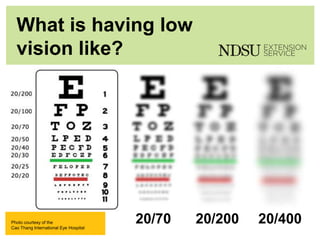
What is having low
vision like?
20/70 20/200 20/400Photo courtesy of the
Cao Thang International Eye Hospital
P: 555.123.4568 F: 555.123.4567
123 West Main Street, New York,
NY 10001
www.rightcare.com|
Symptoms
• Loss of central vision
• Loss of visual field
• Loss of color vision
• Loss of ability to adjust to glare
• Loss of ability to see in dark areas
P: 555.123.4568 F: 555.123.4567
123 West Main Street, New York,
NY 10001
www.rightcare.com|
Causes
Macular
degeneration
Cataracts
Glaucoma
Diabetic
retinopathy
P: 555.123.4568 F: 555.123.4567
123 West Main Street, New York,
NY 10001
www.rightcare.com|
Normal
Vision
Photo courtesy of
the National Eye
Institute
P: 555.123.4568 F: 555.123.4567
123 West Main Street, New York,
NY 10001
www.rightcare.com|
Macular
Degeneration
Photo courtesy of
the National Eye
Institute
P: 555.123.4568 F: 555.123.4567
123 West Main Street, New York,
NY 10001
www.rightcare.com|
Cataracts
Photo courtesy of
the National Eye
Institute
P: 555.123.4568 F: 555.123.4567
123 West Main Street, New York,
NY 10001
www.rightcare.com|
Glaucoma
Photo courtesy of
the National Eye
Institute
P: 555.123.4568 F: 555.123.4567
123 West Main Street, New York,
NY 10001
www.rightcare.com|
Diabetic
Retinopathy
Photo courtesy of
the National Eye
Institute
P: 555.123.4568 F: 555.123.4567
123 West Main Street, New York,
NY 10001
www.rightcare.com|
Risk Factors
Uncontrolled diabetes
Poor diet and obesity
Smoking
Poor health habits
Aging
P: 555.123.4568 F: 555.123.4567
123 West Main Street, New York,
NY 10001
www.rightcare.com|
Statistics
3.5 million Americans
have low vision
180 million people
worldwide have low vision
The number of people
affected is expected to
double in the coming years
P: 555.123.4568 F: 555.123.4567
123 West Main Street, New York,
NY 10001
www.rightcare.com|
Presenting to Those
with Low Vision
P: 555.123.4568 F: 555.123.4567
123 West Main Street, New York,
NY 10001
www.rightcare.com|
Font Styles
•Do not use
BroadwayNo
•Do not use Lucida
CalligraphyNo
P: 555.123.4568 F: 555.123.4567
123 West Main Street, New York,
NY 10001
www.rightcare.com|
Font: Print
Georgia
Courier
New
Times New
Roman
Arial
Bookman
Old Style
P: 555.123.4568 F: 555.123.4567
123 West Main Street, New York,
NY 10001
www.rightcare.com|
Font: Projecting
Arial Tahoma
Verdana
Century
Gothic
P: 555.123.4568 F: 555.123.4567
123 West Main Street, New York,
NY 10001
www.rightcare.com|
Font Size: Print
• Do not use
12-point
No
• Do not use
14-point
No
• 16- to 18-
point font
is best
Yes
P: 555.123.4568 F: 555.123.4567
123 West Main Street, New York,
NY 10001
www.rightcare.com|
Font Size:
Projecting
• Use at least
32-point font
Yes
• Use at least
36-point font
for titles
Yes
P: 555.123.4568 F: 555.123.4567
123 West Main Street, New York,
NY 10001
www.rightcare.com|
Font Style
• Italicized
No
• Standard
No
• Bold
Yes
P: 555.123.4568 F: 555.123.4567
123 West Main Street, New York,
NY 10001
www.rightcare.com|
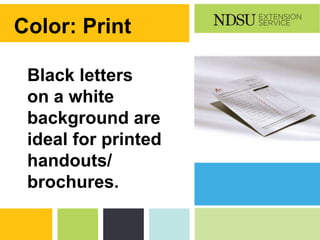
Color: Print
Black letters
on a white
background are
ideal for printed
handouts/
brochures.
P: 555.123.4568 F: 555.123.4567
123 West Main Street, New York,
NY 10001
www.rightcare.com|
Color: Projection
White letters on a
black background
are easiest to read.
P: 555.123.4568 F: 555.123.4567
123 West Main Street, New York,
NY 10001
www.rightcare.com|
Color
Colored letters on a
colored background
are very hard to
read.
P: 555.123.4568 F: 555.123.4567
123 West Main Street, New York,
NY 10001
www.rightcare.com|
Document
Adaptation
Allow extra space between lines of text
Avoid shiny or glossy paper
Limit the use of ALL CAPS
Use a standard format
P: 555.123.4568 F: 555.123.4567
123 West Main Street, New York,
NY 10001
www.rightcare.com|
Controlling Glare
Cover windows with
blinds or drapes
Use shades
on lamps
P: 555.123.4568 F: 555.123.4567
123 West Main Street, New York,
NY 10001
www.rightcare.com|
Things to Note:
The best method is
to ask individuals
what the easiest
way is for them to
learn.
P: 555.123.4568 F: 555.123.4567
123 West Main Street, New York,
NY 10001
www.rightcare.com|
Remember This?
Diabetic
Retinopathy
P: 555.123.4568 F: 555.123.4567
123 West Main Street, New York,
NY 10001
www.rightcare.com|
Peanut Butter
Sandwich and
Glass of Water
Challenge!
P: 555.123.4568 F: 555.123.4567
123 West Main Street, New York,
NY 10001
www.rightcare.com|
Resources
http://aota.org/Consumers/consumers/Adults/LowVision/
35190.aspx
http://nei.nih.gov/lowvision
http://ndvisionservices.com
http://ndipat.org
http://lowvisionchef.com
www.shoplowvision.com
http://assistivetech.net
http://ameds.com/daily-living-aids/eating-aids/adaptive-
eating-utensils.html
P: 555.123.4568 F: 555.123.4567
123 West Main Street, New York,
NY 10001
www.rightcare.com|
Resources
http://Lowvision.org
http://lighthouse.org/navh
www.visionaware.org
www.lowvision.com/tips
www.afb.org/section.aspx?FolderID=2&SectionID=
4&DocumentID=1452cclvi.org/large-print-guidelines.html
www.goingblindmovie.com: “Going Blind: Coming Out of
the Dark About Vision Loss”
P: 555.123.4568 F: 555.123.4567
123 West Main Street, New York,
NY 10001
www.rightcare.com|
References
• Adam R, and Pickering D. Where are all the clients? Barriers to referral for low vision
rehabilitation. Visual Impairment Research. 2007;(9):45-50.
• American Academy of Ophthalmology. 2001. There is hope for those with age-related macular
degeneration. Retrieved Nov. 13, 2004 from www.medem.com/medlb.
• Holbrook EA, Caputo JL, Perry TL, Fuller DK, Morgan DW. Physical activity, body
composition, and perceived quality of life of adults with visual impairments. Journal of Visual
Impairment & Blindness. 2009;103:17–29.
• Kammer R, et al. Survey of optometric low vision rehabilitation training methods for the
moderately visually impaired. Optometry. 2009;(80):185-192.
• Lamoureux E, et al. The effectiveness of low-vision rehabilitation on participation in daily living
and quality of life. Investigative Ophthalmology and Visual Science. 2007;(48):1476-1482.
• LowVisionFAQ.
www.washington.edu/doit/Faculty/Strategies/Disability/Vision/low_vision_faq.html
• Mamer L, et al. Food experiences and eating patterns of visually impaired and blind people.
Canadian Journal of Dietetic Practice & Research. 2009;(70)1:13-18. CINAHL Plus with Full
Text. Web. May 31, 2012.
• Marinoff R. Referral patterns in low vision: a survey of mid-south tri-state eye care providers.
Journal of Behavioral Optometry. 2012;(23):9-15.
P: 555.123.4568 F: 555.123.4567
123 West Main Street, New York,
NY 10001
www.rightcare.com|
References
• Massof R. Low vision and blindness: changing perspective and increasing success. Braille
Monitor. 2006;(49)10:40-43. Web. June 6, 2012.
https://nfb.org/images/nfb/publications/bm/bm06/bm0610/bm061005.htm.
• Misiano J. Low vision requires innovative prevention and treatment strategies. Ocular Surgery
News. 2008;(26)2:41-42. CINAHL Plus with Full Text. Web. May 31, 2012.
• National Eye Institute. www.nei.nih.gov
• Pizzimenti J. Low vision rehabilitation for persons living with retinal disease. Presentation at
the North Dakota Optometric Congress, Bismarck, N.D. September 2012.
• Pizzimenti J. The eye in obesity. Presentation at the North Dakota Optometric
Congress, Bismarck, N.D. September 2012.
• Ray-Deggs S. Peer review lighting and kitchen. Presentation at the North Dakota Optometric
Congress, Bismarck, N.D. September 2012.
• Russell-Minda E, Jutai JW, Strong G, Campbell KA, Gold D, Pretty L, Wilmot L. The legibility
of typefaces for readers with low vision: a research review. Journal of Visual Impairment and
Blindness. 2007;(101):402-415.
• Wilkin C. Designing educational programs for older adults. University of Florida IFAS
Extension. http://edis.ifas.ufl.edu/fy631 Publication Date: 2008. Accessed May 5, 2013
• World Blind Union and Cornell University ILR School. PowerPoint accessibility.
http://digitalcommons.ilr.cornell.edu/cgi/viewcontent.cgi?article=1299&context=gladnetcollect.
Publication Date: 2006. Accessed Sept. 10, 2012.

Low Vision: A Guide for Educators

  • 1.
    P: 555.123.4568 F:555.123.4567 123 West Main Street, New York, NY 10001 www.rightcare.com| Low Vision: Developed by: Julie Garden-Robinson, Ph.D., R.D., L.R.D., Food and Nutrition Specialist Sherri Stastny, Ph.D., R.D., C.S.S.D., L.R.D., Assistant Professor, Health, Nutrition and Exercise Sciences Casey Kjera, R.D., Program Assistant (former) Krystle McNeal, R.D., Program Assistant (former) Stacy Wang, R.D., L.R.D., Extension Associate A Guide for Educators
  • 2.
    P: 555.123.4568 F:555.123.4567 123 West Main Street, New York, NY 10001 www.rightcare.com| Support and review of this project was provided by: • A Healthy Vision Community Grant from the National Eye Institute in collaboration with the North Dakota Optometric Association • Dr. Michael Ranum, Low-vision Specialist, Dakota Eye Institute • Susan Ray-Deggs, NDSU College of Human Development and Education
  • 3.
    P: 555.123.4568 F:555.123.4567 123 West Main Street, New York, NY 10001 www.rightcare.com| What is low vision? Adapting the environment Overview
  • 4.
    P: 555.123.4568 F:555.123.4567 123 West Main Street, New York, NY 10001 www.rightcare.com| What is low vision?
  • 5.
    P: 555.123.4568 F:555.123.4567 123 West Main Street, New York, NY 10001 www.rightcare.com| 20/70 to 20/400 Cannot be corrected with glasses, contact lenses or surgery Interferes with daily activities Low Vision
  • 6.
    P: 555.123.4568 F:555.123.4567 123 West Main Street, New York, NY 10001 www.rightcare.com| What is having low vision like? 20/70 20/200 20/400Photo courtesy of the Cao Thang International Eye Hospital
  • 7.
    P: 555.123.4568 F:555.123.4567 123 West Main Street, New York, NY 10001 www.rightcare.com| Symptoms • Loss of central vision • Loss of visual field • Loss of color vision • Loss of ability to adjust to glare • Loss of ability to see in dark areas
  • 8.
    P: 555.123.4568 F:555.123.4567 123 West Main Street, New York, NY 10001 www.rightcare.com| Causes Macular degeneration Cataracts Glaucoma Diabetic retinopathy
  • 9.
    P: 555.123.4568 F:555.123.4567 123 West Main Street, New York, NY 10001 www.rightcare.com| Normal Vision Photo courtesy of the National Eye Institute
  • 10.
    P: 555.123.4568 F:555.123.4567 123 West Main Street, New York, NY 10001 www.rightcare.com| Macular Degeneration Photo courtesy of the National Eye Institute
  • 11.
    P: 555.123.4568 F:555.123.4567 123 West Main Street, New York, NY 10001 www.rightcare.com| Cataracts Photo courtesy of the National Eye Institute
  • 12.
    P: 555.123.4568 F:555.123.4567 123 West Main Street, New York, NY 10001 www.rightcare.com| Glaucoma Photo courtesy of the National Eye Institute
  • 13.
    P: 555.123.4568 F:555.123.4567 123 West Main Street, New York, NY 10001 www.rightcare.com| Diabetic Retinopathy Photo courtesy of the National Eye Institute
  • 14.
    P: 555.123.4568 F:555.123.4567 123 West Main Street, New York, NY 10001 www.rightcare.com| Risk Factors Uncontrolled diabetes Poor diet and obesity Smoking Poor health habits Aging
  • 15.
    P: 555.123.4568 F:555.123.4567 123 West Main Street, New York, NY 10001 www.rightcare.com| Statistics 3.5 million Americans have low vision 180 million people worldwide have low vision The number of people affected is expected to double in the coming years
  • 16.
    P: 555.123.4568 F:555.123.4567 123 West Main Street, New York, NY 10001 www.rightcare.com| Presenting to Those with Low Vision
  • 17.
    P: 555.123.4568 F:555.123.4567 123 West Main Street, New York, NY 10001 www.rightcare.com| Font Styles •Do not use BroadwayNo •Do not use Lucida CalligraphyNo
  • 18.
    P: 555.123.4568 F:555.123.4567 123 West Main Street, New York, NY 10001 www.rightcare.com| Font: Print Georgia Courier New Times New Roman Arial Bookman Old Style
  • 19.
    P: 555.123.4568 F:555.123.4567 123 West Main Street, New York, NY 10001 www.rightcare.com| Font: Projecting Arial Tahoma Verdana Century Gothic
  • 20.
    P: 555.123.4568 F:555.123.4567 123 West Main Street, New York, NY 10001 www.rightcare.com| Font Size: Print • Do not use 12-point No • Do not use 14-point No • 16- to 18- point font is best Yes
  • 21.
    P: 555.123.4568 F:555.123.4567 123 West Main Street, New York, NY 10001 www.rightcare.com| Font Size: Projecting • Use at least 32-point font Yes • Use at least 36-point font for titles Yes
  • 22.
    P: 555.123.4568 F:555.123.4567 123 West Main Street, New York, NY 10001 www.rightcare.com| Font Style • Italicized No • Standard No • Bold Yes
  • 23.
    P: 555.123.4568 F:555.123.4567 123 West Main Street, New York, NY 10001 www.rightcare.com| Color: Print Black letters on a white background are ideal for printed handouts/ brochures.
  • 24.
    P: 555.123.4568 F:555.123.4567 123 West Main Street, New York, NY 10001 www.rightcare.com| Color: Projection White letters on a black background are easiest to read.
  • 25.
    P: 555.123.4568 F:555.123.4567 123 West Main Street, New York, NY 10001 www.rightcare.com| Color Colored letters on a colored background are very hard to read.
  • 26.
    P: 555.123.4568 F:555.123.4567 123 West Main Street, New York, NY 10001 www.rightcare.com| Document Adaptation Allow extra space between lines of text Avoid shiny or glossy paper Limit the use of ALL CAPS Use a standard format
  • 27.
    P: 555.123.4568 F:555.123.4567 123 West Main Street, New York, NY 10001 www.rightcare.com| Controlling Glare Cover windows with blinds or drapes Use shades on lamps
  • 28.
    P: 555.123.4568 F:555.123.4567 123 West Main Street, New York, NY 10001 www.rightcare.com| Things to Note: The best method is to ask individuals what the easiest way is for them to learn.
  • 29.
    P: 555.123.4568 F:555.123.4567 123 West Main Street, New York, NY 10001 www.rightcare.com| Remember This? Diabetic Retinopathy
  • 30.
    P: 555.123.4568 F:555.123.4567 123 West Main Street, New York, NY 10001 www.rightcare.com| Peanut Butter Sandwich and Glass of Water Challenge!
  • 31.
    P: 555.123.4568 F:555.123.4567 123 West Main Street, New York, NY 10001 www.rightcare.com| Resources http://aota.org/Consumers/consumers/Adults/LowVision/ 35190.aspx http://nei.nih.gov/lowvision http://ndvisionservices.com http://ndipat.org http://lowvisionchef.com www.shoplowvision.com http://assistivetech.net http://ameds.com/daily-living-aids/eating-aids/adaptive- eating-utensils.html
  • 32.
    P: 555.123.4568 F:555.123.4567 123 West Main Street, New York, NY 10001 www.rightcare.com| Resources http://Lowvision.org http://lighthouse.org/navh www.visionaware.org www.lowvision.com/tips www.afb.org/section.aspx?FolderID=2&SectionID= 4&DocumentID=1452cclvi.org/large-print-guidelines.html www.goingblindmovie.com: “Going Blind: Coming Out of the Dark About Vision Loss”
  • 33.
    P: 555.123.4568 F:555.123.4567 123 West Main Street, New York, NY 10001 www.rightcare.com| References • Adam R, and Pickering D. Where are all the clients? Barriers to referral for low vision rehabilitation. Visual Impairment Research. 2007;(9):45-50. • American Academy of Ophthalmology. 2001. There is hope for those with age-related macular degeneration. Retrieved Nov. 13, 2004 from www.medem.com/medlb. • Holbrook EA, Caputo JL, Perry TL, Fuller DK, Morgan DW. Physical activity, body composition, and perceived quality of life of adults with visual impairments. Journal of Visual Impairment & Blindness. 2009;103:17–29. • Kammer R, et al. Survey of optometric low vision rehabilitation training methods for the moderately visually impaired. Optometry. 2009;(80):185-192. • Lamoureux E, et al. The effectiveness of low-vision rehabilitation on participation in daily living and quality of life. Investigative Ophthalmology and Visual Science. 2007;(48):1476-1482. • LowVisionFAQ. www.washington.edu/doit/Faculty/Strategies/Disability/Vision/low_vision_faq.html • Mamer L, et al. Food experiences and eating patterns of visually impaired and blind people. Canadian Journal of Dietetic Practice & Research. 2009;(70)1:13-18. CINAHL Plus with Full Text. Web. May 31, 2012. • Marinoff R. Referral patterns in low vision: a survey of mid-south tri-state eye care providers. Journal of Behavioral Optometry. 2012;(23):9-15.
  • 34.
    P: 555.123.4568 F:555.123.4567 123 West Main Street, New York, NY 10001 www.rightcare.com| References • Massof R. Low vision and blindness: changing perspective and increasing success. Braille Monitor. 2006;(49)10:40-43. Web. June 6, 2012. https://nfb.org/images/nfb/publications/bm/bm06/bm0610/bm061005.htm. • Misiano J. Low vision requires innovative prevention and treatment strategies. Ocular Surgery News. 2008;(26)2:41-42. CINAHL Plus with Full Text. Web. May 31, 2012. • National Eye Institute. www.nei.nih.gov • Pizzimenti J. Low vision rehabilitation for persons living with retinal disease. Presentation at the North Dakota Optometric Congress, Bismarck, N.D. September 2012. • Pizzimenti J. The eye in obesity. Presentation at the North Dakota Optometric Congress, Bismarck, N.D. September 2012. • Ray-Deggs S. Peer review lighting and kitchen. Presentation at the North Dakota Optometric Congress, Bismarck, N.D. September 2012. • Russell-Minda E, Jutai JW, Strong G, Campbell KA, Gold D, Pretty L, Wilmot L. The legibility of typefaces for readers with low vision: a research review. Journal of Visual Impairment and Blindness. 2007;(101):402-415. • Wilkin C. Designing educational programs for older adults. University of Florida IFAS Extension. http://edis.ifas.ufl.edu/fy631 Publication Date: 2008. Accessed May 5, 2013 • World Blind Union and Cornell University ILR School. PowerPoint accessibility. http://digitalcommons.ilr.cornell.edu/cgi/viewcontent.cgi?article=1299&context=gladnetcollect. Publication Date: 2006. Accessed Sept. 10, 2012.

Editor's Notes

  • #4 Briefly give overview of presentation
  • #6 The World Health Organization defines low vision as 20/70 to 20/400. Remember, perfect vision is 20/20.
  • #7 The first picture shows 20/20 vision.Vision acuity (the clarity or sharpness of vision) typically is measured using a Snellen Chart (the chart shown on this slide) and is expressed in a 20/20 format. Normal vision is considered to be 20/20. If a person has 20/20 vision, he or she can see clearly at 20 feet what normally should be seen at that distance. On the other hand, if a person has 20/60 vision, this person must be as close as 20 feet to see what a person with normal vision can see at 60 feet. Legal blindness is defined as 20/200 vision. The World Health Organization defines low vision as 20/70 to 20/400.Sometimes individuals wait too long to get help with their low vision. Older adults may accept low vision, thinking “it’s just part of getting older.” It doesn’t have to be. Those with low vision simply may be in denial, so they don’t seek help. Vision rehabilitation is more successful if individuals get help before their vision worsens. 20/70 is a “red flag” that the individual requires relearning of everyday tasks. At 20/70, an individual will have trouble recognizing faces, writing a check and seeing the television.Goals of vision rehabilitation include:Teaching the individual to use residual vision (remaining vision), such as use of eccentric (side vision) viewingHelping the individual find optical devices and nonoptical aidsOnly trained professionals can offer vision rehabilitation. Not all eye doctors are trained in low vision. For example, contrast sensitivity testing can reveal more vision difficulty than visual acuity, yet not all optometrists use contrast testing as part of their routine exam. Asking patients if they have difficulty with cooking, shopping, reading and other activities of daily living probably is needed with older eye exam patients.With good assistance, 90 percent of low-vision problems can be addressed, according to vision research. Even those with 20/400 vision can be helped.
  • #8 Central vision is used when a person is driving, reading or performing other activities that use fine, sharp and straight-ahead vision. An example of central vision is recognizing faces at the mall.Visual field is the total area in which you can see objects using peripheral (side) vision while looking at a central spot. Driving and finding one’s way in an unfamiliar area requires good peripheral vision.Glare can be a major problem, especially when doing activities in the kitchen. The issue of reducing glare will be addressed in greater detail later in the presentation when cooking is discussed.
  • #9 Macular degeneration affects your sharp, central vision, so what you see is blurry and tasks such as reading and driving become difficult. Cataracts are a clouding of the lens in the eye that affects your vision by creating a cloudy image. Glaucoma is a disease that affects the optic nerve, leading to low vision and even blindness. Diabetic retinopathy damages the blood vessels in the retina of the eye, which causes vision loss and even blindness.**Damage from cataracts can be corrected with surgery, but other eye disease damage usually is irreversible.
  • #11 Living with macular degeneration, this is what the picture might look like.
  • #12 This is what the same picture looks like for a person with cataracts.
  • #13 This is what the same picture looks like for a person with glaucoma.
  • #14 When a person has diabetic retinopathy, oftentimes “spots” block their line of vision, whether reading, cooking or doing other activities of daily living. With low vision, a person is not blind, but vision definitely is impaired.Transition to next slide:The word “blind” can be misleading. Often people have reduced vision that is not correctable (“low vision”). However, one can take important steps to live with low vision.
  • #15 The first step is to prevent low vision from the start.Diabetes can be kept in check with controlled blood pressure, blood sugar and blood fats. In fact, high blood pressure is an independent risk factor for diabetic retinopathy. You can control these through diet, exercise, medication and regular medical care. Poor diets that are low in essential vitamins and minerals and a lack of physical activity may cause or contribute to the development of low vision. Obesity and related diseases such as sleep apnea cause “neovacularization,” or the forced growth and rupture of small blood vessels in the eye.Smoking reduces the amount of oxygen to the eye; our eyes need an oxygen-rich environment to work properly.Poor health habits such as not having regular eye exams and not getting physical activity can lead to low vision.As our eyes get older, the risk of low vision also increases. Wear amber-colored sunglasses and wide-rimmed hats for eye protection at any age.Individuals aged 60+ should have an annual dilated eye exam.
  • #16 Low vision that is not correctable is increasing, partly due to an aging population; we are living longer. Eye injuries also contribute to low vision. A recent study found that 70 percent of people with low vision who could be working are not because they do not know how to adapt. A recent Australian study found that $1 spent on preventing vision loss and eye rehabilitation returns $5 to the community. More veterans are coming home with eye injuries than lost limbs. Personal consultation with an occupational therapist, low-vision specialist or other health professional trained in low vision is imperative to help the individual live with low vision. This program offers tips for the individual with low vision, plus tips for those serving people who may have low vision.
  • #17 Now we will discuss some simple adaptations that can be made to improve the environment and live active, healthy lives with low vision. First, we’ll address how we can better lead presentations using techniques that can help with learning.
  • #18 Avoid decorative script and very condensed (letters that are very close together) fonts.
  • #19 For typed print publications, serif fonts are best. “Serif” refers to the semistructured detail on the end of letters, or the “feet.” For example, Arial is a sans-serif typeface and Times New Roman is a serif typeface. These little “feet” can help guide the readers’ eyes and provide a little more space between letters. Examples of appropriate serif fonts for print publications include Bookman Old Style, Times New Roman and Georgia.
  • #20 For presentations that are projected onto a screen, such as PowerPoints, sans-serif fonts are easier to read than serif fonts. Examples of appropriate sans-serif fonts include Arial, Century Gothic, Tahoma and Verdana.Those with low vision can change settings for email and Web browsers to make them more readable. Refer to the American Foundation for the Blind website (www.afb.org/) for specific details to change computer settings.* This presentation is done in Arial font and is bolded.
  • #21 The best size font for brochures and handoutsfor people with low vision is 16 to 18 point. You should not use the standard 12- or 14-point font because it is too small to focus on and read.Tip for those with low vision: Enlarge font size on the computer before printing or reading online.
  • #22 The best size font for projection presentations (such as PowerPoints) for people with low vision is 32+ point font size for content of the slides and 36+ point font size for slide titles. - The first graphic is 32-point font, which is appropriate for content, but can be larger. - The last graphic is an example of 36-point font, which should be used for slide titles; however, a larger font usually is the default on PowerPoints for slide titles. For example, the title on this slide is 48 point.
  • #23 These guidelines apply to projection and print publications.
  • #24 Black on white is the best option for print publications because white letters on a black background use too much ink (plus can give those handling the publication black fingers).
  • #25 When presenting a program that will be projected on a screen (such as a PowerPoint presentation), a black background with white letters gives the greatest “brightness” contrast and reduces glare. White letters on a dark blue background also can be a very good color combination. Be sure your screen doesn’t emit glare. Whiteboards used with dry-erase markers make poor projection screens.However, remember to ask each person with low vision what colors are easiest for him or her to read because some people may see some color combinations better than others.
  • #26 This is the hardest to read and never should be used because it creates glare and is very hard for anyone's eyes to focus and read this in print publications or projection presentations. Remember that hand-written notes also should follow the same rules: Use black ink on white paper for ease of reading.
  • #27 Shiny and glossy paper may create glare, and turning pages can be difficult if they are too slick.Using ALL CAPS is difficult to read for those with low vision and many older adults as well.Standard format: Use one font style and one color for any educational material. Combining different fonts, colors and other elements in any form of communication can be distracting from the main message. When writing notes, remember to avoid nonstandard ink colors, such as pink and green.
  • #28 Even if you make every effort to ensure your handouts or PowerPoint presentations are readable, glare in the room may make your presentation a lost cause. These are general recommendations for controlling glare in day-to-day activity as well as during teaching presentations. Later in this presentation, we will discuss in further detail how to control glare when cooking and eating.
  • #29 Some are visual learners; some learn best by listening and some by reading. Almost everyone is distracted by background noise, so be sure to find a quiet room for presentations, close the door and remind everyone to turn off his or her cell phone. Each person may have different learning style preferences and different preferences for what color combinations or adaptive tools work best for him or her while trying to cope. Next, we will discuss tips for cooking, eating and grocery shopping with low vision.
  • #30 Remember this picture? This is what someone with diabetic retinopathy might see. Imagine trying to perform tasks in the kitchen when your line of vision looks like this. Imagine trying to prepare a bowl of cereal and milk. Imagine trying to grab the bowl, the box of cereal from the pantry, the milk from the refrigerator. Would you be able to see well enough to grab all these things, then open and pour them into the bowl? Without spilled milk? How would this effect your ability to eat the cereal? Would you even try doing something more complicated, such as chopping fruit/salad greens or cooking over a hot stove?
  • #31 Activity Suggestion:Blindfold Peanut Butter Sandwich PreparationMaterials:Peanut butterSandwich breadPlastic knife/spoon (for spreading)Plates (paper plates may be most practical)Bandana or a semishear material (for blindfold) that limits sight but does not eliminate it. You also may use an eye patch to cover just one eyeWater and cupsSet up materials on a table ahead of time, making room for “work stations” for as many pairs of participants as needed.Have all participants “pair up” and take a minute so they can introduce themselves to each other.Have half of the participants position themselves closer to the materials (if not already) with their partner nearby to assist if needed. Ask participants to blindfold themselves and attempt to gather the materials to make a peanut butter sandwich, make the sandwich, pour a glass of water and then eat some of the sandwich. Give participants several minutes to attempt to make and eat a few bites of the sandwich. After about five minutes, ask participants to remove the blindfold and look at their sandwiches. Ask some discussion questions after the activity is completed. Sample Discussion Questions:What was difficult about trying to make this sandwich when your vision was impaired?What was difficult about trying to eat the sandwich?How do you think this would affect your ability and desire to prepare more complicated meals?What other effects would low vision have on your food choices? Would you eat different foods? Eat out more often? With partner roles reversed, repeat the activity if time permits.
  • #32 The listed websites provide assistive technology (including the products seen on the previous slides) that can be purchased to help with cooking or other daily living activities. They also contain many resources and tips for those with low vision and other common age-related problems. Occupational therapists, if trained in low-vision rehabilitation, can be the expert to help individuals relearn daily living activities. A doctor’s referral can help with insurance coverage.The National Eye Institute has a wealth of materials and tips for people with low vision.North Dakota Vision Services offers assistance for low vision and blindness.IPAT offers “try it first” adaptive equipment such as magnifiers (participants can take the equipment home, try it and then decide whether to buy).Vision Chef suggests kitchen gadgets for help in cooking.ShopLowVision has gadgets for cooking and other daily living activities.Assitivetech has gadgets for assistance with daily living. To find specific assistive products, use the search bar at the top of the browser. For example, search “kitchen” in the “products” part of the site to find assistive cooking technology.Ameds sells items that help with daily living, including particular service items for the dining room (such as the plate with no-slip bottom).
  • #33 These websites contain more general tips but do not contain products to be purchased as do the websites on the previous slide.The first five websites have general tips for coping with low vision.The next two are websites specific to adapting computers or handouts/brochures for people with low vision:American Foundation for the Blind (AFB) provides tips for adjusting computer settings for those with low visionThe Council of Citizens with Low Vision International (CCLVI) provides large-print guidelines“Going Blind: Coming Out of the Dark About Vision Loss” is a film about learning to cope with vision loss. It is intended to raise awareness and support for vision loss. More information can be found at the website www.goingblindmovie.com. The film is available for purchase for educational uses. It also can be streamed online for less cost.