MEASUREMENT OF
SOLUTE
CONCENTRATIONS
SOLUTION
• Homogenous, single-phase mixture of a solute & solvent.
Solvent
• The liquid component.
Solute
• The solid component, or liquid in lesser proportion.
Example of a solution
 Sea water
 Solvent: water, H2O
 Solute: NaCl
Example of a solution
 Air
 What is the solvent? Nitrogen, N2
 What is the solute? Oxygen, O2
Example of a solution
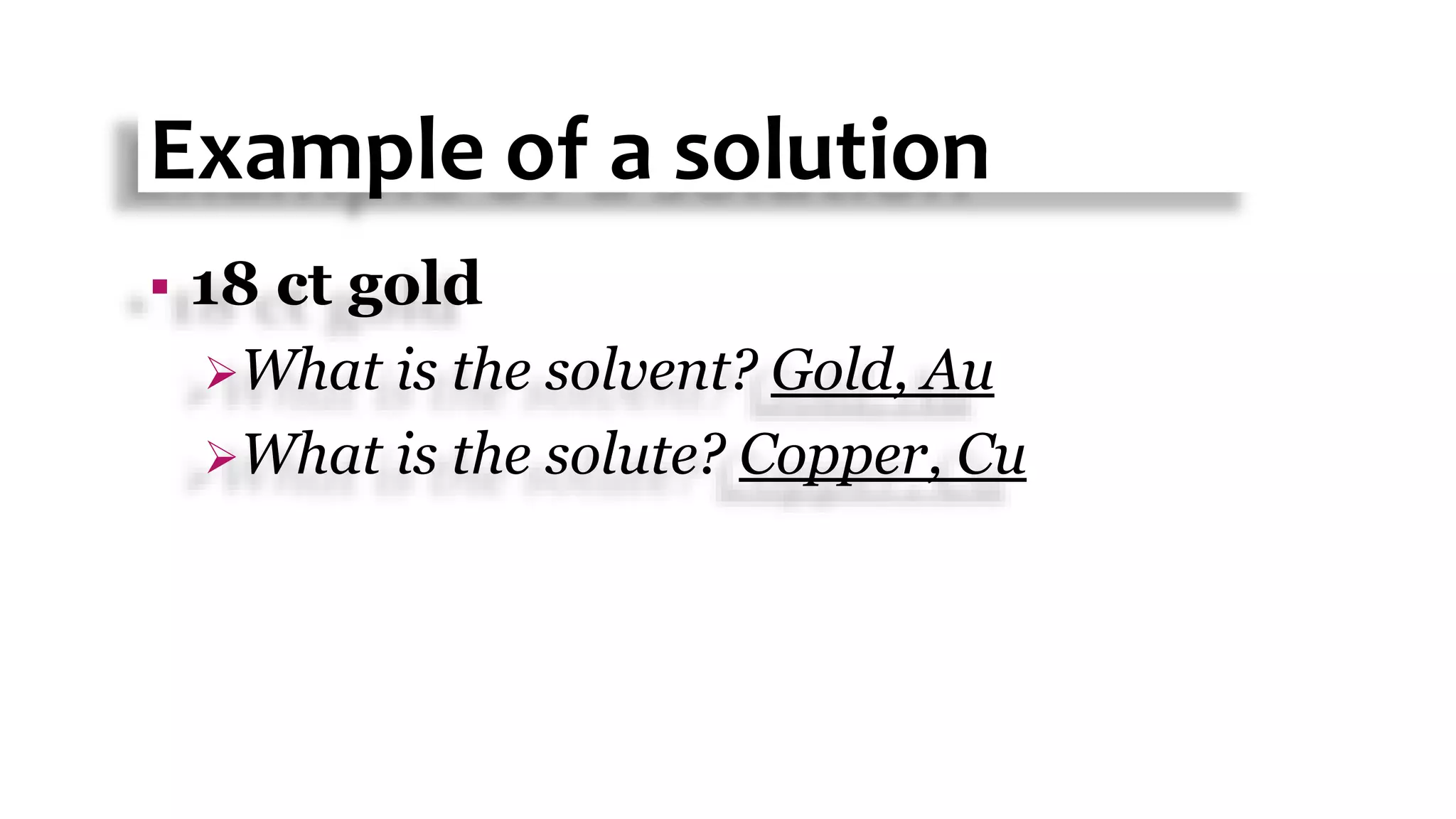
 18 ct gold
What is the solvent? Gold, Au
What is the solute? Copper, Cu
Terminologies
 Soluble substances are those that can
dissolve in a given solvent.
 Insoluble or immiscible substances are
those that cannot dissolve in a given
solvent.
Terminologies
 The maximum amount of a given solute a
solvent can dissolve is called the
solubility.
 The solubility is dependent on the
temperature and pressure.
Concentration of Solutions
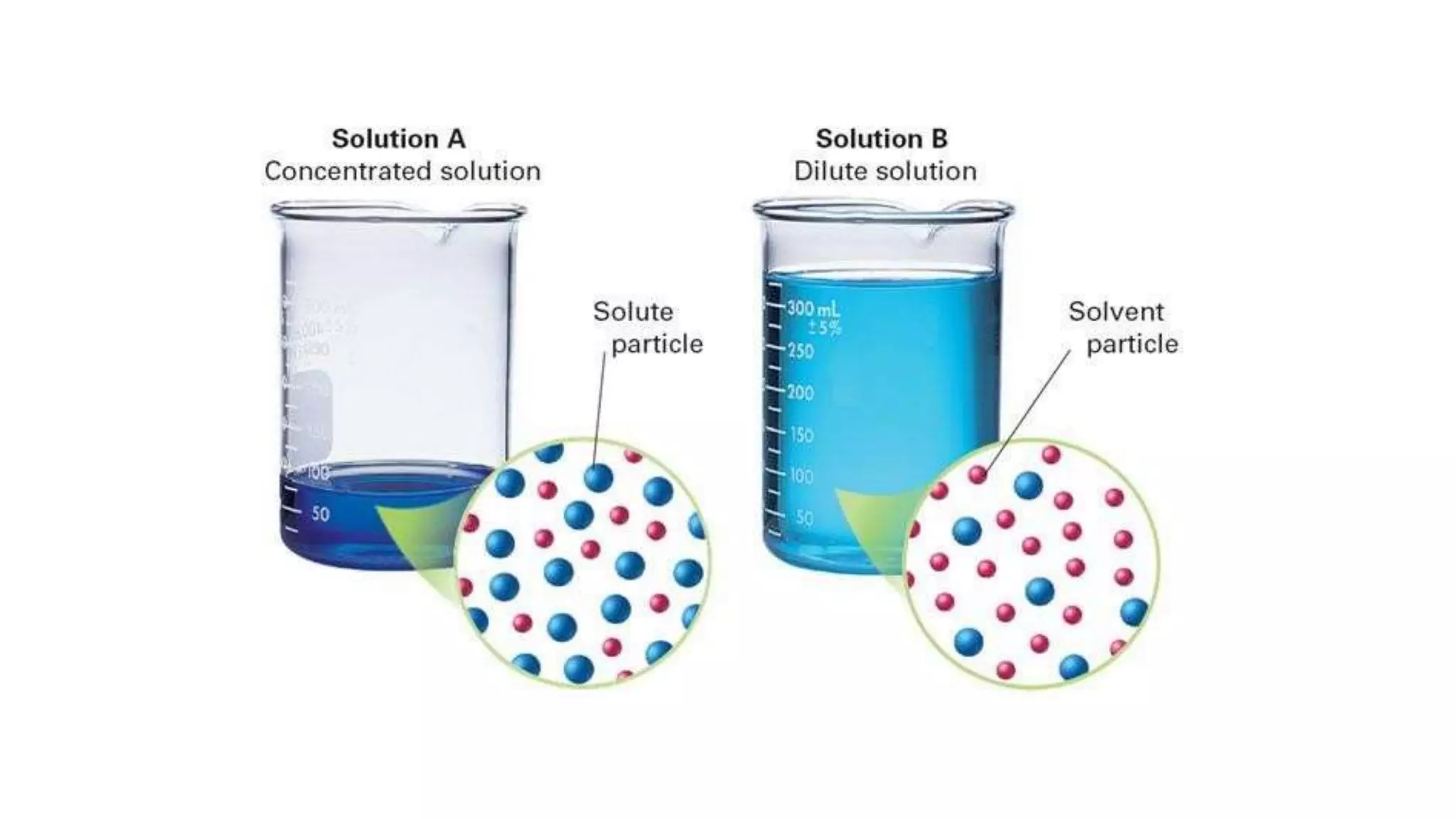
 The CONCENTRATION of a solution is a
measure of the amount of solute that is
dissolved in a given solvent.
 DILUTE solution
 CONCENTRATED solution
EXP. OF
CONCENTRATION
Molarity
Per liter of solution
Molality
Per kg of solvent
Mole
 One mole is equal to 6.02 x 10²³ particles, and the
mass of one mole of particles of a substance is
equal to that substance’s atomic or molecular
weight.
 Scientists often express concentration based on
moles of particles in a given volume of solution.
Mole
 To determine the no. of moles of a substance,
divide the mass by the molecular weight of that
substance.
Moles = mass (g)__________
molecular weight (g/mole)
Compute for mole
 Calculate the number of moles present in 117g of
NaCl.
Moles = 117 g___________
23.0 + 35.5 g/mole
Mole
3 moles Ca2+ and 3 moles 2 Cl- which is 3 moles Ca2+ and 6 moles Cl-
Molality (m)
 The number of moles of solute in one kilogram of
solvent.
m = moles of solute
solvent mass (kg)
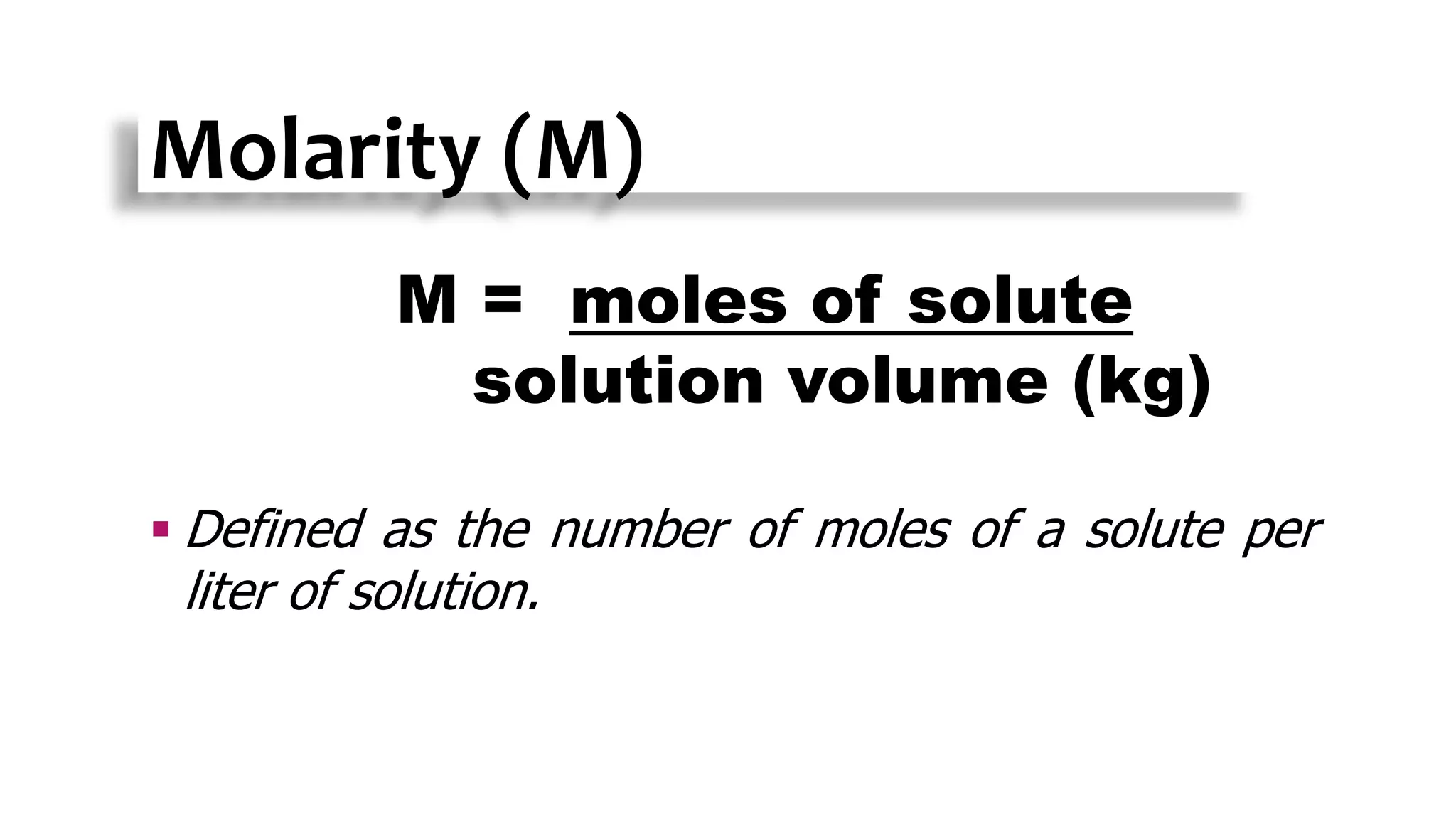
Molarity (M)
 Defined as the number of moles of a solute per
liter of solution.
M = moles of solute
solution volume (kg)
MOLALITY (m) MOLARITY (M)
M = moles of solute
solution volume(L)
m = moles of solute
solvent mass(kg)
MOLARITY
1 mole solute B
Add water to 1L solution
1 mole solute A
1 L1 L
Add water to 1L solution
Solute/Solvent ratio varies
Volume constant
1 mole solute A
Pre-measure 1L (1kg) water
MOLALITY
1 1 mole solute B
Pre-measure 1L (1kg) water
Solute/Solvent ratio constant
Volume varies
1 mole solute A
1 mole solute A
Add water to 1L solution Pre-measure 1L (1kg) water
MOLALITYMOLARITY
Molarity (M)
 Find for the mass of the solute, molecular weight
of that solute, and total volume of the solution.
M = moles of solute
solution volume (L)
Molarity: calculation (1)
 Determine the number of moles of solute
Moles of solute = _______mass(g)_______
molecular wt (g/mole)
Molarity: calculation (2)
 Divide the number of moles solute by the volume
of the solution .
M = moles of solute
solution volume (L)
Molarity: sample calculation
 If we were to mix 90g of glucose (MW =
180g/mole) in 2L of water*.
Moles solute = ______mass_(g)_______
molecular wt (g/mole)
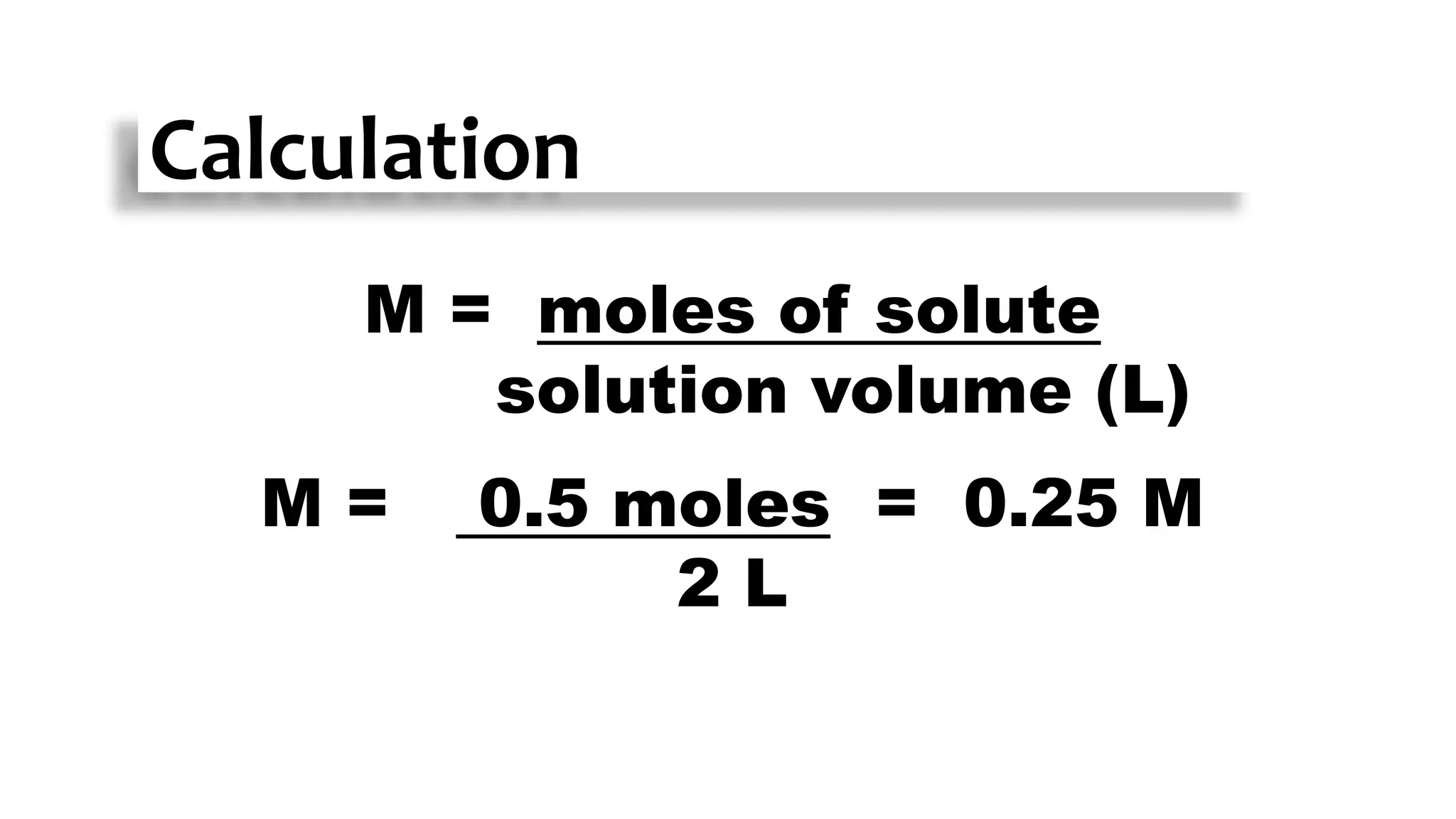
Calculation
M = moles of solute
solution volume (L)
M = 0.5 moles = 0.25 M
2 L
Molarity Example
 If 5 liters of water is added to two moles of
glucose to make a solution, the
concentration (molarity) is said to be 0.4 M
2 mol of glucose
5 liters of soln. = 0.4 M
Molality & Osmolality
 MOLALITY – concerns molecular concentration.
 OSMOLALITY – refers to the particle concentration.
*One mole of any substance, regardless of weight,
contains the same number of molecules (Avogadro’s
No. 6.061 x 10²³ particles/M.
Molality Example
 A solution of sodium chloride, containing 58.5 g
of NaCl dissolved in 1 kg water, has a molal
concentration of 1 mole/kg (1 mmol/kg).
Osmolality Example
 When 58.5 g of sodium chloride is dissolved in
water, such a solution will have an osmolality of
2 osmoles/kg (2000 mOsm/kg).
 This is because NaCl is fully ionized in water
into an equal amount of Na+ and Cl-.
Physical Properties (Solvent)
1. Boiling point
2. Freezing point
3. Osmotic pressure
4. Vapor pressure
Colligative Properties
 A property that depends only upon the
number of solute particles, and not upon
their identity, is called a colligative
property.
Colligative Properties
 Three important colligative properties of
solutions:
1. Vapor-pressure lowering
2. Boiling-point elevation
3. Freezing-point depression
Vapor-pressure lowering
 The decrease in a solution’s vapor pressure is
proportional to the number of particles the solute
makes in solution.
 If one osmole of solute is added to 1 kg water the
vapour pressure falls by 0.04 kPa (0.3 mmHg).
Freezing-point depression
 Defined as the difference in temperature between
the freezing point of a solution and the freezing
point of the pure solvent.
 It is proportional to the number of solute particles
dissolved in the solvent and does not depend
upon their identity.
Boiling-point elevation
 Defined as the difference in temperature between
the boiling point of a solution and the boiling point
of the pure solvent is the boiling-point elevation.
 The boiling point of water increases by 0.512°C
for every mole of particles that the solute forms
when dissolved in 1000 g of water.
Tonicity
 The effect that an extracellular solution has on
the osmotic movement of water into or out of
the cell is described by the tonicity of the ECF.
 Property of a solution in reference to a
particular membrane.
TONICITY
ISOTONIC HYPERTONIC HYPOTONIC
Isotonicity
 Isotonic solution: “equal tension”, equal
osmotic pressures.
 A cell in isotonic environment is in a state of
equilibrium with the ICF & ECF.
 The amount of solute is the same on the inside
and outside the cell.
ISOTONIC SOLUTION:
1. The solution concentration is equal on
both sides of the membrane .
2. There is no net concentration
difference across the cell membrane
3. Water moves back and forth, but
there is no net gain or loss of water.
Erythrocyte suspended in a isotonic solution.
Hypertonicity
 Results when a cell is placed into a solution
with a higher osmotic concentration that the
ICF*.
 Hypertonic: “greater tension”
HYPERTONIC SOLUTION:
1. The solution outside the cell is
more concentrated than inside.
2. There is more water inside the cell
and the water will move out of the
cell.
3. This causes the cell to shrink
Examples of erythrocytes suspended in isotonic and hypertonic
saline solutions.
Hypotonicity
 Results when a cell is placed in a solution with a
lower osmotic concentration (e.g., distilled
water).
 The osmotic pressure of the ECF is less than
that of the ICF.
 Water flows into the cell, causing it to swell.
HYPOTONIC SOLUTION:
1. The concentration inside the cell is
more concentrated than outside.
2. Therefore there is more water
outside of the cell, and water will
move into the cell.
3. This will cause the cell to swell.
Examples of erythrocytes suspended in isotonic, hypertonic and
hypotonic saline solutions.
CALCULATION: DRUG
SOLUTIONS
3 Ways of expressing drug
concentrations of drugs in solution
1. Parts ratio
2. Percent concentration
3. Weight per volume (W/V), Volume per
volume (V/V), Weight per weight (W/W)
Concentration (Strength)
 Amount of dissolved solute in the solvent.
 If we are going to add more solute, we are
also going to increase the concentration.
PARTS RATIO
 No reference units of measurement;
relationship of solute to solution.
 Ex. 1:32 dilution
PARTS RATIO
 Parts per million (PPM)
 1 mg of solute in a kg or liter of solution
 1 mcg of solute in a gram or milliliter
% CONCENTRATION
 % = Parts of solute per 100 parts of a solution.
 % Weight to Volume (W/V)
 x no. of grams of solute in a 100 mL of
solution
WEIGHT PER VOLUME

Measurement of Solute

  • 1.
  • 2.
    SOLUTION • Homogenous, single-phasemixture of a solute & solvent. Solvent • The liquid component. Solute • The solid component, or liquid in lesser proportion.
  • 3.
    Example of asolution  Sea water  Solvent: water, H2O  Solute: NaCl
  • 4.
    Example of asolution  Air  What is the solvent? Nitrogen, N2  What is the solute? Oxygen, O2
  • 5.
    Example of asolution  18 ct gold What is the solvent? Gold, Au What is the solute? Copper, Cu
  • 6.
    Terminologies  Soluble substancesare those that can dissolve in a given solvent.  Insoluble or immiscible substances are those that cannot dissolve in a given solvent.
  • 7.
    Terminologies  The maximumamount of a given solute a solvent can dissolve is called the solubility.  The solubility is dependent on the temperature and pressure.
  • 8.
    Concentration of Solutions The CONCENTRATION of a solution is a measure of the amount of solute that is dissolved in a given solvent.  DILUTE solution  CONCENTRATED solution
  • 10.
    EXP. OF CONCENTRATION Molarity Per literof solution Molality Per kg of solvent
  • 11.
    Mole  One moleis equal to 6.02 x 10²³ particles, and the mass of one mole of particles of a substance is equal to that substance’s atomic or molecular weight.  Scientists often express concentration based on moles of particles in a given volume of solution.
  • 12.
    Mole  To determinethe no. of moles of a substance, divide the mass by the molecular weight of that substance. Moles = mass (g)__________ molecular weight (g/mole)
  • 13.
    Compute for mole Calculate the number of moles present in 117g of NaCl. Moles = 117 g___________ 23.0 + 35.5 g/mole
  • 14.
  • 15.
    3 moles Ca2+and 3 moles 2 Cl- which is 3 moles Ca2+ and 6 moles Cl-
  • 16.
    Molality (m)  Thenumber of moles of solute in one kilogram of solvent. m = moles of solute solvent mass (kg)
  • 17.
    Molarity (M)  Definedas the number of moles of a solute per liter of solution. M = moles of solute solution volume (kg)
  • 18.
    MOLALITY (m) MOLARITY(M) M = moles of solute solution volume(L) m = moles of solute solvent mass(kg)
  • 19.
    MOLARITY 1 mole soluteB Add water to 1L solution 1 mole solute A 1 L1 L Add water to 1L solution Solute/Solvent ratio varies Volume constant
  • 20.
    1 mole soluteA Pre-measure 1L (1kg) water MOLALITY 1 1 mole solute B Pre-measure 1L (1kg) water Solute/Solvent ratio constant Volume varies
  • 21.
    1 mole soluteA 1 mole solute A Add water to 1L solution Pre-measure 1L (1kg) water MOLALITYMOLARITY
  • 22.
    Molarity (M)  Findfor the mass of the solute, molecular weight of that solute, and total volume of the solution. M = moles of solute solution volume (L)
  • 23.
    Molarity: calculation (1) Determine the number of moles of solute Moles of solute = _______mass(g)_______ molecular wt (g/mole)
  • 24.
    Molarity: calculation (2) Divide the number of moles solute by the volume of the solution . M = moles of solute solution volume (L)
  • 25.
    Molarity: sample calculation If we were to mix 90g of glucose (MW = 180g/mole) in 2L of water*. Moles solute = ______mass_(g)_______ molecular wt (g/mole)
  • 26.
    Calculation M = molesof solute solution volume (L) M = 0.5 moles = 0.25 M 2 L
  • 27.
    Molarity Example  If5 liters of water is added to two moles of glucose to make a solution, the concentration (molarity) is said to be 0.4 M 2 mol of glucose 5 liters of soln. = 0.4 M
  • 28.
    Molality & Osmolality MOLALITY – concerns molecular concentration.  OSMOLALITY – refers to the particle concentration. *One mole of any substance, regardless of weight, contains the same number of molecules (Avogadro’s No. 6.061 x 10²³ particles/M.
  • 29.
    Molality Example  Asolution of sodium chloride, containing 58.5 g of NaCl dissolved in 1 kg water, has a molal concentration of 1 mole/kg (1 mmol/kg).
  • 30.
    Osmolality Example  When58.5 g of sodium chloride is dissolved in water, such a solution will have an osmolality of 2 osmoles/kg (2000 mOsm/kg).  This is because NaCl is fully ionized in water into an equal amount of Na+ and Cl-.
  • 31.
    Physical Properties (Solvent) 1.Boiling point 2. Freezing point 3. Osmotic pressure 4. Vapor pressure
  • 32.
    Colligative Properties  Aproperty that depends only upon the number of solute particles, and not upon their identity, is called a colligative property.
  • 33.
    Colligative Properties  Threeimportant colligative properties of solutions: 1. Vapor-pressure lowering 2. Boiling-point elevation 3. Freezing-point depression
  • 34.
  • 35.
    Vapor-pressure lowering  Thedecrease in a solution’s vapor pressure is proportional to the number of particles the solute makes in solution.  If one osmole of solute is added to 1 kg water the vapour pressure falls by 0.04 kPa (0.3 mmHg).
  • 36.
    Freezing-point depression  Definedas the difference in temperature between the freezing point of a solution and the freezing point of the pure solvent.  It is proportional to the number of solute particles dissolved in the solvent and does not depend upon their identity.
  • 37.
    Boiling-point elevation  Definedas the difference in temperature between the boiling point of a solution and the boiling point of the pure solvent is the boiling-point elevation.  The boiling point of water increases by 0.512°C for every mole of particles that the solute forms when dissolved in 1000 g of water.
  • 38.
    Tonicity  The effectthat an extracellular solution has on the osmotic movement of water into or out of the cell is described by the tonicity of the ECF.  Property of a solution in reference to a particular membrane.
  • 39.
  • 40.
    Isotonicity  Isotonic solution:“equal tension”, equal osmotic pressures.  A cell in isotonic environment is in a state of equilibrium with the ICF & ECF.  The amount of solute is the same on the inside and outside the cell.
  • 41.
    ISOTONIC SOLUTION: 1. Thesolution concentration is equal on both sides of the membrane . 2. There is no net concentration difference across the cell membrane 3. Water moves back and forth, but there is no net gain or loss of water.
  • 42.
    Erythrocyte suspended ina isotonic solution.
  • 43.
    Hypertonicity  Results whena cell is placed into a solution with a higher osmotic concentration that the ICF*.  Hypertonic: “greater tension”
  • 44.
    HYPERTONIC SOLUTION: 1. Thesolution outside the cell is more concentrated than inside. 2. There is more water inside the cell and the water will move out of the cell. 3. This causes the cell to shrink
  • 45.
    Examples of erythrocytessuspended in isotonic and hypertonic saline solutions.
  • 46.
    Hypotonicity  Results whena cell is placed in a solution with a lower osmotic concentration (e.g., distilled water).  The osmotic pressure of the ECF is less than that of the ICF.  Water flows into the cell, causing it to swell.
  • 47.
    HYPOTONIC SOLUTION: 1. Theconcentration inside the cell is more concentrated than outside. 2. Therefore there is more water outside of the cell, and water will move into the cell. 3. This will cause the cell to swell.
  • 48.
    Examples of erythrocytessuspended in isotonic, hypertonic and hypotonic saline solutions.
  • 49.
  • 50.
    3 Ways ofexpressing drug concentrations of drugs in solution 1. Parts ratio 2. Percent concentration 3. Weight per volume (W/V), Volume per volume (V/V), Weight per weight (W/W)
  • 51.
    Concentration (Strength)  Amountof dissolved solute in the solvent.  If we are going to add more solute, we are also going to increase the concentration.
  • 52.
    PARTS RATIO  Noreference units of measurement; relationship of solute to solution.  Ex. 1:32 dilution
  • 53.
    PARTS RATIO  Partsper million (PPM)  1 mg of solute in a kg or liter of solution  1 mcg of solute in a gram or milliliter
  • 54.
    % CONCENTRATION  %= Parts of solute per 100 parts of a solution.  % Weight to Volume (W/V)  x no. of grams of solute in a 100 mL of solution
  • 56.

Editor's Notes

  • #2 This report will talk about the different units in measuring solute concentrations in a solution. This will also cover the various properties of a solvent that can be used to determine the particle concentration of a solution.
  • #3 A SOLUTION is homogenous mixture of one substance dissolved in another substance. A solution consist of a major component called the SOLVENT and one or minor components called the SOLUTE.
  • #6 From these examples, we can say that solutions are made up of a SOLVENT, which is the larger component; and SOLUTE which is the smaller component. Hence, solutions may be formed between solids, liquids, or gases. They are homogenous in composition; they do not settle under gravity; they do not scatter light (like muddy water). Solutions form when one substance dissolves in another.
  • #7 Which of the following are soluble in water? *NaCl, sugar, cooking oil, alcohol, gasoline, motor oil Which of the following are immiscible in cooking oil? *NaCl, sugar, alcohol, gasoline, motor oil, water
  • #8 When a solvent contains the maximum amount of a solute possible the solutions is said to be saturated. The solubility of most liquids and solids in water increases with temperature. The effect of pressure on the solubility of liquid or solid solutes in water is negligible. The solubility of many gases in water is directly proportional to the pressure being applied to the solution. i.e. double the pressure, double the solubility
  • #9 Define Concentration HOW DO WE DESCRIBE THE CONCENTRATION OF A SOLUTION? A dilute solution is one that contains a small amount of solute. A concentrated solution contains a large amount of solute. WHAT WE NEED IS A WAY OF QUANTIFYING THE CONC. OF A SOLUTION! There are many ways to express concentrations. Two of the many ways to express concentrations are molality and molarity.
  • #11 Two common expressions of concentration: MOLARITY – molecular concentration per liter of a solution; MOLALITY – molecular concentration per kg of solution. Both use the mole of a substance to solve for the concentration of solute in a solution. The unit of both molarity & molality is expressed in mole (s)
  • #12  Using solute mass as a surrogate presents a problem, since different solutes have different particle sizes the same mass of solute could have very different numbers of particles for two different solutes.
  • #14 The atomic weight of Na is ~23.0 g/mole, and that of Cl is ~35.5 g/mole, so the molecular weight would be the sum of the two (23.0 + 35.5 = 58.5 g/mole). The number of moles of NaCl is then calculated by dividing the mass by the molecular weight, so 117 g / 58.5 g/mole = 2 moles.
  • #15  In determining the number of moles of a particular substance, we should first consider whether that substance is an ionic compound or covalent compound. Three moles of glucose dissolved in water produce 3 mol of particles because glucose does not dissociate. Three moles of sodium chloride dissolved in water produce 6 mol of particles because each formula unit of NaCl dissociates into two ions. 3 moles Na+ and 3 moles Cl- *In case of molecular solutes like glucose, the solute particles are individual molecules. However, if the solute particle is ionic, the individual ions separate or dissociate from each other and become surrounded by solvent particles. That is, the cations and anions of an ionic solute separate when the solute dissolves.
  • #16 c) Three moles of calcium chloride dissolved in water produce 9 mol of particles because each formula unit of CaCl2 dissociates into three ions.
  • #17  *The unit used to express molality is MOLAL (m), where 1 m = one mole solute per kg solvent.
  • #19 *There are two key differences between molarity and molality. MOLALITY uses MASS rather than volume and it uses SOLVENT instead solution. *MOLARITY changes slightly with temperature because the volume of a solution changes with temperature. MOLALITY is independent of temperature because mass does not change with temperature. It is said that physiologists prefer molality while chemists prefer to use molarity.
  • #20 A comparison of molarity of using two solutes of different molecular weights. When mixing 1 L of a 1 molar (M) solution of each, notice that a different amount of water is used to bring the total volume of the solution to 1L. Thus although the final volume of the two solutions is the same (1L), the solute to solvent ratio is different.
  • #21 A comparison of molality using two solutes of different molecular weights. When mixing a 1 molal (m) solution with a specified solvent mass of 1 kg, notice that in both cases the total solution volume exceeds 1L, and that the solution with the larger solute particles has a greater total volume. However, since both the amount of solute and the amount of solvent are specified, the two solutions have equal solute/solvent ratios.
  • #22 A 1 molal solution is generally more dilute than 1 molar solution. In 1 molal solution, there is a region where the fluid is displaced by the solute. In measuring for molality, the volume of the solution occupied by the solvent is constant, so the total volume will vary based on the volume of the specific solute used in the solution. The larger the particle size of the solute, the larger the displacement for molality.
  • #23 Determining the molarity of any solution is easy given the mass of solute, the molecular weight of that solute, and the total volume of the solution.
  • #24 Determining the molarity of any solution is easy given the mass of solute, the molecular weight of that solute, and the total volume of the solution.
  • #26 *First step is determine the number of moles of glucose (90g / 180g/mole = 0.5 moles).
  • #28 *Remember that solution is always in liters!
  • #31 Therefore, if a molecule in solution dissociates into two or three particles, the osmolality is also doubled or tripled, respectively.
  • #32 The number of solute that is dissolved in a solvent will affect the physical properties of the solvent. BOILING POINT: the temperature at which a solvent or solution will turn from liquid to gas. FREEZING POINT: the temperature at which a solvent or solution will turn from liquid to solid. OSMOTIC PRESSURE: the pressure which must be exerted on a solution to prevent the net passage of solvent molecules across a semipermeable membrane. VAPOR PRESSURE:
  • #33 When a solute is dissolved in a solvent, some of the physical properties of the solvent change. The presence of a solute induces a stable order to the solvent molecules. It results in increases in boiling point and osmotic pressure and decreases in the freezing point and vapour pressure of the solvent.
  • #34 When a solute is dissolved in a solvent, some of the physical properties of the solvent change. The presence of a solute induces a stable order to the solvent molecules. It results in increases in boiling point and osmotic pressure and decreases in the freezing point and vapour pressure of the solvent.
  • #35 In a pure solvent, equilibrium is established between the liquid and the vapor. In a solution, solute particles reduce the number of free solvent particles able to escape the liquid. Equilibrium is established at a lower vapor pressure.
  • #37  If one osmole of solute is added to 1 kg water, the freezing point decreases by 1.858”C.
  • #38 The same antifreeze added to automobile engines to prevent freeze-ups in winter, protects the engine from boiling over in summer. *Its magnitude is proportional to the number of solute particles dissolved in the solvent.
  • #39 Living cells have the potential of gaining or losing water from the surrounding extracellular fluid through osmosis. The net movement of water into or out of the cell is driven by differences in osmotic pressures between the extracellular fluid and the intracellular fluid. Thus, the effect that an extracellular solution has on the osmotic movement of water into or out of the cell is described by the tonicity of the extracellular fluid.
  • #41 The osmotic pressure becomes equal; the force of water trying to exit and enter the cell balances out. In an isotonic environment, none of the solutes can pass through the cell membrane, no net osmosis will occur.
  • #43 *Based on the experiment of immersing the red blood cells in an isotonic solution, if the red cells stay the same size, the test solution is said to be ISOTONIC with plasma. Cells removed from the body and placed in isotonic solutions will retain the “normal” shape they have in the body. Example of isotonic prep in medicine: 0.9% w/v solution of water & NaCl is considered isotonic in relation to red blood cells and their semi-permeable membranes.
  • #44 *(For example, human blood cells in sea water), then the osmotic pressure of the extracellular fluid will exceed that of the intracellular fluid. As a result, water will flow out of the cell and into the extracellular fluid, causing the cell to shrink and crenate. In this case, the extracellular fluid is said to be hypertonic (“greater tension”).
  • #46 *(For example, human blood cells in sea water), then the osmotic pressure of the extracellular fluid will exceed that of the intracellular fluid. As a result, water will flow out of the cell and into the extracellular fluid, causing the cell to shrink and crenate.
  • #47 If a cell is placed in a solution with a lower osmotic concentration (for example, distilled water), then the osmotic pressure of the extracellular fluid is less than that of the intracellular fluid. As a result, water flows into the cell, causing it to swell perhaps so much that the cell may undergo lysis (burst). In this situation, the extracellular fluid is said to be hypotonic.
  • #48 Hypotonic: cause hemolysis
  • #49 Water flows into the cell, causing it to swell perhaps so much that the cell may undergo lysis (burst).
  • #53 It is the relationship of the solute (1) to the total amount of a solution (32)
  • #54 1 ppm is similar to saying there’s 1 mg of solute in a kg/l of solution – means that there’s 1 mg of solute in a million part; there are a million mg in 1 kg
  • #55 % Concentration in a weight to volume basis
  • #56 1 gram of solute per 100 ml of solution
  • #57 % Concentration in a weight to volume basis