Dialysis Basics

         Dr.Ashutosh Ojha
MD,DNB(Gen Med)PDCC-Nephro (student)
         GMCH..Guwahati.
Outline
 Indications
 Modalities
 Apparatus
 Access
 Complications of dialysis access
 Acute complications of dialysis
Indications
 Pericarditis or pleuritis
 Progressive uremic encephalopathy or neuropathy ( asterixis,
    myoclonus, seizures)
   Bleeding diathesis
   Fluid overload unresponsive to diuretics
   Metabolic disturbances refractory to medical therapy
    (hyperkalemia, metabolic acidosis, hyper- calcemia , hyper-
    phosphatemia)
   Persistent nausea/vomiting, weight loss, or malnutrition
   Toxic overdose of a dialyzable drug….Dialysable substance
    IgG/>>>>IgM
Indications for RRT
 Acute management of life-threatening complications of AKI:
 A: Metabolic acidosis (pH less than 7.1)
 E: Electrolytes -- Hyperkalemia (K >6.5 meq/L) or rapidly rising
  K)
 I: Ingestion -- Certain alcohol and drug intoxications
 O: Refractory fluid overload
 U: Uremia, ie. pericarditis, neuropathy, decline in mental status
Goals of Dialysis
  Solute clearance
    Diffusive transport (based on countercurrent flow of blood and dialysate)
    Convective transport (solvent drag with ultrafiltration)
  Fluid removal
Modalities
 Peritoneal dialysis
 Intermittent hemodialysis
 Hemofiltration
 Continuous renal replacement therapy


   Decision of modality determined by catabolic rate,
    hemodynamic stability, and whether primary goal is fluid or
    solute removal
Principles of dialysis
 Dialysis = diffusion = passive
  movement of solutes across a semi-
  permeable membrane down
  concentration gradient
   Good for small molecules
 (Ultra)filtration = convection =
  solute + fluid removal across semi-
  permeable membrane down a
  pressure gradient (solvent drag)
   Better for removal of fluid and medium-
    size molecules


                                              Faber. Nursing in Critical Care 2009; 14: 4
Principles of dialysis
   Hemodialysis = solute passively diffuses down concentration
    gradient
       Dialysate flows countercurrent to blood flow.
       Urea, creatinine, K move from blood to dialysate
       Ca and bicarb move from dialysate to blood.
   Hemofiltration: uses hydrostatic pressure gradient to induce filtration
    / convection plasma water + solutes across membrane.
   Hemodiafiltration: combination of dialysis and filtration.


       •Miller's Anesthesia, 7th ed. 2009
       •Foot. Current Anaesthesia and Critical Care 2005; 16:321-329
Hemodialysis Apparatus
 Dialyzer (cellulose, substituted cellulose, synthetic
  noncellulose membranes)
 Dialysis solution (dialysate – water must remain free of Al,
  Cu, chloramine, bacteria, and endotoxin)ABDEC
 Tubing for transport of blood and dialysis solution
 Machine to power and mechanically monitor the procedure
  (includes air monitor, proportioning system, temperature
  sensor, urea sensor to calculate clearance)CAPUT
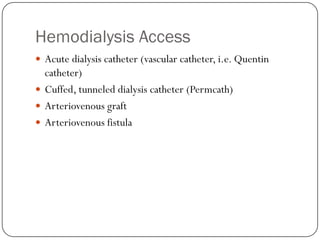
Hemodialysis Access
 Acute dialysis catheter (vascular catheter, i.e. Quentin
  catheter)
 Cuffed, tunneled dialysis catheter (Permcath)
 Arteriovenous graft
 Arteriovenous fistula
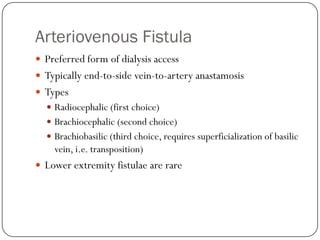
Arteriovenous Fistula
 Preferred form of dialysis access
 Typically end-to-side vein-to-artery anastamosis
 Types
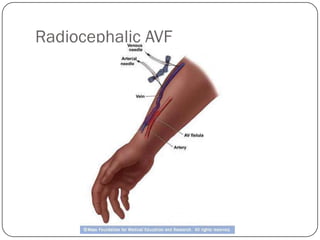
   Radiocephalic (first choice)
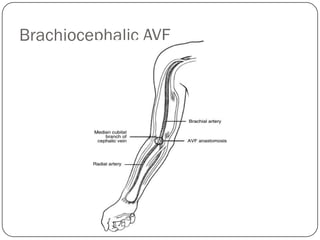
   Brachiocephalic (second choice)
   Brachiobasilic (third choice, requires superficialization of basilic
    vein, i.e. transposition)
 Lower extremity fistulae are rare
Radiocephalic AVF
Brachiocephalic AVF
Arteriovenous Graft
 Synthetic conduit, usually polytetrafluoroethylene (PTFE,
  aka Gortex), between an artery and a vein
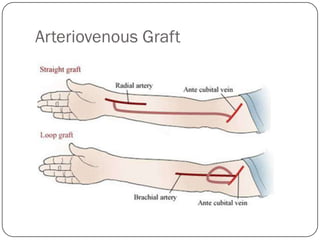
 Either straight or looped
 Common sites
   Straight forearm : Radial artery to cephalic vein
   Looped forearm : brachial artery to cephalic vein
   Straight upper arm : brachial artery to axillary vein
   Looped upper arm : axillary artery to axillary vein
Arteriovenous Graft cont’d
 Rare sites
   Leg grafts
   Looped chest grafts
   Axillary-axillary (necklace)
   Axillary-atrial grafts
Arteriovenous Graft
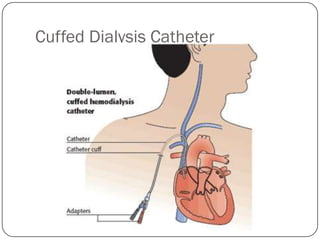
Tunneled Cuffed Catheters
 Dual lumen catheters
 Most commonly placed in the internal jugular vein, exiting at
  the upper, anterior chest
 Can also be placed in the femoral vein
 Subclavian catheters should be avoided given the risk of
  subclavian stenosis
Cuffed Dialysis Catheter
Dialysis Access : Time to use
 Graft
   Usually cannulated within weeks
   Vectra or flexine grafts can safely be cannulated after ~12 hours
 Fistula
   Median period of 100 days before cannulation in the U.S. and U.K.
   Initial cannulation should be performed with small gauge needles
    and low blood flow
   Needles Chart for home care Dialysis
Dialysis Access : Longevity
 Native fistulas have a high rate of primary failure, but long-
  term patency is superior to grafts if they mature
 R-C fistulas 5- and 10-year patency are 53 and
  45%, respectively
 PTFE grafts 1-, 2-, and 4-year patency are 67, 50, and
  43%, respectively
Complications of AVF and AVG
 Thrombosis
 Infection (10% for AVG, 5% for transposed AVF, 2% for non-
    transposed AVF)
   Seromas
   Steal (6% of B-C AVF, 1% of R-C AVF)
   Aneurysms and pseudoaneurysms (3% of AVF, 5% of AVG)
   Venous hypertension (usually 2/2 central venous stenosis)
   Heart failure (Avoid AVFs in pts with severely depressed
    LVEF)
   Local bleeding
Tunnel Cuffed Catheters
 Indications
   Intermediate-duration vascular access during maturation of AVF
    or AVG
   Expected lifespan on dialysis of < 1 year (due to co-morbidities
    or on living donor transplant list)
   Medical contra-indication to permanent dialysis access (severe
    heart failure)
   Patients who refuse AVF or AVG after explanation of the risks of
    a catheter
   All other dialysis access options have been exhausted
Tunnel Cuffed Catheters :
Complications
 Infection
   Risk of bacteremia 2.3 per 1000 catheter days or 20 to 25%
    over the average duration of use
 Dysfunction
   Defined as inability to sustain blood flow of >300 mL/min
   By this definition, 87% of catheters malfunction in their lifetime


 Central venous stenosis
 Mortality     (may be influenced by selection bias)
Tunnel Cuffed Catheters : Bacteremia
 Metastatic infections
   Osteomyelitis, endocarditis, septic arthritis, suppurative
    thrombophlebitis, or epidural abscess
 Risk factors : prolonged duration of usage, previous
  bacteremia, recent surgery, diabetes mellitus, iron overload,
  immunosuppression, malnutrition
Tunnel Cuffed Catheters : Bacteremia
 Microbiology
   Coagulase-negative staph and S. aureus together account for 40
    to 80%
   Significant morbidity and mortality with S. aureus, esp. MRSA
   Nonstaphylococcal infections predominantly due to enterococci
    and Gram negative rods (30-40%)
   If HIV positive, consider polymicrobial and fungal infections
Tunnel Cuffed Catheters : Bacteremia
 Clinical manifestations
   Fevers or chills in catheter-dependent dialysis patients
    associated with positive blood cultures in 60 to 80%
   Less commonly : hypotension, altered mental status, catheter
    dysfunction, hypothermia, and acidosis
Tunnel Cuffed Catheters : Bacteremia
 Empiric Treatment
   Vancomycin (load with 15-20 mg/kg and then 500-1000 mg
    after each HD session) plus either gentamicin (load with 2
    mg/kg and then 1 mg/kg after each HD session) or ceftazidime
    (2 grams after each HD session)
   Avoid prolonged use of an aminoglycoside given the risk of
    ototoxicity with vestibular dysfunction
Tunnel Cuffed Catheters : Bacteremia
 Tailored treatment
   MRSA : vancomycin, daptomycin if vancomycin allergy
   MSSA : cefazolin (Ancef)
   VRE : daptomycin
   Gram-negative organisms : ceftazidime, levaquin
   Candidemia : immediate catheter removal, Infectious disease
    consultation for appropriate anti-fungal agent (ex., micafungin)
Tunnel Cuffed Catheters : Bacteremia
 Duration
   Catheter removal and replacement, early resolution of
    symptoms, blood cultures quickly negative : 2 to 3 weeks
   Uncomplicated S. aureus infection : 4 weeks
   Metastatic infection or persistently positive blood cultures :
    minimum 6 weeks
   Osteomyelitis : 6 to 8 weeks
Tunnel Cuffed Catheters : Bacteremia
 Catheter management
   Immediate removal if severe sepsis, hypotension, endocarditis
    or metastatic infection, persistent bacteremia (usually defined as
    >72 hrs), tunnel site infection
   Consider removal if S. aureus, P. aeruginosa, fungi, or
    mycobacteria
   Consider salvage if coagulase negative staphylococcus (may be a
    risk factor for recurrence)
Tunnel Cuffed Catheters : Bacteremia
 Catheter management
   Guidewire exchange
     Not well studied (small, uncontrolled studies)
     Theoretically, useful for preservation of vasculature
     May be indicated if coagulopathy or hemodynamic instability precludes
      catheter removal and temporary catheter placement
     Catheter tip should be sent for culture, and if positive, new catheter
      should be relocated to a new site
Acute Complications of Dialysis
 Hypotension (25-55%)
 Cramps (5-20%)
 Nausea and vomiting (5-15%)
 Headache (5%)
 Chest pain (2-5%)
 Back pain (2-5%)
 Itching (5%)
 Fever and chills (<1%)
Acute Complications of Dialysis
 Chest pain
   Can be associated with hypotension and dialysis disequilibrium
    syndrome
   Always consider angina, hemolysis, and (rarely) air embolism
   Consider pulmonary embolism if recent manipulation of
    thrombus and/or occlusion of the dialysis access
Acute Complications of Dialysis
 Hemolysis
   Suggestive findings include port wine appearance of the blood
    in the venous line, a falling hematocrit, or complaints of chest
    pain, SOB, and/or back pain
   Usually due to dialysis solution problems, including
    overheating, hypotonicity, and contamination with
    formaldehyde, bleach, chloramine, or nitrates in the water, or
    copper in the dialysis tubing
   Treatment includes discontinuation of dialysis without blood
    return to the patient, and evaluation for hyperkalemia with
    medical treatment as necessary
Acute Complications of Dialysis
 Arrhythmias
   Common during, and between, dialysis treatments
   Controversial whether due to disturbances in plasma potassium
   Treatment is similar to the non-dialysis population, except for
    medication dosing adjustments
Thank you
 Blood and Dialysate have to run opposite to achieve optimum
  clearance …..Fluid and Solute


 Learning is always unidirectional …..Institute to Individual.

Dialysis basics

  • 1.
    Dialysis Basics Dr.Ashutosh Ojha MD,DNB(Gen Med)PDCC-Nephro (student) GMCH..Guwahati.
  • 2.
    Outline  Indications  Modalities Apparatus  Access  Complications of dialysis access  Acute complications of dialysis
  • 3.
    Indications  Pericarditis orpleuritis  Progressive uremic encephalopathy or neuropathy ( asterixis, myoclonus, seizures)  Bleeding diathesis  Fluid overload unresponsive to diuretics  Metabolic disturbances refractory to medical therapy (hyperkalemia, metabolic acidosis, hyper- calcemia , hyper- phosphatemia)  Persistent nausea/vomiting, weight loss, or malnutrition  Toxic overdose of a dialyzable drug….Dialysable substance IgG/>>>>IgM
  • 4.
    Indications for RRT Acute management of life-threatening complications of AKI:  A: Metabolic acidosis (pH less than 7.1)  E: Electrolytes -- Hyperkalemia (K >6.5 meq/L) or rapidly rising K)  I: Ingestion -- Certain alcohol and drug intoxications  O: Refractory fluid overload  U: Uremia, ie. pericarditis, neuropathy, decline in mental status
  • 5.
    Goals of Dialysis  Solute clearance  Diffusive transport (based on countercurrent flow of blood and dialysate)  Convective transport (solvent drag with ultrafiltration)  Fluid removal
  • 6.
    Modalities  Peritoneal dialysis Intermittent hemodialysis  Hemofiltration  Continuous renal replacement therapy  Decision of modality determined by catabolic rate, hemodynamic stability, and whether primary goal is fluid or solute removal
  • 7.
    Principles of dialysis Dialysis = diffusion = passive movement of solutes across a semi- permeable membrane down concentration gradient  Good for small molecules  (Ultra)filtration = convection = solute + fluid removal across semi- permeable membrane down a pressure gradient (solvent drag)  Better for removal of fluid and medium- size molecules Faber. Nursing in Critical Care 2009; 14: 4
  • 8.
    Principles of dialysis  Hemodialysis = solute passively diffuses down concentration gradient  Dialysate flows countercurrent to blood flow.  Urea, creatinine, K move from blood to dialysate  Ca and bicarb move from dialysate to blood.  Hemofiltration: uses hydrostatic pressure gradient to induce filtration / convection plasma water + solutes across membrane.  Hemodiafiltration: combination of dialysis and filtration. •Miller's Anesthesia, 7th ed. 2009 •Foot. Current Anaesthesia and Critical Care 2005; 16:321-329
  • 9.
    Hemodialysis Apparatus  Dialyzer(cellulose, substituted cellulose, synthetic noncellulose membranes)  Dialysis solution (dialysate – water must remain free of Al, Cu, chloramine, bacteria, and endotoxin)ABDEC  Tubing for transport of blood and dialysis solution  Machine to power and mechanically monitor the procedure (includes air monitor, proportioning system, temperature sensor, urea sensor to calculate clearance)CAPUT
  • 10.
    Hemodialysis Access  Acutedialysis catheter (vascular catheter, i.e. Quentin catheter)  Cuffed, tunneled dialysis catheter (Permcath)  Arteriovenous graft  Arteriovenous fistula
  • 11.
    Arteriovenous Fistula  Preferredform of dialysis access  Typically end-to-side vein-to-artery anastamosis  Types  Radiocephalic (first choice)  Brachiocephalic (second choice)  Brachiobasilic (third choice, requires superficialization of basilic vein, i.e. transposition)  Lower extremity fistulae are rare
  • 12.
  • 13.
  • 14.
    Arteriovenous Graft  Syntheticconduit, usually polytetrafluoroethylene (PTFE, aka Gortex), between an artery and a vein  Either straight or looped  Common sites  Straight forearm : Radial artery to cephalic vein  Looped forearm : brachial artery to cephalic vein  Straight upper arm : brachial artery to axillary vein  Looped upper arm : axillary artery to axillary vein
  • 15.
    Arteriovenous Graft cont’d Rare sites  Leg grafts  Looped chest grafts  Axillary-axillary (necklace)  Axillary-atrial grafts
  • 16.
  • 17.
    Tunneled Cuffed Catheters Dual lumen catheters  Most commonly placed in the internal jugular vein, exiting at the upper, anterior chest  Can also be placed in the femoral vein  Subclavian catheters should be avoided given the risk of subclavian stenosis
  • 18.
  • 19.
    Dialysis Access :Time to use  Graft  Usually cannulated within weeks  Vectra or flexine grafts can safely be cannulated after ~12 hours  Fistula  Median period of 100 days before cannulation in the U.S. and U.K.  Initial cannulation should be performed with small gauge needles and low blood flow  Needles Chart for home care Dialysis
  • 20.
    Dialysis Access :Longevity  Native fistulas have a high rate of primary failure, but long- term patency is superior to grafts if they mature  R-C fistulas 5- and 10-year patency are 53 and 45%, respectively  PTFE grafts 1-, 2-, and 4-year patency are 67, 50, and 43%, respectively
  • 21.
    Complications of AVFand AVG  Thrombosis  Infection (10% for AVG, 5% for transposed AVF, 2% for non- transposed AVF)  Seromas  Steal (6% of B-C AVF, 1% of R-C AVF)  Aneurysms and pseudoaneurysms (3% of AVF, 5% of AVG)  Venous hypertension (usually 2/2 central venous stenosis)  Heart failure (Avoid AVFs in pts with severely depressed LVEF)  Local bleeding
  • 22.
    Tunnel Cuffed Catheters Indications  Intermediate-duration vascular access during maturation of AVF or AVG  Expected lifespan on dialysis of < 1 year (due to co-morbidities or on living donor transplant list)  Medical contra-indication to permanent dialysis access (severe heart failure)  Patients who refuse AVF or AVG after explanation of the risks of a catheter  All other dialysis access options have been exhausted
  • 23.
    Tunnel Cuffed Catheters: Complications  Infection  Risk of bacteremia 2.3 per 1000 catheter days or 20 to 25% over the average duration of use  Dysfunction  Defined as inability to sustain blood flow of >300 mL/min  By this definition, 87% of catheters malfunction in their lifetime  Central venous stenosis  Mortality (may be influenced by selection bias)
  • 24.
    Tunnel Cuffed Catheters: Bacteremia  Metastatic infections  Osteomyelitis, endocarditis, septic arthritis, suppurative thrombophlebitis, or epidural abscess  Risk factors : prolonged duration of usage, previous bacteremia, recent surgery, diabetes mellitus, iron overload, immunosuppression, malnutrition
  • 25.
    Tunnel Cuffed Catheters: Bacteremia  Microbiology  Coagulase-negative staph and S. aureus together account for 40 to 80%  Significant morbidity and mortality with S. aureus, esp. MRSA  Nonstaphylococcal infections predominantly due to enterococci and Gram negative rods (30-40%)  If HIV positive, consider polymicrobial and fungal infections
  • 26.
    Tunnel Cuffed Catheters: Bacteremia  Clinical manifestations  Fevers or chills in catheter-dependent dialysis patients associated with positive blood cultures in 60 to 80%  Less commonly : hypotension, altered mental status, catheter dysfunction, hypothermia, and acidosis
  • 27.
    Tunnel Cuffed Catheters: Bacteremia  Empiric Treatment  Vancomycin (load with 15-20 mg/kg and then 500-1000 mg after each HD session) plus either gentamicin (load with 2 mg/kg and then 1 mg/kg after each HD session) or ceftazidime (2 grams after each HD session)  Avoid prolonged use of an aminoglycoside given the risk of ototoxicity with vestibular dysfunction
  • 28.
    Tunnel Cuffed Catheters: Bacteremia  Tailored treatment  MRSA : vancomycin, daptomycin if vancomycin allergy  MSSA : cefazolin (Ancef)  VRE : daptomycin  Gram-negative organisms : ceftazidime, levaquin  Candidemia : immediate catheter removal, Infectious disease consultation for appropriate anti-fungal agent (ex., micafungin)
  • 29.
    Tunnel Cuffed Catheters: Bacteremia  Duration  Catheter removal and replacement, early resolution of symptoms, blood cultures quickly negative : 2 to 3 weeks  Uncomplicated S. aureus infection : 4 weeks  Metastatic infection or persistently positive blood cultures : minimum 6 weeks  Osteomyelitis : 6 to 8 weeks
  • 30.
    Tunnel Cuffed Catheters: Bacteremia  Catheter management  Immediate removal if severe sepsis, hypotension, endocarditis or metastatic infection, persistent bacteremia (usually defined as >72 hrs), tunnel site infection  Consider removal if S. aureus, P. aeruginosa, fungi, or mycobacteria  Consider salvage if coagulase negative staphylococcus (may be a risk factor for recurrence)
  • 31.
    Tunnel Cuffed Catheters: Bacteremia  Catheter management  Guidewire exchange  Not well studied (small, uncontrolled studies)  Theoretically, useful for preservation of vasculature  May be indicated if coagulopathy or hemodynamic instability precludes catheter removal and temporary catheter placement  Catheter tip should be sent for culture, and if positive, new catheter should be relocated to a new site
  • 32.
    Acute Complications ofDialysis  Hypotension (25-55%)  Cramps (5-20%)  Nausea and vomiting (5-15%)  Headache (5%)  Chest pain (2-5%)  Back pain (2-5%)  Itching (5%)  Fever and chills (<1%)
  • 33.
    Acute Complications ofDialysis  Chest pain  Can be associated with hypotension and dialysis disequilibrium syndrome  Always consider angina, hemolysis, and (rarely) air embolism  Consider pulmonary embolism if recent manipulation of thrombus and/or occlusion of the dialysis access
  • 34.
    Acute Complications ofDialysis  Hemolysis  Suggestive findings include port wine appearance of the blood in the venous line, a falling hematocrit, or complaints of chest pain, SOB, and/or back pain  Usually due to dialysis solution problems, including overheating, hypotonicity, and contamination with formaldehyde, bleach, chloramine, or nitrates in the water, or copper in the dialysis tubing  Treatment includes discontinuation of dialysis without blood return to the patient, and evaluation for hyperkalemia with medical treatment as necessary
  • 35.
    Acute Complications ofDialysis  Arrhythmias  Common during, and between, dialysis treatments  Controversial whether due to disturbances in plasma potassium  Treatment is similar to the non-dialysis population, except for medication dosing adjustments
  • 36.
    Thank you  Bloodand Dialysate have to run opposite to achieve optimum clearance …..Fluid and Solute  Learning is always unidirectional …..Institute to Individual.