Colligative Properties of solutionsChapter 14.2
Objectives:List four colligative properties, and explain why they are classified as colligative properties.Calculate freezing-point depression, boiling-point elevation, and solution molality of nonelectrolytic solutions.Calculate the expected changes in freezing point and boiling point of an electrolytic solution.Discuss causes of the differences between expected and experimentally observed colligative properties of electrolytic solutions.
Colligative Properties of SolutionsProperties that depend on the concentration of solute particles but not on their identity.ExamplesVapor-pressure loweringFreezing-point depressionBoiling-point elevation
Vapor-Pressure LoweringNonvolatile solute raises boiling point and lowers freezing point of solutionNonvolatile substance : one that has little tendency to become a gas under existing conditionsLook at figures 14.6 and 7 on page 436 & 437Solute molecules crowd surface of solution, lowering tendency of water molecules to escape to liquid phase.
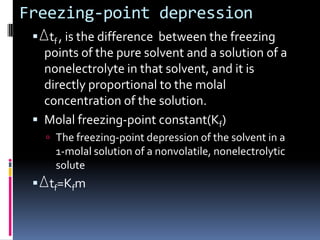
Freezing-point depression  tf , is the difference  between the freezing points of the pure solvent and a solution of a nonelectrolyte in that solvent, and it is directly proportional to the molal concentration of the solution.Molal freezing-point constant(Kf)The freezing-point depression of the solvent in a 1-molal solution of a nonvolatile, nonelectrolytic solute  tf=Kfm
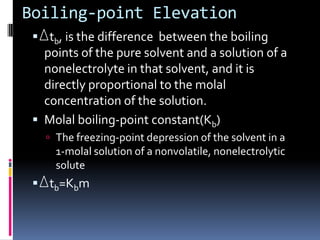
Boiling-point Elevationtb, is the difference  between the boiling points of the pure solvent and a solution of a nonelectrolyte in that solvent, and it is directly proportional to the molal concentration of the solution.Molal boiling-point constant(Kb)The freezing-point depression of the solvent in a 1-molal solution of a nonvolatile, nonelectrolytic solutetb=Kbm
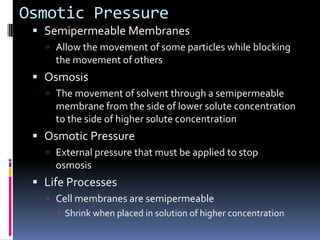
Osmotic PressureSemipermeable MembranesAllow the movement of some particles while blocking the movement of othersOsmosisThe movement of solvent through a semipermeable membrane from the side of lower solute concentration to the side of higher solute concentrationOsmotic PressureExternal pressure that must be applied to stop osmosisLife ProcessesCell membranes are semipermeable Shrink when placed in solution of higher concentration
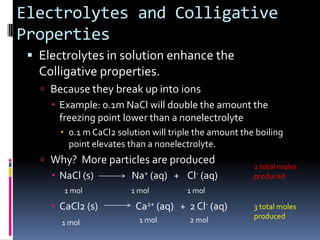
Electrolytes and Colligative PropertiesElectrolytes in solution enhance the Colligative properties.Because they break up into ionsExample: 0.1m NaCl will double the amount the freezing point lower than a nonelectrolyte0.1 m CaCl2 solution will triple the amount the boiling point elevates than a nonelectrolyte. Why?  More particles are producedNaCl (s)                  Na+ (aq)   +    Cl- (aq)CaCl2 (s)                  Ca2+(aq)   +  2 Cl- (aq)2 total moles produced1 mol1 mol1 mol3 total moles produced2 mol1 mol1 mol

Chapter 14.2 : Colligative Properties

  • 1.
    Colligative Properties ofsolutionsChapter 14.2
  • 2.
    Objectives:List four colligativeproperties, and explain why they are classified as colligative properties.Calculate freezing-point depression, boiling-point elevation, and solution molality of nonelectrolytic solutions.Calculate the expected changes in freezing point and boiling point of an electrolytic solution.Discuss causes of the differences between expected and experimentally observed colligative properties of electrolytic solutions.
  • 3.
    Colligative Properties ofSolutionsProperties that depend on the concentration of solute particles but not on their identity.ExamplesVapor-pressure loweringFreezing-point depressionBoiling-point elevation
  • 4.
    Vapor-Pressure LoweringNonvolatile soluteraises boiling point and lowers freezing point of solutionNonvolatile substance : one that has little tendency to become a gas under existing conditionsLook at figures 14.6 and 7 on page 436 & 437Solute molecules crowd surface of solution, lowering tendency of water molecules to escape to liquid phase.
  • 5.
    Freezing-point depression tf , is the difference between the freezing points of the pure solvent and a solution of a nonelectrolyte in that solvent, and it is directly proportional to the molal concentration of the solution.Molal freezing-point constant(Kf)The freezing-point depression of the solvent in a 1-molal solution of a nonvolatile, nonelectrolytic solute tf=Kfm
  • 6.
    Boiling-point Elevationtb, isthe difference between the boiling points of the pure solvent and a solution of a nonelectrolyte in that solvent, and it is directly proportional to the molal concentration of the solution.Molal boiling-point constant(Kb)The freezing-point depression of the solvent in a 1-molal solution of a nonvolatile, nonelectrolytic solutetb=Kbm
  • 7.
    Osmotic PressureSemipermeable MembranesAllowthe movement of some particles while blocking the movement of othersOsmosisThe movement of solvent through a semipermeable membrane from the side of lower solute concentration to the side of higher solute concentrationOsmotic PressureExternal pressure that must be applied to stop osmosisLife ProcessesCell membranes are semipermeable Shrink when placed in solution of higher concentration
  • 8.
    Electrolytes and ColligativePropertiesElectrolytes in solution enhance the Colligative properties.Because they break up into ionsExample: 0.1m NaCl will double the amount the freezing point lower than a nonelectrolyte0.1 m CaCl2 solution will triple the amount the boiling point elevates than a nonelectrolyte. Why? More particles are producedNaCl (s) Na+ (aq) + Cl- (aq)CaCl2 (s) Ca2+(aq) + 2 Cl- (aq)2 total moles produced1 mol1 mol1 mol3 total moles produced2 mol1 mol1 mol