Khalid T Maaroof
MSc. Pharmaceutical sciences
School of pharmacy – Pharmaceutics department

1
Online access: bit.ly/physicalpharmacy
Solutions
Physical Pharmacy
10/31/2015
Solutions
2
Types ofsolutes
Na+
Cl-
• Electrolytes (Conductive):
Dissociation in to ions in
solution
Eg: NaCl
• Nonelectrolytes (no conductivity):
no dissociation
Eg: suger
Concentration expressions for solutions
4
 Molarity?
 Normality?
 Molarity?
 Mole fracction?
 Mole percent?
 Percent
 Percent by weight % w/w
 Percent by volume %v/v
 Percent weight in volume % w/v
Concentration expressed as percentage
5
– Percent weight-in-weight (w/w) is the grams of solute in
100 grams of the solution.
– Percent weight-in-volume (w/v) is the grams of solute in
100ml of the solution.
– Percent volume-in-volume (v/v) is the milliliters of solute
in 100ml of the solution.
A 20 % w/w solution contains 20g solute how many grams the solvent is?
Molarity, Normality, and Molality
6
 Molarity and normality both depend on the volume of
the solvent, so their values are affected by change of
volume caused by factors such as change in
temperature.
 Molality doesn’t has this disadvantage.
Mole fraction
7
 In a solution containing 0.01 mole of solute and 0.04
mole of solvent, the mole fraction of the solute is 0.2
and for solvent it is 0.8
Mole percent = mole fraction X 100
8
 An aqueous solution of ferrous sulfate was prepared
by adding 41.50 g of FeSO4 to enough water to
make 1000 mL of solution. The density of the
solution is 1.0375 and the molecular weight of
FeSO4 is 151.9.
Calculate
 (a) molarity
 (b) molality
 (c) mole fraction of FeSO4, mole fraction of water,
and the mole percent of the two constituents
 (d) % w/w of FeSO4.
Ideal and real solutions
9
 Ideal solution is defined as a solution in which there is
no change in the properties of the components other
than dilution when they are mixed to form the solution
 Molecules exhibit complete freedom of motion and
randomness of distribution in the solution.
 Ideality in solutions means complete uniformity of
attractive forces
Ideal Solutions and
10
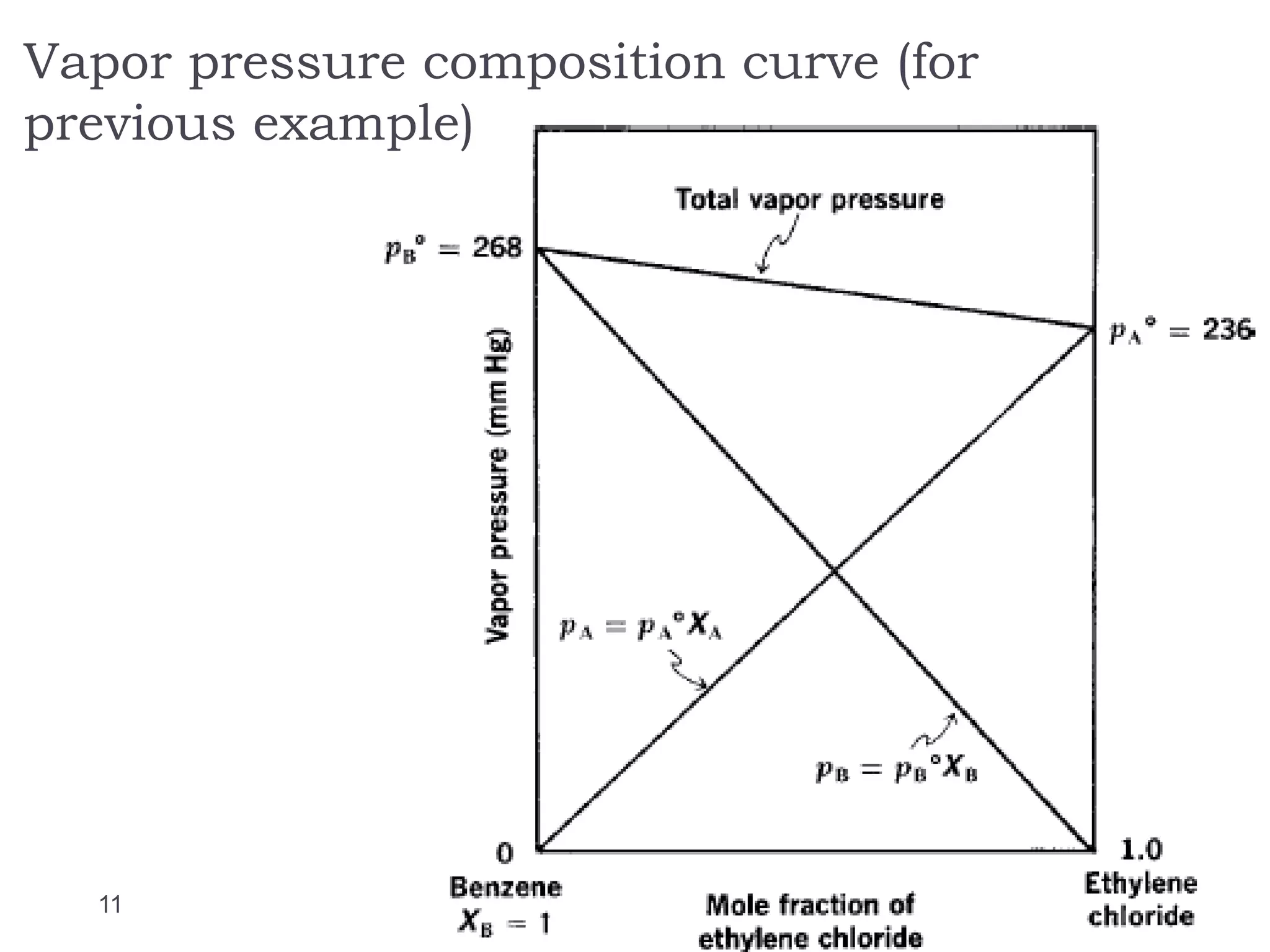
 P = pA + pB
 pA = pA◦ XA
 pB = pB◦ XB
 What is the partial vapor pressure of benzene and of
ethylene chloride in a solution at a mole fraction of
benzene of 0.6? The vapor pressure of pure benzene at
50◦C is 268 mm, and the corresponding pA ◦ for
ethylene chloride is 236 mm.
Raoult's Law States that, in an ideal solution, the partial vapor pressure of each volatile
constituent is equal to the vapor pressure of the pure constituent multiplied by its
mole fraction in the solution. Thus, for two constituents A and B,
11
Vapor pressure composition curve (for
previous example)
Real Solutions
12
 Ideality in solutions presupposes complete uniformity
of attractive forces.
 Many examples of solution pairs are known,
however, in which the “cohesive” attraction of A for A
exceeds the “adhesive” attraction existing between A
and B.
 Similarly, the attractive forces between A and B may
be greater than those between A and A or B and B.
 Such mixtures are real or nonideal; that is, they do
not adhere to Raoult’s law
 Two types of deviation from Raoult’s law are
recognized, negative deviation and positive
13
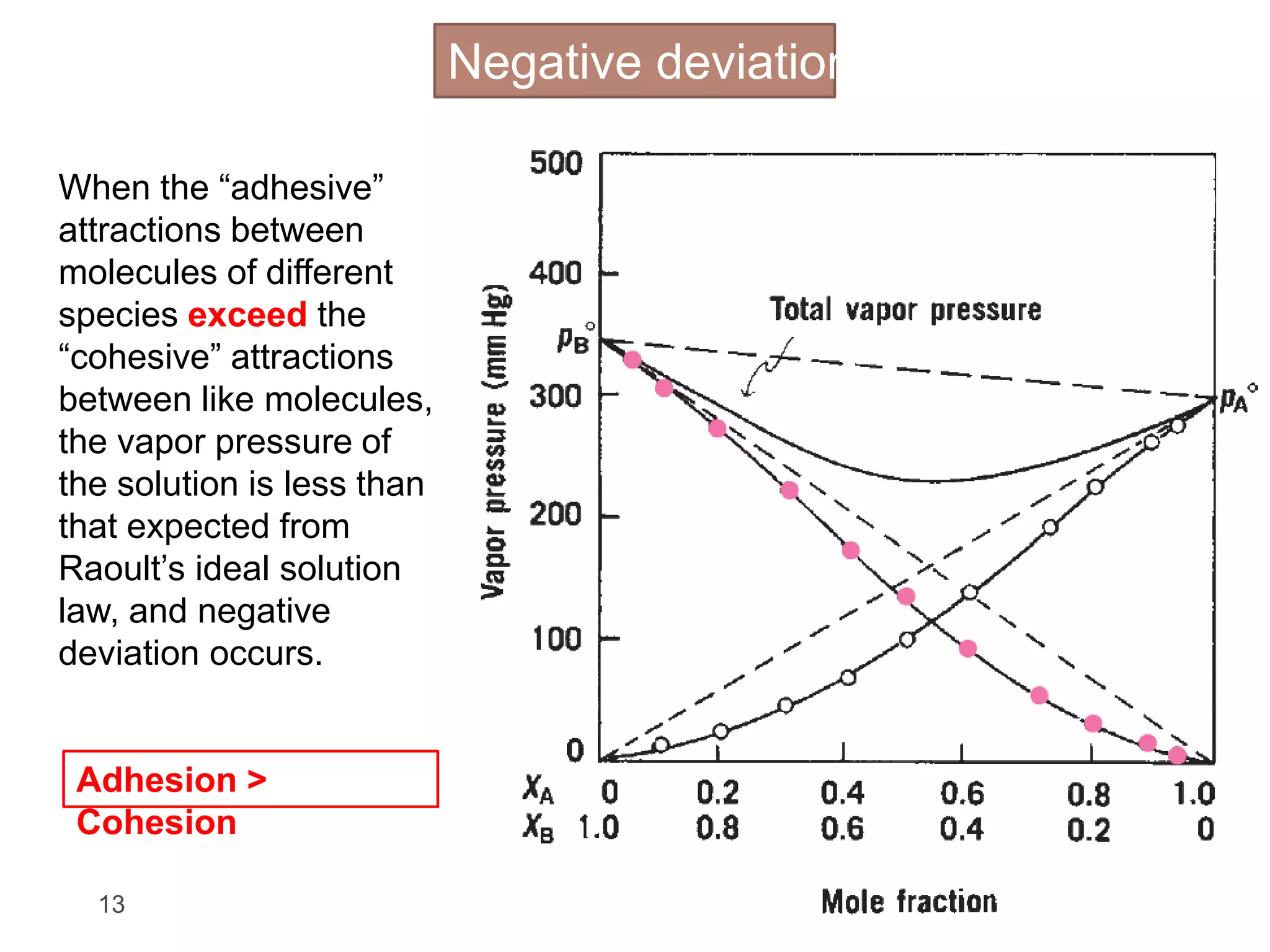
When the “adhesive”
attractions between
molecules of different
species exceed the
“cohesive” attractions
between like molecules,
the vapor pressure of
the solution is less than
that expected from
Raoult’s ideal solution
law, and negative
deviation occurs.
Negative deviation
Adhesion >
Cohesion
14
When the “adhesive”
attractions between
molecules of different
species are weaker
than “cohesive”
attractions between like
molecules, the vapor
pressure of the solution
is more than that
expected from Raoult’s
ideal solution law, and
positive deviation
occurs.
Positive deviation
Adhesion <
Cohesion
Questions !
10/31/201515
Colligative properties
16
Colligative properties
17
 Colligative properties of solutions are those that
affected (changed) by the presence of solute and
depend solely on the number (amount of solute in
the solutions) rather than nature of constituents.
 Examples of colligative properties are:
 Vapor pressure
 Boiling point
 Freezing point
 Osmotic pressure
Colligative vs Non-colligative
18
Compare 1.0 M aqueous sugar solution to a 0.5 M solution of
salt (NaCl) in water.
both solutions have the same number of dissolved particles
any difference in the properties of those two solutions is due to
a non-colligative property.
Both have the same freezing point, boiling point, vapor
pressure, and osmotic pressure
Non-Colligative Properties
Sugar solution is sweet and salt solution is salty.
Therefore, the taste of the solution is not a colligative
property.
Another non-colligative property is the color of a solution.
Other non-colligative properties include viscosity, surface
tension, and solubility.
19
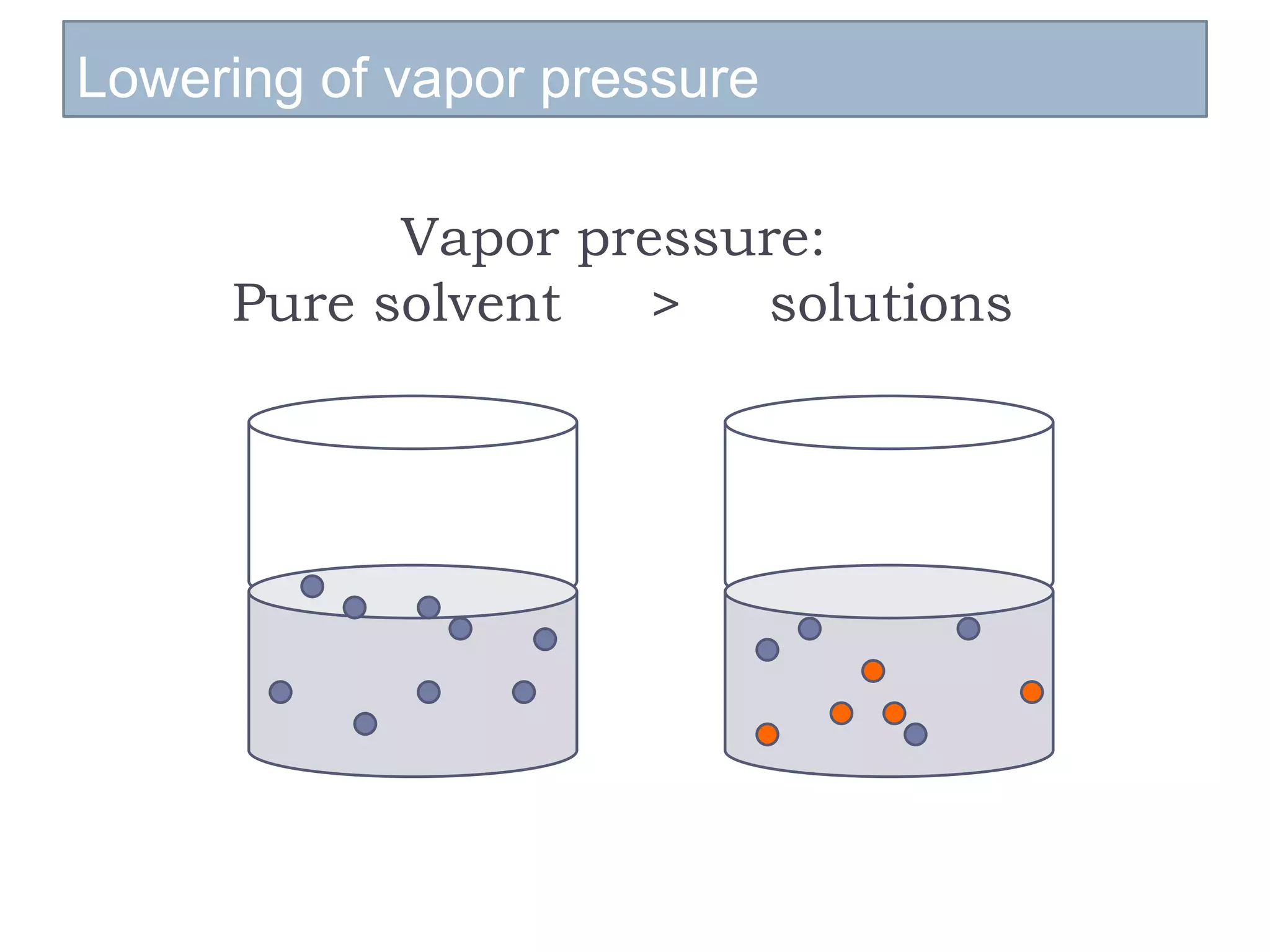
Lowering of vapor pressure
Vapor pressure:
Pure solvent > solutions
Lowering of vapor pressure
21
 According to raoult’s law Psolvent = Pºsolvent Xsolvent
 But if the solute used in non volatile only pressure from
solvent can be considered.
 So:
 On the other hand
Psolute = Pºsolute Xsolute
Psolution = Pºsolvent Xsolvent
X1 = mole fraction of solvent
X2 = mole fraction of solute
22
 ∆p = p1◦ − p is the lowering of the vapor pressure
and ∆p/p1◦ is the relative vapor pressure lowering.
 The relative vapor pressure lowering depends only
on the mole fraction of the solute, X2, that is, on the
number of solute particles in a definite volume of
solution. Therefore, the relative vapor pressure
lowering is a colligative property.
23
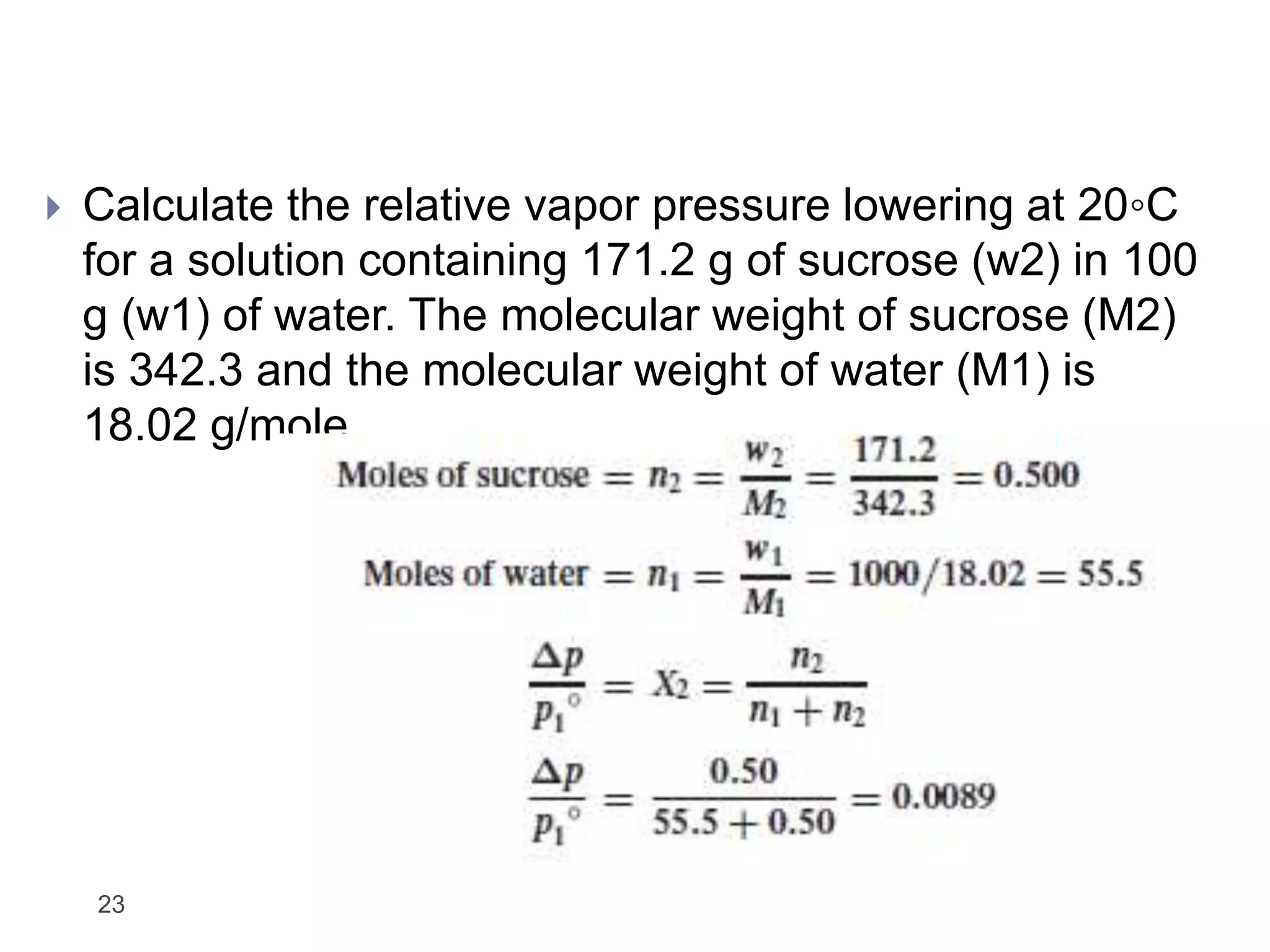
 Calculate the relative vapor pressure lowering at 20◦C
for a solution containing 171.2 g of sucrose (w2) in 100
g (w1) of water. The molecular weight of sucrose (M2)
is 342.3 and the molecular weight of water (M1) is
18.02 g/mole.
Boiling point elevation
24
Boiling point elevation is a colligative property related to
vapor pressure lowering.
The boiling point is defined as the temperature at which
the vapor pressure of a liquid equals the atmospheric
pressure.
Due to vapor pressure lowering, a solution will require a
higher temperature to reach its boiling point than the pure
solvent.
Elevation of the Boiling Point
25
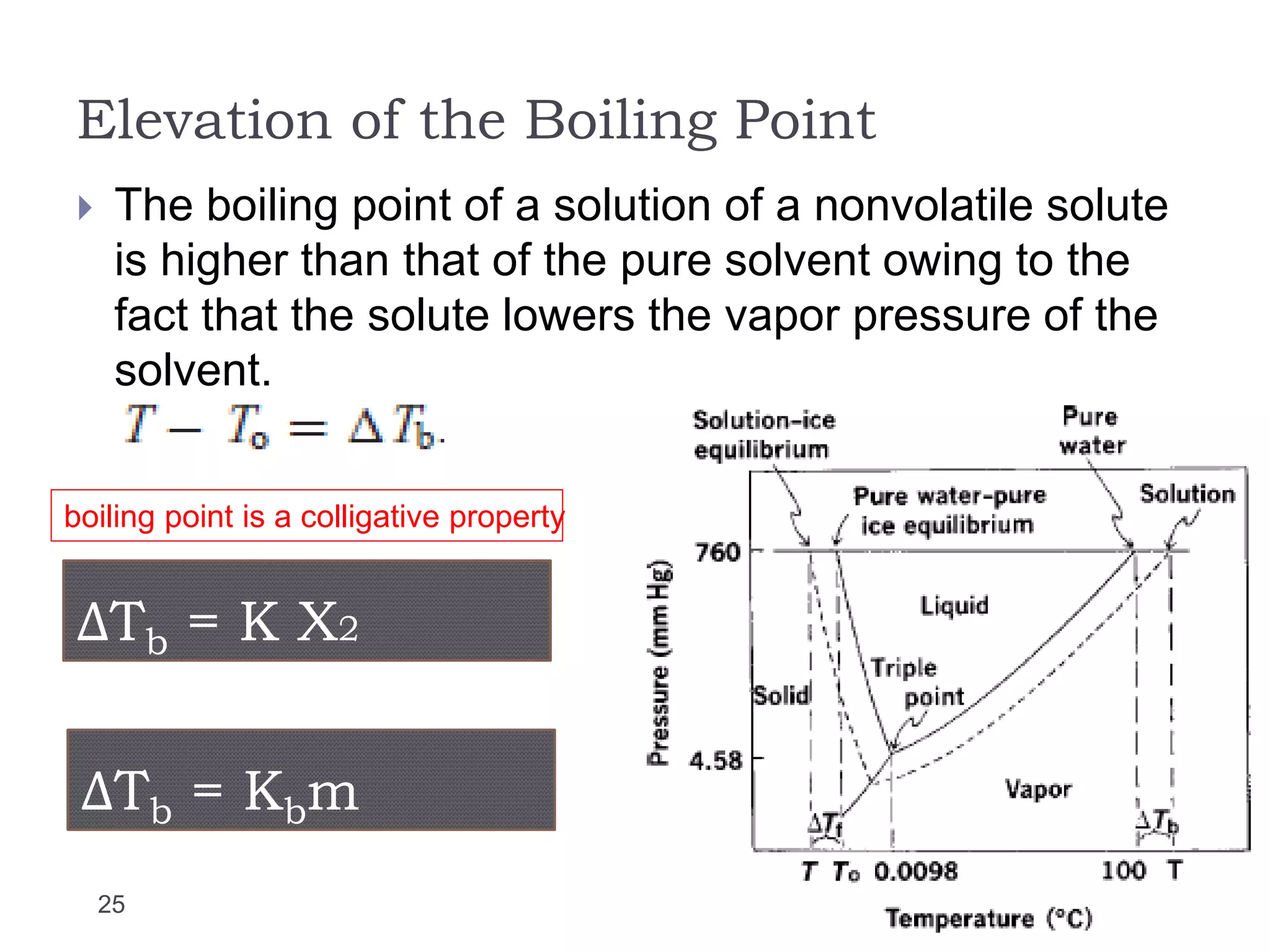
 The boiling point of a solution of a nonvolatile solute
is higher than that of the pure solvent owing to the
fact that the solute lowers the vapor pressure of the
solvent.
ΔTb = K X2
ΔTb = Kbm
boiling point is a colligative property
26
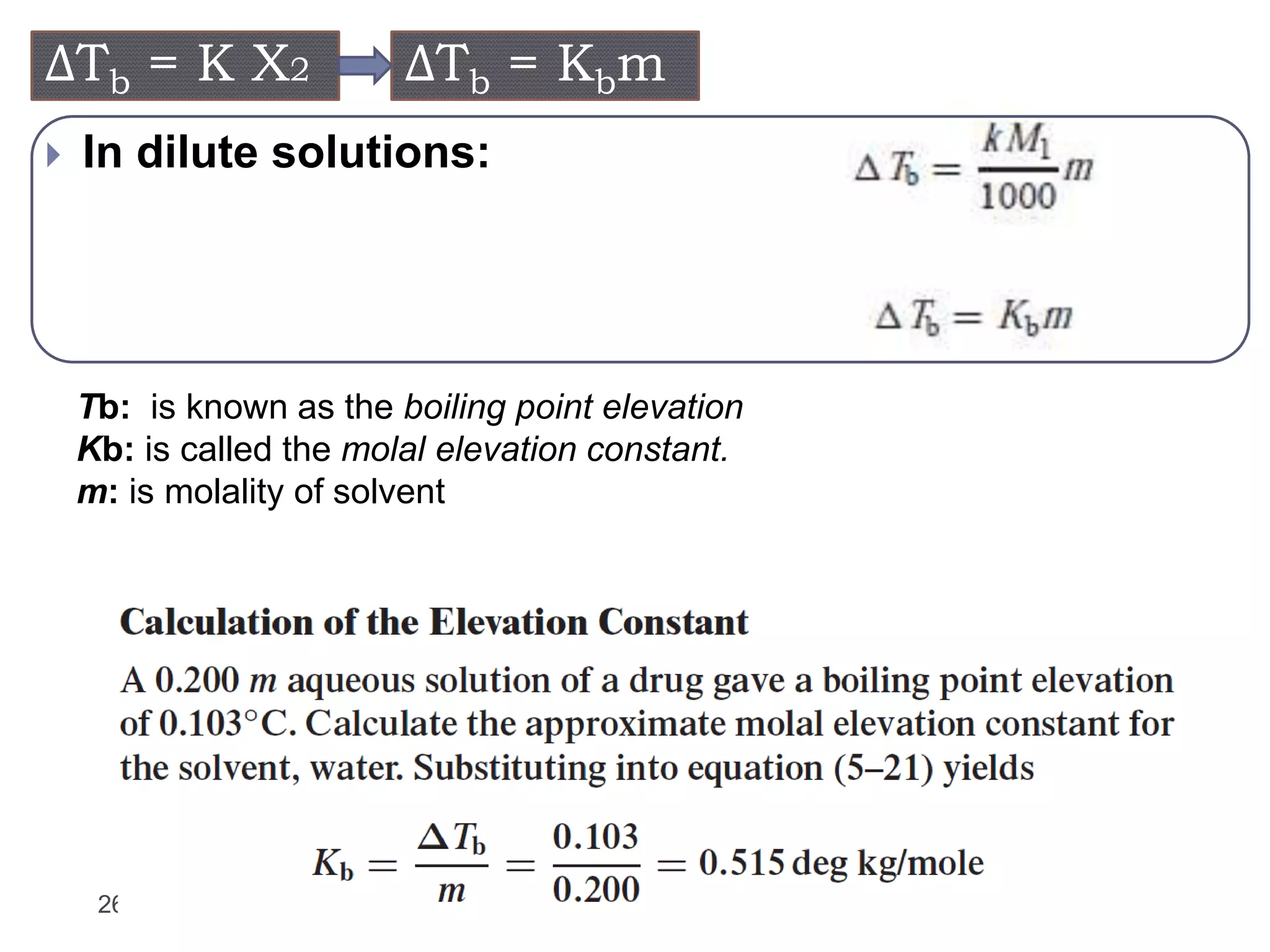
 In dilute solutions:
ΔTb = K X2 ΔTb = Kbm
Tb: is known as the boiling point elevation
Kb: is called the molal elevation constant.
m: is molality of solvent
Freezing Point
27
Every liquid has a freezing point - the temperature at
which a liquid undergoes a phase change from liquid to
solid.
When solutes are added to a liquid, forming a solution, the
solute molecules disrupt the formation of crystals of the
solvent.
That disruption in the freezing process results in a
depression of the freezing point for the solution relative to
the pure solvent.
Depression of the Freezing Point
28
∆T f = Tº f – T f
Kf is the molal epression constant
29
What happens to the triple point?
30
Osmotic Pressure
31
When a solution is separated
from a volume of pure solvent
by a semi-permeable
membrane that allows only the
passage of solvent molecules,
the height of the solution
begins to rise.
The value of the height
difference between the two
compartments reflects a
property called the osmotic
pressure of a solution.
Osmotic Pressure
32
Where
π is the osmotic pressure .
V is the volume of the solution in liters.
n is the number of moles of solute.
R is the gas constant, equal to 0.082 liter atm/mole deg.
T is the absolute temperature.
 Van't Hoff and Morse Equations for Osmotic Pressure:
33
MOLECULAR WEIGHT DETERMINATION
34
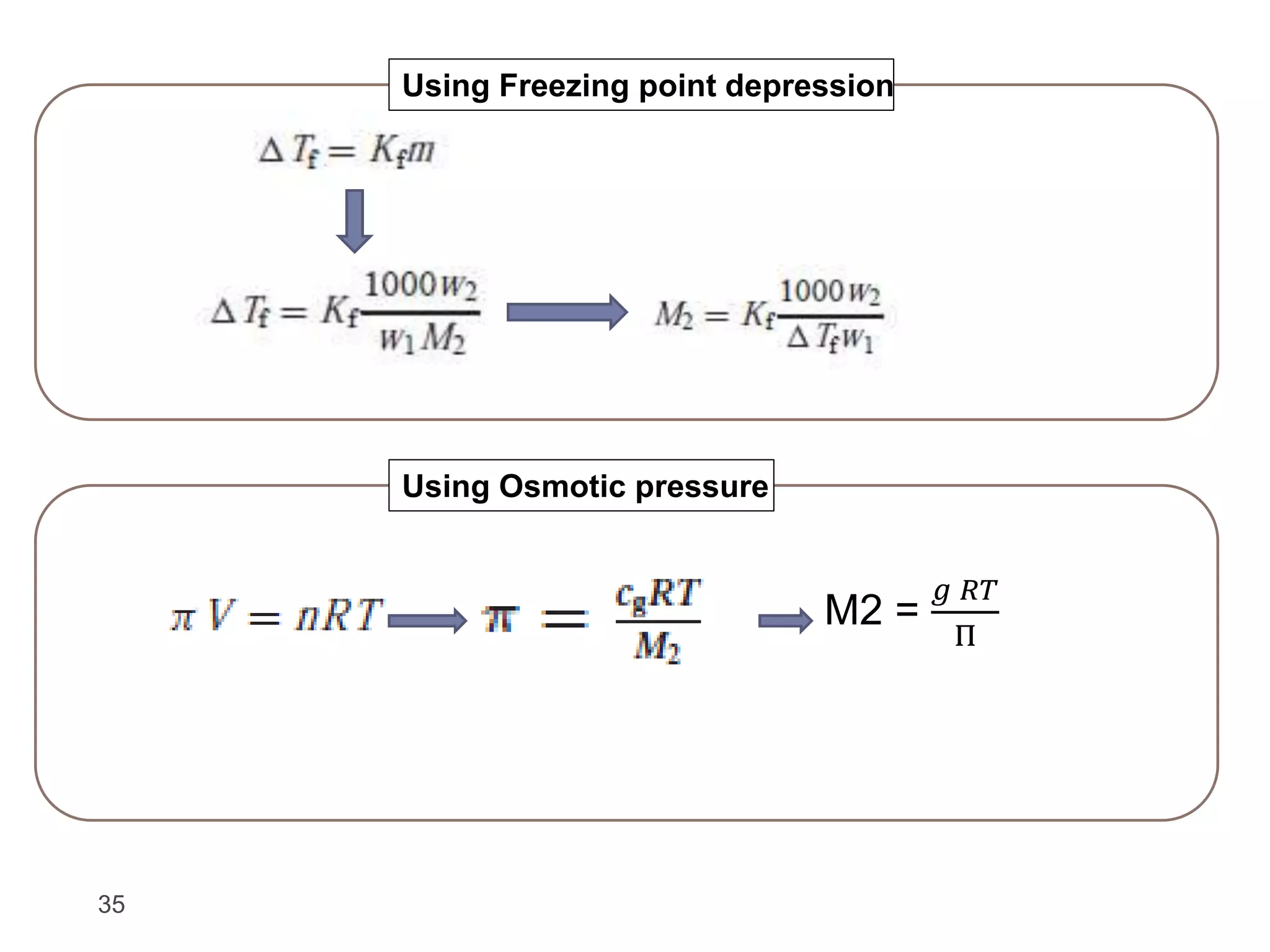
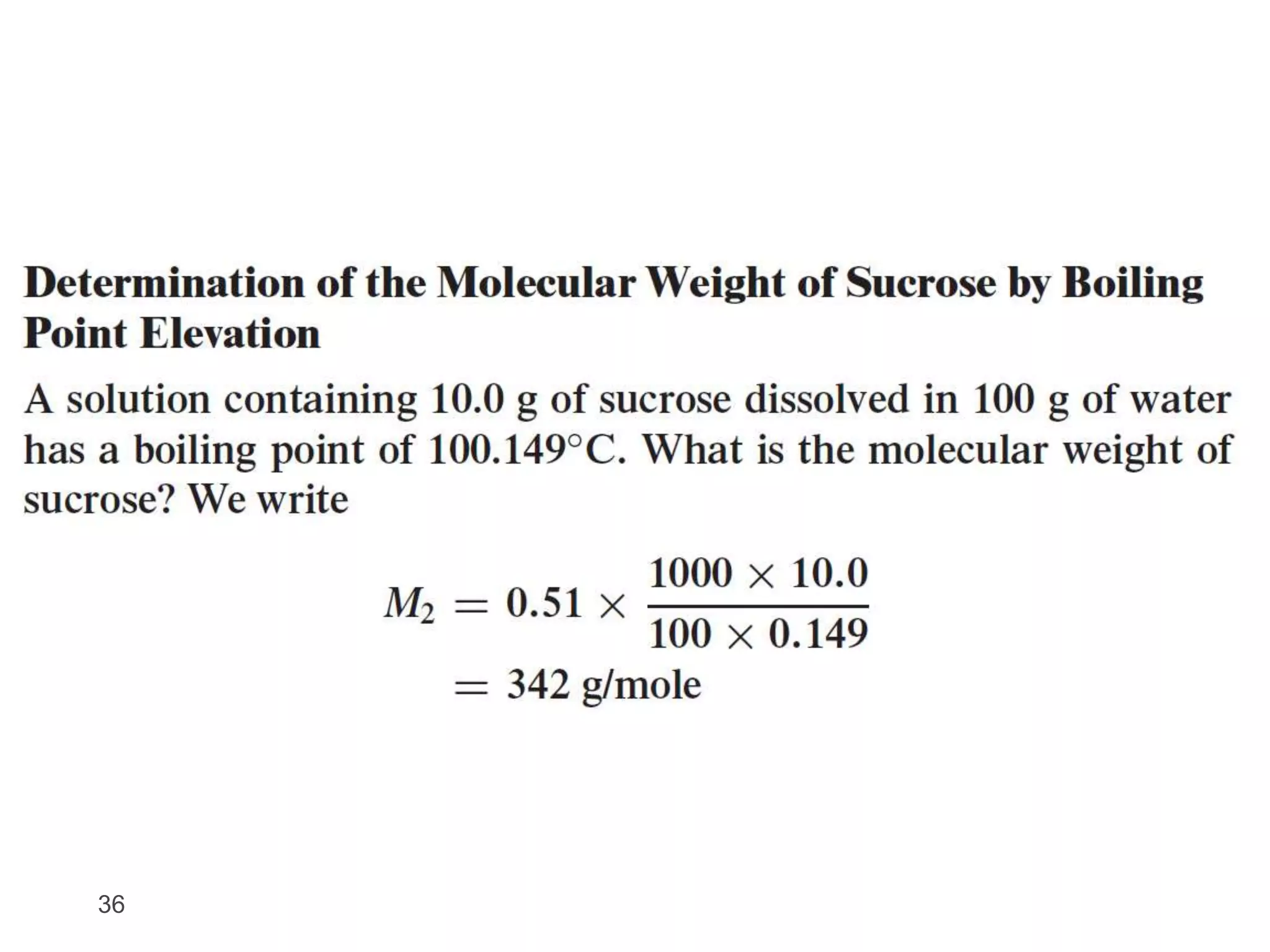
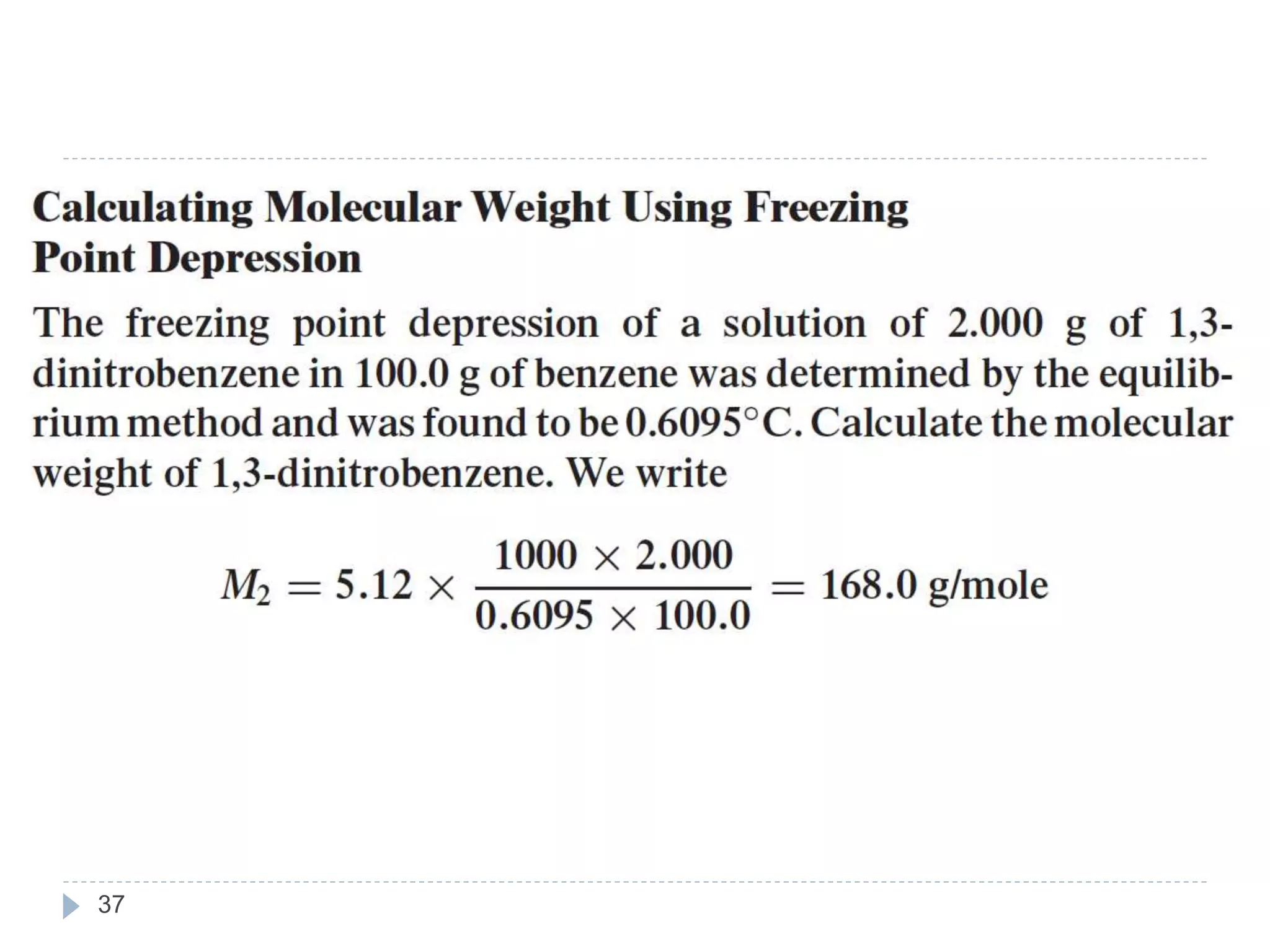
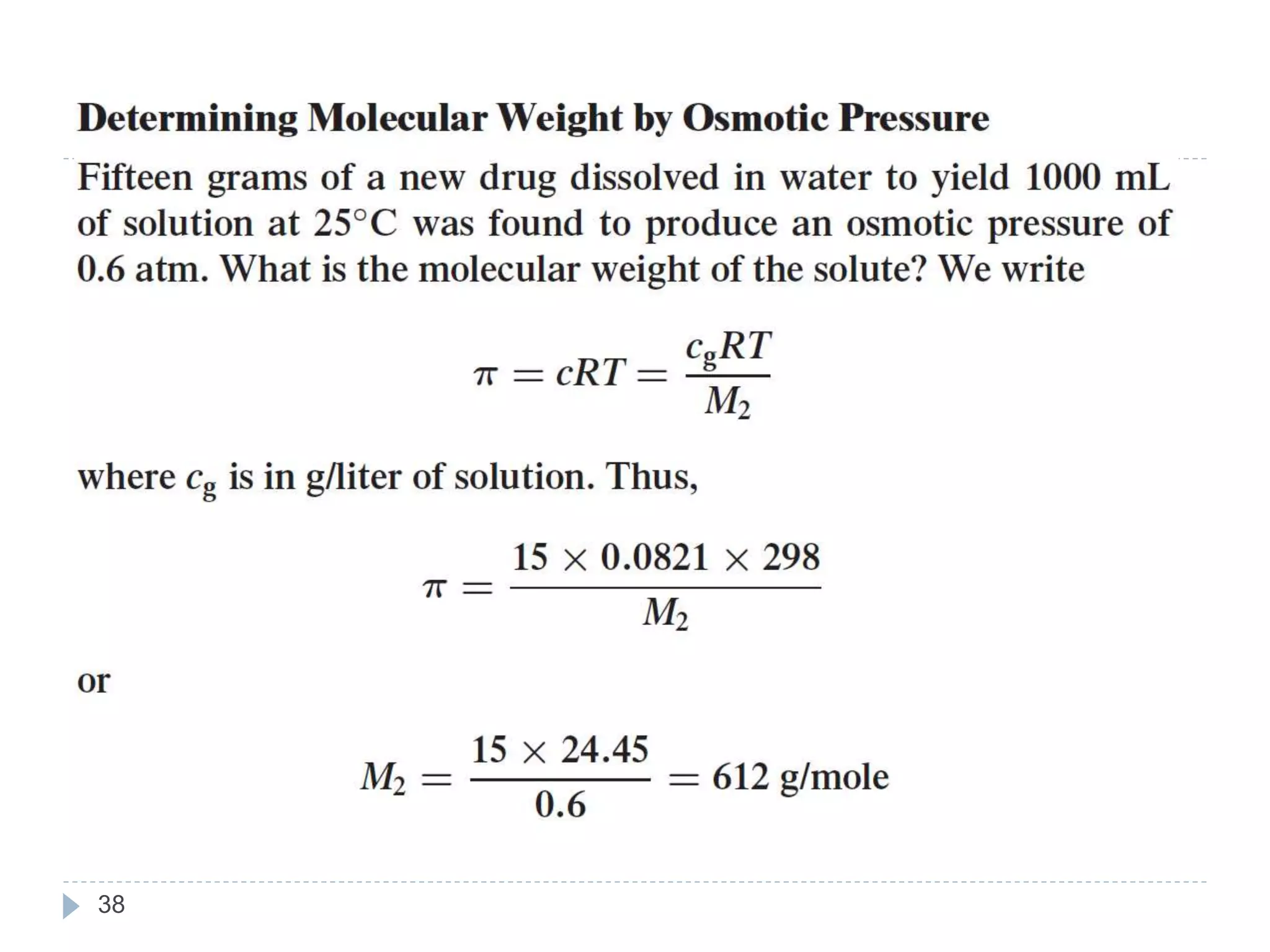
 The four colligative properties can be used to calculate
the molecular weights of nonelectrolytes present as
solutes. Using vapor pressure lowering
Using boining point elevation
35
Using Freezing point depression
M2 =
𝑔 𝑅𝑇
Π
Using Osmotic pressure
36
37
38
Questions !
10/31/201539

3- Solutions & It's Colligative Properties(Physical Pharmacy)

  • 1.
    Khalid T Maaroof MSc.Pharmaceutical sciences School of pharmacy – Pharmaceutics department 1 Online access: bit.ly/physicalpharmacy Solutions Physical Pharmacy 10/31/2015
  • 2.
  • 3.
    Types ofsolutes Na+ Cl- • Electrolytes(Conductive): Dissociation in to ions in solution Eg: NaCl • Nonelectrolytes (no conductivity): no dissociation Eg: suger
  • 4.
    Concentration expressions forsolutions 4  Molarity?  Normality?  Molarity?  Mole fracction?  Mole percent?  Percent  Percent by weight % w/w  Percent by volume %v/v  Percent weight in volume % w/v
  • 5.
    Concentration expressed aspercentage 5 – Percent weight-in-weight (w/w) is the grams of solute in 100 grams of the solution. – Percent weight-in-volume (w/v) is the grams of solute in 100ml of the solution. – Percent volume-in-volume (v/v) is the milliliters of solute in 100ml of the solution. A 20 % w/w solution contains 20g solute how many grams the solvent is?
  • 6.
    Molarity, Normality, andMolality 6  Molarity and normality both depend on the volume of the solvent, so their values are affected by change of volume caused by factors such as change in temperature.  Molality doesn’t has this disadvantage.
  • 7.
    Mole fraction 7  Ina solution containing 0.01 mole of solute and 0.04 mole of solvent, the mole fraction of the solute is 0.2 and for solvent it is 0.8 Mole percent = mole fraction X 100
  • 8.
    8  An aqueoussolution of ferrous sulfate was prepared by adding 41.50 g of FeSO4 to enough water to make 1000 mL of solution. The density of the solution is 1.0375 and the molecular weight of FeSO4 is 151.9. Calculate  (a) molarity  (b) molality  (c) mole fraction of FeSO4, mole fraction of water, and the mole percent of the two constituents  (d) % w/w of FeSO4.
  • 9.
    Ideal and realsolutions 9  Ideal solution is defined as a solution in which there is no change in the properties of the components other than dilution when they are mixed to form the solution  Molecules exhibit complete freedom of motion and randomness of distribution in the solution.  Ideality in solutions means complete uniformity of attractive forces
  • 10.
    Ideal Solutions and 10 P = pA + pB  pA = pA◦ XA  pB = pB◦ XB  What is the partial vapor pressure of benzene and of ethylene chloride in a solution at a mole fraction of benzene of 0.6? The vapor pressure of pure benzene at 50◦C is 268 mm, and the corresponding pA ◦ for ethylene chloride is 236 mm. Raoult's Law States that, in an ideal solution, the partial vapor pressure of each volatile constituent is equal to the vapor pressure of the pure constituent multiplied by its mole fraction in the solution. Thus, for two constituents A and B,
  • 11.
    11 Vapor pressure compositioncurve (for previous example)
  • 12.
    Real Solutions 12  Idealityin solutions presupposes complete uniformity of attractive forces.  Many examples of solution pairs are known, however, in which the “cohesive” attraction of A for A exceeds the “adhesive” attraction existing between A and B.  Similarly, the attractive forces between A and B may be greater than those between A and A or B and B.  Such mixtures are real or nonideal; that is, they do not adhere to Raoult’s law  Two types of deviation from Raoult’s law are recognized, negative deviation and positive
  • 13.
    13 When the “adhesive” attractionsbetween molecules of different species exceed the “cohesive” attractions between like molecules, the vapor pressure of the solution is less than that expected from Raoult’s ideal solution law, and negative deviation occurs. Negative deviation Adhesion > Cohesion
  • 14.
    14 When the “adhesive” attractionsbetween molecules of different species are weaker than “cohesive” attractions between like molecules, the vapor pressure of the solution is more than that expected from Raoult’s ideal solution law, and positive deviation occurs. Positive deviation Adhesion < Cohesion
  • 15.
  • 16.
  • 17.
    Colligative properties 17  Colligativeproperties of solutions are those that affected (changed) by the presence of solute and depend solely on the number (amount of solute in the solutions) rather than nature of constituents.  Examples of colligative properties are:  Vapor pressure  Boiling point  Freezing point  Osmotic pressure
  • 18.
    Colligative vs Non-colligative 18 Compare1.0 M aqueous sugar solution to a 0.5 M solution of salt (NaCl) in water. both solutions have the same number of dissolved particles any difference in the properties of those two solutions is due to a non-colligative property. Both have the same freezing point, boiling point, vapor pressure, and osmotic pressure
  • 19.
    Non-Colligative Properties Sugar solutionis sweet and salt solution is salty. Therefore, the taste of the solution is not a colligative property. Another non-colligative property is the color of a solution. Other non-colligative properties include viscosity, surface tension, and solubility. 19
  • 20.
    Lowering of vaporpressure Vapor pressure: Pure solvent > solutions
  • 21.
    Lowering of vaporpressure 21  According to raoult’s law Psolvent = Pºsolvent Xsolvent  But if the solute used in non volatile only pressure from solvent can be considered.  So:  On the other hand Psolute = Pºsolute Xsolute Psolution = Pºsolvent Xsolvent X1 = mole fraction of solvent X2 = mole fraction of solute
  • 22.
    22  ∆p =p1◦ − p is the lowering of the vapor pressure and ∆p/p1◦ is the relative vapor pressure lowering.  The relative vapor pressure lowering depends only on the mole fraction of the solute, X2, that is, on the number of solute particles in a definite volume of solution. Therefore, the relative vapor pressure lowering is a colligative property.
  • 23.
    23  Calculate therelative vapor pressure lowering at 20◦C for a solution containing 171.2 g of sucrose (w2) in 100 g (w1) of water. The molecular weight of sucrose (M2) is 342.3 and the molecular weight of water (M1) is 18.02 g/mole.
  • 24.
    Boiling point elevation 24 Boilingpoint elevation is a colligative property related to vapor pressure lowering. The boiling point is defined as the temperature at which the vapor pressure of a liquid equals the atmospheric pressure. Due to vapor pressure lowering, a solution will require a higher temperature to reach its boiling point than the pure solvent.
  • 25.
    Elevation of theBoiling Point 25  The boiling point of a solution of a nonvolatile solute is higher than that of the pure solvent owing to the fact that the solute lowers the vapor pressure of the solvent. ΔTb = K X2 ΔTb = Kbm boiling point is a colligative property
  • 26.
    26  In dilutesolutions: ΔTb = K X2 ΔTb = Kbm Tb: is known as the boiling point elevation Kb: is called the molal elevation constant. m: is molality of solvent
  • 27.
    Freezing Point 27 Every liquidhas a freezing point - the temperature at which a liquid undergoes a phase change from liquid to solid. When solutes are added to a liquid, forming a solution, the solute molecules disrupt the formation of crystals of the solvent. That disruption in the freezing process results in a depression of the freezing point for the solution relative to the pure solvent.
  • 28.
    Depression of theFreezing Point 28 ∆T f = Tº f – T f Kf is the molal epression constant
  • 29.
    29 What happens tothe triple point?
  • 30.
  • 31.
    Osmotic Pressure 31 When asolution is separated from a volume of pure solvent by a semi-permeable membrane that allows only the passage of solvent molecules, the height of the solution begins to rise. The value of the height difference between the two compartments reflects a property called the osmotic pressure of a solution.
  • 32.
    Osmotic Pressure 32 Where π isthe osmotic pressure . V is the volume of the solution in liters. n is the number of moles of solute. R is the gas constant, equal to 0.082 liter atm/mole deg. T is the absolute temperature.  Van't Hoff and Morse Equations for Osmotic Pressure:
  • 33.
  • 34.
    MOLECULAR WEIGHT DETERMINATION 34 The four colligative properties can be used to calculate the molecular weights of nonelectrolytes present as solutes. Using vapor pressure lowering Using boining point elevation
  • 35.
    35 Using Freezing pointdepression M2 = 𝑔 𝑅𝑇 Π Using Osmotic pressure
  • 36.
  • 37.
  • 38.
  • 39.