LECTURE №5
QUIZ ME
NEXT
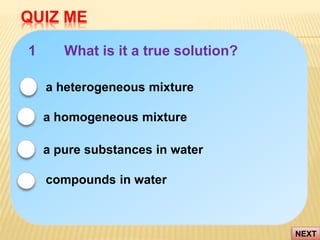
1 What is it a true solution?
a pure substances in water
compounds in water
a heterogeneous mixture
a homogeneous mixture
QUIZ ME
NEXT
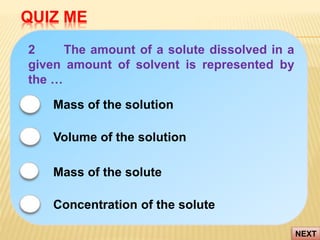
2 The amount of a solute dissolved in a
given amount of solvent is represented by
the …
Volume of the solution
Mass of the solute
Mass of the solution
Concentration of the solute
QUIZ ME
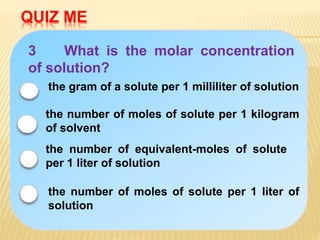
3 What is the molar concentration
of solution?
the number of equivalent-moles of solute
per 1 liter of solution
the gram of a solute per 1 milliliter of solution
the number of moles of solute per 1 kilogram
of solvent
the number of moles of solute per 1 liter of
solution
QUIZ ME
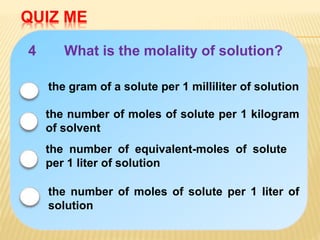
4 What is the molality of solution?
the number of equivalent-moles of solute
per 1 liter of solution
the gram of a solute per 1 milliliter of solution
the number of moles of solute per 1 kilogram
of solvent
the number of moles of solute per 1 liter of
solution
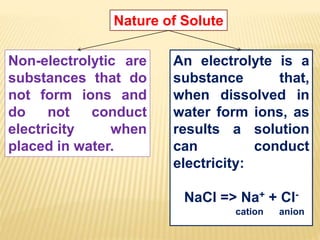
Nature of Solute
Non-electrolytic are
substances that do
not form ions and
do not conduct
electricity when
placed in water.
An electrolyte is a
substance that,
when dissolved in
water form ions, as
results a solution
can conduct
electricity:
NaCl => Na+ + Cl-
cation anion
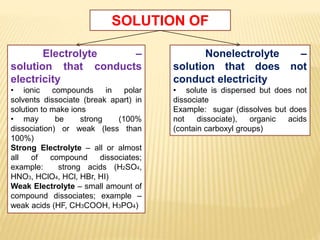
SOLUTION OF
Electrolyte –
solution that conducts
electricity
• ionic compounds in polar
solvents dissociate (break apart) in
solution to make ions
• may be strong (100%
dissociation) or weak (less than
100%)
Strong Electrolyte – all or almost
all of compound dissociates;
example: strong acids (H2SO4,
HNO3, HClO4, HCl, HBr, HI)
Weak Electrolyte – small amount of
compound dissociates; example –
weak acids (HF, CH3COOH, H3PO4)
Nonelectrolyte –
solution that does not
conduct electricity
• solute is dispersed but does not
dissociate
Example: sugar (dissolves but does
not dissociate), organic acids
(contain carboxyl groups)
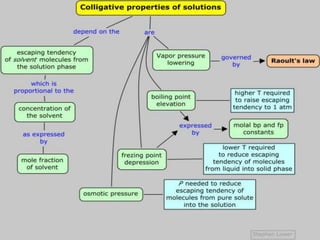
COLLIGATIVE PROPERTIES
Colligative properties are the
set of properties that depend only
on the concentration of solute
particles (ions or molecules) in the
solution and not the type.
In other words, it doesn’t matter if it is salt, sugar,
gasoline, or tennis balls – it will behave the same way!
1) Vapor Pressure Lowering (1st Raoult’s
Law)
 Related to boiling point
2) Freezing Point Depression
 Salt on the road
 Anti-freeze in your radiator
And Boiling Point Elevation (2nd Raoult’s
Law)
 Anti-freeze in your radiator
3) Osmotic Pressure (Van’t Hoff’s Law)
 Membrane diffusion
 The Great Sugar Fountain
COLLIGATIVE PROPERTIES:
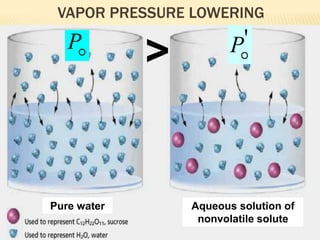
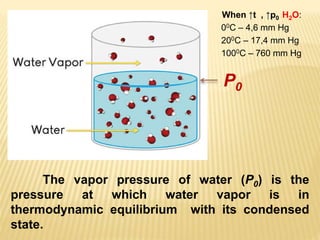
The vapor pressure of water (P0) is the
pressure at which water vapor is in
thermodynamic equilibrium with its condensed
state.
When ↑t , ↑p0 H2O:
00C – 4,6 mm Hg
200C – 17,4 mm Hg
1000C – 760 mm Hg
P0
Vapor pressure depends on various
factors:
• the nature of the liquid,
• the presence of dissolved substances in
the liquid or solid.
According to Raoult's law, the vapor
pressure of a pure liquid or solid is lowered
by the addition of a solute.
VAPOR PRESSURE LOWERING
Pure water Aqueous solution of
nonvolatile solute

P '

P
>
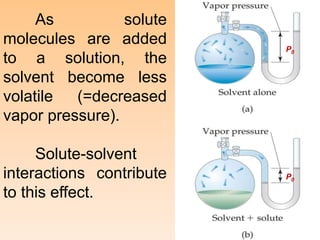
As solute
molecules are added
to a solution, the
solvent become less
volatile (=decreased
vapor pressure).
Solute-solvent
interactions contribute
to this effect.
P0
P0
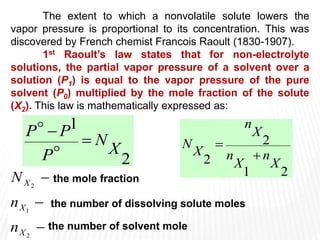
The extent to which a nonvolatile solute lowers the
vapor pressure is proportional to its concentration. This was
discovered by French chemist Francois Raoult (1830-1907).
1st Raoult’s law states that for non-electrolyte
solutions, the partial vapor pressure of a solvent over a
solution (P1) is equal to the vapor pressure of the pure
solvent (P0) multiplied by the mole fraction of the solute
(X2). This law is mathematically expressed as:
2
1
X
N
P
P
P







2
1
2
X
X
X
n
n
N
the number of dissolving solute moles
the number of solvent mole
2
1
2
2 X
n
X
n
X
n
X
N


the mole fraction
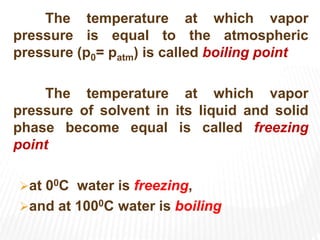
The temperature at which vapor
pressure is equal to the atmospheric
pressure (p0= pаtm) is called boiling point
The temperature at which vapor
pressure of solvent in its liquid and solid
phase become equal is called freezing
point
at 00C water is freezing,
and at 1000C water is boiling
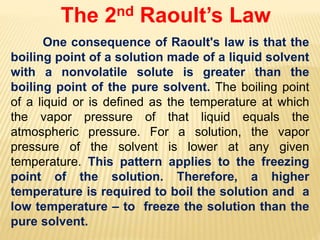
The 2nd Raoult’s Law
One consequence of Raoult's law is that the
boiling point of a solution made of a liquid solvent
with a nonvolatile solute is greater than the
boiling point of the pure solvent. The boiling point
of a liquid or is defined as the temperature at which
the vapor pressure of that liquid equals the
atmospheric pressure. For a solution, the vapor
pressure of the solvent is lower at any given
temperature. This pattern applies to the freezing
point of the solution. Therefore, a higher
temperature is required to boil the solution and a
low temperature – to freeze the solution than the
pure solvent.
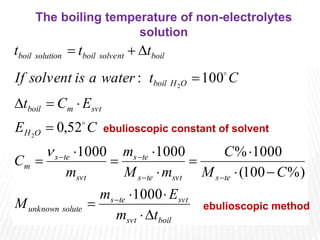
boil
svt
svt
te
s
solute
unknown
te
s
svt
te
s
te
s
svt
te
s
m
O
H
svt
m
boil
O
H
boil
boil
solvent
boil
solution
boil
t
m
E
m
M
C
M
C
m
M
m
m
C
C
E
E
C
t
C
t
water
a
is
solvent
If
t
t
t



























1000
%)
100
(
1000
%
1000
1000
52
,
0
100
:
2
2



ebulioscopic constant of solvent
The boiling temperature of non-electrolytes
solution
ebulioscopic method
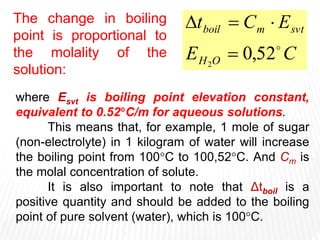
where Esvt is boiling point elevation constant,
equivalent to 0.52C/m for aqueous solutions.
This means that, for example, 1 mole of sugar
(non-electrolyte) in 1 kilogram of water will increase
the boiling point from 100C to 100,52C. And Cm is
the molal concentration of solute.
It is also important to note that Δtboil is a
positive quantity and should be added to the boiling
point of pure solvent (water), which is 100C.
C
E
E
C
t
O
H
svt
m
boil

52
,
0
2




The change in boiling
point is proportional to
the molality of the
solution:
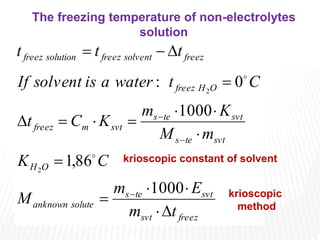
freez
svt
svt
te
s
solute
anknown
O
H
svt
te
s
svt
te
s
svt
m
freez
O
H
freez
freez
solvent
freez
solution
freez
t
m
E
m
M
C
K
m
M
K
m
K
C
t
C
t
water
a
is
solvent
If
t
t
t




















1000
86
,
1
1000
0
:
2
2


krioscopic constant of solvent
The freezing temperature of non-electrolytes
solution
krioscopic
method
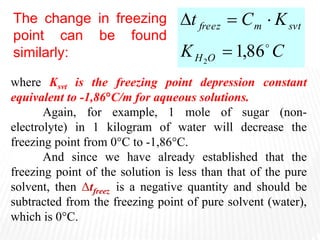
where Ksvt is the freezing point depression constant
equivalent to -1,86C/m for aqueous solutions.
Again, for example, 1 mole of sugar (non-
electrolyte) in 1 kilogram of water will decrease the
freezing point from 0C to -1,86C.
And since we have already established that the
freezing point of the solution is less than that of the pure
solvent, then Δtfreez is a negative quantity and should be
subtracted from the freezing point of pure solvent (water),
which is 0C.
C
K
K
C
t
O
H
svt
m
freez

86
,
1
2




The change in freezing
point can be found
similarly:
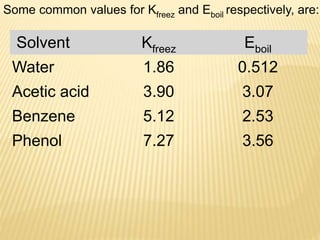
Solvent Kfreez Eboil
Water 1.86 0.512
Acetic acid 3.90 3.07
Benzene 5.12 2.53
Phenol 7.27 3.56
Some common values for Kfreez and Eboil respectively, are:
In 1784, the French physicist Jean Antoine Nollet
discovered that a pig's bladder filled with a concentrated
solution of alcohol in water expanded when it was immersed in
water. The bladder acted as a semipermeable membrane,
which allowed water molecules to enter the solution, but kept
alcohol molecules from moving in the other direction.
Movement of one component of a solution through a
membrane to dilute the solution is called osmosis, and the
pressure this produces is called the osmotic pressure ().
Osmotic pressure can be demonstrated with the
apparatus shown in the figure below. A semipermeable
membrane is tied across the open end of a thistle tube. The
tube is then partially filled with a solution of sugar or alcohol in
water and immersed in a beaker of water. Water will flow into
the tube until the pressure on the column of water due to the
force of gravity balances the osmotic pressure driving water
through the membrane.
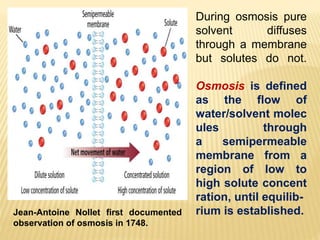
Jean-Antoine Nollet first documented
observation of osmosis in 1748.
During osmosis pure
solvent diffuses
through a membrane
but solutes do not.
Osmosis is defined
as the flow of
water/solvent molec
ules through
a semipermeable
membrane from a
region of low to
high solute concent
ration, until equilib-
rium is established.
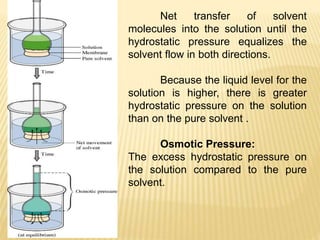
Net transfer of solvent
molecules into the solution until the
hydrostatic pressure equalizes the
solvent flow in both directions.
Because the liquid level for the
solution is higher, there is greater
hydrostatic pressure on the solution
than on the pure solvent .
Osmotic Pressure:
The excess hydrostatic pressure on
the solution compared to the pure
solvent.
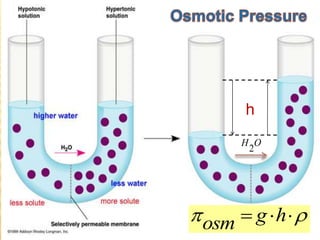
h

 

 h
g
оsm
O
H
2
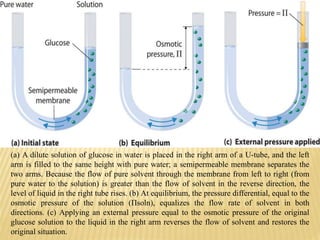
(a) A dilute solution of glucose in water is placed in the right arm of a U-tube, and the left
arm is filled to the same height with pure water; a semipermeable membrane separates the
two arms. Because the flow of pure solvent through the membrane from left to right (from
pure water to the solution) is greater than the flow of solvent in the reverse direction, the
level of liquid in the right tube rises. (b) At equilibrium, the pressure differential, equal to the
osmotic pressure of the solution (Πsoln), equalizes the flow rate of solvent in both
directions. (c) Applying an external pressure equal to the osmotic pressure of the original
glucose solution to the liquid in the right arm reverses the flow of solvent and restores the
original situation.
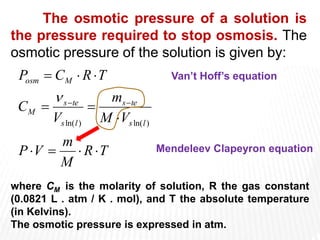
The osmotic pressure of a solution is
the pressure required to stop osmosis. The
osmotic pressure of the solution is given by:
T
R
M
m
V
P
V
M
m
V
С
T
R
С
P
l
s
te
s
l
s
te
s
М
М
osm












)
ln(
)
ln(

where CM is the molarity of solution, R the gas constant
(0.0821 L . atm / K . mol), and T the absolute temperature
(in Kelvins).
The osmotic pressure is expressed in atm.
Van’t Hoff’s equation
Mendeleev Clapeyron equation
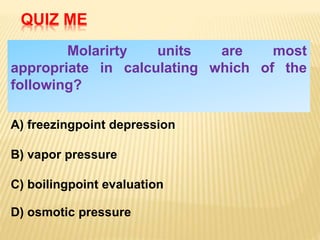
Molarirty units are most
appropriate in calculating which of the
following?
QUIZ ME
A) freezingpoint depression
B) vapor pressure
C) boilingpoint evaluation
D) osmotic pressure
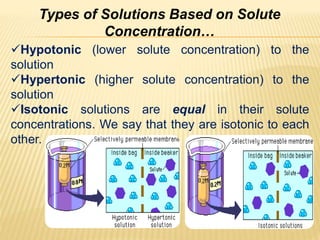
Types of Solutions Based on Solute
Concentration…
Hypotonic (lower solute concentration) to the
solution
Hypertonic (higher solute concentration) to the
solution
Isotonic solutions are equal in their solute
concentrations. We say that they are isotonic to each
other.
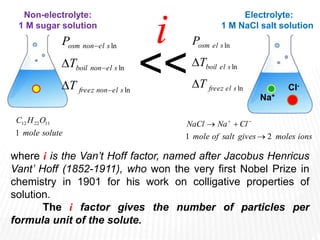
Non-electrolyte:
1 М sugar solution
Electrolyte:
1 М NaCl salt solution
solute
mole
О
Н
С
1
11
22
12
ions
moles
gives
salt
of
mole
Cl
Na
NaCl
2
1 

 

where i is the Van’t Hoff factor, named after Jacobus Henricus
Vant’ Hoff (1852-1911), who won the very first Nobel Prize in
chemistry in 1901 for his work on colligative properties of
solution.
The i factor gives the number of particles per
formula unit of the solute.
ln
ln
ln
s
el
non
freez
s
el
non
boil
s
el
non
osm
Т
T
P





ln
ln
ln
s
el
freez
s
el
boil
s
el
osm
Т
T
P


<<
i
Na+
Cl-
5
3
2
3
2
)
(
1
)
1
(
1
1
2
4
3
3
4
2















anion
cation
n
SO
Al
SO
Al
n
i
n
i


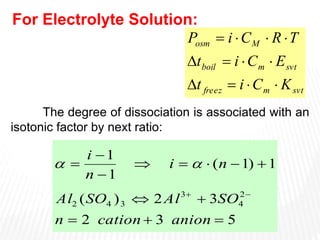
The degree of dissociation is associated with an
isotonic factor by next ratio:
svt
m
freez
svt
m
boil
M
osm
K
C
i
t
E
C
i
t
T
R
C
i
P












For Electrolyte Solution:
If equal numbers of moles of each
of the following are dissolved in 1 kg
of distilled water, the one with the
lowest boiling point will be:
A)NaI
B) AlCl3
C) Mg(NO3)2
D) CH3COOH
E) C6H12O6
QUIZ ME
SUMMARY OF FACTS AND CONCEPTS
1. Colligative properties (or collective properties) are
properties that depend only on the number of solute particles in
solution and not on the nature of the solute particles.
2. The four colligative properties of a solution are vapor
pressure, osmotic pressure, boiling point and freezing point.
3. The change in vapor pressure where the solute is less
volatile than the solvent is regulated by Raoult’s law, which
states that the vapor pressure of a solvent over a solution is
equal to the mole fraction of the solvent times the vapor
pressure of pure solvent.
4. The osmotic pressure of a solution is the pressure
required to stop osmosis.
5. The freezing point of the solution is always less than
the freezing point of the pure solvent.
7. In electrolyte solutions, the interaction between ions
leads to the formation of ion pairs. The Van’t Hoff factor (i)
provides a measure of the extent of dissociation of electrolytes in
solution.
8. Solutions can be classified as hypertonic, hypotonic or
isotonic depending on the concentration of solute inside and
outside the cell.
9. A hypertonic solution has a higher concentration of
particle than the cell causing the cell to shrink.
10. A hypotonic solution has a lower concentration of
particles than the cell causing the cell to swell.
11. An isotonic solution has the same osmotic strength on
both sides of the semipermeable membrane.
12. Osmosis is the spontaneous net movement
of solvent molecules through a semi-permeable membrane into a
region of higher solute concentration, in the direction that tends to
equalize the solute concentrations on the two sides.
Coligative solution .pptx

Coligative solution .pptx

  • 1.
  • 2.
    QUIZ ME NEXT 1 Whatis it a true solution? a pure substances in water compounds in water a heterogeneous mixture a homogeneous mixture
  • 3.
    QUIZ ME NEXT 2 Theamount of a solute dissolved in a given amount of solvent is represented by the … Volume of the solution Mass of the solute Mass of the solution Concentration of the solute
  • 4.
    QUIZ ME 3 Whatis the molar concentration of solution? the number of equivalent-moles of solute per 1 liter of solution the gram of a solute per 1 milliliter of solution the number of moles of solute per 1 kilogram of solvent the number of moles of solute per 1 liter of solution
  • 5.
    QUIZ ME 4 Whatis the molality of solution? the number of equivalent-moles of solute per 1 liter of solution the gram of a solute per 1 milliliter of solution the number of moles of solute per 1 kilogram of solvent the number of moles of solute per 1 liter of solution
  • 6.
    Nature of Solute Non-electrolyticare substances that do not form ions and do not conduct electricity when placed in water. An electrolyte is a substance that, when dissolved in water form ions, as results a solution can conduct electricity: NaCl => Na+ + Cl- cation anion
  • 7.
    SOLUTION OF Electrolyte – solutionthat conducts electricity • ionic compounds in polar solvents dissociate (break apart) in solution to make ions • may be strong (100% dissociation) or weak (less than 100%) Strong Electrolyte – all or almost all of compound dissociates; example: strong acids (H2SO4, HNO3, HClO4, HCl, HBr, HI) Weak Electrolyte – small amount of compound dissociates; example – weak acids (HF, CH3COOH, H3PO4) Nonelectrolyte – solution that does not conduct electricity • solute is dispersed but does not dissociate Example: sugar (dissolves but does not dissociate), organic acids (contain carboxyl groups)
  • 8.
    COLLIGATIVE PROPERTIES Colligative propertiesare the set of properties that depend only on the concentration of solute particles (ions or molecules) in the solution and not the type. In other words, it doesn’t matter if it is salt, sugar, gasoline, or tennis balls – it will behave the same way!
  • 9.
    1) Vapor PressureLowering (1st Raoult’s Law)  Related to boiling point 2) Freezing Point Depression  Salt on the road  Anti-freeze in your radiator And Boiling Point Elevation (2nd Raoult’s Law)  Anti-freeze in your radiator 3) Osmotic Pressure (Van’t Hoff’s Law)  Membrane diffusion  The Great Sugar Fountain COLLIGATIVE PROPERTIES:
  • 10.
    The vapor pressureof water (P0) is the pressure at which water vapor is in thermodynamic equilibrium with its condensed state. When ↑t , ↑p0 H2O: 00C – 4,6 mm Hg 200C – 17,4 mm Hg 1000C – 760 mm Hg P0
  • 11.
    Vapor pressure dependson various factors: • the nature of the liquid, • the presence of dissolved substances in the liquid or solid. According to Raoult's law, the vapor pressure of a pure liquid or solid is lowered by the addition of a solute.
  • 12.
    VAPOR PRESSURE LOWERING Purewater Aqueous solution of nonvolatile solute  P '  P >
  • 13.
    As solute molecules areadded to a solution, the solvent become less volatile (=decreased vapor pressure). Solute-solvent interactions contribute to this effect. P0 P0
  • 14.
    The extent towhich a nonvolatile solute lowers the vapor pressure is proportional to its concentration. This was discovered by French chemist Francois Raoult (1830-1907). 1st Raoult’s law states that for non-electrolyte solutions, the partial vapor pressure of a solvent over a solution (P1) is equal to the vapor pressure of the pure solvent (P0) multiplied by the mole fraction of the solute (X2). This law is mathematically expressed as: 2 1 X N P P P        2 1 2 X X X n n N the number of dissolving solute moles the number of solvent mole 2 1 2 2 X n X n X n X N   the mole fraction
  • 15.
    The temperature atwhich vapor pressure is equal to the atmospheric pressure (p0= pаtm) is called boiling point The temperature at which vapor pressure of solvent in its liquid and solid phase become equal is called freezing point at 00C water is freezing, and at 1000C water is boiling
  • 16.
    The 2nd Raoult’sLaw One consequence of Raoult's law is that the boiling point of a solution made of a liquid solvent with a nonvolatile solute is greater than the boiling point of the pure solvent. The boiling point of a liquid or is defined as the temperature at which the vapor pressure of that liquid equals the atmospheric pressure. For a solution, the vapor pressure of the solvent is lower at any given temperature. This pattern applies to the freezing point of the solution. Therefore, a higher temperature is required to boil the solution and a low temperature – to freeze the solution than the pure solvent.
  • 17.
  • 18.
    where Esvt isboiling point elevation constant, equivalent to 0.52C/m for aqueous solutions. This means that, for example, 1 mole of sugar (non-electrolyte) in 1 kilogram of water will increase the boiling point from 100C to 100,52C. And Cm is the molal concentration of solute. It is also important to note that Δtboil is a positive quantity and should be added to the boiling point of pure solvent (water), which is 100C. C E E C t O H svt m boil  52 , 0 2     The change in boiling point is proportional to the molality of the solution:
  • 19.
  • 20.
    where Ksvt isthe freezing point depression constant equivalent to -1,86C/m for aqueous solutions. Again, for example, 1 mole of sugar (non- electrolyte) in 1 kilogram of water will decrease the freezing point from 0C to -1,86C. And since we have already established that the freezing point of the solution is less than that of the pure solvent, then Δtfreez is a negative quantity and should be subtracted from the freezing point of pure solvent (water), which is 0C. C K K C t O H svt m freez  86 , 1 2     The change in freezing point can be found similarly:
  • 21.
    Solvent Kfreez Eboil Water1.86 0.512 Acetic acid 3.90 3.07 Benzene 5.12 2.53 Phenol 7.27 3.56 Some common values for Kfreez and Eboil respectively, are:
  • 22.
    In 1784, theFrench physicist Jean Antoine Nollet discovered that a pig's bladder filled with a concentrated solution of alcohol in water expanded when it was immersed in water. The bladder acted as a semipermeable membrane, which allowed water molecules to enter the solution, but kept alcohol molecules from moving in the other direction. Movement of one component of a solution through a membrane to dilute the solution is called osmosis, and the pressure this produces is called the osmotic pressure (). Osmotic pressure can be demonstrated with the apparatus shown in the figure below. A semipermeable membrane is tied across the open end of a thistle tube. The tube is then partially filled with a solution of sugar or alcohol in water and immersed in a beaker of water. Water will flow into the tube until the pressure on the column of water due to the force of gravity balances the osmotic pressure driving water through the membrane.
  • 23.
    Jean-Antoine Nollet firstdocumented observation of osmosis in 1748. During osmosis pure solvent diffuses through a membrane but solutes do not. Osmosis is defined as the flow of water/solvent molec ules through a semipermeable membrane from a region of low to high solute concent ration, until equilib- rium is established.
  • 24.
    Net transfer ofsolvent molecules into the solution until the hydrostatic pressure equalizes the solvent flow in both directions. Because the liquid level for the solution is higher, there is greater hydrostatic pressure on the solution than on the pure solvent . Osmotic Pressure: The excess hydrostatic pressure on the solution compared to the pure solvent.
  • 25.
  • 26.
    (a) A dilutesolution of glucose in water is placed in the right arm of a U-tube, and the left arm is filled to the same height with pure water; a semipermeable membrane separates the two arms. Because the flow of pure solvent through the membrane from left to right (from pure water to the solution) is greater than the flow of solvent in the reverse direction, the level of liquid in the right tube rises. (b) At equilibrium, the pressure differential, equal to the osmotic pressure of the solution (Πsoln), equalizes the flow rate of solvent in both directions. (c) Applying an external pressure equal to the osmotic pressure of the original glucose solution to the liquid in the right arm reverses the flow of solvent and restores the original situation.
  • 27.
    The osmotic pressureof a solution is the pressure required to stop osmosis. The osmotic pressure of the solution is given by: T R M m V P V M m V С T R С P l s te s l s te s М М osm             ) ln( ) ln(  where CM is the molarity of solution, R the gas constant (0.0821 L . atm / K . mol), and T the absolute temperature (in Kelvins). The osmotic pressure is expressed in atm. Van’t Hoff’s equation Mendeleev Clapeyron equation
  • 28.
    Molarirty units aremost appropriate in calculating which of the following? QUIZ ME A) freezingpoint depression B) vapor pressure C) boilingpoint evaluation D) osmotic pressure
  • 29.
    Types of SolutionsBased on Solute Concentration… Hypotonic (lower solute concentration) to the solution Hypertonic (higher solute concentration) to the solution Isotonic solutions are equal in their solute concentrations. We say that they are isotonic to each other.
  • 30.
    Non-electrolyte: 1 М sugarsolution Electrolyte: 1 М NaCl salt solution solute mole О Н С 1 11 22 12 ions moles gives salt of mole Cl Na NaCl 2 1      where i is the Van’t Hoff factor, named after Jacobus Henricus Vant’ Hoff (1852-1911), who won the very first Nobel Prize in chemistry in 1901 for his work on colligative properties of solution. The i factor gives the number of particles per formula unit of the solute. ln ln ln s el non freez s el non boil s el non osm Т T P      ln ln ln s el freez s el boil s el osm Т T P   << i Na+ Cl-
  • 31.
    5 3 2 3 2 ) ( 1 ) 1 ( 1 1 2 4 3 3 4 2                anion cation n SO Al SO Al n i n i   The degree ofdissociation is associated with an isotonic factor by next ratio: svt m freez svt m boil M osm K C i t E C i t T R C i P             For Electrolyte Solution:
  • 32.
    If equal numbersof moles of each of the following are dissolved in 1 kg of distilled water, the one with the lowest boiling point will be: A)NaI B) AlCl3 C) Mg(NO3)2 D) CH3COOH E) C6H12O6 QUIZ ME
  • 33.
    SUMMARY OF FACTSAND CONCEPTS 1. Colligative properties (or collective properties) are properties that depend only on the number of solute particles in solution and not on the nature of the solute particles. 2. The four colligative properties of a solution are vapor pressure, osmotic pressure, boiling point and freezing point. 3. The change in vapor pressure where the solute is less volatile than the solvent is regulated by Raoult’s law, which states that the vapor pressure of a solvent over a solution is equal to the mole fraction of the solvent times the vapor pressure of pure solvent. 4. The osmotic pressure of a solution is the pressure required to stop osmosis. 5. The freezing point of the solution is always less than the freezing point of the pure solvent.
  • 34.
    7. In electrolytesolutions, the interaction between ions leads to the formation of ion pairs. The Van’t Hoff factor (i) provides a measure of the extent of dissociation of electrolytes in solution. 8. Solutions can be classified as hypertonic, hypotonic or isotonic depending on the concentration of solute inside and outside the cell. 9. A hypertonic solution has a higher concentration of particle than the cell causing the cell to shrink. 10. A hypotonic solution has a lower concentration of particles than the cell causing the cell to swell. 11. An isotonic solution has the same osmotic strength on both sides of the semipermeable membrane. 12. Osmosis is the spontaneous net movement of solvent molecules through a semi-permeable membrane into a region of higher solute concentration, in the direction that tends to equalize the solute concentrations on the two sides.