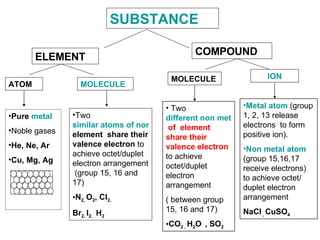
SUBSTANCE ELEMENT COMPOUND ATOM MOLECULE MOLECULE ION Pure  metal Noble gases He, Ne, Ar Cu, Mg, Ag Two  similar atoms of non metal  element  share their valence electron  to achieve octet/duplet electron arrangement  (group 15, 16 and 17) N 2,  O 2 , Cl 2,  Br 2,  I 2,  H 2 Two  different non metal atoms   of  element   share their valence electron  to achieve octet/duplet electron arrangement  ( between group 15, 16 and 17) CO 2 ,  H 2 O  , SO 2 Metal   atom   (group 1, 2, 13 release electrons  to form positive ion). Non metal   atom  (group 15,16,17 receive electrons) to achieve octet/ duplet electron arrangement  NaCl  ,  CuSO 4
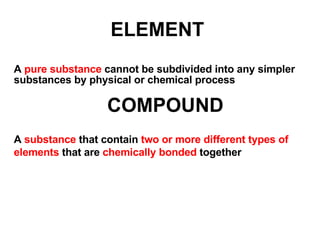
ELEMENT A  pure substance  cannot be subdivided into any simpler substances by physical or chemical process COMPOUND A  substance  that contain  two or more different types of elements  that are  chemically bonded  together
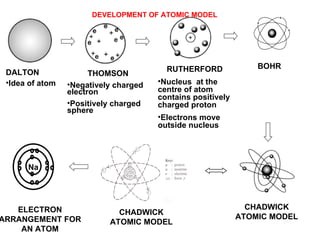
DEVELOPMENT OF ATOMIC MODEL DALTON  Idea of atom THOMSON Negatively charged electron Positively charged sphere RUTHERFORD Nucleus  at the centre of atom contains positively charged proton Electrons move outside nucleus CHADWICK ATOMIC MODEL BOHR CHADWICK ATOMIC MODEL ELECTRON ARRANGEMENT FOR AN ATOM Na
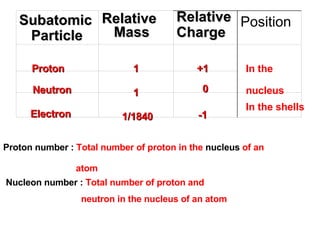
Proton Electron Neutron 1 1/1840 1 +1 -1 0 Proton number :  Total number of proton in the  nucleus  of an  atom Nucleon number :  Total number of proton and neutron in the nucleus of an atom In the nucleus In the shells Position Relative  Charge Relative Mass Subatomic Particle
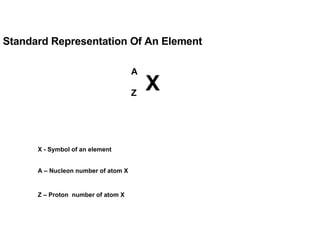
Standard Representation Of An Element X - Symbol of an element A – Nucleon number of atom X Z – Proton  number of atom X A Z X
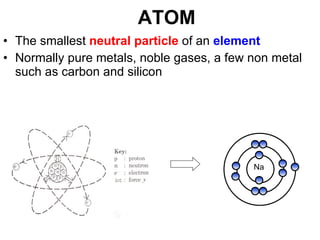
ATOM The smallest  neutral particle  of an  element Normally pure metals, noble gases, a few non metal such as carbon and silicon Na
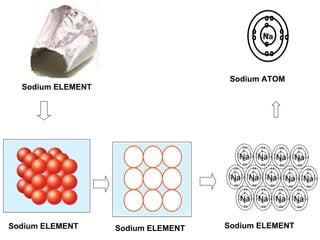
Sodium ELEMENT Sodium ELEMENT Sodium ELEMENT Sodium ELEMENT Sodium ATOM Na Na Na Na Na Na Na Na Na Na Na Na Na Na Na Na Na Na Na Na Na Na Na Na Na Na Na Na
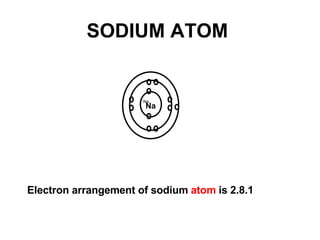
SODIUM ATOM Electron arrangement of sodium  atom  is 2.8.1 Na Na
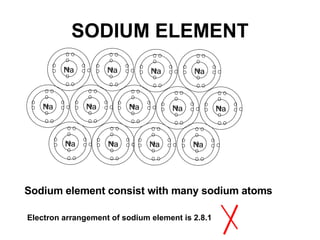
SODIUM ELEMENT Sodium element consist with many sodium atoms Electron arrangement of sodium element is 2.8.1 Na Na Na Na Na Na Na Na Na Na Na Na Na Na Na Na Na Na Na Na Na Na Na Na Na Na
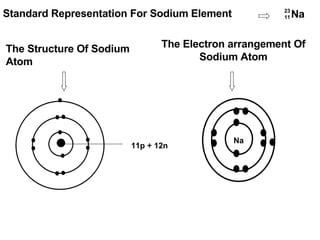
Standard Representation For Sodium Element The Structure Of Sodium Atom         11p + 12n The Electron arrangement Of Sodium Atom 23 11 Na Na
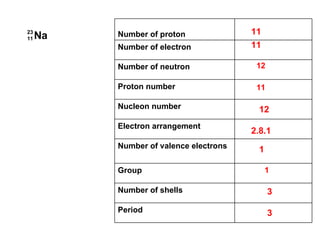
11 11 12 11 12 2.8.1 1 1 3 3 Period Number of shells Group Number of valence electrons Electron arrangement Nucleon number Proton number Number of neutron Number of electron Number of proton 23 11 Na
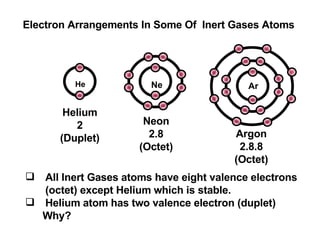
Electron Arrangements In Some Of  Inert Gases Atoms All Inert Gases atoms have eight valence electrons (octet) except Helium which is stable. Helium atom has two valence electron (duplet) Why?  Helium 2 (Duplet) Neon 2.8 (Octet) Argon 2.8.8 (Octet) He Ne Ar
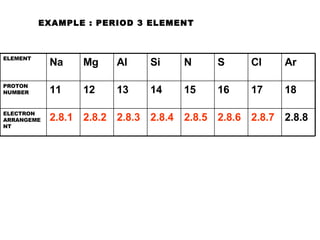
EXAMPLE : PERIOD 3 ELEMENT 2.8.8 2.8.7 2.8.6 2.8.5 2.8.4 2.8.3 2.8.2 2.8.1 ELECTRON ARRANGEMENT 18 17 16 15 14 13 12 11 PROTON NUMBER Ar Cl S N Si Al Mg Na ELEMENT
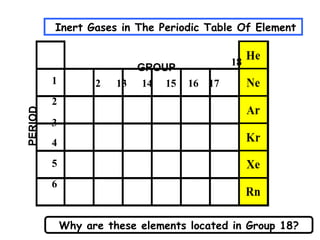
GROUP PERIOD Inert Gases in The Periodic Table Of Element Why are these elements located in Group 18? I 2 13 14 15 16 17 18 1 2 3 4 5 6
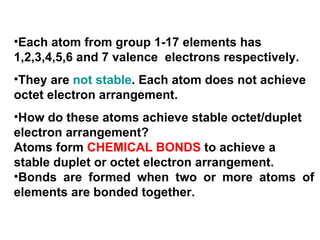
Each atom from group 1-17 elements has 1,2,3,4,5,6 and 7 valence  electrons respectively. They are  not stable . Each atom does not achieve octet electron arrangement. How do these atoms achieve stable octet/duplet electron arrangement? Atoms form  CHEMICAL BONDS  to achieve a stable duplet or octet electron arrangement. Bonds are formed when two or more atoms of elements are bonded together.
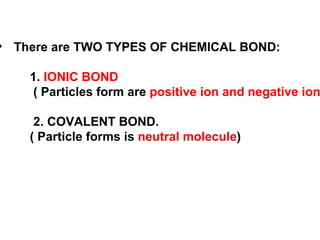
There are TWO TYPES OF CHEMICAL BOND: 1.  IONIC BOND ( Particles form are  positive ion and negative ion ) 2. COVALENT BOND. ( Particle forms is  neutral molecule )

A T O M & E L E M E N T

  • 1.
    SUBSTANCE ELEMENT COMPOUNDATOM MOLECULE MOLECULE ION Pure metal Noble gases He, Ne, Ar Cu, Mg, Ag Two similar atoms of non metal element share their valence electron to achieve octet/duplet electron arrangement (group 15, 16 and 17) N 2, O 2 , Cl 2, Br 2, I 2, H 2 Two different non metal atoms of element share their valence electron to achieve octet/duplet electron arrangement ( between group 15, 16 and 17) CO 2 , H 2 O , SO 2 Metal atom (group 1, 2, 13 release electrons to form positive ion). Non metal atom (group 15,16,17 receive electrons) to achieve octet/ duplet electron arrangement NaCl , CuSO 4
  • 2.
    ELEMENT A pure substance cannot be subdivided into any simpler substances by physical or chemical process COMPOUND A substance that contain two or more different types of elements that are chemically bonded together
  • 3.
    DEVELOPMENT OF ATOMICMODEL DALTON Idea of atom THOMSON Negatively charged electron Positively charged sphere RUTHERFORD Nucleus at the centre of atom contains positively charged proton Electrons move outside nucleus CHADWICK ATOMIC MODEL BOHR CHADWICK ATOMIC MODEL ELECTRON ARRANGEMENT FOR AN ATOM Na
  • 4.
    Proton Electron Neutron1 1/1840 1 +1 -1 0 Proton number : Total number of proton in the nucleus of an atom Nucleon number : Total number of proton and neutron in the nucleus of an atom In the nucleus In the shells Position Relative Charge Relative Mass Subatomic Particle
  • 5.
    Standard Representation OfAn Element X - Symbol of an element A – Nucleon number of atom X Z – Proton number of atom X A Z X
  • 6.
    ATOM The smallest neutral particle of an element Normally pure metals, noble gases, a few non metal such as carbon and silicon Na
  • 7.
    Sodium ELEMENT SodiumELEMENT Sodium ELEMENT Sodium ELEMENT Sodium ATOM Na Na Na Na Na Na Na Na Na Na Na Na Na Na Na Na Na Na Na Na Na Na Na Na Na Na Na Na
  • 8.
    SODIUM ATOM Electronarrangement of sodium atom is 2.8.1 Na Na
  • 9.
    SODIUM ELEMENT Sodiumelement consist with many sodium atoms Electron arrangement of sodium element is 2.8.1 Na Na Na Na Na Na Na Na Na Na Na Na Na Na Na Na Na Na Na Na Na Na Na Na Na Na
  • 10.
    Standard Representation ForSodium Element The Structure Of Sodium Atom         11p + 12n The Electron arrangement Of Sodium Atom 23 11 Na Na
  • 11.
    11 11 1211 12 2.8.1 1 1 3 3 Period Number of shells Group Number of valence electrons Electron arrangement Nucleon number Proton number Number of neutron Number of electron Number of proton 23 11 Na
  • 12.
    Electron Arrangements InSome Of Inert Gases Atoms All Inert Gases atoms have eight valence electrons (octet) except Helium which is stable. Helium atom has two valence electron (duplet) Why? Helium 2 (Duplet) Neon 2.8 (Octet) Argon 2.8.8 (Octet) He Ne Ar
  • 13.
    EXAMPLE : PERIOD3 ELEMENT 2.8.8 2.8.7 2.8.6 2.8.5 2.8.4 2.8.3 2.8.2 2.8.1 ELECTRON ARRANGEMENT 18 17 16 15 14 13 12 11 PROTON NUMBER Ar Cl S N Si Al Mg Na ELEMENT
  • 14.
    GROUP PERIOD InertGases in The Periodic Table Of Element Why are these elements located in Group 18? I 2 13 14 15 16 17 18 1 2 3 4 5 6
  • 15.
    Each atom fromgroup 1-17 elements has 1,2,3,4,5,6 and 7 valence electrons respectively. They are not stable . Each atom does not achieve octet electron arrangement. How do these atoms achieve stable octet/duplet electron arrangement? Atoms form CHEMICAL BONDS to achieve a stable duplet or octet electron arrangement. Bonds are formed when two or more atoms of elements are bonded together.
  • 16.
    There are TWOTYPES OF CHEMICAL BOND: 1. IONIC BOND ( Particles form are positive ion and negative ion ) 2. COVALENT BOND. ( Particle forms is neutral molecule )