ATOMS AND ELEMENTS

What is an element?

Simply put, an element is made of identical atoms

Every element is different from each other and they can combine together in so many ways to
produce many many useful compounds for our daily use!

An atom is the simplest form of an element

Compounds refers to two or more elements chemically combined together

You can form 10grams of water from 1.2grams of hydrogen and 8.8grams of oxygen

The basic unit of a compound is the repeating unit

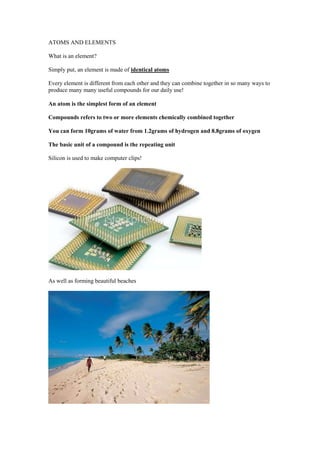
Silicon is used to make computer clips!


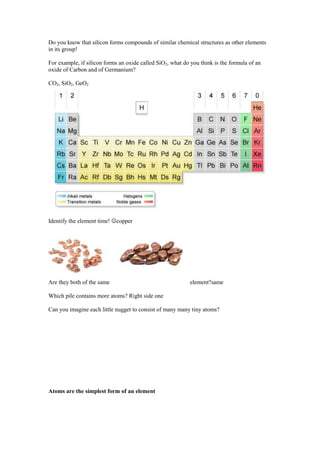
As well as forming beautiful beaches
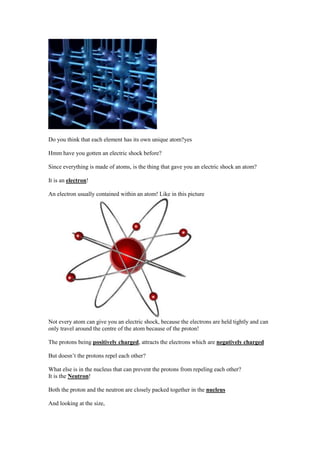
Do you know that silicon forms compounds of similar chemical structures as other elements
in its group!

For example, if silicon forms an oxide called SiO2, what do you think is the formula of an
oxide of Carbon and of Germanium?

CO2, SiO2, GeO2


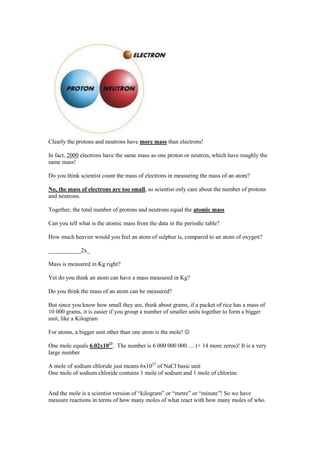
Identify the element time! copper


Are they both of the same                                  element?same

Which pile contains more atoms? Right side one

Can you imagine each little nugget to consist of many many tiny atoms?


Atoms are the simplest form of an element
Do you think that each element has its own unique atom?yes

Hmm have you gotten an electric shock before?

Since everything is made of atoms, is the thing that gave you an electric shock an atom?

It is an electron!

An electron usually contained within an atom! Like in this picture


Not every atom can give you an electric shock, because the electrons are held tightly and can
only travel around the centre of the atom because of the proton!

The protons being positively charged, attracts the electrons which are negatively charged

But doesn’t the protons repel each other?

What else is in the nucleus that can prevent the protons from repeling each other?
It is the Neutron!

Both the proton and the neutron are closely packed together in the nucleus

And looking at the size,
Clearly the protons and neutrons have more mass than electrons!

In fact, 2000 electrons have the same mass as one proton or neutron, which have roughly the
same mass!

Do you think scientist count the mass of electrons in measuring the mass of an atom?

No, the mass of electrons are too small, so scientist only care about the number of protons
and neutrons.

Together, the total number of protons and neutrons equal the atomic mass

Can you tell what is the atomic mass from the data in the periodic table?

How much heavier would you feel an atom of sulphur is, compared to an atom of oxygen?

___________2x_

Mass is measured in Kg right?

Yet do you think an atom can have a mass measured in Kg?

Do you think the mass of an atom can be measured?

But since you know how small they are, think about grams, if a packet of rice has a mass of
10 000 grams, it is easier if you group a number of smaller units together to form a bigger
unit, like a Kilogram

For atoms, a bigger unit other than one atom is the mole! 

One mole equals 6.02x10²³. The number is 6 000 000 000…. (+ 14 more zeros)! It is a very
large number

A mole of sodium chloride just means 6x10²³ of NaCl basic unit
One mole of sodium chloride contains 1 mole of sodium and 1 mole of chlorine


And the mole is a scientist version of “kilogram” or “metre” or “minute”! So we have
measure reactions in terms of how many moles of what react with how many moles of who.
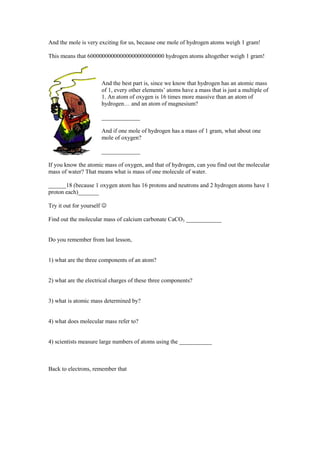
And the mole is very exciting for us, because one mole of hydrogen atoms weigh 1 gram!

This means that 60000000000000000000000000 hydrogen atoms altogether weigh 1 gram!


                      And the best part is, since we know that hydrogen has an atomic mass
                      of 1, every other elements’ atoms have a mass that is just a multiple of
                      1. An atom of oxygen is 16 times more massive than an atom of
                      hydrogen… and an atom of magnesium?

                      _____________

                      And if one mole of hydrogen has a mass of 1 gram, what about one
                      mole of oxygen?

                      _____________

If you know the atomic mass of oxygen, and that of hydrogen, can you find out the molecular
mass of water? That means what is mass of one molecule of water.

______18 (because 1 oxygen atom has 16 protons and neutrons and 2 hydrogen atoms have 1
proton each)_______

Try it out for yourself 

Find out the molecular mass of calcium carbonate CaCO3 ____________


Do you remember from last lesson,


1) what are the three components of an atom?


2) what are the electrical charges of these three components?


3) what is atomic mass determined by?


4) what does molecular mass refer to?


4) scientists measure large numbers of atoms using the ___________


Back to electrons, remember that
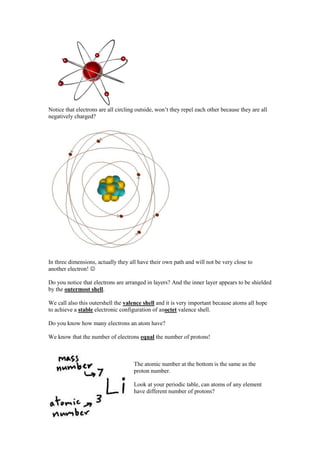
Notice that electrons are all circling outside, won’t they repel each other because they are all
negatively charged?


In three dimensions, actually they all have their own path and will not be very close to
another electron! 

Do you notice that electrons are arranged in layers? And the inner layer appears to be shielded
by the outermost shell.

We call also this outershell the valence shell and it is very important because atoms all hope
to achieve a stable electronic configuration of anoctet valence shell.

Do you know how many electrons an atom have?

We know that the number of electrons equal the number of protons!


                                     The atomic number at the bottom is the same as the
                                     proton number.

                                     Look at your periodic table, can atoms of any element
                                     have different number of protons?
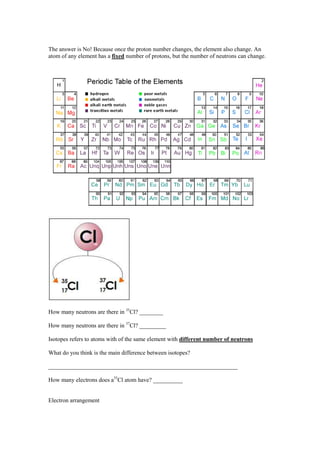
The answer is No! Because once the proton number changes, the element also change. An
atom of any element has a fixed number of protons, but the number of neutrons can change.


How many neutrons are there in 35Cl? ________

How many neutrons are there in 37Cl? _________

Isotopes refers to atoms with of the same element with different number of neutrons

What do you think is the main difference between isotopes?

________________________________________________________________

How many electrons does a35Cl atom have? __________


Electron arrangement
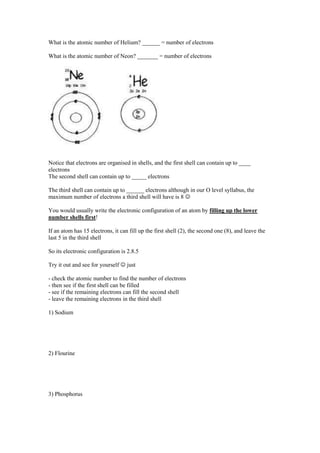
What is the atomic number of Helium? ______ = number of electrons

What is the atomic number of Neon? _______ = number of electrons


Notice that electrons are organised in shells, and the first shell can contain up to ____
electrons
The second shell can contain up to _____ electrons

The third shell can contain up to ______ electrons although in our O level syllabus, the
maximum number of electrons a third shell will have is 8 

You would usually write the electronic configuration of an atom by filling up the lower
number shells first!

If an atom has 15 electrons, it can fill up the first shell (2), the second one (8), and leave the
last 5 in the third shell

So its electronic configuration is 2.8.5

Try it out and see for yourself  just

- check the atomic number to find the number of electrons
- then see if the first shell can be filled
- see if the remaining electrons can fill the second shell
- leave the remaining electrons in the third shell

1) Sodium


2) Flourine


3) Phosphorus
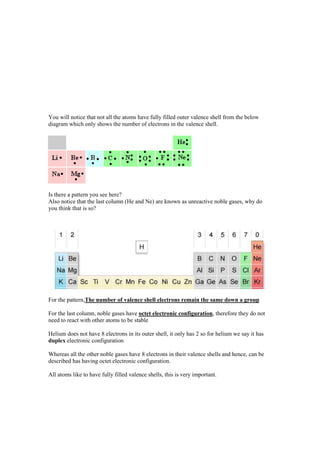
You will notice that not all the atoms have fully filled outer valence shell from the below
diagram which only shows the number of electrons in the valence shell.


Is there a pattern you see here?
Also notice that the last column (He and Ne) are known as unreactive noble gases, why do
you think that is so?


For the pattern,The number of valence shell electrons remain the same down a group

For the last column, noble gases have octet electronic configuration, therefore they do not
need to react with other atoms to be stable

Helium does not have 8 electrons in its outer shell, it only has 2 so for helium we say it has
duplex electronic configuration

Whereas all the other noble gases have 8 electrons in their valence shells and hence, can be
described has having octet electronic configuration.

All atoms like to have fully filled valence shells, this is very important.
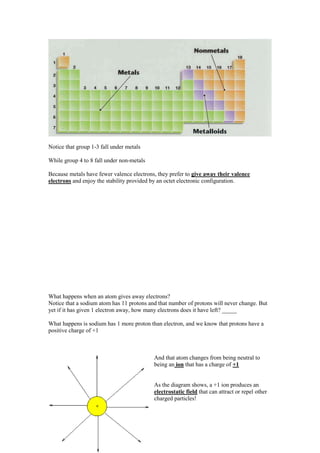
Notice that group 1-3 fall under metals

While group 4 to 8 fall under non-metals

Because metals have fewer valence electrons, they prefer to give away their valence
electrons and enjoy the stability provided by an octet electronic configuration.


What happens when an atom gives away electrons?
Notice that a sodium atom has 11 protons and that number of protons will never change. But
yet if it has given 1 electron away, how many electrons does it have left? _____

What happens is sodium has 1 more proton than electron, and we know that protons have a
positive charge of +1


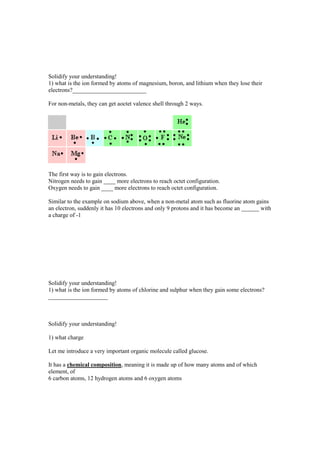
                                           And that atom changes from being neutral to
                                           being an ion that has a charge of +1


                                           As the diagram shows, a +1 ion produces an
                                           electrostatic field that can attract or repel other
                                           charged particles!
Solidify your understanding!
1) what is the ion formed by atoms of magnesium, boron, and lithium when they lose their
electrons?_________________________

For non-metals, they can get aoctet valence shell through 2 ways.


The first way is to gain electrons.
Nitrogen needs to gain ____ more electrons to reach octet configuration.
Oxygen needs to gain ____ more electrons to reach octet configuration.

Similar to the example on sodium above, when a non-metal atom such as fluorine atom gains
an electron, suddenly it has 10 electrons and only 9 protons and it has become an ______ with
a charge of -1


Solidify your understanding!
1) what is the ion formed by atoms of chlorine and sulphur when they gain some electrons?
____________________


Solidify your understanding!

1) what charge

Let me introduce a very important organic molecule called glucose.

It has a chemical composition, meaning it is made up of how many atoms and of which
element, of
6 carbon atoms, 12 hydrogen atoms and 6 oxygen atoms

Atoms elements

  • 1.
    ATOMS AND ELEMENTS Whatis an element? Simply put, an element is made of identical atoms Every element is different from each other and they can combine together in so many ways to produce many many useful compounds for our daily use! An atom is the simplest form of an element Compounds refers to two or more elements chemically combined together You can form 10grams of water from 1.2grams of hydrogen and 8.8grams of oxygen The basic unit of a compound is the repeating unit Silicon is used to make computer clips! As well as forming beautiful beaches
  • 2.
    Do you knowthat silicon forms compounds of similar chemical structures as other elements in its group! For example, if silicon forms an oxide called SiO2, what do you think is the formula of an oxide of Carbon and of Germanium? CO2, SiO2, GeO2 Identify the element time! copper Are they both of the same element?same Which pile contains more atoms? Right side one Can you imagine each little nugget to consist of many many tiny atoms? Atoms are the simplest form of an element
  • 3.
    Do you thinkthat each element has its own unique atom?yes Hmm have you gotten an electric shock before? Since everything is made of atoms, is the thing that gave you an electric shock an atom? It is an electron! An electron usually contained within an atom! Like in this picture Not every atom can give you an electric shock, because the electrons are held tightly and can only travel around the centre of the atom because of the proton! The protons being positively charged, attracts the electrons which are negatively charged But doesn’t the protons repel each other? What else is in the nucleus that can prevent the protons from repeling each other? It is the Neutron! Both the proton and the neutron are closely packed together in the nucleus And looking at the size,
  • 4.
    Clearly the protonsand neutrons have more mass than electrons! In fact, 2000 electrons have the same mass as one proton or neutron, which have roughly the same mass! Do you think scientist count the mass of electrons in measuring the mass of an atom? No, the mass of electrons are too small, so scientist only care about the number of protons and neutrons. Together, the total number of protons and neutrons equal the atomic mass Can you tell what is the atomic mass from the data in the periodic table? How much heavier would you feel an atom of sulphur is, compared to an atom of oxygen? ___________2x_ Mass is measured in Kg right? Yet do you think an atom can have a mass measured in Kg? Do you think the mass of an atom can be measured? But since you know how small they are, think about grams, if a packet of rice has a mass of 10 000 grams, it is easier if you group a number of smaller units together to form a bigger unit, like a Kilogram For atoms, a bigger unit other than one atom is the mole!  One mole equals 6.02x10²³. The number is 6 000 000 000…. (+ 14 more zeros)! It is a very large number A mole of sodium chloride just means 6x10²³ of NaCl basic unit One mole of sodium chloride contains 1 mole of sodium and 1 mole of chlorine And the mole is a scientist version of “kilogram” or “metre” or “minute”! So we have measure reactions in terms of how many moles of what react with how many moles of who.
  • 5.
    And the moleis very exciting for us, because one mole of hydrogen atoms weigh 1 gram! This means that 60000000000000000000000000 hydrogen atoms altogether weigh 1 gram! And the best part is, since we know that hydrogen has an atomic mass of 1, every other elements’ atoms have a mass that is just a multiple of 1. An atom of oxygen is 16 times more massive than an atom of hydrogen… and an atom of magnesium? _____________ And if one mole of hydrogen has a mass of 1 gram, what about one mole of oxygen? _____________ If you know the atomic mass of oxygen, and that of hydrogen, can you find out the molecular mass of water? That means what is mass of one molecule of water. ______18 (because 1 oxygen atom has 16 protons and neutrons and 2 hydrogen atoms have 1 proton each)_______ Try it out for yourself  Find out the molecular mass of calcium carbonate CaCO3 ____________ Do you remember from last lesson, 1) what are the three components of an atom? 2) what are the electrical charges of these three components? 3) what is atomic mass determined by? 4) what does molecular mass refer to? 4) scientists measure large numbers of atoms using the ___________ Back to electrons, remember that
  • 6.
    Notice that electronsare all circling outside, won’t they repel each other because they are all negatively charged? In three dimensions, actually they all have their own path and will not be very close to another electron!  Do you notice that electrons are arranged in layers? And the inner layer appears to be shielded by the outermost shell. We call also this outershell the valence shell and it is very important because atoms all hope to achieve a stable electronic configuration of anoctet valence shell. Do you know how many electrons an atom have? We know that the number of electrons equal the number of protons! The atomic number at the bottom is the same as the proton number. Look at your periodic table, can atoms of any element have different number of protons?
  • 7.
    The answer isNo! Because once the proton number changes, the element also change. An atom of any element has a fixed number of protons, but the number of neutrons can change. How many neutrons are there in 35Cl? ________ How many neutrons are there in 37Cl? _________ Isotopes refers to atoms with of the same element with different number of neutrons What do you think is the main difference between isotopes? ________________________________________________________________ How many electrons does a35Cl atom have? __________ Electron arrangement
  • 8.
    What is theatomic number of Helium? ______ = number of electrons What is the atomic number of Neon? _______ = number of electrons Notice that electrons are organised in shells, and the first shell can contain up to ____ electrons The second shell can contain up to _____ electrons The third shell can contain up to ______ electrons although in our O level syllabus, the maximum number of electrons a third shell will have is 8  You would usually write the electronic configuration of an atom by filling up the lower number shells first! If an atom has 15 electrons, it can fill up the first shell (2), the second one (8), and leave the last 5 in the third shell So its electronic configuration is 2.8.5 Try it out and see for yourself  just - check the atomic number to find the number of electrons - then see if the first shell can be filled - see if the remaining electrons can fill the second shell - leave the remaining electrons in the third shell 1) Sodium 2) Flourine 3) Phosphorus
  • 9.
    You will noticethat not all the atoms have fully filled outer valence shell from the below diagram which only shows the number of electrons in the valence shell. Is there a pattern you see here? Also notice that the last column (He and Ne) are known as unreactive noble gases, why do you think that is so? For the pattern,The number of valence shell electrons remain the same down a group For the last column, noble gases have octet electronic configuration, therefore they do not need to react with other atoms to be stable Helium does not have 8 electrons in its outer shell, it only has 2 so for helium we say it has duplex electronic configuration Whereas all the other noble gases have 8 electrons in their valence shells and hence, can be described has having octet electronic configuration. All atoms like to have fully filled valence shells, this is very important.
  • 10.
    Notice that group1-3 fall under metals While group 4 to 8 fall under non-metals Because metals have fewer valence electrons, they prefer to give away their valence electrons and enjoy the stability provided by an octet electronic configuration. What happens when an atom gives away electrons? Notice that a sodium atom has 11 protons and that number of protons will never change. But yet if it has given 1 electron away, how many electrons does it have left? _____ What happens is sodium has 1 more proton than electron, and we know that protons have a positive charge of +1 And that atom changes from being neutral to being an ion that has a charge of +1 As the diagram shows, a +1 ion produces an electrostatic field that can attract or repel other charged particles!
  • 11.
    Solidify your understanding! 1)what is the ion formed by atoms of magnesium, boron, and lithium when they lose their electrons?_________________________ For non-metals, they can get aoctet valence shell through 2 ways. The first way is to gain electrons. Nitrogen needs to gain ____ more electrons to reach octet configuration. Oxygen needs to gain ____ more electrons to reach octet configuration. Similar to the example on sodium above, when a non-metal atom such as fluorine atom gains an electron, suddenly it has 10 electrons and only 9 protons and it has become an ______ with a charge of -1 Solidify your understanding! 1) what is the ion formed by atoms of chlorine and sulphur when they gain some electrons? ____________________ Solidify your understanding! 1) what charge Let me introduce a very important organic molecule called glucose. It has a chemical composition, meaning it is made up of how many atoms and of which element, of 6 carbon atoms, 12 hydrogen atoms and 6 oxygen atoms