The Early Periodic Table First developed by Dmitri Mendeleev Attempted to place elements with similar properties near each other. Organized according to  combining capacity  and  atomic mass Zumdahl, Steven S.  Chemical Principles 5 th  Ed.  Houghton Mifflin; 2005.
Mendeleev’s Periodic Table Zumdahl, Steven S.  Chemical Principles 5 th  Ed.  Houghton Mifflin; 2005.
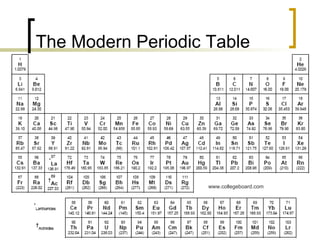
The Modern Periodic Table www.collegeboard.com
The Modern Periodic Table Atomic Number  increases as you go from left to right  Organized according to  atomic number  and  electron arrangement (configuration)
Electron Arrangement Electrons are arranged in  energy levels  or  shells  around the nucleus of the atom There are 7 energy levels Each shell holds a set number of electrons 1 st  Shell holds up to 2 electrons 2 nd  Shell holds up to 8 electrons 3 rd  Shell holds up to 18 electrons (8 for  main group elements ) 4 th  Shell holds up to 32 electrons (8 for  main group elements )
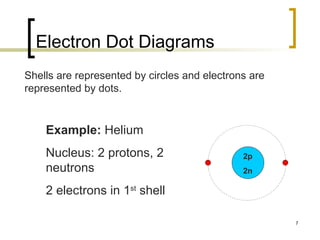
Electron Dot Diagrams Shells are represented by circles and electrons are represented by dots. Example:  Helium Nucleus: 2 protons, 2 neutrons 2 electrons in 1 st  shell 2p 2n
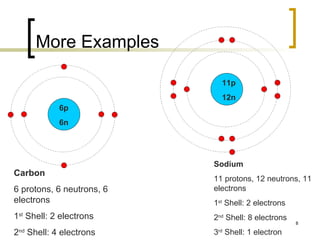
More Examples Carbon 6 protons, 6 neutrons, 6 electrons 1 st  Shell: 2 electrons 2 nd  Shell: 4 electrons Sodium 11 protons, 12 neutrons, 11 electrons 1 st  Shell: 2 electrons 2 nd  Shell: 8 electrons 3 rd  Shell: 1 electron 11p 12n 6p 6n
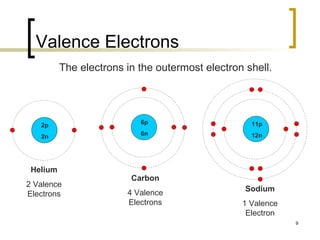
Valence Electrons The electrons in the outermost electron shell. Helium 2 Valence Electrons Carbon 4 Valence Electrons Sodium 1 Valence Electron 2p 2n 6p 6n 11p 12n
Example Draw electron dot diagrams and determine the number of valence electrons in the following elements: Lithium Beryllium Sodium Magnesium
 
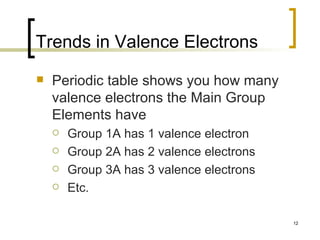
Trends in Valence Electrons Periodic table shows you how many valence electrons the Main Group Elements have Group 1A has 1 valence electron Group 2A has 2 valence electrons Group 3A has 3 valence electrons Etc.
Periodic Table IA IIA IIIA IVA VA VIA VIIA VIIIA
Ions Positively or negatively charged atoms Positively charged =  cation Negatively charged =  anion Formed by gaining or losing electrons Why do atoms gain or lose electrons? To achieve a  stable electron configuration
Octet Rule Main Group  elements will gain, lose, or share electrons to get eight valence electrons. 8 valence electrons = stable configuration Metals lose electrons Non-metals gain electrons
Example Sodium Atom 1 Valence Electron Charge = 11 + (-11) =0  11p 12n 11p 12n Sodium Ion 8 Valence Electrons Charge = 11 + (-10) = 1
What happened? A sodium atom lost an electron and became a  sodium ion  (Na + ) Is it a cation or anion? A Cation!
Anion Example Fluorine Atom 7 Valence Electrons Charge = 9 + (-9) =0  Fluorine Ion 8 Valence Electrons Charge = 9 + (-10) =-1  9p 10n 9p 10n
Example
Another Cation Magnesium Atom 2 Valence Electrons Charge = 12 + (-12) =0  Magnesium Ion 8 Valence Electrons Charge = 12 + (-10) =2  12p 12n 12p 12n
Another Anion Oxygen Atom 6 Valence Electrons Charge = 8 + (-8) =0  Oxygen Ion 8 Valence Electrons Charge = 8 + (-10) =-2  8p 8n 8p 8n
Average Atomic Mass 6 C 12.011 Atomic number Average atomic mass (amu) Why an average atomic mass?
Isotopes Isotopes  are atoms of the same element that differ in the number of _________________. Same number of protons Same number of electrons Similar chemical behavior Different number of neutrons Different atomic mass Different isotopes are NOT equally abundant (some are more rare)
Isotope Notation
What is the average atomic mass of carbon? trace 14 Carbon-14 1.1 13 Carbon-13 98.9 12 Carbon-12 % Abundance Atomic Mass  Isotope
Picture Credits Zumdahl, Steven S.  Chemical Principles 5th Ed.  Houghton Mifflin; 2005 www.collegeboard.com

The periodic table

  • 1.
  • 2.
    The Early PeriodicTable First developed by Dmitri Mendeleev Attempted to place elements with similar properties near each other. Organized according to combining capacity and atomic mass Zumdahl, Steven S. Chemical Principles 5 th Ed. Houghton Mifflin; 2005.
  • 3.
    Mendeleev’s Periodic TableZumdahl, Steven S. Chemical Principles 5 th Ed. Houghton Mifflin; 2005.
  • 4.
    The Modern PeriodicTable www.collegeboard.com
  • 5.
    The Modern PeriodicTable Atomic Number increases as you go from left to right Organized according to atomic number and electron arrangement (configuration)
  • 6.
    Electron Arrangement Electronsare arranged in energy levels or shells around the nucleus of the atom There are 7 energy levels Each shell holds a set number of electrons 1 st Shell holds up to 2 electrons 2 nd Shell holds up to 8 electrons 3 rd Shell holds up to 18 electrons (8 for main group elements ) 4 th Shell holds up to 32 electrons (8 for main group elements )
  • 7.
    Electron Dot DiagramsShells are represented by circles and electrons are represented by dots. Example: Helium Nucleus: 2 protons, 2 neutrons 2 electrons in 1 st shell 2p 2n
  • 8.
    More Examples Carbon6 protons, 6 neutrons, 6 electrons 1 st Shell: 2 electrons 2 nd Shell: 4 electrons Sodium 11 protons, 12 neutrons, 11 electrons 1 st Shell: 2 electrons 2 nd Shell: 8 electrons 3 rd Shell: 1 electron 11p 12n 6p 6n
  • 9.
    Valence Electrons Theelectrons in the outermost electron shell. Helium 2 Valence Electrons Carbon 4 Valence Electrons Sodium 1 Valence Electron 2p 2n 6p 6n 11p 12n
  • 10.
    Example Draw electrondot diagrams and determine the number of valence electrons in the following elements: Lithium Beryllium Sodium Magnesium
  • 11.
  • 12.
    Trends in ValenceElectrons Periodic table shows you how many valence electrons the Main Group Elements have Group 1A has 1 valence electron Group 2A has 2 valence electrons Group 3A has 3 valence electrons Etc.
  • 13.
    Periodic Table IAIIA IIIA IVA VA VIA VIIA VIIIA
  • 14.
    Ions Positively ornegatively charged atoms Positively charged = cation Negatively charged = anion Formed by gaining or losing electrons Why do atoms gain or lose electrons? To achieve a stable electron configuration
  • 15.
    Octet Rule MainGroup elements will gain, lose, or share electrons to get eight valence electrons. 8 valence electrons = stable configuration Metals lose electrons Non-metals gain electrons
  • 16.
    Example Sodium Atom1 Valence Electron Charge = 11 + (-11) =0 11p 12n 11p 12n Sodium Ion 8 Valence Electrons Charge = 11 + (-10) = 1
  • 17.
    What happened? Asodium atom lost an electron and became a sodium ion (Na + ) Is it a cation or anion? A Cation!
  • 18.
    Anion Example FluorineAtom 7 Valence Electrons Charge = 9 + (-9) =0 Fluorine Ion 8 Valence Electrons Charge = 9 + (-10) =-1 9p 10n 9p 10n
  • 19.
  • 20.
    Another Cation MagnesiumAtom 2 Valence Electrons Charge = 12 + (-12) =0 Magnesium Ion 8 Valence Electrons Charge = 12 + (-10) =2 12p 12n 12p 12n
  • 21.
    Another Anion OxygenAtom 6 Valence Electrons Charge = 8 + (-8) =0 Oxygen Ion 8 Valence Electrons Charge = 8 + (-10) =-2 8p 8n 8p 8n
  • 22.
    Average Atomic Mass6 C 12.011 Atomic number Average atomic mass (amu) Why an average atomic mass?
  • 23.
    Isotopes Isotopes are atoms of the same element that differ in the number of _________________. Same number of protons Same number of electrons Similar chemical behavior Different number of neutrons Different atomic mass Different isotopes are NOT equally abundant (some are more rare)
  • 24.
  • 25.
    What is theaverage atomic mass of carbon? trace 14 Carbon-14 1.1 13 Carbon-13 98.9 12 Carbon-12 % Abundance Atomic Mass Isotope
  • 26.
    Picture Credits Zumdahl,Steven S. Chemical Principles 5th Ed. Houghton Mifflin; 2005 www.collegeboard.com