contents
•Laws of Chemical Combination
•Law of Conservation of Mass
•Law of Constent Proportion
•Atom
•Molecule
Introduction
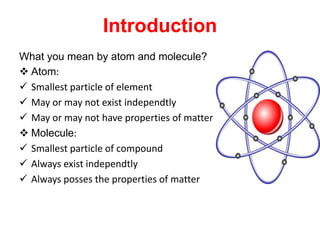
What you mean by atom and molecule?
 Atom:
 Smallest particle of element
 May or may not exist independtly
 May or may not have properties of matter
 Molecule:
 Smallest particle of compound
 Always exist independtly
 Always posses the properties of matter
Law of chemical combination
• atoms exist in the combined form
I. Law of conservation of mass
II. Law of constent proportion
Law of conservation of mass
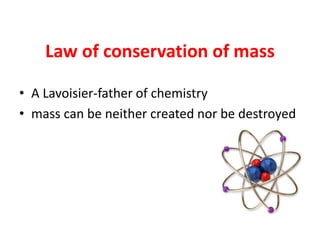
• A Lavoisier-father of chemistry
• mass can be neither created nor be destroyed
Law of constent proportion
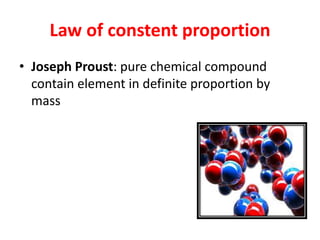
• Joseph Proust: pure chemical compound
contain element in definite proportion by
mass
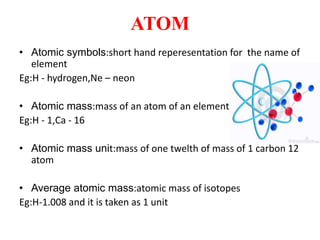
ATOM
• Atomic symbols:short hand reperesentation for the name of
element
Eg:H - hydrogen,Ne – neon
• Atomic mass:mass of an atom of an element
Eg:H - 1,Ca - 16
• Atomic mass unit:mass of one twelth of mass of 1 carbon 12
atom
• Average atomic mass:atomic mass of isotopes
Eg:H-1.008 and it is taken as 1 unit
• Gram atomic mass: atomic mass expressed in grams
Eg:C – 12g , N-14g
• Atomic combination: atoms are bonded together by strong
forces of attraction and the new species is called
molecules.Molecules are of 2 types
I. Homoatomic: same type of atoms
II. Heteroatomic: 2 or more types of atoms
• Ions:atom having +ve or –ve charge
I. Cation: +ve charged ion
II. Anion: -ve charged ion
MOLECULE
• Molecular mass: mass of the molecules of a chemical compound.
 Expressed in amu
 Determined by adding the individual atomic mass
Eg:molecular mass of NH3 =atomic mass of N + 3 * atomic mass of H
= 14+[3*1]
=17 amu
• Gram molecular mass: molecular mass expressed in grams
 Numericlly equal to molecular mass in amu
 Eg: I g molecule of H20 =18g
MOLE CONCEPT
• 1 Mole = 6.023 * 1023 number of particles
• 1 mole of any substance contain avagrado
number[6.023*1023] of particles which have weight
equvalent to atomic mass
• Number of moles = total mass
molecular mass
N= W
M
Conclusion
• All elemnts are made up of atom
• Atoms have differenr mass and organisation
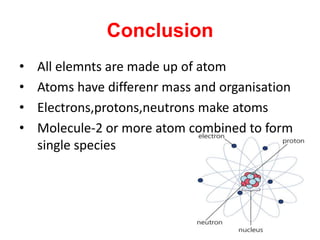
• Electrons,protons,neutrons make atoms
• Molecule-2 or more atom combined to form
single species
atoms and molcules

atoms and molcules

  • 2.
    contents •Laws of ChemicalCombination •Law of Conservation of Mass •Law of Constent Proportion •Atom •Molecule
  • 3.
    Introduction What you meanby atom and molecule?  Atom:  Smallest particle of element  May or may not exist independtly  May or may not have properties of matter  Molecule:  Smallest particle of compound  Always exist independtly  Always posses the properties of matter
  • 4.
    Law of chemicalcombination • atoms exist in the combined form I. Law of conservation of mass II. Law of constent proportion
  • 5.
    Law of conservationof mass • A Lavoisier-father of chemistry • mass can be neither created nor be destroyed
  • 6.
    Law of constentproportion • Joseph Proust: pure chemical compound contain element in definite proportion by mass
  • 7.
    ATOM • Atomic symbols:shorthand reperesentation for the name of element Eg:H - hydrogen,Ne – neon • Atomic mass:mass of an atom of an element Eg:H - 1,Ca - 16 • Atomic mass unit:mass of one twelth of mass of 1 carbon 12 atom • Average atomic mass:atomic mass of isotopes Eg:H-1.008 and it is taken as 1 unit
  • 8.
    • Gram atomicmass: atomic mass expressed in grams Eg:C – 12g , N-14g • Atomic combination: atoms are bonded together by strong forces of attraction and the new species is called molecules.Molecules are of 2 types I. Homoatomic: same type of atoms II. Heteroatomic: 2 or more types of atoms • Ions:atom having +ve or –ve charge I. Cation: +ve charged ion II. Anion: -ve charged ion
  • 9.
    MOLECULE • Molecular mass:mass of the molecules of a chemical compound.  Expressed in amu  Determined by adding the individual atomic mass Eg:molecular mass of NH3 =atomic mass of N + 3 * atomic mass of H = 14+[3*1] =17 amu • Gram molecular mass: molecular mass expressed in grams  Numericlly equal to molecular mass in amu  Eg: I g molecule of H20 =18g
  • 10.
    MOLE CONCEPT • 1Mole = 6.023 * 1023 number of particles • 1 mole of any substance contain avagrado number[6.023*1023] of particles which have weight equvalent to atomic mass • Number of moles = total mass molecular mass N= W M
  • 11.
    Conclusion • All elemntsare made up of atom • Atoms have differenr mass and organisation • Electrons,protons,neutrons make atoms • Molecule-2 or more atom combined to form single species