Basic units of EVERYTHING!
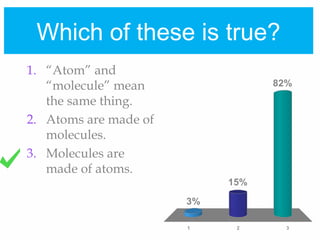
Which of these is true?
1 2 3
3%
82%
15%
1. “Atom” and
“molecule” mean
the same thing.
2. Atoms are made of
molecules.
3. Molecules are
made of atoms.
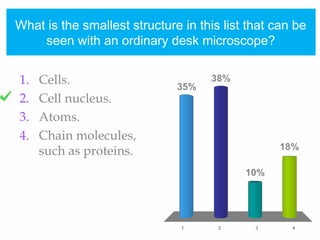
What is the smallest structure in this list that can be
seen with an ordinary desk microscope?
1 2 3 4
35%
18%
10%
38%1. Cells.
2. Cell nucleus.
3. Atoms.
4. Chain molecules,
such as proteins.
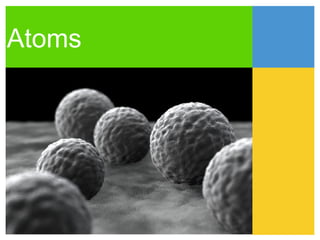
Atoms
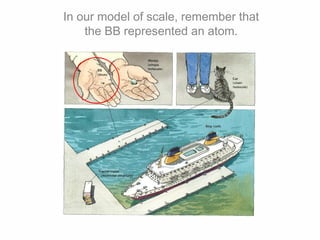
In our model of scale, remember that
the BB represented an atom.
As a class, identify the atoms represented here and label
the sub-atomic particles.
Electrons
Protons
Neutrons
Hydrogen Helium
What elements are represented here? Use the Periodic
Table on the wall to identify these atoms.
What does the term “valence shell” mean? Label the
valence shell on each of these.
Carbon Oxygen Phosphorous Calcium
Ions
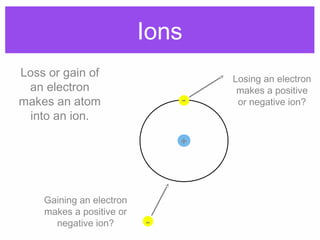
Loss or gain of
an electron
makes an atom
into an ion.
+
-
-
Gaining an electron
makes a positive or
negative ion?
Losing an electron
makes a positive
or negative ion?
Isotopes
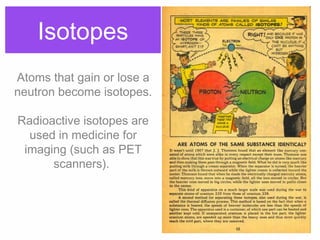
Atoms that gain or lose a
neutron become isotopes.
Radioactive isotopes are
used in medicine for
imaging (such as PET
scanners).
Why is this important?
• Each element has distinct properties:
color, melting point, reactivity, etc.
• The basic atomic structure of each
element determines that element’s
properties. Change the structure, and
you have an entirely different element.
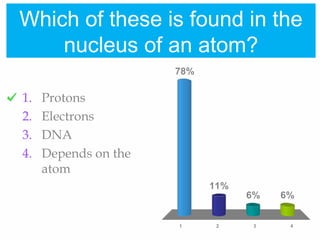
Which of these is found in the
nucleus of an atom?
1 2 3 4
78%
6%6%
11%
1. Protons
2. Electrons
3. DNA
4. Depends on the
atom
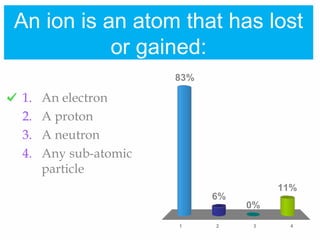
An ion is an atom that has lost
or gained:
1 2 3 4
83%
11%
0%
6%
1. An electron
2. A proton
3. A neutron
4. Any sub-atomic
particle
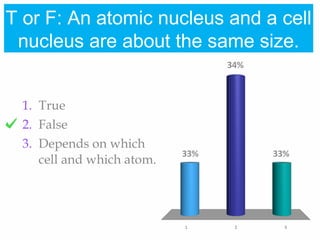
T or F: An atomic nucleus and a cell
nucleus are about the same size.
1. True
2. False
3. Depends on which
cell and which atom.
Atoms bond together
• Molecules are made up of atoms bonded
together.
• The structure of an individual atom
determines:
• Whether the atom can form bonds.
• How many other atoms it can bond to.
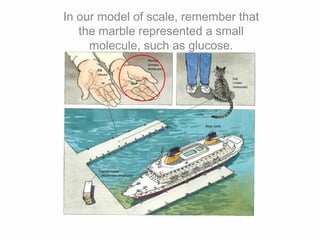
In our model of scale, remember that
the marble represented a small
molecule, such as glucose.
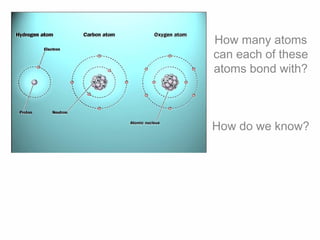
How many atoms
can each of these
atoms bond with?
How do we know?
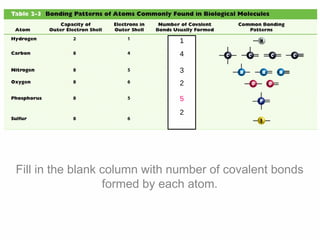
Fill in the blank column with number of covalent bonds
formed by each atom.
1
4
3
2
5
2
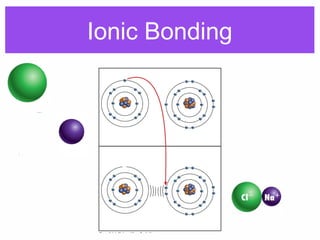
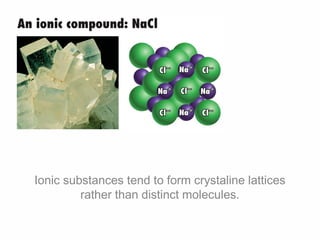
Ionic Bonding
Ionic substances tend to form crystaline lattices
rather than distinct molecules.
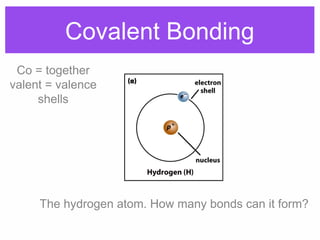
Covalent Bonding
Co = together
valent = valence
shells
The hydrogen atom. How many bonds can it form?
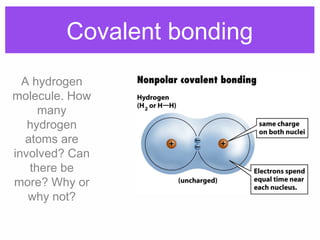
Covalent bonding
A hydrogen
molecule. How
many
hydrogen
atoms are
involved? Can
there be
more? Why or
why not?
• Describe in your own words the
difference between ionic and covalent
bonding.
W
O
R
K
T
O
G
E
T
H
E
R
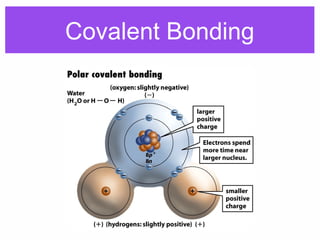
Covalent Bonding
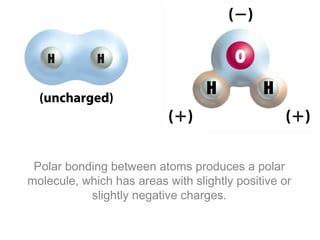
Polar bonding between atoms produces a polar
molecule, which has areas with slightly positive or
slightly negative charges.
• Describe in your own words the
difference between nonpolar and polar
covalent bonding
W
O
R
K
T
O
G
E
T
H
E
R
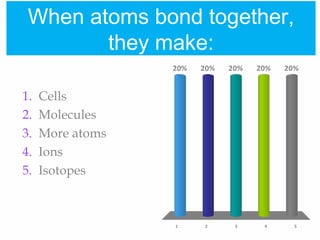
When atoms bond together,
they make:
1 2 3 4 5
20% 20% 20%20%20%
1. Cells
2. Molecules
3. More atoms
4. Ions
5. Isotopes
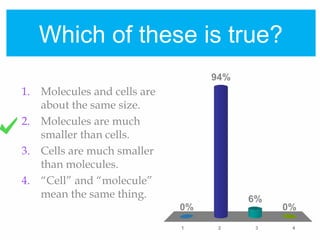
Which of these is true?
1 2 3 4
0% 0%
6%
94%
1. Molecules and cells are
about the same size.
2. Molecules are much
smaller than cells.
3. Cells are much smaller
than molecules.
4. “Cell” and “molecule”
mean the same thing.
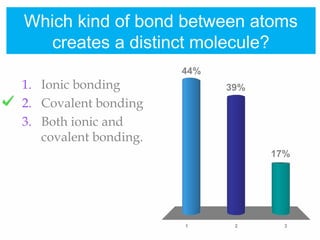
Which kind of bond between atoms
creates a distinct molecule?
1 2 3
44%
17%
39%1. Ionic bonding
2. Covalent bonding
3. Both ionic and
covalent bonding.
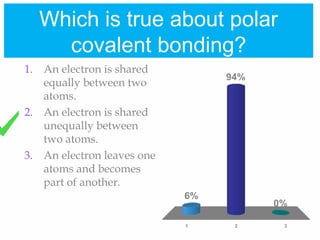
Which is true about polar
covalent bonding?
1 2 3
6%
0%
94%
1. An electron is shared
equally between two
atoms.
2. An electron is shared
unequally between
two atoms.
3. An electron leaves one
atoms and becomes
part of another.
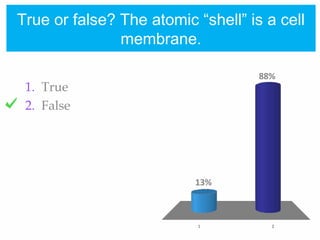
True or false? The atomic “shell” is a cell
membrane.
1 2
88%
13%
1. True
2. False
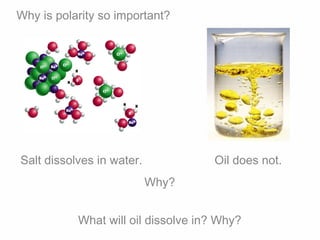
Why is polarity so important?
Salt dissolves in water. Oil does not.
Why?
What will oil dissolve in? Why?
• Is a water molecule in the gas phase
larger than, smaller than, or the same
size as a water molecule in the solid
phase?
• Describe what happens to water
molecules as liquid water evaporates.
W
O
R
K
T
O
G
E
T
H
E
R
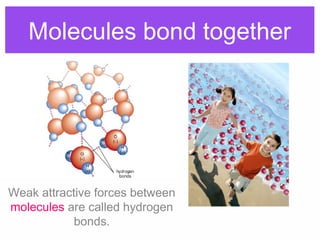
Molecules bond together
Weak attractive forces between
molecules are called hydrogen
bonds.
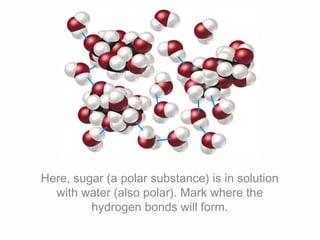
Here, sugar (a polar substance) is in solution
with water (also polar). Mark where the
hydrogen bonds will form.
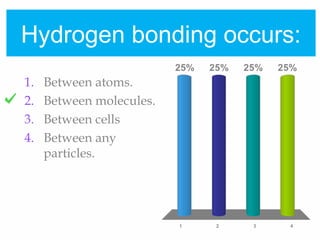
Hydrogen bonding occurs:
1 2 3 4
25% 25%25%25%
1. Between atoms.
2. Between molecules.
3. Between cells
4. Between any
particles.
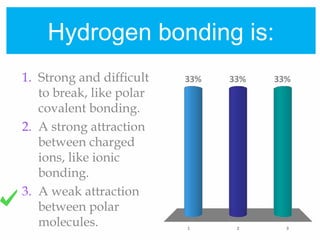
Hydrogen bonding is:
1 2 3
33% 33%33%1. Strong and difficult
to break, like polar
covalent bonding.
2. A strong attraction
between charged
ions, like ionic
bonding.
3. A weak attraction
between polar
molecules.
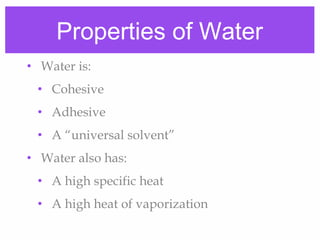
Properties of Water
• Water is:
• Cohesive
• Adhesive
• A “universal solvent”
• Water also has:
• A high specific heat
• A high heat of vaporization
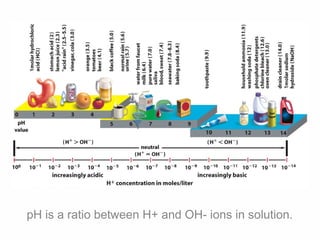
pH is a ratio between H+ and OH- ions in solution.
• One unusual property of water is that it
is less dense in the solid stage than in the
liquid stage, which causes ice to float.
Why does water become less dense as it
freezes? Use what you learned about
hydrogen bonding between molecules.
W
O
R
K
T
O
G
E
T
H
E
R
Recap
1. What is the difference between atoms
and molecules?
2. What is the difference between ionic
bonding and polar covalent bonding?
3. How is polarity related to pH?
Atoms & molecules

Atoms & molecules

  • 1.
    Basic units ofEVERYTHING!
  • 2.
    Which of theseis true? 1 2 3 3% 82% 15% 1. “Atom” and “molecule” mean the same thing. 2. Atoms are made of molecules. 3. Molecules are made of atoms.
  • 3.
    What is thesmallest structure in this list that can be seen with an ordinary desk microscope? 1 2 3 4 35% 18% 10% 38%1. Cells. 2. Cell nucleus. 3. Atoms. 4. Chain molecules, such as proteins.
  • 4.
  • 5.
    In our modelof scale, remember that the BB represented an atom.
  • 6.
    As a class,identify the atoms represented here and label the sub-atomic particles. Electrons Protons Neutrons Hydrogen Helium
  • 7.
    What elements arerepresented here? Use the Periodic Table on the wall to identify these atoms. What does the term “valence shell” mean? Label the valence shell on each of these. Carbon Oxygen Phosphorous Calcium
  • 8.
    Ions Loss or gainof an electron makes an atom into an ion. + - - Gaining an electron makes a positive or negative ion? Losing an electron makes a positive or negative ion?
  • 9.
    Isotopes Atoms that gainor lose a neutron become isotopes. Radioactive isotopes are used in medicine for imaging (such as PET scanners).
  • 10.
    Why is thisimportant? • Each element has distinct properties: color, melting point, reactivity, etc. • The basic atomic structure of each element determines that element’s properties. Change the structure, and you have an entirely different element.
  • 11.
    Which of theseis found in the nucleus of an atom? 1 2 3 4 78% 6%6% 11% 1. Protons 2. Electrons 3. DNA 4. Depends on the atom
  • 12.
    An ion isan atom that has lost or gained: 1 2 3 4 83% 11% 0% 6% 1. An electron 2. A proton 3. A neutron 4. Any sub-atomic particle
  • 13.
    T or F:An atomic nucleus and a cell nucleus are about the same size. 1. True 2. False 3. Depends on which cell and which atom.
  • 14.
    Atoms bond together •Molecules are made up of atoms bonded together. • The structure of an individual atom determines: • Whether the atom can form bonds. • How many other atoms it can bond to.
  • 15.
    In our modelof scale, remember that the marble represented a small molecule, such as glucose.
  • 16.
    How many atoms caneach of these atoms bond with? How do we know?
  • 17.
    Fill in theblank column with number of covalent bonds formed by each atom. 1 4 3 2 5 2
  • 18.
  • 19.
    Ionic substances tendto form crystaline lattices rather than distinct molecules.
  • 20.
    Covalent Bonding Co =together valent = valence shells The hydrogen atom. How many bonds can it form?
  • 21.
    Covalent bonding A hydrogen molecule.How many hydrogen atoms are involved? Can there be more? Why or why not?
  • 22.
    • Describe inyour own words the difference between ionic and covalent bonding. W O R K T O G E T H E R
  • 23.
  • 24.
    Polar bonding betweenatoms produces a polar molecule, which has areas with slightly positive or slightly negative charges.
  • 25.
    • Describe inyour own words the difference between nonpolar and polar covalent bonding W O R K T O G E T H E R
  • 26.
    When atoms bondtogether, they make: 1 2 3 4 5 20% 20% 20%20%20% 1. Cells 2. Molecules 3. More atoms 4. Ions 5. Isotopes
  • 27.
    Which of theseis true? 1 2 3 4 0% 0% 6% 94% 1. Molecules and cells are about the same size. 2. Molecules are much smaller than cells. 3. Cells are much smaller than molecules. 4. “Cell” and “molecule” mean the same thing.
  • 28.
    Which kind ofbond between atoms creates a distinct molecule? 1 2 3 44% 17% 39%1. Ionic bonding 2. Covalent bonding 3. Both ionic and covalent bonding.
  • 29.
    Which is trueabout polar covalent bonding? 1 2 3 6% 0% 94% 1. An electron is shared equally between two atoms. 2. An electron is shared unequally between two atoms. 3. An electron leaves one atoms and becomes part of another.
  • 30.
    True or false?The atomic “shell” is a cell membrane. 1 2 88% 13% 1. True 2. False
  • 31.
    Why is polarityso important? Salt dissolves in water. Oil does not. Why? What will oil dissolve in? Why?
  • 32.
    • Is awater molecule in the gas phase larger than, smaller than, or the same size as a water molecule in the solid phase? • Describe what happens to water molecules as liquid water evaporates. W O R K T O G E T H E R
  • 33.
    Molecules bond together Weakattractive forces between molecules are called hydrogen bonds.
  • 34.
    Here, sugar (apolar substance) is in solution with water (also polar). Mark where the hydrogen bonds will form.
  • 35.
    Hydrogen bonding occurs: 12 3 4 25% 25%25%25% 1. Between atoms. 2. Between molecules. 3. Between cells 4. Between any particles.
  • 36.
    Hydrogen bonding is: 12 3 33% 33%33%1. Strong and difficult to break, like polar covalent bonding. 2. A strong attraction between charged ions, like ionic bonding. 3. A weak attraction between polar molecules.
  • 37.
    Properties of Water •Water is: • Cohesive • Adhesive • A “universal solvent” • Water also has: • A high specific heat • A high heat of vaporization
  • 38.
    pH is aratio between H+ and OH- ions in solution.
  • 39.
    • One unusualproperty of water is that it is less dense in the solid stage than in the liquid stage, which causes ice to float. Why does water become less dense as it freezes? Use what you learned about hydrogen bonding between molecules. W O R K T O G E T H E R
  • 40.
    Recap 1. What isthe difference between atoms and molecules? 2. What is the difference between ionic bonding and polar covalent bonding? 3. How is polarity related to pH?