Atomic Structure and Periodic Table A substance’s atomic structure determines its physical and chemical properties Atoms are the smallest forms of elements Elements make up the periodic table The periodic table is a map of the elements
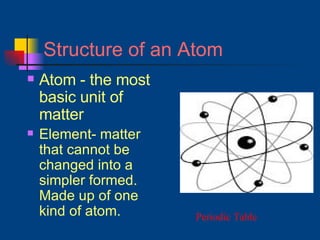
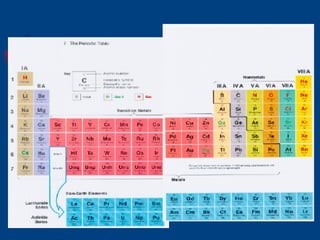
Structure of an Atom Atom - the most basic unit of matter Element- matter that cannot be changed into a simpler formed.  Made up of one kind of atom. Periodic Table
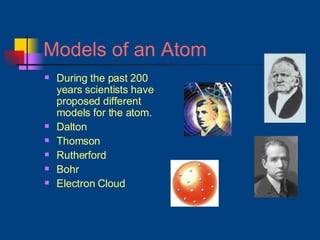
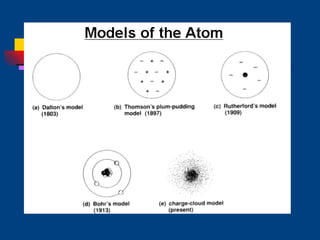
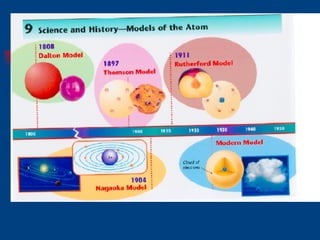
Models of an Atom During the past 200 years scientists have proposed different models for the atom. Dalton Thomson Rutherford Bohr Electron Cloud
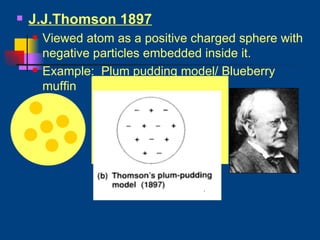
J.J.Thomson 1897 Viewed atom as a positive charged sphere with negative particles embedded inside it. Example:  Plum pudding model/ Blueberry muffin
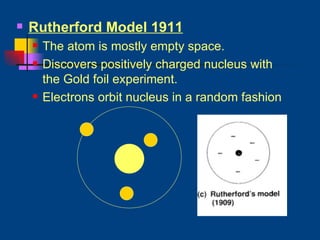
Rutherford Model 1911 The atom is mostly empty space. Discovers positively charged nucleus with the Gold foil experiment. Electrons orbit nucleus in a random fashion
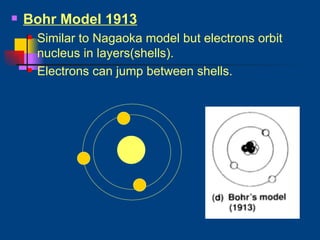
Bohr Model 1913 Similar to Nagaoka model but electrons orbit nucleus in layers(shells). Electrons can jump between shells.
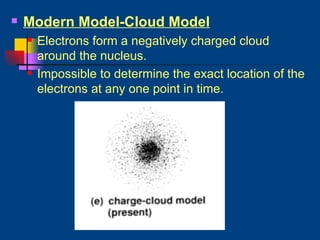
Modern Model-Cloud Model Electrons form a negatively charged cloud around the nucleus. Impossible to determine the exact location of the electrons at any one point in time.
 
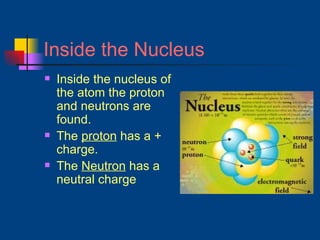
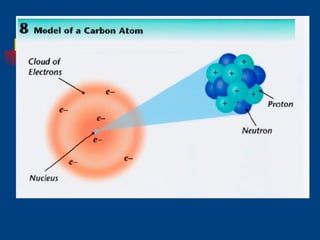
Inside the Nucleus Inside the nucleus of the atom the proton and neutrons are found. The  proton  has a + charge. The  Neutron  has a neutral charge
Atomic Number The atomic number identifies  an element This represents the amount of protons and neutrons
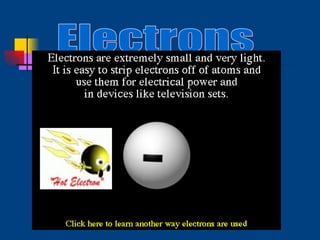
Electrons
Mass Number-  the total number of proton and neutrons Atomic Mass Unit - is used to describe the mass of an atom.
Elements An element is a substance made up of just one kind of atom The same properties used to describe matter in general can be used to describe the elements in their pure form. Luster Ductile Malleable
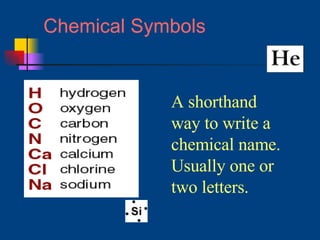
Chemical Symbols A shorthand way to write a chemical name.  Usually one or two letters.
Compounds A compound is a substance made of two or more elements chemically combined. What are a few ways they can be formed?
Type of Compounds A compound made up of molecules is a  molecular compound A  molecule  is a particle of matter made by the sharing of electrons An  ionic compound  is a combination of positive and negative ions. An  ion  is a charged particle when an atom gains or loses an electron
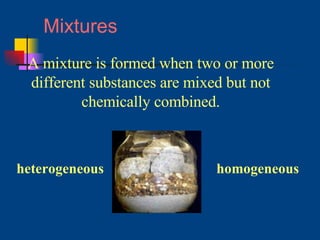
Mixtures A mixture is formed when two or more different substances are mixed but not chemically combined. heterogeneous homogeneous
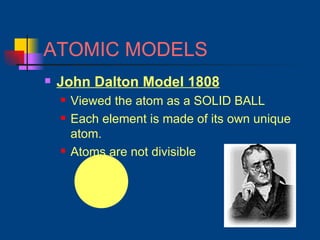
ATOMIC MODELS John Dalton Model 1808 Viewed the atom as a SOLID BALL Each element is made of its own unique atom. Atoms are not divisible
 
 
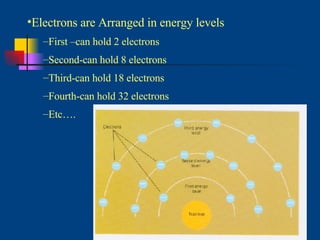
Electrons are Arranged in energy levels First –can hold 2 electrons Second-can hold 8 electrons Third-can hold 18 electrons Fourth-can hold 32 electrons  Etc….
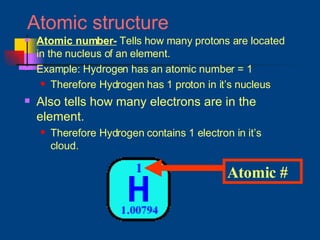
Atomic structure Atomic number-  Tells how many protons are located in the nucleus of an element. Example: Hydrogen has an atomic number = 1 Therefore Hydrogen has 1 proton in it’s nucleus Also tells how many electrons are in the element. Therefore Hydrogen contains 1 electron in it’s cloud. Atomic #
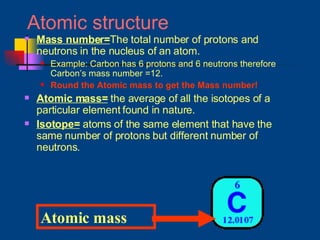
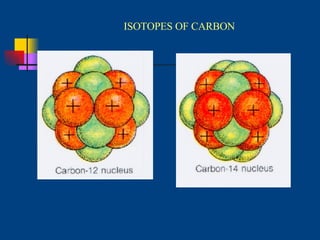
Atomic structure Mass number= The total number of protons and neutrons in the nucleus of an atom. Example: Carbon has 6 protons and 6 neutrons therefore Carbon’s mass number =12. Round the Atomic mass to get the Mass number! Atomic mass=  the average of all the isotopes of a particular element found in nature. Isotope=  atoms of the same element that have the same number of protons but different number of neutrons. Atomic mass
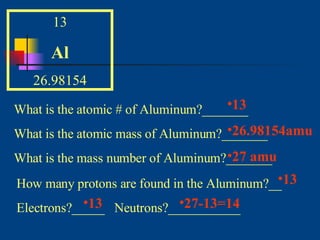
13 Al 26.98154 What is the atomic # of Aluminum?_______ What is the atomic mass of Aluminum?_______ What is the mass number of Aluminum?_______ How many protons are found in the Aluminum?__ Electrons?_____  Neutrons?___________ 13 26.98154amu 27 amu 13 13 27-13=14
ISOTOPES OF CARBON
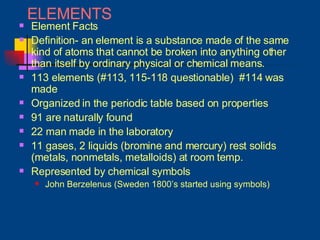
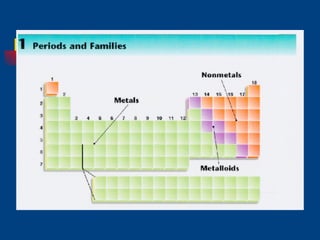
ELEMENTS Element Facts Definition- an element is a substance made of the same kind of atoms that cannot be broken into anything other than itself by ordinary physical or chemical means. 113 elements (#113, 115-118 questionable)  #114 was made Organized in the periodic table based on properties 91 are naturally found 22 man made in the laboratory 11 gases, 2 liquids (bromine and mercury) rest solids (metals, nonmetals, metalloids) at room temp. Represented by chemical symbols John Berzelenus (Sweden 1800’s started using symbols)


Atomicnotes 7 And 8

  • 1.
    Atomic Structure andPeriodic Table A substance’s atomic structure determines its physical and chemical properties Atoms are the smallest forms of elements Elements make up the periodic table The periodic table is a map of the elements
  • 2.
    Structure of anAtom Atom - the most basic unit of matter Element- matter that cannot be changed into a simpler formed. Made up of one kind of atom. Periodic Table
  • 3.
    Models of anAtom During the past 200 years scientists have proposed different models for the atom. Dalton Thomson Rutherford Bohr Electron Cloud
  • 4.
    J.J.Thomson 1897 Viewedatom as a positive charged sphere with negative particles embedded inside it. Example: Plum pudding model/ Blueberry muffin
  • 5.
    Rutherford Model 1911The atom is mostly empty space. Discovers positively charged nucleus with the Gold foil experiment. Electrons orbit nucleus in a random fashion
  • 6.
    Bohr Model 1913Similar to Nagaoka model but electrons orbit nucleus in layers(shells). Electrons can jump between shells.
  • 7.
    Modern Model-Cloud ModelElectrons form a negatively charged cloud around the nucleus. Impossible to determine the exact location of the electrons at any one point in time.
  • 8.
  • 9.
    Inside the NucleusInside the nucleus of the atom the proton and neutrons are found. The proton has a + charge. The Neutron has a neutral charge
  • 10.
    Atomic Number Theatomic number identifies an element This represents the amount of protons and neutrons
  • 11.
  • 12.
    Mass Number- the total number of proton and neutrons Atomic Mass Unit - is used to describe the mass of an atom.
  • 13.
    Elements An elementis a substance made up of just one kind of atom The same properties used to describe matter in general can be used to describe the elements in their pure form. Luster Ductile Malleable
  • 14.
    Chemical Symbols Ashorthand way to write a chemical name. Usually one or two letters.
  • 15.
    Compounds A compoundis a substance made of two or more elements chemically combined. What are a few ways they can be formed?
  • 16.
    Type of CompoundsA compound made up of molecules is a molecular compound A molecule is a particle of matter made by the sharing of electrons An ionic compound is a combination of positive and negative ions. An ion is a charged particle when an atom gains or loses an electron
  • 17.
    Mixtures A mixtureis formed when two or more different substances are mixed but not chemically combined. heterogeneous homogeneous
  • 18.
    ATOMIC MODELS JohnDalton Model 1808 Viewed the atom as a SOLID BALL Each element is made of its own unique atom. Atoms are not divisible
  • 19.
  • 20.
  • 21.
    Electrons are Arrangedin energy levels First –can hold 2 electrons Second-can hold 8 electrons Third-can hold 18 electrons Fourth-can hold 32 electrons Etc….
  • 22.
    Atomic structure Atomicnumber- Tells how many protons are located in the nucleus of an element. Example: Hydrogen has an atomic number = 1 Therefore Hydrogen has 1 proton in it’s nucleus Also tells how many electrons are in the element. Therefore Hydrogen contains 1 electron in it’s cloud. Atomic #
  • 23.
    Atomic structure Massnumber= The total number of protons and neutrons in the nucleus of an atom. Example: Carbon has 6 protons and 6 neutrons therefore Carbon’s mass number =12. Round the Atomic mass to get the Mass number! Atomic mass= the average of all the isotopes of a particular element found in nature. Isotope= atoms of the same element that have the same number of protons but different number of neutrons. Atomic mass
  • 24.
    13 Al 26.98154What is the atomic # of Aluminum?_______ What is the atomic mass of Aluminum?_______ What is the mass number of Aluminum?_______ How many protons are found in the Aluminum?__ Electrons?_____ Neutrons?___________ 13 26.98154amu 27 amu 13 13 27-13=14
  • 25.
  • 26.
    ELEMENTS Element FactsDefinition- an element is a substance made of the same kind of atoms that cannot be broken into anything other than itself by ordinary physical or chemical means. 113 elements (#113, 115-118 questionable) #114 was made Organized in the periodic table based on properties 91 are naturally found 22 man made in the laboratory 11 gases, 2 liquids (bromine and mercury) rest solids (metals, nonmetals, metalloids) at room temp. Represented by chemical symbols John Berzelenus (Sweden 1800’s started using symbols)
  • 27.
  • 28.