WRP:
CHEMISTRY
CHAPTER 2: ATOMS AND ELEMENTS
SANAVI NAIK
IGCSE 1
AGENDA
ATOMS, ELEMENTS,
COMPOUNDS, MOLECULES
THE PERIODIC TABLE
ATOMIC NUMBER, NUCLEON
NUMBER
ELECTRONIC CONFIGURATION
VALENCY
VALENCE ELECTRONS
NAMING CHEMICAL
COMPOUNDS
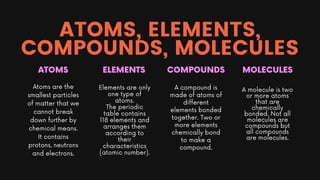
ATOMS, ELEMENTS,
COMPOUNDS, MOLECULES
ATOMS ELEMENTS COMPOUNDS MOLECULES
Atoms are the
smallest particles
of matter that we
cannot break
down further by
chemical means.
It contains
protons, neutrons
and electrons.
Elements are only
one type of
atoms.
The periodic
table contains
118 elements and
arranges them
according to
their
characteristics
(atomic number).
A molecule is two
or more atoms
that are
chemically
bonded. Not all
molecules are
compounds but
all compounds
are molecules.
A compound is
made of atoms of
different
elements bonded
together. Two or
more elements
chemically bond
to make a
compound.
THE
PERIODIC
TABLE
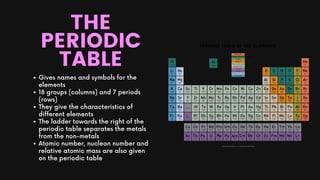
Gives names and symbols for the
elements
18 groups (columns) and 7 periods
(rows)
They give the characteristics of
different elements
The ladder towards the right of the
periodic table separates the metals
from the non-metals
Atomic number, nucleon number and
relative atomic mass are also given
on the periodic table
ATOMIC NUMBER AND
NUCLEON NUMBER
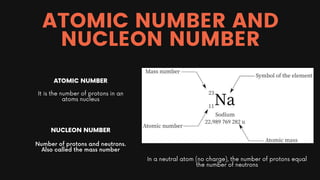
ATOMIC NUMBER
It is the number of protons in an
atoms nucleus
NUCLEON NUMBER
Number of protons and neutrons.
Also called the mass number
In a neutral atom (no charge), the number of protons equal
the number of neutrons
ARRANGEMENT OF
PARTICLES
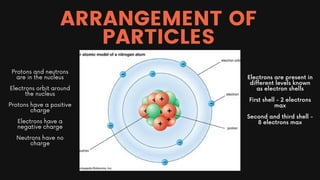
Protons and neutrons
are in the nucleus
Electrons orbit around
the nucleus
Protons have a positive
charge
Electrons have a
negative charge
Neutrons have no
charge
Electrons are present in
different levels known
as electron shells
First shell - 2 electrons
max
Second and third shell -
8 electrons max
ELECTRONIC
CONFIGURATION
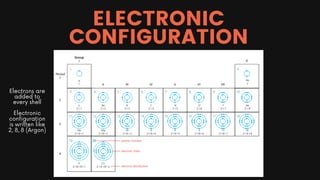
Electrons are
added to
every shell
Electronic
configuration
is written like
2, 8, 8 (Argon)
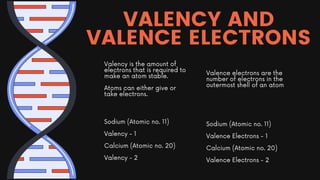
VALENCY AND
VALENCE ELECTRONS
Valency is the amount of
electrons that is required to
make an atom stable.
Atoms can either give or
take electrons.
Valence electrons are the
number of electrons in the
outermost shell of an atom
Sodium (Atomic no. 11)
Valency - 1
Calcium (Atomic no. 20)
Valency - 2
Sodium (Atomic no. 11)
Valence Electrons - 1
Calcium (Atomic no. 20)
Valence Electrons - 2
NAMING
FORMULAE OF
CHEMICAL
COMPOUNDS
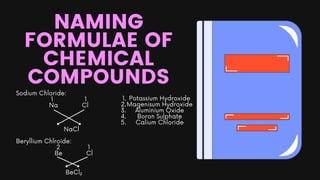
Sodium Chloride:
1 1
Na Cl
NaCl
Beryllium Chlroide:
2 1
Be Cl
BeCl₂
Potassium Hydroxide
1.
Magenisum Hydroxide
2.
Aluminium Oxide
3.
Boron Sulphate
4.
Calium Chloride
5.
BIBLIOGRAPHY
Gallagher, RoseMaria, and
Paul Ingram. “Atoms and
Elements.” Cambridge
IGCSE & O Level Complete
Chemistry, 4th ed., Oxford
University Press, 2021, pp.
14–19.
“Atomic Number Images –
Browse 265,286 Stock
Photos, Vectors, and
Video.” Adobe Stock,
https://stock.adobe.com/
au/search?
k=atomic+number.
Accessed 28 June 2024.
“Periodic Table of
Elements.” Periodic Table,
https://www.periodictable
.co.za/. Accessed 28 June
2024.
THANK YOU

IGCSE Chemistry Atoms Elements and Compounds Chapter 2.pdf

  • 1.
    WRP: CHEMISTRY CHAPTER 2: ATOMSAND ELEMENTS SANAVI NAIK IGCSE 1
  • 2.
    AGENDA ATOMS, ELEMENTS, COMPOUNDS, MOLECULES THEPERIODIC TABLE ATOMIC NUMBER, NUCLEON NUMBER ELECTRONIC CONFIGURATION VALENCY VALENCE ELECTRONS NAMING CHEMICAL COMPOUNDS
  • 3.
    ATOMS, ELEMENTS, COMPOUNDS, MOLECULES ATOMSELEMENTS COMPOUNDS MOLECULES Atoms are the smallest particles of matter that we cannot break down further by chemical means. It contains protons, neutrons and electrons. Elements are only one type of atoms. The periodic table contains 118 elements and arranges them according to their characteristics (atomic number). A molecule is two or more atoms that are chemically bonded. Not all molecules are compounds but all compounds are molecules. A compound is made of atoms of different elements bonded together. Two or more elements chemically bond to make a compound.
  • 4.
    THE PERIODIC TABLE Gives names andsymbols for the elements 18 groups (columns) and 7 periods (rows) They give the characteristics of different elements The ladder towards the right of the periodic table separates the metals from the non-metals Atomic number, nucleon number and relative atomic mass are also given on the periodic table
  • 5.
    ATOMIC NUMBER AND NUCLEONNUMBER ATOMIC NUMBER It is the number of protons in an atoms nucleus NUCLEON NUMBER Number of protons and neutrons. Also called the mass number In a neutral atom (no charge), the number of protons equal the number of neutrons
  • 6.
    ARRANGEMENT OF PARTICLES Protons andneutrons are in the nucleus Electrons orbit around the nucleus Protons have a positive charge Electrons have a negative charge Neutrons have no charge Electrons are present in different levels known as electron shells First shell - 2 electrons max Second and third shell - 8 electrons max
  • 7.
    ELECTRONIC CONFIGURATION Electrons are added to everyshell Electronic configuration is written like 2, 8, 8 (Argon)
  • 8.
    VALENCY AND VALENCE ELECTRONS Valencyis the amount of electrons that is required to make an atom stable. Atoms can either give or take electrons. Valence electrons are the number of electrons in the outermost shell of an atom Sodium (Atomic no. 11) Valency - 1 Calcium (Atomic no. 20) Valency - 2 Sodium (Atomic no. 11) Valence Electrons - 1 Calcium (Atomic no. 20) Valence Electrons - 2
  • 9.
    NAMING FORMULAE OF CHEMICAL COMPOUNDS Sodium Chloride: 11 Na Cl NaCl Beryllium Chlroide: 2 1 Be Cl BeCl₂ Potassium Hydroxide 1. Magenisum Hydroxide 2. Aluminium Oxide 3. Boron Sulphate 4. Calium Chloride 5.
  • 10.
    BIBLIOGRAPHY Gallagher, RoseMaria, and PaulIngram. “Atoms and Elements.” Cambridge IGCSE & O Level Complete Chemistry, 4th ed., Oxford University Press, 2021, pp. 14–19. “Atomic Number Images – Browse 265,286 Stock Photos, Vectors, and Video.” Adobe Stock, https://stock.adobe.com/ au/search? k=atomic+number. Accessed 28 June 2024. “Periodic Table of Elements.” Periodic Table, https://www.periodictable .co.za/. Accessed 28 June 2024.
  • 11.