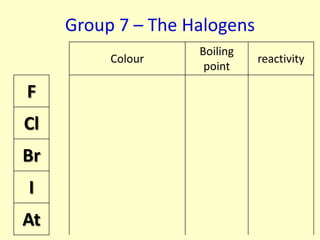
Group 7 – The Halogens
                    Boiling
          Colour              reactivity
                     point

F
Cl
Br
I
At
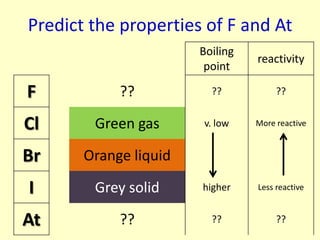
Predict the properties of F and At
                       Boiling
                                 reactivity
                        point

F           ??           ??           ??


Cl      Green gas      v. low    More reactive


Br     Orange liquid

I       Grey solid     higher    Less reactive


At          ??           ??           ??
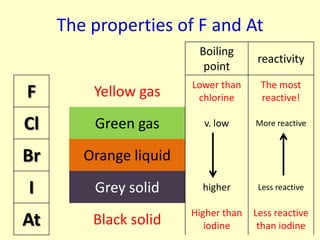
The properties of F and At
                         Boiling
                                      reactivity
                          point
                        Lower than     The most
F        Yellow gas      chlorine      reactive!

Cl       Green gas        v. low      More reactive


Br      Orange liquid

I        Grey solid       higher       Less reactive

                        Higher than   Less reactive
At       Black solid       iodine      than iodine
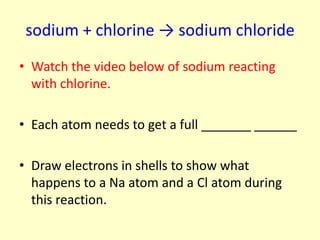
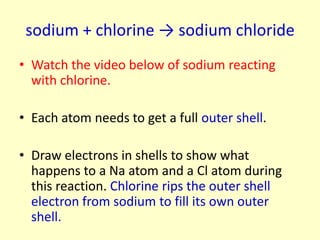
sodium + chlorine → sodium chloride
• Watch the video below of sodium reacting
  with chlorine.

• Each atom needs to get a full _______ ______

• Draw electrons in shells to show what
  happens to a Na atom and a Cl atom during
  this reaction.
sodium + chlorine → sodium chloride
• Watch the video below of sodium reacting
  with chlorine.

• Each atom needs to get a full outer shell.

• Draw electrons in shells to show what
  happens to a Na atom and a Cl atom during
  this reaction. Chlorine rips the outer shell
  electron from sodium to fill its own outer
  shell.
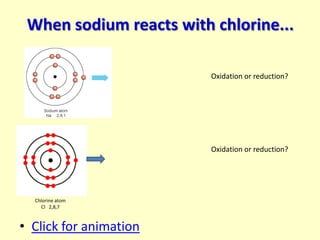
When sodium reacts with chlorine...

                         Oxidation or reduction?


                         Oxidation or reduction?


  Chlorine atom
    Cl 2,8,7


• Click for animation
Ionic bonding in NaCl
                                         Na → Na+ + e-

                                         Oxidation Is Loss
                                         (OIL)


                                         Cl + e- → Cl-

                                         Reduction Is Gain
                                         (RIG)
  Chlorine atom         Chloride ion
    Cl 2,8,7             Cl - [2,8,8]-


• Click for animation
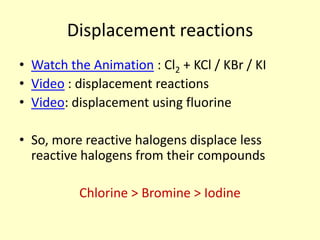
Displacement reactions
• Watch the Animation : Cl2 + KCl / KBr / KI
• Video : displacement reactions
• Video: displacement using fluorine

• So, more reactive halogens displace less
  reactive halogens from their compounds

          Chlorine > Bromine > Iodine
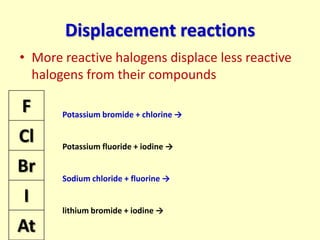
Displacement reactions
• More reactive halogens displace less reactive
  halogens from their compounds

F      Potassium bromide + chlorine →

Cl     Potassium fluoride + iodine →

Br     Sodium chloride + fluorine →

I
       lithium bromide + iodine →

At
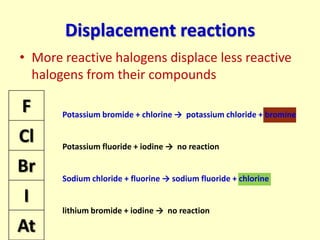
Displacement reactions
• More reactive halogens displace less reactive
  halogens from their compounds

F      Potassium bromide + chlorine → potassium chloride + bromine

Cl     Potassium fluoride + iodine → no reaction

Br     Sodium chloride + fluorine → sodium fluoride + chlorine

I
       lithium bromide + iodine → no reaction

At
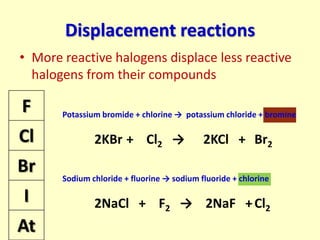
Displacement reactions
• More reactive halogens displace less reactive
  halogens from their compounds

F      Potassium bromide + chlorine → potassium chloride + bromine

Cl             2KBr + Cl2 →                 2KCl + Br2
Br     Sodium chloride + fluorine → sodium fluoride + chlorine

I              2NaCl + F2 → 2NaF + Cl2
At
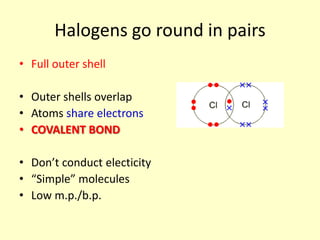
Halogens go round in pairs
• Full outer shell

• Outer shells overlap
• Atoms share electrons
• COVALENT BOND

• Don’t conduct electicity
• “Simple” molecules
• Low m.p./b.p.
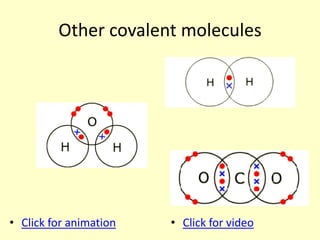
Other covalent molecules


• Click for animation   • Click for video

Group 7 – the halogens lesson

  • 1.
    Group 7 –The Halogens Boiling Colour reactivity point F Cl Br I At
  • 2.
    Predict the propertiesof F and At Boiling reactivity point F ?? ?? ?? Cl Green gas v. low More reactive Br Orange liquid I Grey solid higher Less reactive At ?? ?? ??
  • 3.
    The properties ofF and At Boiling reactivity point Lower than The most F Yellow gas chlorine reactive! Cl Green gas v. low More reactive Br Orange liquid I Grey solid higher Less reactive Higher than Less reactive At Black solid iodine than iodine
  • 4.
    sodium + chlorine→ sodium chloride • Watch the video below of sodium reacting with chlorine. • Each atom needs to get a full _______ ______ • Draw electrons in shells to show what happens to a Na atom and a Cl atom during this reaction.
  • 5.
    sodium + chlorine→ sodium chloride • Watch the video below of sodium reacting with chlorine. • Each atom needs to get a full outer shell. • Draw electrons in shells to show what happens to a Na atom and a Cl atom during this reaction. Chlorine rips the outer shell electron from sodium to fill its own outer shell.
  • 6.
    When sodium reactswith chlorine... Oxidation or reduction? Oxidation or reduction? Chlorine atom Cl 2,8,7 • Click for animation
  • 7.
    Ionic bonding inNaCl Na → Na+ + e- Oxidation Is Loss (OIL) Cl + e- → Cl- Reduction Is Gain (RIG) Chlorine atom Chloride ion Cl 2,8,7 Cl - [2,8,8]- • Click for animation
  • 8.
    Displacement reactions • Watchthe Animation : Cl2 + KCl / KBr / KI • Video : displacement reactions • Video: displacement using fluorine • So, more reactive halogens displace less reactive halogens from their compounds Chlorine > Bromine > Iodine
  • 9.
    Displacement reactions • Morereactive halogens displace less reactive halogens from their compounds F Potassium bromide + chlorine → Cl Potassium fluoride + iodine → Br Sodium chloride + fluorine → I lithium bromide + iodine → At
  • 10.
    Displacement reactions • Morereactive halogens displace less reactive halogens from their compounds F Potassium bromide + chlorine → potassium chloride + bromine Cl Potassium fluoride + iodine → no reaction Br Sodium chloride + fluorine → sodium fluoride + chlorine I lithium bromide + iodine → no reaction At
  • 11.
    Displacement reactions • Morereactive halogens displace less reactive halogens from their compounds F Potassium bromide + chlorine → potassium chloride + bromine Cl 2KBr + Cl2 → 2KCl + Br2 Br Sodium chloride + fluorine → sodium fluoride + chlorine I 2NaCl + F2 → 2NaF + Cl2 At
  • 12.
    Halogens go roundin pairs • Full outer shell • Outer shells overlap • Atoms share electrons • COVALENT BOND • Don’t conduct electicity • “Simple” molecules • Low m.p./b.p.
  • 13.
    Other covalent molecules •Click for animation • Click for video