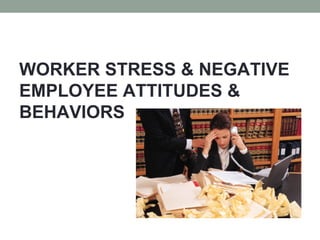
WORKER STRESS & NEGATIVE EMPLOYEE ATTITUDES & BEHAVIORS
Stress in the Workplace 46% of workers find job to be  extremely  stressful Cost of stress related disorders is estimated in the Philippines cannot be expressed in terms of money Stress related disorders comprise 14% of workers’ issues
Stress – What is it? Stress – physiological and psychological responses to events in the environment Eustress: good stress Distress: bad stress Physiological Effects Alarm: preparation of body for fight or flight Resistance: maintain state of elevated preparation Exhaustion: when demands exceed body’s capabilities
Stress – More Background Where does stress come from? Major life events? Daily hassles: frequency, intensity, duration Job satisfaction and stress – those who enjoy work suffer less impact from stressful events
Individual Differences in Coping  Social Support Job Skill – the more skilled at job, the less stress Physical Health – good health leads to reduced impact of stress Type A/Type B Personality – Type A personality reflected by competitiveness, inflated sense of time urgency, hostility
Type A Personality Hostility component of Type A personality is linked to heart disease Type A individuals, in essence, create more stress for themselves Type B individuals rarely have heart attacks before the age of 70
More Individual Differences Job Complexity – increased complexity leads to heart disease in Type A individuals.  But, complexity also is linked to job satisfaction!! Locus of Control – internal locus of control is linked to reduced impact of stress Negative Affectivity – linked to neuroticism from the Big 5.  A tendency to focus on the negative aspects of life.  Linked to high levels of stress
Individual Differences: Hardiness Reflects a resistance to stress: elements include : Sense of commitment to family and work A perceived sense of control A view of change as normal and challenging
Even More Individual Differences Organization-based Self Esteem – our assessment of our adequacy and worth with regard to our place in the employing organization (job specific self esteem) Gender Differences – female managers face more stressors than do male managers (e.g., role conflict, discrimination, harassment)
Stress and Type of Occupation Clerical and blue collar workers suffer the most stress due to a relative lack of control Most stressful professions include: laborer, secretary, clinical lab. technician, nurse, first-line supervisor, restaurant server, machine operator, farm worker, miner One of the least stressful professions is college professor – yeah!!
Work-Family Conflicts Greater role conflict for women – primary responsibility for family life falls on woman Family with 3 kids, average work week for females is 90 hours, for males it is 70 hours Bad work days tend to carry over into family life – tendency is stronger for women.  Sadly, positive states do not carry over
Work-Family Conflict, Continued Workers report that jobs interfere with family life more than vice versa Companies can help reduce stress with flexible schedules and supportive supervisors – more helpful than child care facilities Despite these problems, women with paying jobs are psychological and physically healthier than full-time homemakers
Causes of Stress in the Workplace Work overload Quantitative: too much to do in too short a time Qualitative: work that is too difficult Quantitative has increased in recent years due to downsizing Work underload – work that is too simple or insufficient to fill one’s time Both of these impact stress and health, appears that a moderate amount of stress is optimal
Causes of Stress - Continued Organizational Change – if not hardy, change causes stress in individuals.  Can be reduced by including employees in planning Role Ambiguity – unstructured or poorly defined job responsibilities (expected standards, methods, schedules) Role Conflict – conflict between job demands and employee’s personal standards
Procrastination Delay action for no “good” reason Suggestions for controlling: Calculate the cost of procrastination: e.g., reduce chance of promotion Worst in, first out principle: tackle worst task first Break task into manageable chunks Make a commitment to other people: “I’ll give it to you on Friday/by lunch Remove mind clutter: eliminate trivial items from to do list Fill your schedule – provides stimulation you had been  receiving by working up to deadlines
Effects of Stress in the Workplace Mass psychogenic illness – also known as assembly line hysteria.  Isolation and suggestibility Burn out – results from overwork.  Includes, Emotional Exhaustion Depersonalization Reduced sense of personal accomplishment Quantity of work may stay the same, but the quality declines, depression, apathy, irritability, and boredom may occur
Workaholism “ Addiction” to work because of anxiety and insecurity or because of a genuine liking for the job Healthy, work enthusiasts – usually have jobs with autonomy and variety, appropriate skills for job, and supportive families Unhealthy, workaholics – Compulsive, driven to perform job tasks.  Often negatively impact co-workers
Treating Stress in the Workplace  Organizational Techniques Provide sufficient support for change Provide sense of control through participation Clearly define employee roles Eliminate work over and under load EAPs for stress reduction (teach coping strategies) Provide opportunity for social support (formal or informal)
Individual Techniques for Stress Reduction Exercise Relaxation Training Biofeedback Behavior Modification

9 workplace stress

  • 1.
    WORKER STRESS &NEGATIVE EMPLOYEE ATTITUDES & BEHAVIORS
  • 2.
    Stress in theWorkplace 46% of workers find job to be extremely stressful Cost of stress related disorders is estimated in the Philippines cannot be expressed in terms of money Stress related disorders comprise 14% of workers’ issues
  • 3.
    Stress – Whatis it? Stress – physiological and psychological responses to events in the environment Eustress: good stress Distress: bad stress Physiological Effects Alarm: preparation of body for fight or flight Resistance: maintain state of elevated preparation Exhaustion: when demands exceed body’s capabilities
  • 4.
    Stress – MoreBackground Where does stress come from? Major life events? Daily hassles: frequency, intensity, duration Job satisfaction and stress – those who enjoy work suffer less impact from stressful events
  • 5.
    Individual Differences inCoping Social Support Job Skill – the more skilled at job, the less stress Physical Health – good health leads to reduced impact of stress Type A/Type B Personality – Type A personality reflected by competitiveness, inflated sense of time urgency, hostility
  • 6.
    Type A PersonalityHostility component of Type A personality is linked to heart disease Type A individuals, in essence, create more stress for themselves Type B individuals rarely have heart attacks before the age of 70
  • 7.
    More Individual DifferencesJob Complexity – increased complexity leads to heart disease in Type A individuals. But, complexity also is linked to job satisfaction!! Locus of Control – internal locus of control is linked to reduced impact of stress Negative Affectivity – linked to neuroticism from the Big 5. A tendency to focus on the negative aspects of life. Linked to high levels of stress
  • 8.
    Individual Differences: HardinessReflects a resistance to stress: elements include : Sense of commitment to family and work A perceived sense of control A view of change as normal and challenging
  • 9.
    Even More IndividualDifferences Organization-based Self Esteem – our assessment of our adequacy and worth with regard to our place in the employing organization (job specific self esteem) Gender Differences – female managers face more stressors than do male managers (e.g., role conflict, discrimination, harassment)
  • 10.
    Stress and Typeof Occupation Clerical and blue collar workers suffer the most stress due to a relative lack of control Most stressful professions include: laborer, secretary, clinical lab. technician, nurse, first-line supervisor, restaurant server, machine operator, farm worker, miner One of the least stressful professions is college professor – yeah!!
  • 11.
    Work-Family Conflicts Greaterrole conflict for women – primary responsibility for family life falls on woman Family with 3 kids, average work week for females is 90 hours, for males it is 70 hours Bad work days tend to carry over into family life – tendency is stronger for women. Sadly, positive states do not carry over
  • 12.
    Work-Family Conflict, ContinuedWorkers report that jobs interfere with family life more than vice versa Companies can help reduce stress with flexible schedules and supportive supervisors – more helpful than child care facilities Despite these problems, women with paying jobs are psychological and physically healthier than full-time homemakers
  • 13.
    Causes of Stressin the Workplace Work overload Quantitative: too much to do in too short a time Qualitative: work that is too difficult Quantitative has increased in recent years due to downsizing Work underload – work that is too simple or insufficient to fill one’s time Both of these impact stress and health, appears that a moderate amount of stress is optimal
  • 14.
    Causes of Stress- Continued Organizational Change – if not hardy, change causes stress in individuals. Can be reduced by including employees in planning Role Ambiguity – unstructured or poorly defined job responsibilities (expected standards, methods, schedules) Role Conflict – conflict between job demands and employee’s personal standards
  • 15.
    Procrastination Delay actionfor no “good” reason Suggestions for controlling: Calculate the cost of procrastination: e.g., reduce chance of promotion Worst in, first out principle: tackle worst task first Break task into manageable chunks Make a commitment to other people: “I’ll give it to you on Friday/by lunch Remove mind clutter: eliminate trivial items from to do list Fill your schedule – provides stimulation you had been receiving by working up to deadlines
  • 16.
    Effects of Stressin the Workplace Mass psychogenic illness – also known as assembly line hysteria. Isolation and suggestibility Burn out – results from overwork. Includes, Emotional Exhaustion Depersonalization Reduced sense of personal accomplishment Quantity of work may stay the same, but the quality declines, depression, apathy, irritability, and boredom may occur
  • 17.
    Workaholism “ Addiction”to work because of anxiety and insecurity or because of a genuine liking for the job Healthy, work enthusiasts – usually have jobs with autonomy and variety, appropriate skills for job, and supportive families Unhealthy, workaholics – Compulsive, driven to perform job tasks. Often negatively impact co-workers
  • 18.
    Treating Stress inthe Workplace Organizational Techniques Provide sufficient support for change Provide sense of control through participation Clearly define employee roles Eliminate work over and under load EAPs for stress reduction (teach coping strategies) Provide opportunity for social support (formal or informal)
  • 19.
    Individual Techniques forStress Reduction Exercise Relaxation Training Biofeedback Behavior Modification