Unit 4-
Work Stress
What is Stress?
• Stress is defined as “a state of psychological
and physiological imbalance resulting from the
disparity between situational demand and the
individual's ability and motivation to meet
those needs.”
• Dr. Hans Selye, one of the leading authorities
on the concept of stress, described stress as
“the rate of all wear and tear caused by life.”
Stress can be positive or negative:
• Stress is good when the situation offers an
opportunity to a person to gain something. It
acts as a motivator for peak performance.
• Stress is negative when a person faces social,
physical, organizational and emotional
problems.
Factors that are responsible for causing stress
are called stressors.
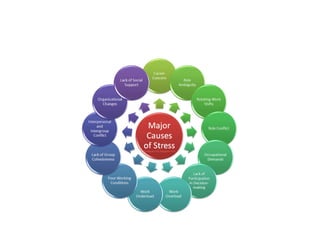
• Career Concern: If an employee feels that he is very
much behind in the corporate ladder, then he may
experience stress. If he seems that there are no
opportunities for self-growth, he may experience
stress. Hence, unfulfilled career expectations are the
significant source of stress.
• Role Ambiguity: It occurs when the person doesn't
know what he is supposed to do, on the job. His tasks
and responsibilities are not clear. The employee is not
sure what he is expected to do. It creates confusion in
the minds of the worker and results in stress.
• Rotating Work Shifts: Stress may occur in those
individuals who work on different work shifts.
Employees may be expected to work on day shift for
some days and then on the night shift. That may create
problems in adjusting to the shift timings, and it can
affect not only personal life but also family life of the
employee.
• Role Conflict: It takes place when people have different
expectations from the person performing a particular
role. It can also occur if the job is not as per
expectation, or when a job demands a certain type of
behavior that is against the person's moral values.
• Occupational Demands: Some jobs are more
demanding than others. Jobs that involve risk, and
danger are more stressful. Research findings indicate,
job that cause stress needs constant monitoring of
equipments and devices, unpleasant physical
conditions, making decisions, etc.
• Lack of Participation in Decision-making: Many
experienced employees feel that management should
consult them on matters affecting their jobs. In reality,
the superiors hardly ask the concerned employees
before taking a decision. That develops a feeling of
being neglected, which may lead to stress.
• Lack of Group Cohesiveness: Every group is
characterized by its cohesiveness, although they differ
widely in its degree. Individuals experience stress when
there is no unity among work group members. There
are mistrust, jealousy, frequent quarrels, etc., in groups
and this lead to stress to employees.
• Interpersonal and Intergroup Conflict: These conflicts
take place due to differences in perceptions, attitudes,
values and beliefs between two or more individuals
and groups. Such conflicts can be a source of stress for
group members.
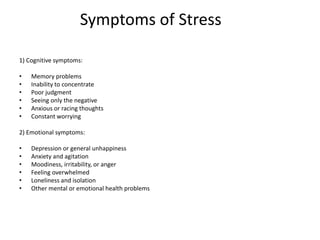
Symptoms of Stress
1) Cognitive symptoms:
• Memory problems
• Inability to concentrate
• Poor judgment
• Seeing only the negative
• Anxious or racing thoughts
• Constant worrying
2) Emotional symptoms:
• Depression or general unhappiness
• Anxiety and agitation
• Moodiness, irritability, or anger
• Feeling overwhelmed
• Loneliness and isolation
• Other mental or emotional health problems
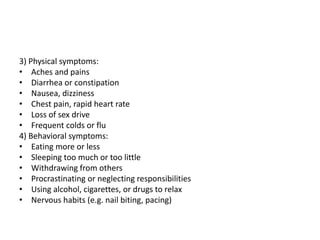
3) Physical symptoms:
• Aches and pains
• Diarrhea or constipation
• Nausea, dizziness
• Chest pain, rapid heart rate
• Loss of sex drive
• Frequent colds or flu
4) Behavioral symptoms:
• Eating more or less
• Sleeping too much or too little
• Withdrawing from others
• Procrastinating or neglecting responsibilities
• Using alcohol, cigarettes, or drugs to relax
• Nervous habits (e.g. nail biting, pacing)
Sources of Stress
• Money
• Work
• Family responsibilities
• Health Concerns
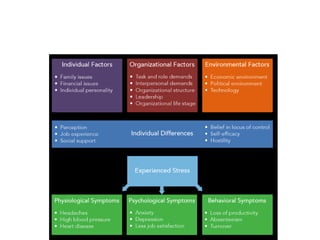
Individual Factors
• The first of three sources of stress is individual. Individuals
might experience stressful commutes to work, or a stressful
couple of weeks helping at a work event, but those kinds of
temporary, individual stresses are not what we’re looking at
here. We’re looking for a deeper, longer-term stress. Family
stress—marriages that are ending, issues with children, an
ailing parent—these are stressful situations that an employee
really can’t leave at home when he or she comes to work.
Financial stress, like the inability to pay bills or an unexpected
new demand on a person’s cash flow might also be an issue
that disturbs an employee’s time at work. Finally, an
individual’s own personality might actually contribute to his or
her stress. People’s dispositions—how they perceive things as
negative or positive—can be a factor in each person’s stress as
Organizational Factors
• Task or role demands: these are factors related to a person’s role at work,
including the design of a person’s job or working conditions. A stressful task
demand might be a detailed, weekly presentation to the company’s senior team. A
stressful role demand might be where a person is expected to achieve more in a
set amount of time than is possible.
• Interpersonal demands: these are stressors created by co-workers. Perhaps an
employee is experiencing ongoing conflict with a co-worker he or she is expected
to collaborate closely with. Or maybe employees are experiencing a lack of social
support in their roles.
• Organizational structure: this refers to the level of differentiation within an
organization, the degree of rules and regulations, and where decisions are made. If
employees are unable to participate in decisions that affect them, they may
experience stress.
• Organizational leadership: this refers to the organization’s style of leadership,
particularly the managerial style of its senior executives. Leaders can create an
environment of tension, fear and anxiety and can exert unrealistic pressure and
control. If employees are afraid they’ll be fired for not living up to leadership’s
standards, this can definitely be a source of stress.
Environmental Factors
• Finally, there are environmental sources of stress.
The economy may be in a downturn, creating
uncertainty for job futures and bank accounts.
There may be political unrest or change creating
stress. Finally, technology can cause stress, as
new developments are constantly making
employee skills obsolete, and workers fear they’ll
be replaced by a machine that can do the same.
Employee are also often expected to stay
connected to the workplace 24/7 because
technology allows it.
Individual Differences
• Perception. This is what moderates the individual’s relationship to the stressor. For
instance, one person might see a potential layoff as a stressful situation, while
another person might see that same layoff as an opportunity for a nice severance
package and the opportunity to start a new business.
• Job Experience. Because stress is associated with turnover, it would stand to
reason that those employees with a long tenure are the most stress-resistant of
the bunch.
• Social Support. Co-workers, especially those who are caring or considered to be
friends, can help protect a fellow employee against the affects of stress.
• Belief in locus of control. Those who have a high internal locus of control (those
that believe they are in control of their own fate) are, unsurprisingly, not as
affected by stress as those who feel they are not in control.
• Self-efficacy. Self-efficacy is an individual’s belief that he or she can complete a
task. Research shows that employees who have strong levels of self-efficacy are
more resistant to the effects of stress.
• Hostility. Some employees carry around a high level of hostility as a part of their
personalities, and they’re often suspicious and distrustful of their co-workers.
These personality traits make a person more susceptible to stress.
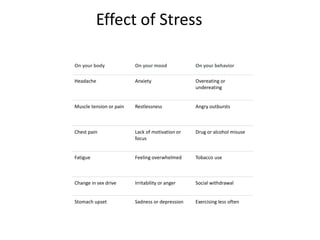
Effect of Stress
On your body On your mood On your behavior
Headache Anxiety Overeating or
undereating
Muscle tension or pain Restlessness Angry outbursts
Chest pain Lack of motivation or
focus
Drug or alcohol misuse
Fatigue Feeling overwhelmed Tobacco use
Change in sex drive Irritability or anger Social withdrawal
Stomach upset Sadness or depression Exercising less often
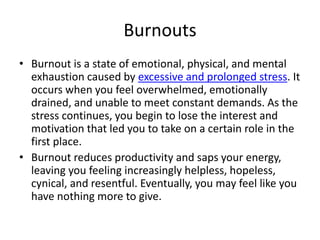
Burnouts
• Burnout is a state of emotional, physical, and mental
exhaustion caused by excessive and prolonged stress. It
occurs when you feel overwhelmed, emotionally
drained, and unable to meet constant demands. As the
stress continues, you begin to lose the interest and
motivation that led you to take on a certain role in the
first place.
• Burnout reduces productivity and saps your energy,
leaving you feeling increasingly helpless, hopeless,
cynical, and resentful. Eventually, you may feel like you
have nothing more to give.
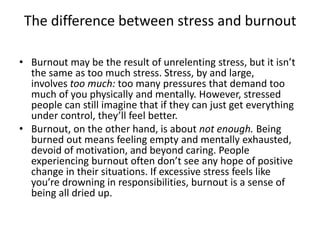
The difference between stress and burnout
• Burnout may be the result of unrelenting stress, but it isn’t
the same as too much stress. Stress, by and large,
involves too much: too many pressures that demand too
much of you physically and mentally. However, stressed
people can still imagine that if they can just get everything
under control, they’ll feel better.
• Burnout, on the other hand, is about not enough. Being
burned out means feeling empty and mentally exhausted,
devoid of motivation, and beyond caring. People
experiencing burnout often don’t see any hope of positive
change in their situations. If excessive stress feels like
you’re drowning in responsibilities, burnout is a sense of
being all dried up.
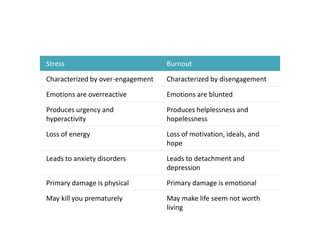
Stress Burnout
Characterized by over-engagement Characterized by disengagement
Emotions are overreactive Emotions are blunted
Produces urgency and
hyperactivity
Produces helplessness and
hopelessness
Loss of energy Loss of motivation, ideals, and
hope
Leads to anxiety disorders Leads to detachment and
depression
Primary damage is physical Primary damage is emotional
May kill you prematurely May make life seem not worth
living
StressManagement
• Stress management consists of making changes to
your life if you are in a constant stressful situation,
preventing stress by practicing self-care and
relaxation and managing your response to stressful
situations when they do occur. Stress management is
a wide spectrum of techniques
and psychotherapies aimed at controlling a person's
level of stress, especially chronic stress, usually for
the purpose of and for the motive of improving
everyday functioning
Stress management strategy #1
(Individual Techniques)
• Learn how to say “no” – Know your limits and stick to them.
Whether in your personal or professional life, refuse to
accept added responsibilities when you’re close to reaching
them. Taking on more than you can handle is a surefire
recipe for stress.
• Avoid people who stress you out – If someone consistently
causes stress in your life and you can’t turn the relationship
around, limit the amount of time you spend with that
person or end the relationship entirely.
• Take control of your environment – If the evening news
makes you anxious, turn the TV off. If traffic’s got you tense,
take a longer but less-traveled route. If going to the market
is an unpleasant chore, do your grocery shopping online.
Stress management strategy #2
(Individual Techniques)
• Express your feelings instead of bottling them up. If
something or someone is bothering you, communicate your
concerns in an open and respectful way. If you don’t voice
your feelings, resentment will build and the situation will
likely remain the same.
• Be willing to compromise. When you ask someone to change
their behavior, be willing to do the same. If you both are
willing to bend at least a little, you’ll have a good chance of
finding a happy middle ground.
• Be more assertive. Don’t take a backseat in your own life.
Deal with problems head on, doing your best to anticipate
and prevent them. If you’ve got an exam to study for and your
chatty roommate just got home, say up front that you only
have five minutes to talk.
Stress management strategy #3
(Individual Techniques)
• Reframe problems. Try to view stressful situations from a more
positive perspective. Rather than fuming about a traffic jam, look at
it as an opportunity to pause and regroup, listen to your favorite
radio station, or enjoy some alone time.
• Look at the big picture. Take perspective of the stressful situation.
Ask yourself how important it will be in the long run. Will it matter
in a month? A year? Is it really worth getting upset over? If the
answer is no, focus your time and energy elsewhere.
• Adjust your standards. Perfectionism is a major source of avoidable
stress. Stop setting yourself up for failure by demanding perfection.
Set reasonable standards for yourself and others, and learn to be
okay with “good enough.”
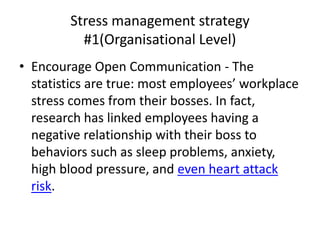
Stress management strategy
#1(Organisational Level)
• Encourage Open Communication - The
statistics are true: most employees’ workplace
stress comes from their bosses. In fact,
research has linked employees having a
negative relationship with their boss to
behaviors such as sleep problems, anxiety,
high blood pressure, and even heart attack
risk.
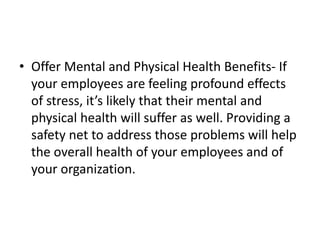
• Offer Mental and Physical Health Benefits- If
your employees are feeling profound effects
of stress, it’s likely that their mental and
physical health will suffer as well. Providing a
safety net to address those problems will help
the overall health of your employees and of
your organization.
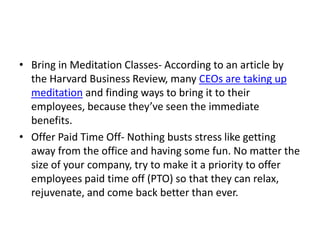
• Bring in Meditation Classes- According to an article by
the Harvard Business Review, many CEOs are taking up
meditation and finding ways to bring it to their
employees, because they’ve seen the immediate
benefits.
• Offer Paid Time Off- Nothing busts stress like getting
away from the office and having some fun. No matter the
size of your company, try to make it a priority to offer
employees paid time off (PTO) so that they can relax,
rejuvenate, and come back better than ever.
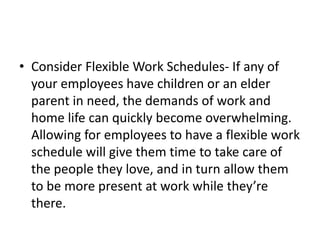
• Consider Flexible Work Schedules- If any of
your employees have children or an elder
parent in need, the demands of work and
home life can quickly become overwhelming.
Allowing for employees to have a flexible work
schedule will give them time to take care of
the people they love, and in turn allow them
to be more present at work while they’re
there.

Unit 4

  • 1.
  • 2.
    What is Stress? •Stress is defined as “a state of psychological and physiological imbalance resulting from the disparity between situational demand and the individual's ability and motivation to meet those needs.” • Dr. Hans Selye, one of the leading authorities on the concept of stress, described stress as “the rate of all wear and tear caused by life.”
  • 3.
    Stress can bepositive or negative: • Stress is good when the situation offers an opportunity to a person to gain something. It acts as a motivator for peak performance. • Stress is negative when a person faces social, physical, organizational and emotional problems. Factors that are responsible for causing stress are called stressors.
  • 5.
    • Career Concern:If an employee feels that he is very much behind in the corporate ladder, then he may experience stress. If he seems that there are no opportunities for self-growth, he may experience stress. Hence, unfulfilled career expectations are the significant source of stress. • Role Ambiguity: It occurs when the person doesn't know what he is supposed to do, on the job. His tasks and responsibilities are not clear. The employee is not sure what he is expected to do. It creates confusion in the minds of the worker and results in stress.
  • 6.
    • Rotating WorkShifts: Stress may occur in those individuals who work on different work shifts. Employees may be expected to work on day shift for some days and then on the night shift. That may create problems in adjusting to the shift timings, and it can affect not only personal life but also family life of the employee. • Role Conflict: It takes place when people have different expectations from the person performing a particular role. It can also occur if the job is not as per expectation, or when a job demands a certain type of behavior that is against the person's moral values.
  • 7.
    • Occupational Demands:Some jobs are more demanding than others. Jobs that involve risk, and danger are more stressful. Research findings indicate, job that cause stress needs constant monitoring of equipments and devices, unpleasant physical conditions, making decisions, etc. • Lack of Participation in Decision-making: Many experienced employees feel that management should consult them on matters affecting their jobs. In reality, the superiors hardly ask the concerned employees before taking a decision. That develops a feeling of being neglected, which may lead to stress.
  • 8.
    • Lack ofGroup Cohesiveness: Every group is characterized by its cohesiveness, although they differ widely in its degree. Individuals experience stress when there is no unity among work group members. There are mistrust, jealousy, frequent quarrels, etc., in groups and this lead to stress to employees. • Interpersonal and Intergroup Conflict: These conflicts take place due to differences in perceptions, attitudes, values and beliefs between two or more individuals and groups. Such conflicts can be a source of stress for group members.
  • 9.
    Symptoms of Stress 1)Cognitive symptoms: • Memory problems • Inability to concentrate • Poor judgment • Seeing only the negative • Anxious or racing thoughts • Constant worrying 2) Emotional symptoms: • Depression or general unhappiness • Anxiety and agitation • Moodiness, irritability, or anger • Feeling overwhelmed • Loneliness and isolation • Other mental or emotional health problems
  • 10.
    3) Physical symptoms: •Aches and pains • Diarrhea or constipation • Nausea, dizziness • Chest pain, rapid heart rate • Loss of sex drive • Frequent colds or flu 4) Behavioral symptoms: • Eating more or less • Sleeping too much or too little • Withdrawing from others • Procrastinating or neglecting responsibilities • Using alcohol, cigarettes, or drugs to relax • Nervous habits (e.g. nail biting, pacing)
  • 11.
    Sources of Stress •Money • Work • Family responsibilities • Health Concerns
  • 13.
    Individual Factors • Thefirst of three sources of stress is individual. Individuals might experience stressful commutes to work, or a stressful couple of weeks helping at a work event, but those kinds of temporary, individual stresses are not what we’re looking at here. We’re looking for a deeper, longer-term stress. Family stress—marriages that are ending, issues with children, an ailing parent—these are stressful situations that an employee really can’t leave at home when he or she comes to work. Financial stress, like the inability to pay bills or an unexpected new demand on a person’s cash flow might also be an issue that disturbs an employee’s time at work. Finally, an individual’s own personality might actually contribute to his or her stress. People’s dispositions—how they perceive things as negative or positive—can be a factor in each person’s stress as
  • 14.
    Organizational Factors • Taskor role demands: these are factors related to a person’s role at work, including the design of a person’s job or working conditions. A stressful task demand might be a detailed, weekly presentation to the company’s senior team. A stressful role demand might be where a person is expected to achieve more in a set amount of time than is possible. • Interpersonal demands: these are stressors created by co-workers. Perhaps an employee is experiencing ongoing conflict with a co-worker he or she is expected to collaborate closely with. Or maybe employees are experiencing a lack of social support in their roles. • Organizational structure: this refers to the level of differentiation within an organization, the degree of rules and regulations, and where decisions are made. If employees are unable to participate in decisions that affect them, they may experience stress. • Organizational leadership: this refers to the organization’s style of leadership, particularly the managerial style of its senior executives. Leaders can create an environment of tension, fear and anxiety and can exert unrealistic pressure and control. If employees are afraid they’ll be fired for not living up to leadership’s standards, this can definitely be a source of stress.
  • 15.
    Environmental Factors • Finally,there are environmental sources of stress. The economy may be in a downturn, creating uncertainty for job futures and bank accounts. There may be political unrest or change creating stress. Finally, technology can cause stress, as new developments are constantly making employee skills obsolete, and workers fear they’ll be replaced by a machine that can do the same. Employee are also often expected to stay connected to the workplace 24/7 because technology allows it.
  • 16.
    Individual Differences • Perception.This is what moderates the individual’s relationship to the stressor. For instance, one person might see a potential layoff as a stressful situation, while another person might see that same layoff as an opportunity for a nice severance package and the opportunity to start a new business. • Job Experience. Because stress is associated with turnover, it would stand to reason that those employees with a long tenure are the most stress-resistant of the bunch. • Social Support. Co-workers, especially those who are caring or considered to be friends, can help protect a fellow employee against the affects of stress. • Belief in locus of control. Those who have a high internal locus of control (those that believe they are in control of their own fate) are, unsurprisingly, not as affected by stress as those who feel they are not in control. • Self-efficacy. Self-efficacy is an individual’s belief that he or she can complete a task. Research shows that employees who have strong levels of self-efficacy are more resistant to the effects of stress. • Hostility. Some employees carry around a high level of hostility as a part of their personalities, and they’re often suspicious and distrustful of their co-workers. These personality traits make a person more susceptible to stress.
  • 17.
    Effect of Stress Onyour body On your mood On your behavior Headache Anxiety Overeating or undereating Muscle tension or pain Restlessness Angry outbursts Chest pain Lack of motivation or focus Drug or alcohol misuse Fatigue Feeling overwhelmed Tobacco use Change in sex drive Irritability or anger Social withdrawal Stomach upset Sadness or depression Exercising less often
  • 18.
    Burnouts • Burnout isa state of emotional, physical, and mental exhaustion caused by excessive and prolonged stress. It occurs when you feel overwhelmed, emotionally drained, and unable to meet constant demands. As the stress continues, you begin to lose the interest and motivation that led you to take on a certain role in the first place. • Burnout reduces productivity and saps your energy, leaving you feeling increasingly helpless, hopeless, cynical, and resentful. Eventually, you may feel like you have nothing more to give.
  • 19.
    The difference betweenstress and burnout • Burnout may be the result of unrelenting stress, but it isn’t the same as too much stress. Stress, by and large, involves too much: too many pressures that demand too much of you physically and mentally. However, stressed people can still imagine that if they can just get everything under control, they’ll feel better. • Burnout, on the other hand, is about not enough. Being burned out means feeling empty and mentally exhausted, devoid of motivation, and beyond caring. People experiencing burnout often don’t see any hope of positive change in their situations. If excessive stress feels like you’re drowning in responsibilities, burnout is a sense of being all dried up.
  • 20.
    Stress Burnout Characterized byover-engagement Characterized by disengagement Emotions are overreactive Emotions are blunted Produces urgency and hyperactivity Produces helplessness and hopelessness Loss of energy Loss of motivation, ideals, and hope Leads to anxiety disorders Leads to detachment and depression Primary damage is physical Primary damage is emotional May kill you prematurely May make life seem not worth living
  • 21.
    StressManagement • Stress managementconsists of making changes to your life if you are in a constant stressful situation, preventing stress by practicing self-care and relaxation and managing your response to stressful situations when they do occur. Stress management is a wide spectrum of techniques and psychotherapies aimed at controlling a person's level of stress, especially chronic stress, usually for the purpose of and for the motive of improving everyday functioning
  • 22.
    Stress management strategy#1 (Individual Techniques) • Learn how to say “no” – Know your limits and stick to them. Whether in your personal or professional life, refuse to accept added responsibilities when you’re close to reaching them. Taking on more than you can handle is a surefire recipe for stress. • Avoid people who stress you out – If someone consistently causes stress in your life and you can’t turn the relationship around, limit the amount of time you spend with that person or end the relationship entirely. • Take control of your environment – If the evening news makes you anxious, turn the TV off. If traffic’s got you tense, take a longer but less-traveled route. If going to the market is an unpleasant chore, do your grocery shopping online.
  • 23.
    Stress management strategy#2 (Individual Techniques) • Express your feelings instead of bottling them up. If something or someone is bothering you, communicate your concerns in an open and respectful way. If you don’t voice your feelings, resentment will build and the situation will likely remain the same. • Be willing to compromise. When you ask someone to change their behavior, be willing to do the same. If you both are willing to bend at least a little, you’ll have a good chance of finding a happy middle ground. • Be more assertive. Don’t take a backseat in your own life. Deal with problems head on, doing your best to anticipate and prevent them. If you’ve got an exam to study for and your chatty roommate just got home, say up front that you only have five minutes to talk.
  • 24.
    Stress management strategy#3 (Individual Techniques) • Reframe problems. Try to view stressful situations from a more positive perspective. Rather than fuming about a traffic jam, look at it as an opportunity to pause and regroup, listen to your favorite radio station, or enjoy some alone time. • Look at the big picture. Take perspective of the stressful situation. Ask yourself how important it will be in the long run. Will it matter in a month? A year? Is it really worth getting upset over? If the answer is no, focus your time and energy elsewhere. • Adjust your standards. Perfectionism is a major source of avoidable stress. Stop setting yourself up for failure by demanding perfection. Set reasonable standards for yourself and others, and learn to be okay with “good enough.”
  • 25.
    Stress management strategy #1(OrganisationalLevel) • Encourage Open Communication - The statistics are true: most employees’ workplace stress comes from their bosses. In fact, research has linked employees having a negative relationship with their boss to behaviors such as sleep problems, anxiety, high blood pressure, and even heart attack risk.
  • 26.
    • Offer Mentaland Physical Health Benefits- If your employees are feeling profound effects of stress, it’s likely that their mental and physical health will suffer as well. Providing a safety net to address those problems will help the overall health of your employees and of your organization.
  • 27.
    • Bring inMeditation Classes- According to an article by the Harvard Business Review, many CEOs are taking up meditation and finding ways to bring it to their employees, because they’ve seen the immediate benefits. • Offer Paid Time Off- Nothing busts stress like getting away from the office and having some fun. No matter the size of your company, try to make it a priority to offer employees paid time off (PTO) so that they can relax, rejuvenate, and come back better than ever.
  • 28.
    • Consider FlexibleWork Schedules- If any of your employees have children or an elder parent in need, the demands of work and home life can quickly become overwhelming. Allowing for employees to have a flexible work schedule will give them time to take care of the people they love, and in turn allow them to be more present at work while they’re there.