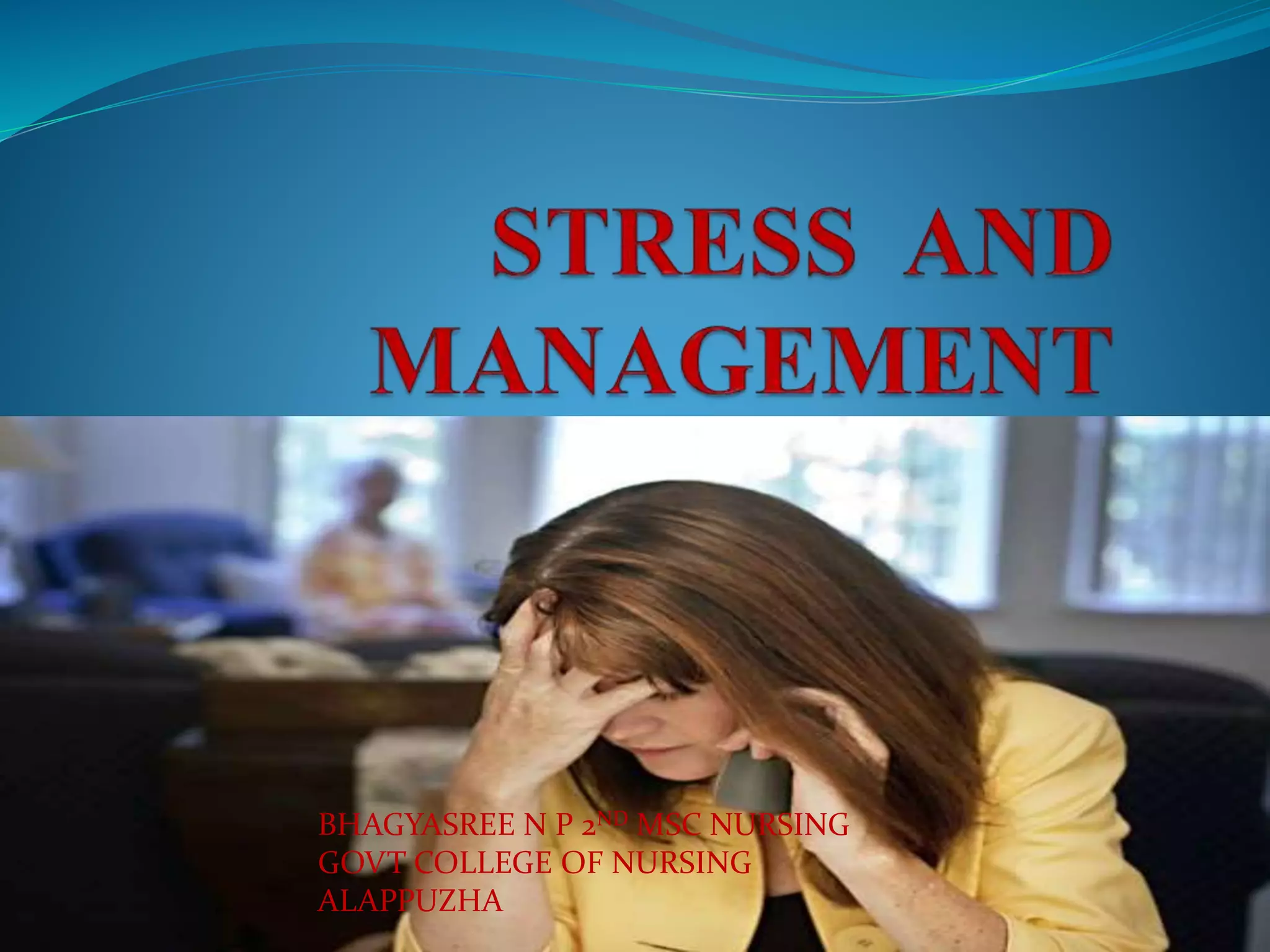
BHAGYASREE N P 2ND MSC NURSING
GOVT COLLEGE OF NURSING
ALAPPUZHA
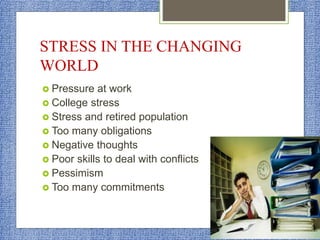
STRESS IN THE CHANGING
WORLD
 Pressure at work
 College stress
 Stress and retired population
 Too many obligations
 Negative thoughts
 Poor skills to deal with conflicts
 Pessimism
 Too many commitments
STRESS
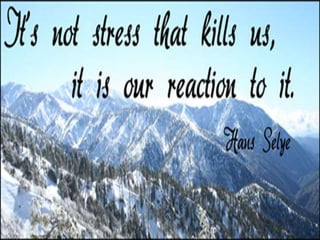
 Stress is a condition in which the human respond
to change in normal balanced state.
 Stress is a process of adjusting to or dealing with
circumstances that disrupt or threats to disrupt a
persons physical or psychological functioning-
Hans Selye
TYPES OF STRESS
 Acute stress
 Chronic stress
 Episodic stress
 Eustress
 Distress
STRESSORS
 Stressors are psychological or physical stimuli that
are precipitating a change.
 Stressors are anything that is perceived as
challenging, threatening or demanding
TYPES OF STRESSORS
STRESSORS RELATED TO PERSONALITY
 Irrational beliefs, values and attitudes
 Type A personality
 Perfectionistic attitude
 Poor time sense
 Poor decision making
 Poor habits
PERSONAL STRESSORS
 Improper life style
 Loneliness
 Marital conflicts
 Poor physical health
 Financial problems
ENVIRONMENTAL STRESSORS
 Pollution
 Noise
 Overcrowding
 Extreme heat or cold
STRESSORS RELATED TO JOB
 Poor knowledge of job
 Unwanted job
 Shift work
 Low salary
 Job insecurity
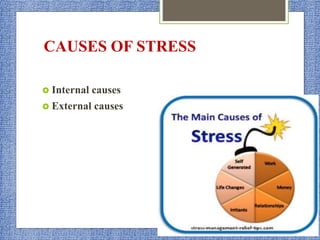
CAUSES OF STRESS
 Internal causes
 External causes
INDICATORS OF STRESS
Physiologic indicators
 Pupil dilates to increase visual perception
 Sweat production increased to control the elevated
body heat
 The heart rate and cardiac output increase
 The rate and depth of respirations increase
 Urinary output decreases.
 Blood sugar increase because of release of
glucocorticoids.
 Muscle tension increases.
PSYCHOLOGICAL INDICATORS
 Anxiety -state of mental uneasiness, apprehension or
a feeling of helplessness related to an impending or
anticipated threat.
 Fear- Fear is an emotion or feeling of apprehension
aroused by impending or seeming danger, pain or
other perceived threat.
 Depression -Depression is a common reaction to
events that seem overwhelming or negative
COGNITIVE INDICATORS
 Problem solving
 Problem solving involves thinking through the
threatening situation, using specific steps to arrive at
a solution.
 Structuring
 Structuring is the arrangement or manipulation of
situation so that threatening events do not occur. For
example a nurse can structure or control the
interview with client by asking only
 Self-control/self-discipline assuming a manner and
facial expression that convey a sense of being in
control or in charge
 Suppression
 Suppression is consciously and wilfully
putting a thought or feeling out of the mind
 Fantasy.
 Fantasy or day dreaming is likened make
believe unfulfilled wishes and desires and
imagined as fulfilled or a threatening
experiences reworked or replace so that it
ends differently from reality.
ADAPTATION
 Adaptation is an on-going process as a person
strives to maintain balance in his / her internal or
external environments.
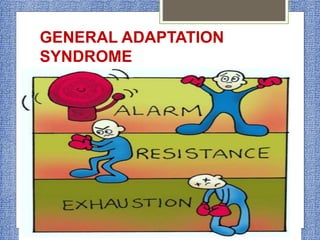
GENERAL ADAPTATION
SYNDROME
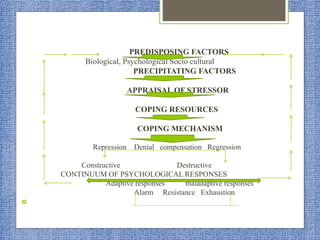
STUART STRESS ADAPTATION
MODEL
PREDISPOSING FACTORS
Biological, Psychological Socio cultural
PRECIPITATING FACTORS
APPRAISAL OF STRESSOR
COPING RESOURCES
COPING MECHANISM
Repression Denial compensation Regression
Constructive Destructive
CONTINUUM OF PSYCHOLOGICAL RESPONSES
Adaptive responses maladaptive responses
Alarm Resistance Exhaustion

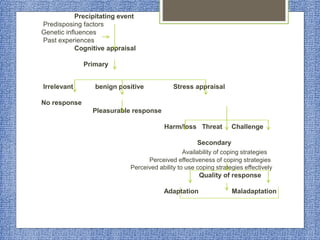
 TRANSACTIONAL MODEL OF STRESS
Precipitating event
Predisposing factors
Genetic influences
Past experiences
Cognitive appraisal
Primary
Irrelevant benign positive Stress appraisal
No response
Pleasurable response
Harm/loss Threat Challenge
Secondary
Availability of coping strategies
Perceived effectiveness of coping strategies
Perceived ability to use coping strategies effectively
Quality of response
Adaptation Maladaptation
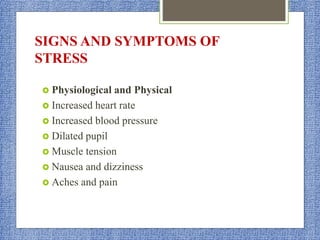
SIGNS AND SYMPTOMS OF
STRESS
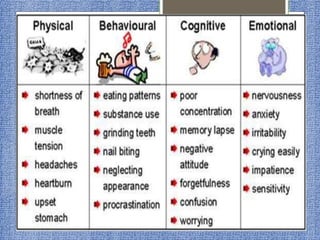
 Physiological and Physical
 Increased heart rate
 Increased blood pressure
 Dilated pupil
 Muscle tension
 Nausea and dizziness
 Aches and pain
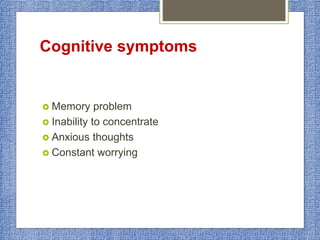
Cognitive symptoms
 Memory problem
 Inability to concentrate
 Anxious thoughts
 Constant worrying
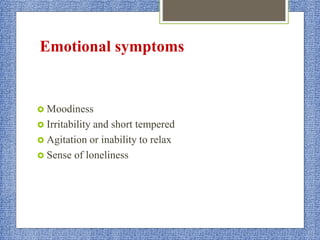
Emotional symptoms
 Moodiness
 Irritability and short tempered
 Agitation or inability to relax
 Sense of loneliness
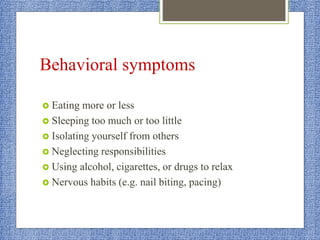
Behavioral symptoms
 Eating more or less
 Sleeping too much or too little
 Isolating yourself from others
 Neglecting responsibilities
 Using alcohol, cigarettes, or drugs to relax
 Nervous habits (e.g. nail biting, pacing)
STRESS
ASSESSMENT
SCALE
HOLMES AND RAHE STRESS
SCALE
 Social Readjustment Rating Scale (SRRS)
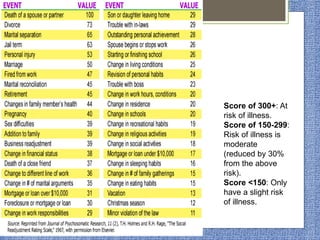
Score of 300+: At
risk of illness.
Score of 150-299:
Risk of illness is
moderate
(reduced by 30%
from the above
risk).
Score <150: Only
have a slight risk
of illness.
DEPRESSION ANXIETY STRESS
SCALES (DASS)
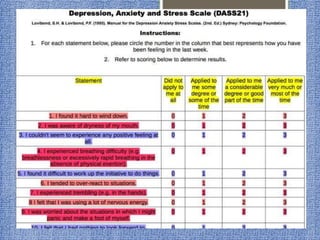
 DASS, the Depression Anxiety Stress Scales is
made up of 42 self-report items to be completed
over five to ten minutes, each reflecting a negative
emotional symptom.
 The main purpose of the DASS is to isolate and
identify aspects of emotional disturbance
PERCEIVED STRESS SCALE
 The Perceived Stress Scale (PSS) is the most
widely used psychological instrument for
measuring the perception of stress. It is a measure
of the degree to which situations in one’s life are
appraised as stressful.
 For each question choose from the following
alternatives:
 0 –never 1 -almost never 2 –sometimes 3 -fairly
often 4 very often
 Scores ranging from 0-13 would be considered
low stress.
 Scores ranging from 14-26 would be considered
moderate stress.
 Scores ranging from 27-40 would be considered
high perceived stress.

KINGSTON CAREGIVER STRESS
SCALE (KCSS)
 The Kingston Caregiver Stress Scale (KCSS) is
primarily a scale used to monitor change in a
family caregiver’s stress level over time.
Adaptive coping strategies
AWARENESS
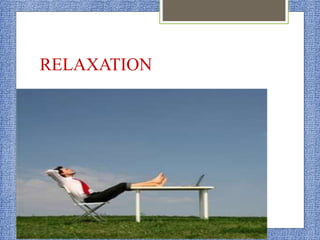
RELAXATION
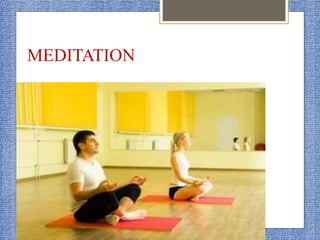
MEDITATION
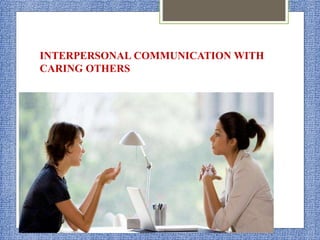
INTERPERSONAL COMMUNICATION WITH
CARING OTHERS
PROBLEM SOLVING
PETS
MUSIC
BREATHING EXCERCISES
 Find a comfortable position.
 Relax your shoulders and chest; let your body relax.
 Shift to relaxed, abdominal breathing. Take a deep
breathe through your mouth, expanding the abdomen,
Hold it for 3 seconds and then exhale slowly through the
nose; exhale completely and telling yourself to relax.
 With every breath turn attention to muscular sensation
that accompanies the expansion of belly.
 As you concentrate on you breathing, you will start to
feel focused.
 Repeat this exercise for 2-5 minutes.

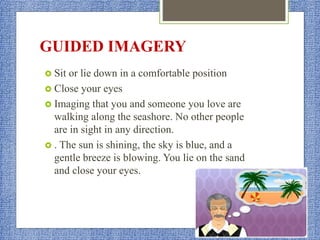
GUIDED IMAGERY
 Sit or lie down in a comfortable position
 Close your eyes
 Imaging that you and someone you love are
walking along the seashore. No other people
are in sight in any direction.
 . The sun is shining, the sky is blue, and a
gentle breeze is blowing. You lie on the sand
and close your eyes.
 You hear the sound of the wave as they splash
against the shore.
 The sun feels warm on your face and body. The sand
feels soft and warm against your back.
 An occasional wave, splash you with a cool mist that
dry rapidly in the warm sun. You lay in this quiet
place for what seems like a very long time, talking in
the sounds of the wave, the warmth of the sun and
the cooling sensation of the mist and ocean breeze. It
is very quiet and warm.
 You feel relaxed contented. This is your special
place whenever you want to relax
MEDITATION
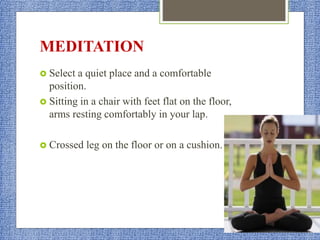
 Select a quiet place and a comfortable
position.
 Sitting in a chair with feet flat on the floor,
arms resting comfortably in your lap.
 Crossed leg on the floor or on a cushion.
 In the lotus yoga position, sitting on the floor with
your legs flexed at the knees. The ankle are crossed
each foot rests top of the opposite thigh.
Select an object word or thought on which to dwell.
During meditation individual become preoccupied
with selected focus. This total preoccupation serves to
prevent distractions from interrupting attention.
Counting ones breath- all attention focussed on
breathing in and out.
Mantra- A mantra is syllable, word or name that
repeats much time as the mind is cleared of thought.
A thought that has special meaning to you- With
eyes closed focus total attention on a specific
thought or idea.
 Practice directing attention you selected focus for
10-15 minutes a day for several weeks
RELAXATION EXCERSISES
 1938 Edmund Jacobson developed Progressive
Muscle Relaxation technique
 Each muscle group is tensed for 5-7 seconds and
then relaxed for 20-30 seconds during which the
individual concentrates on the difference in
sensation between the two conditions. Soft, slow
back ground music may facilitate relaxation.
 Next tense the muscles of the thigh and buttocks, and
hold for a count of 5.
 Now release the hold. Feel the tension drain away and be
aware of the difference in sensation.
 Next tense the abdominal muscles. Hold for a count of 5.
 Now release the hold. Concentrate on the feeling of
relaxation in the muscles. You may feel a warmth
sensation. Hold on to that feeling for 15-20 seconds.
 Next tense the muscles in the back and hold for a count
of 5.
 Now release the hold and feels the sensation of
relaxation.
 Now tense the muscle of your hands, biceps and forearm
and clench your hands into a tight fist. Hold for a count
of 5.
 Sit in a comfortable chair with your hands in your
lap, your feet flat on the floor and your eyes closed.
 Begin by talking three deep, slow breaths, inhaling
through nose and releasing air slowly through the
mouth.
 Now starting with the feet, pulls the toes forward
toward the knees, stiffen your calves, and hold for a
count of 5.
 Now release the hold. Let go of the tension. Feel the
sensation of relaxation and warmth as the tension
flow out of the muscle.
 Now release the hold. Notice the sensations. You
may feel tingling, warmth or a tight airy feeling.
Recognise these sensation as tension leaves the
muscle.
 Next tense the muscle of the shoulders and neck.
Shrug the shoulders tightly and hold for a count of 5.
 Now release the hold. Sense the tension as it leaves
the muscle and experience the feeling of relaxation.
 Next tense the muscle of the face. Wrinkle the
forehead, frown, squint the eyes and purse the lips.
Hold for a count of 5.
 Now release the hold. Recognize a light, warm
feeling flowing into the muscles.
 Now feel he relaxation on your whole body. As the
tension leaves your entire being, you feel
completely relaxed.
 Open your eyes and enjoy renewed energy.
STRESS MANAGEMENT FOR
NURSES
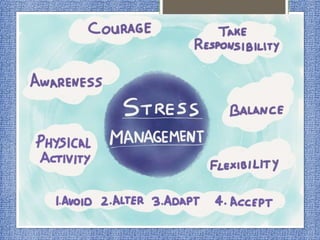
 Alter the situation
 Avoid unnecessary stress
 Adapt to the stressor
 Accept the things you can’t change
 Set aside relaxation time.
 Exercise regularly.
 Eat a healthy diet.
 Get adequate sleep
 Be organized
 Breathe
 Talk
 Learn to identify the feeling
 Evaluate and relies on spirituality
 Acquire skills in needed areas
Stress  and management

Stress and management

  • 1.
    BHAGYASREE N P2ND MSC NURSING GOVT COLLEGE OF NURSING ALAPPUZHA
  • 2.
    STRESS IN THECHANGING WORLD  Pressure at work  College stress  Stress and retired population  Too many obligations  Negative thoughts  Poor skills to deal with conflicts  Pessimism  Too many commitments
  • 5.
    STRESS  Stress isa condition in which the human respond to change in normal balanced state.  Stress is a process of adjusting to or dealing with circumstances that disrupt or threats to disrupt a persons physical or psychological functioning- Hans Selye
  • 6.
    TYPES OF STRESS Acute stress  Chronic stress  Episodic stress  Eustress  Distress
  • 7.
    STRESSORS  Stressors arepsychological or physical stimuli that are precipitating a change.  Stressors are anything that is perceived as challenging, threatening or demanding
  • 8.
    TYPES OF STRESSORS STRESSORSRELATED TO PERSONALITY  Irrational beliefs, values and attitudes  Type A personality  Perfectionistic attitude  Poor time sense  Poor decision making  Poor habits
  • 9.
    PERSONAL STRESSORS  Improperlife style  Loneliness  Marital conflicts  Poor physical health  Financial problems
  • 10.
    ENVIRONMENTAL STRESSORS  Pollution Noise  Overcrowding  Extreme heat or cold
  • 11.
    STRESSORS RELATED TOJOB  Poor knowledge of job  Unwanted job  Shift work  Low salary  Job insecurity
  • 12.
    CAUSES OF STRESS Internal causes  External causes
  • 13.
    INDICATORS OF STRESS Physiologicindicators  Pupil dilates to increase visual perception  Sweat production increased to control the elevated body heat  The heart rate and cardiac output increase  The rate and depth of respirations increase
  • 14.
     Urinary outputdecreases.  Blood sugar increase because of release of glucocorticoids.  Muscle tension increases.
  • 15.
    PSYCHOLOGICAL INDICATORS  Anxiety-state of mental uneasiness, apprehension or a feeling of helplessness related to an impending or anticipated threat.  Fear- Fear is an emotion or feeling of apprehension aroused by impending or seeming danger, pain or other perceived threat.  Depression -Depression is a common reaction to events that seem overwhelming or negative
  • 16.
    COGNITIVE INDICATORS  Problemsolving  Problem solving involves thinking through the threatening situation, using specific steps to arrive at a solution.  Structuring  Structuring is the arrangement or manipulation of situation so that threatening events do not occur. For example a nurse can structure or control the interview with client by asking only  Self-control/self-discipline assuming a manner and facial expression that convey a sense of being in control or in charge
  • 17.
     Suppression  Suppressionis consciously and wilfully putting a thought or feeling out of the mind  Fantasy.  Fantasy or day dreaming is likened make believe unfulfilled wishes and desires and imagined as fulfilled or a threatening experiences reworked or replace so that it ends differently from reality.
  • 18.
    ADAPTATION  Adaptation isan on-going process as a person strives to maintain balance in his / her internal or external environments.
  • 19.
  • 20.
  • 21.
    PREDISPOSING FACTORS Biological, PsychologicalSocio cultural PRECIPITATING FACTORS APPRAISAL OF STRESSOR COPING RESOURCES COPING MECHANISM Repression Denial compensation Regression Constructive Destructive CONTINUUM OF PSYCHOLOGICAL RESPONSES Adaptive responses maladaptive responses Alarm Resistance Exhaustion 
  • 22.
  • 23.
    Precipitating event Predisposing factors Geneticinfluences Past experiences Cognitive appraisal Primary Irrelevant benign positive Stress appraisal No response Pleasurable response Harm/loss Threat Challenge Secondary Availability of coping strategies Perceived effectiveness of coping strategies Perceived ability to use coping strategies effectively Quality of response Adaptation Maladaptation
  • 24.
    SIGNS AND SYMPTOMSOF STRESS  Physiological and Physical  Increased heart rate  Increased blood pressure  Dilated pupil  Muscle tension  Nausea and dizziness  Aches and pain
  • 25.
    Cognitive symptoms  Memoryproblem  Inability to concentrate  Anxious thoughts  Constant worrying
  • 26.
    Emotional symptoms  Moodiness Irritability and short tempered  Agitation or inability to relax  Sense of loneliness
  • 27.
    Behavioral symptoms  Eatingmore or less  Sleeping too much or too little  Isolating yourself from others  Neglecting responsibilities  Using alcohol, cigarettes, or drugs to relax  Nervous habits (e.g. nail biting, pacing)
  • 29.
  • 30.
    HOLMES AND RAHESTRESS SCALE  Social Readjustment Rating Scale (SRRS)
  • 31.
    Score of 300+:At risk of illness. Score of 150-299: Risk of illness is moderate (reduced by 30% from the above risk). Score <150: Only have a slight risk of illness.
  • 32.
    DEPRESSION ANXIETY STRESS SCALES(DASS)  DASS, the Depression Anxiety Stress Scales is made up of 42 self-report items to be completed over five to ten minutes, each reflecting a negative emotional symptom.  The main purpose of the DASS is to isolate and identify aspects of emotional disturbance
  • 34.
    PERCEIVED STRESS SCALE The Perceived Stress Scale (PSS) is the most widely used psychological instrument for measuring the perception of stress. It is a measure of the degree to which situations in one’s life are appraised as stressful.  For each question choose from the following alternatives:  0 –never 1 -almost never 2 –sometimes 3 -fairly often 4 very often
  • 35.
     Scores rangingfrom 0-13 would be considered low stress.  Scores ranging from 14-26 would be considered moderate stress.  Scores ranging from 27-40 would be considered high perceived stress. 
  • 36.
    KINGSTON CAREGIVER STRESS SCALE(KCSS)  The Kingston Caregiver Stress Scale (KCSS) is primarily a scale used to monitor change in a family caregiver’s stress level over time.
  • 39.
  • 40.
  • 41.
  • 42.
  • 43.
  • 44.
  • 45.
  • 46.
  • 47.
    BREATHING EXCERCISES  Finda comfortable position.  Relax your shoulders and chest; let your body relax.  Shift to relaxed, abdominal breathing. Take a deep breathe through your mouth, expanding the abdomen, Hold it for 3 seconds and then exhale slowly through the nose; exhale completely and telling yourself to relax.  With every breath turn attention to muscular sensation that accompanies the expansion of belly.  As you concentrate on you breathing, you will start to feel focused.  Repeat this exercise for 2-5 minutes. 
  • 48.
    GUIDED IMAGERY  Sitor lie down in a comfortable position  Close your eyes  Imaging that you and someone you love are walking along the seashore. No other people are in sight in any direction.  . The sun is shining, the sky is blue, and a gentle breeze is blowing. You lie on the sand and close your eyes.
  • 49.
     You hearthe sound of the wave as they splash against the shore.  The sun feels warm on your face and body. The sand feels soft and warm against your back.  An occasional wave, splash you with a cool mist that dry rapidly in the warm sun. You lay in this quiet place for what seems like a very long time, talking in the sounds of the wave, the warmth of the sun and the cooling sensation of the mist and ocean breeze. It is very quiet and warm.
  • 50.
     You feelrelaxed contented. This is your special place whenever you want to relax
  • 51.
    MEDITATION  Select aquiet place and a comfortable position.  Sitting in a chair with feet flat on the floor, arms resting comfortably in your lap.  Crossed leg on the floor or on a cushion.
  • 52.
     In thelotus yoga position, sitting on the floor with your legs flexed at the knees. The ankle are crossed each foot rests top of the opposite thigh. Select an object word or thought on which to dwell. During meditation individual become preoccupied with selected focus. This total preoccupation serves to prevent distractions from interrupting attention. Counting ones breath- all attention focussed on breathing in and out.
  • 53.
    Mantra- A mantrais syllable, word or name that repeats much time as the mind is cleared of thought. A thought that has special meaning to you- With eyes closed focus total attention on a specific thought or idea.  Practice directing attention you selected focus for 10-15 minutes a day for several weeks
  • 54.
    RELAXATION EXCERSISES  1938Edmund Jacobson developed Progressive Muscle Relaxation technique  Each muscle group is tensed for 5-7 seconds and then relaxed for 20-30 seconds during which the individual concentrates on the difference in sensation between the two conditions. Soft, slow back ground music may facilitate relaxation.
  • 55.
     Next tensethe muscles of the thigh and buttocks, and hold for a count of 5.  Now release the hold. Feel the tension drain away and be aware of the difference in sensation.  Next tense the abdominal muscles. Hold for a count of 5.  Now release the hold. Concentrate on the feeling of relaxation in the muscles. You may feel a warmth sensation. Hold on to that feeling for 15-20 seconds.  Next tense the muscles in the back and hold for a count of 5.  Now release the hold and feels the sensation of relaxation.  Now tense the muscle of your hands, biceps and forearm and clench your hands into a tight fist. Hold for a count of 5.
  • 56.
     Sit ina comfortable chair with your hands in your lap, your feet flat on the floor and your eyes closed.  Begin by talking three deep, slow breaths, inhaling through nose and releasing air slowly through the mouth.  Now starting with the feet, pulls the toes forward toward the knees, stiffen your calves, and hold for a count of 5.  Now release the hold. Let go of the tension. Feel the sensation of relaxation and warmth as the tension flow out of the muscle.
  • 57.
     Now releasethe hold. Notice the sensations. You may feel tingling, warmth or a tight airy feeling. Recognise these sensation as tension leaves the muscle.  Next tense the muscle of the shoulders and neck. Shrug the shoulders tightly and hold for a count of 5.  Now release the hold. Sense the tension as it leaves the muscle and experience the feeling of relaxation.  Next tense the muscle of the face. Wrinkle the forehead, frown, squint the eyes and purse the lips. Hold for a count of 5.
  • 58.
     Now releasethe hold. Recognize a light, warm feeling flowing into the muscles.  Now feel he relaxation on your whole body. As the tension leaves your entire being, you feel completely relaxed.  Open your eyes and enjoy renewed energy.
  • 60.
    STRESS MANAGEMENT FOR NURSES Alter the situation  Avoid unnecessary stress  Adapt to the stressor  Accept the things you can’t change
  • 61.
     Set asiderelaxation time.  Exercise regularly.  Eat a healthy diet.  Get adequate sleep  Be organized  Breathe  Talk
  • 62.
     Learn toidentify the feeling  Evaluate and relies on spirituality  Acquire skills in needed areas