Atty. HARVE B. ABELLA, Esq.

THE LAW ON NULLITY OF MARRIAGE IN
THE PHILIPPINES
MARRIAGE

 Article XV. Sec. 2. 1987 Constitution
 Marriage, as an inviolable social institution, is
  the foundation of the family and shall be
  protected by the State.
MARRIAGE
 Article 1. Marriage is a special contract of
  permanent union between a man and a woman
  entered into in accordance with law for the
  establishment of conjugal and family life. It is the
  foundation of the family and an inviolable social
  institution whose nature, consequences, and
  incidents are governed by law and not subject to
  stipulation, except that marriage settlements may
  fix the property relations during the marriage
  within the limits provided by this Code.
 (EO 209, as Amended)
DISSOLUTION OF MARRIAGE

HISTORICAL ANTECEDENTS
SPANISH PERIOD
 Siete Partidas
 Legal Separation / Relative divorce
     Divorce   a mensa et thoro
   Grounds
     Adultery
     The desire of one of the spouses to take up holy
      orders and the other spouses grants the same
     Conversion of one of the parties to heresy,
      Mohammedanism or Judaism
AMERICAN PERIOD

 Act No. 2710 (1917)
 Divorce Law
       Granted absolute divorce (divorce a vinculo matrimonii)
   Grounds:
     Adultery on the part of the wife
     Concubinage on the part of the husband if committed
      in any of the forms provided by the Penal Code
   Granted one year after the final judgment of the
    court.
JAPANESE OCCUPATION

 EO 141
 Expanded the grounds for absolute divorce in
  Act No. 2710 from two to 11
MUSLIM DIVORCE LAW 1949
   RA 394
       Granted absolute divorce to Muslims – effective only up to
        June 1969.
   PD 793 extended the period beyond June 18, 1969
       Recognized Muslim divorce and was retroactively applied.
   1977 Code of Muslim Personal Laws of the Philippines
    (PD 1083) became effective.
       It provided absolute divorce to muslims only after the
        exhaustion of possible means of reconciliation between the
        spouses
NEW CIVIL CODE (1950)
 RA 386 – repealed absolute divorce granted in Act
  2710 and EO 141
 A proposed chapter on Absolute Divorce was
  struck down during the deliberations due to the
  fact that the House was flooded with letters and
  telegrams from the Catholic population on its
  perception that that provision liberalized divorce
 The proposal was in fact more strict than that
  covered by Act No. 2710
 The Lower House prevailed and deleted the
  proposal on account that it was an election year.
FAMILY CODE (1988)

 A new ground for the declaration of nullity of
  marriage was added based on Psychological
  Incapacity.
 Divorce is still not recognized, except perhaps a
  divorce obtained abroad by the alien spouse of
  a Filipino citizen and divorce among Muslims
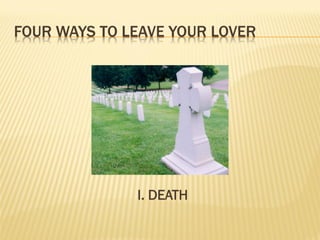
FOUR WAYS TO LEAVE YOUR LOVER


              I. DEATH
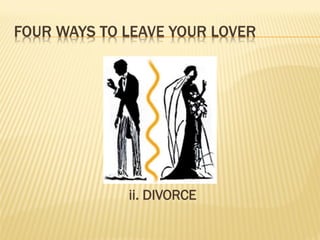
FOUR WAYS TO LEAVE YOUR LOVER


             ii. DIVORCE
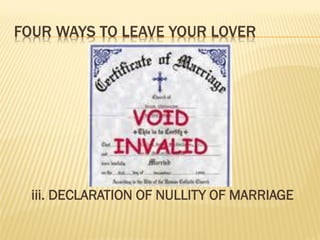
FOUR WAYS TO LEAVE YOUR LOVER


  iii. DECLARATION OF NULLITY OF MARRIAGE
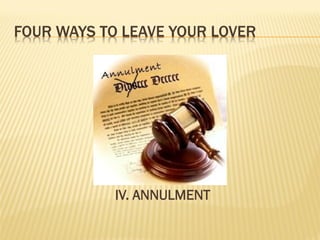
FOUR WAYS TO LEAVE YOUR LOVER


            IV. ANNULMENT
TWO MOST POPULAR REMEDIES TO DISSOLVE
MARRIAGES
   ACTION FOR ANNULMENT (Voidable Marriages)
     Lack  of parental consent (18 y.o. but below 21 y.o.)
     Consent obtained through fraud

     Consent obtained through force, intimidation or
      undue influence
     Insanity or unsoundness of mind

     Impotence or physical inability to consummate the
      marriage
     Affliction with a sexually transmitted disease.
TWO MOST POPULAR REMEDIES TO DISSOLVE
MARRIAGES
   ACTION FOR THE DECLARATION OF NULLITY OF
    MARRIAGES (Void Marriages)
     Underage (below 18 years of age even with parental
      consent)
     No authority to solemnize the marriage
     Bigamy / polygamy
     No marriage license (with exceptions)
     Psychological incapacity
     Subsequent marriage after failing to record annulment
      or declaration judgment of annulment or declaration of
      nullity of marriage with the civil registry
     Incest
     Breach of public policy
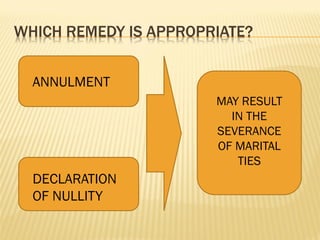
WHICH REMEDY IS APPROPRIATE?


  ANNULMENT
                       MAY RESULT
                         IN THE
                       SEVERANCE
                       OF MARITAL
                          TIES
  DECLARATION
  OF NULLITY
WHEN IS A MARRIAGE RIPE FOR DISSOLUTION?

   A painful choice must be made between clashing
    alternatives:
     between the sanctity of the marital contract and the
      need to provide for an escape where the relationship
      becomes intolerable
     Between the marriage institution and the instability
      which results from incompatibility
     Between the society’s concern for children and the
      equally great injury which may be done to them in a
      hostile parental environment
     Between financial concern for the wife and the
      imposition of alimony to the husband
   The decision to seek annulment should be made
    with utmost care and consideration of what the
    future holds for you (and your children)

   A matrimonial contest often results in love turning
    to hate. Vengeance becomes the order of the day.

   If one partner has become sexually enslaved by
    the other, the urge to destroy the wanderer
    becomes almost overwhelming.
WHAT TO EXPECT?
 Annulment cases are rich in entertainment and
  thrills for a society that seemingly cannot get too
  much of the peccadilloes of the haut monde
 The radical surgery of annulment pushes the
  parties to enter a crapulous joint once the battle
  over the children begins
 The lawyer is viewed by the opposing party as the
  devil’s acolyte, a person out to grab his entire
  fortune, wreck his life and take away his wife and
  children.
 Anticipate the unexpected once the first bullet is
  fired
 Prepare a substantial financial war chest to last up
  to the end of the conflict.
 The government has as special interest in your
  case. Both the prosecutor and a representative
  from the Office of the Solicitor General will keep a
  watchful eye over your demeanour and the
  evidence you present in court.
       They are looking for any behaviour or hint that you and
        your spouse have secretly agreed to engage in play
        acting just to convince the judge that your marriage
        ought to be annulled or declared void.
 You and your spouse may end up washing dirty
  linen in open court because the law requires
  that fault be found in either or both of you
  before your marriage is dissolved.
 Prolonged court contest could take its toll on
  your sanity and mental tranquility, if you are not
  psychologically incapacitated going into the
  contest, you may just as well end up being
  psychologically incapacitated after (or even
  before) the court releases its decision.
VOID AND VOIDABLE MARRIAGES

HOW DO THEY DIFFER?
VOID MARRIAGE
   It is one that is non-existent from the time of
    performance
       Considered invalid from the time the parties tried to
        enter it
   Cannot be ratified or convalidated by free
    cohabitation or prescription
       The passage of time cannot validate a void marriage
 It may be attached directly or collaterally
 Bur for purposes of remarriage, there must be a
  judicial declaration of absolute nullity of marriage.
VOIDABLE MARRIAGE

 It is invalid only if a court declares it is invalid
 Can be ratified or convalidated by free
  cohabitation or prescription
 Can only be attacked directly

 Defective at the time off marriage

 If no person initiates an action in court to
  invalidate a voidable marriage, it will always be
  considered a valid marriage.
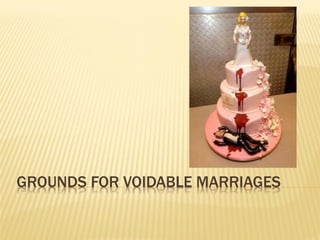
GROUNDS FOR VOIDABLE MARRIAGES
ABSENCE OF CONSENT FROM PARENTS OR
GUARDIANS
 Between 18 of age but below 21
 Failure to get the consent from either of these
  individuals will make your marriage annullable.

   Remedy in order to validate:
     By freely living with the other party as husband and
      wife upon reaching the age of 21, the cause for
      annulment for the party whose parents did not give
      their consent is removed automatically.
   To be classified as a valid cause for annulment,
    the degree of force must be in the serious and
    physical power (Art. 1335 Civil Code)
       The standard is high
   Intimidation to be an acceptable ground for
    annulment must be one that compels one of the
    parties to give his consent because of a
    reasonable and well-grounded belief of an
    imminent and grave evil upon the person or
    property of the party, his spouse, descendants or
    ascendants.
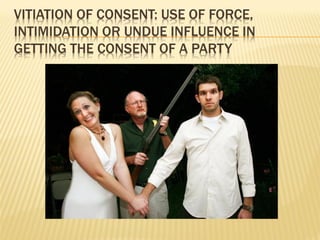
VITIATION OF CONSENT: USE OF FORCE,
INTIMIDATION OR UNDUE INFLUENCE IN
GETTING THE CONSENT OF A PARTY
   Undue Influence
     An amorphous term that begs for a precise legal
      definition
   The influence must be sufficient to “subjugate”
    the mind of another so as to deprive the party
    of his freedom of choice and to “destroy” his
    free will.
   To determine the existence of undue influence,
    factors such as family, religious and other close
    relationships between the parties are
    considered. The mental and financial position
    of the parties will be taken into account in
    finding if one party exerted undue influence
    over the other. (Coso vs Ferndandez Daza, 42
    Phil. 596)
EMPLOYMENT OF FRAUD IN GETTING CONSENT
   There are only 4 types of fraud recognized as
    grounds for annulment and all four of them involve
    the concealment or failure to reveal a “material”
    fact:
     Non-disclosure of a conviction by final judgment of a
      crime involving moral turpitude
     Concealment by the wife of the fact that at the time of
      the marriage, she was pregnant by a man other than
      her husband
     Concealment of a sexually-transmissible disease,
      regardless of its nature, existing at the time of the
      marriage
     Concealment of drug addiction, habitual alcoholism,
      homosexuality or lesbianism at the time of the
      marriage.
UNSOUNDNESS OF MIND
   “manifestation, in language or conduct, of disease or defect
    of the brain, or a more or less permanently diseased or
    disordered condition of the mentality, functional or organic,
    and characterized by perversion, inhibition, or disordered
    function of the sensory of the intellective faculties or by
    impaired or disordered volition.” (Act No. 2122, Sec. 9)

   To be a ground for annulment, one of the parties must have
    been incapable of understanding the nature and
    consequences of the marriage.

   Equivalent to incapacity of intelligent consenting or lack of
    understanding or realization of what is being done and to
    consent to it.
PHYSICAL INCAPABILITY OF CONSUMMATING
THE MARRIAGE
 Impotence must exist at the time of the
  celebration of the marriage
 It is a continuing kind up to the time of the trial

 Incurable beyond medical relief

 Spouse was not aware of your impotence
AFFLICTION WITH A SEXUALLY TRANSMISSIBLE
DISEASE
 Must be existing at the time of the marriage
 Serious

 Incurable
Some are luckier than others

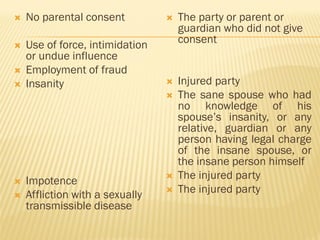
WHO MAY FILE AN ANNULMENT ACTION
   No parental consent             The party or parent or
                                     guardian who did not give
   Use of force, intimidation       consent
    or undue influence
   Employment of fraud
   Insanity                        Injured party
                                    The sane spouse who had
                                     no knowledge of his
                                     spouse’s insanity, or any
                                     relative, guardian or any
                                     person having legal charge
                                     of the insane spouse, or
                                     the insane person himself
   Impotence                       The injured party
   Affliction with a sexually      The injured party
    transmissible disease
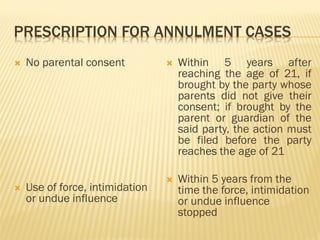
PRESCRIPTION FOR ANNULMENT CASES
   No parental consent             Within 5 years after
                                     reaching the age of 21, if
                                     brought by the party whose
                                     parents did not give their
                                     consent; if brought by the
                                     parent or guardian of the
                                     said party, the action must
                                     be filed before the party
                                     reaches the age of 21

                                    Within 5 years from the
   Use of force, intimidation       time the force, intimidation
    or undue influence               or undue influence
                                     stopped
PRESCRIPTION FOR ANNULMENT CASES
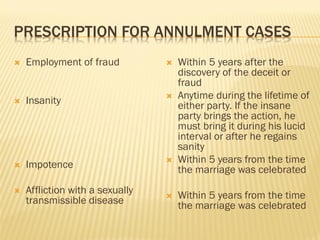
   Employment of fraud             Within 5 years after the
                                     discovery of the deceit or
                                     fraud
   Insanity                        Anytime during the lifetime of
                                     either party. If the insane
                                     party brings the action, he
                                     must bring it during his lucid
                                     interval or after he regains
                                     sanity
   Impotence                       Within 5 years from the time
                                     the marriage was celebrated
   Affliction with a sexually      Within 5 years from the time
    transmissible disease            the marriage was celebrated
FREE COHABITATION. CURING THE DEFECT
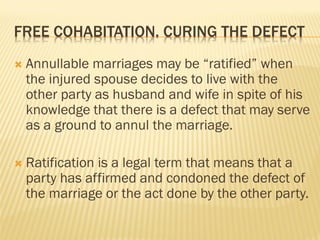
   Annullable marriages may be “ratified” when
    the injured spouse decides to live with the
    other party as husband and wife in spite of his
    knowledge that there is a defect that may serve
    as a ground to annul the marriage.

   Ratification is a legal term that means that a
    party has affirmed and condoned the defect of
    the marriage or the act done by the other party.
INSTANCES WHEN FREE COHABITATION WILL
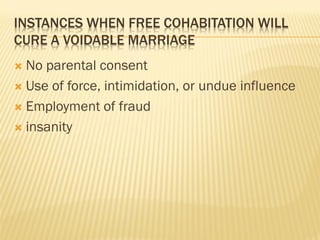
CURE A VOIDABLE MARRIAGE
 No parental consent
 Use of force, intimidation, or undue influence

 Employment of fraud

 insanity
INSTANCES WHEN FREE COHABITATION WILL
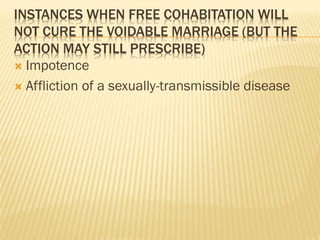
NOT CURE THE VOIDABLE MARRIAGE (BUT THE
ACTION MAY STILL PRESCRIBE)
 Impotence

 Affliction of a sexually-transmissible disease
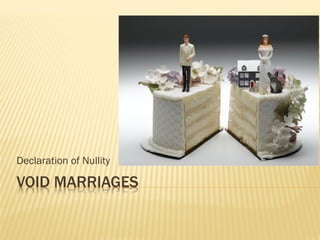
Declaration of Nullity

VOID MARRIAGES
   A void marriage is one that has no legal effect and
    is invalid because it has not complied with the
    procedural (formal) or substantive (essential)
    requirements of the law for valid marriages.

   A void marriage is always invalid and the only thing
    that needs to be done in court is to ask for a
    judicial declaration that the marriage is in fact
    invalid for official record purposes
LIST OF ALL VOID MARRIAGES
   Marriages without a marriage license (with exceptions)
   Marriages without a marriage ceremony
   Marriages officiated by a person without any legal
    authority to solemnize marriages (with exceptions)
   Marriages in which the contracting parties lack the legal
    capacity to contract a marriage (below 18 years of age)
   Marriages between persons of the same sex
   Marriages that are incestuous and those that are
    against public policy
   Marriages that are bigamous and polygamous
   Marriages that are contracted through mistake by one
    party as to the identity of the other
 Marriages that are subsequently contracted
  after the previous marriage has been annulled
  or declared void and the annulment judgment,
  partition, distribution of the properties of the
  spouse and the delivery of the children’s
  presumptive legitimes were not recorded in the
  civil registry
 Marriages in which at least one of the parties is
  psychologically incapacitated
TYPES OF VOID MARRIAGES
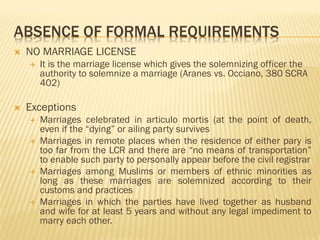
ABSENCE OF FORMAL REQUIREMENTS
   NO MARRIAGE LICENSE
       It is the marriage license which gives the solemnizing officer the
        authority to solemnize a marriage (Aranes vs. Occiano, 380 SCRA
        402)

   Exceptions
       Marriages celebrated in articulo mortis (at the point of death,
        even if the “dying” or ailing party survives
       Marriages in remote places when the residence of either pary is
        too far from the LCR and there are “no means of transportation”
        to enable such party to personally appear before the civil registrar
       Marriages among Muslims or members of ethnic minorities as
        long as these marriages are solemnized according to their
        customs and practices
       Marriages in which the parties have lived together as husband
        and wife for at least 5 years and without any legal impediment to
        marry each other.
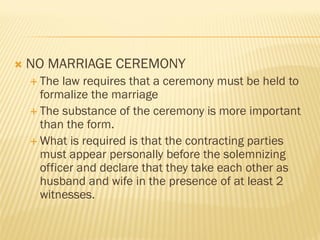
   NO MARRIAGE CEREMONY
     The  law requires that a ceremony must be held to
      formalize the marriage
     The substance of the ceremony is more important
      than the form.
     What is required is that the contracting parties
      must appear personally before the solemnizing
      officer and declare that they take each other as
      husband and wife in the presence of at least 2
      witnesses.
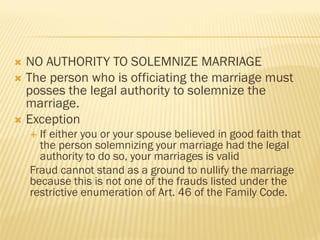
 NO AUTHORITY TO SOLEMNIZE MARRIAGE
 The person who is officiating the marriage must
  posses the legal authority to solemnize the
  marriage.
 Exception
     If either you or your spouse believed in good faith that
      the person solemnizing your marriage had the legal
      authority to do so, your marriages is valid
    Fraud cannot stand as a ground to nullify the marriage
    because this is not one of the frauds listed under the
    restrictive enumeration of Art. 46 of the Family Code.
ABSENCE OF ESSENTIAL REQUIREMENTS

 LACK OF LEGAL CAPACITY TO MARRY
 At least 18 years of age
     Old rules:
     The marrying age for men was 16, and for women,
      14.
   If either party is below 18 years of age, the
    marriage is VOID even if the parents gave their
    consent.
 HOMOSEXUAL MARRIAGES
 The difference in gender is regarded as an
  essential element in a marriage
 See Art. 1, Family Code
 INCESTUOUS MARRIAGES
 The horror of inbreeding is depicted by the
  abnormal offspring from incestuous unions.
 Philippine law safeguards the health and welfare
  of the population by prohibiting marriages
  between “Close” relatives.
 2 types of marriages expressly labeled as
  incestuous and therefore void for the beginning:
     Marriages between ascendants and descendants of
      any degree
     Marriages between brothers and sisters whether full or
      halfblood.
   VOID MARRIAGES FOR REASONS OF PUBLIC POLICY
       Between collateral blood relatives within the 4th civil degree
        (first cousins) whether legitimate or illegitimate
       Between stepparents and stepchildren
       Parents-in-law and children-in-law
       Adopting parent and the adopted child
       Surviving spouse of the adopting parent and the adopted
        child
       Surviving spouse of the adopted child and the adopter
       Adopted child and a legitimate child of the adopter
       Between adopted children of the same adopter
       Marriages between parties where one, with the intention to
        marry the other, killed that other person’s spouse or his or
        her own spouse.
 ILLEGAL MARRIAGES (Bigamy / Polygamy)
 Observance of the seriatim rule (one marriage
  at a time)
     Exeption:   Muslims
 MARRIAGES CONTRACTED THROUGH MISTAKE
  OF IDENTITY
 Equivalent to absence of consent
 MARRIAGES THAT HAVE NOT COMPLIED WITH
  RECORDING REQUIREMENTS
 The law makes the subsequent marriage “null and
  void” if the recording requirements in the
  appropriate civil registry and registry of property
  are not met.

   IF you got married again with full knowledge of the
    fact that there was a failure to comply with the
    recording requirements of the law, you may face
    criminal liability for bigamy.
 MARRIAGES IN WHICH AT LEAST ONE OF THE
  PARTIES IS PSYCHOLOGICALLY INCAPACITATED
 Psychological incapacity is a term of art that
  has been used and abused for over two
  decades.
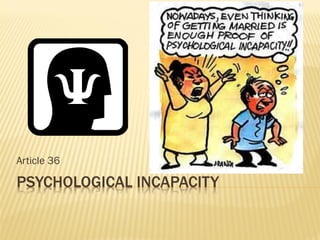
Article 36

PSYCHOLOGICAL INCAPACITY
   EO 227 (July 17, 1987)
     Created Article 36, offering psychological incapacity
      as a new ground for the declaration of nullity of
      marriage
   Lawyers now use various forms of personality
    disorder to show the existence of psychological
    incapacity:
     Homosexuality,     mental retardation, irresponsibility,
      promiscuity, alcoholism, compulsive gambling,
      infidelity, low intelligence, explosive temper, drug
      use, excessive jealousy, criminal behaviour,
      continuous and prolonged unwillingness to engage
      in sexual intercourse, abandonment, immaturity,
      etc etc etc
   Some experts say that taken as a whole, these
    conditions may help from the bases for
    psychological incapacity.

 INABILITY OR FAILURE TO UNDERSTAND AND TO
  COMPLY WITH THE MARITAL DUTIES AND
  OBLIGATIONS IMPOSED BY THE FAMILY CODE IS
  THE GENERAL GROUND USED IN PSYCHOLOGICAL
  INCAPACITY ISSUES.
 Art. 36 does not require that both spouses should
  be psychologically incapacitated.
CANON 1095
   The essence of psychological incapacity as a
    ground was derived from Canon 1095, par. 3, of
    the New Code of Canon Law (1983) which
    provides:
     Can. 1095 The following are incapable of contracting
      marriage:
     1/ those who lack the sufficient use of reason;
     2/ those who suVer from a grave defect of discretion of
      judgment concerning the essential matrimonial rights
      and duties mutually to be handed over and accepted;
     3/ those who are not able to assume the essential
      obligations of marriage for causes of a psychic nature.
PSYCHOLOGICAL INCAPACITY: UNDEFINED

 Undefined by Canon Law
 Undefined by Civil Law


   Some judges took the failure to define
    psychological incapacity in the Family Code as
    a blanket license to engage in judicial
    legislation and to set up precedents in
    uncharted waters of Philippine jurisprudence
DEFINING THE UNDEFINED

   The SC en banc made the first major attempt to
    define psychological incapacity in Santos vs.
    Santos (240 SCRA 20)
       “no less than a mental (not physical) incapacity that
        causes a party to be truly incognitive of the basic
        marital covenants that concomitantly must be assumed
        and discharged by the parties to the marriage which, as
        so expressed in Article 68 of the Family Code, include
        their mutual obligations to live together, observe love,
        respect and fidelity and render help and support.”
 This conservative judicial stance gave the
  impression that the Court viewed psychological
  incapacity as a very exceptional human condition
  requiring the application of strict standards that
  should be examined thoroughly by the trial courts
  before marriage can be declared an absolute
  nullity
 Judges, out of an overabundance of caution have
  denied issuing any declarations of nullity of
  marriage following the strict standards in Santos.
10 RULES GOVERNING PSYCHOLOGICAL
INCAPACITY CASES
   These are the SC guidelines in the interpretation
    and application of Article 36
     The burden of proof to show the nullity of the marriage
      belongs to the plaintiff. Any doubts should be resolved
      in favor of the existence and continuation of the
      marriage and against dissolution and nullity;
     The root cause of the psychological incapacity must be
      a.) medically and clinically identified b.)alleged in the
      complaint c.) sufficiently proven by experts d.) clearly
      explained in the decision
 The  incapacity must be proven to be existing at the
  time of the marriage. The evidence must show that
  the illness was existing when the parties exchanged
  their vows.
 The incapacity must also be shown to be medically
  or clinically permanent or incurable. Such
  incurability may be absolute or even relative only in
  regard to the other spouse, not necessarily
  absolute against everyone of the same sex.
 The illness must be grave enough to bring about the
  disability of the party to assume the essential
  obligations of marriage. Mild characteriological
  peculiarities, mood changes, occasional emotional
  outburst cannot be accepted as root causes. The illness
  must be shown as downright incapacity or inability, not
  refusal, neglect or difficulty, much less, ill will.
 The essential marital obligations must be embraced by
  Art. 68-71 of the FC as regards the husband and wife
  as well as Articles 220, 221 and 225 of the FC in
  regard to parents and their children. The non-
  compliance of these marital duties must be stated in
  the petition, proven by evidence and included in the
  decision;
 The  interpretations of the National Appellate
  Matrimonial Tribunal of the Catholic Church of the
  Philippines, while not controlling, should be given
  great weight by the courts;
 The trial court must order the prosecuting attorney
  and the Solicitor General to appear as counsel for
  the State (defensor vinculi)
 9 and 10, eliminated by AM No. 02-11-10-SC, #2
  modified by Barcelona vs Barcelona
Annulment Symposium