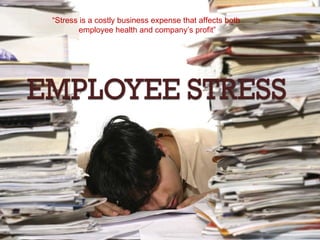
“ Stress is a costly business expense that affects both  employee health and company’s profit”
WHAT IS STRESS . . . ? Stress is an adaptive response mediated by individual characteristics and psychological process, that is, a consequence of any external action, situation or event that places special physical and psychological demands upon a person.
“ STRESS IS AN ADAPTIVE RESPONSE TO AN  EXTERNAL SITUATION THAT RESULTS IN  PHYSICAL , PSYCHOLOGICAL   AND  BEHAVIORIAL DEVIATIONS  FOR ORGANISATIONAL PARTICIPATION” EMPLOYEE STRESS  :: “ It is a condition arising from the  interaction of people  and their jobs and characterized by changes within people that force them to deviate from their normal functioning”
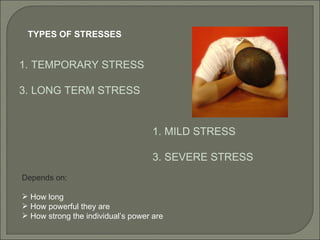
TYPES OF STRESSES  TEMPORARY STRESS  LONG TERM STRESS MILD STRESS SEVERE STRESS Depends on: How long How powerful they are How strong the individual’s power are
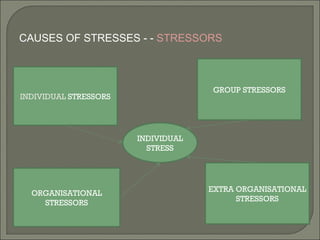
CAUSES OF STRESSES - -  STRESSORS INDIVIDUAL  STRESSORS EXTRA ORGANISATIONAL STRESSORS ORGANISATIONAL STRESSORS GROUP STRESSORS INDIVIDUAL STRESS
1.  INDIVIDUAL STRESSORS  LIFE AND CAREER CHANGES Every change produces a stress Young people  >  old people ,  Urban people  >  rural people Caused by Promotions, demotions, transfers, separations etc. . . Below are  life events  causes stress Life events  Stress levels Death of spouse Divorce  Personal injury/illness Change in financial status Change in nature of work Change in working conditions 100 73 53 38 36 20
2. PERSONALITY TYPE Characteristics –  authoritarianism  rigidity  Masculinity Feminity Extroversion Supportiveness  Spontaneity Emotionality Tolerance for ambiguity locus of control Anxiety Need for achievements 2. Type A, Type B personality
Difference between Type A, Type B personality  Type A personality Type B personality Is always moving Walks rapidly Eats rapidly Talks rapidly Is impatient  Does two things at a time Measures success by quantity Is aggressive Is competitive Feels time pressure Is never in hurry Is patient Does not brag Plays for fun, not for win Relaxes without guilt Is mild mannered Has no pressing deadlines
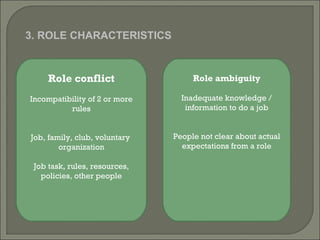
3. ROLE CHARACTERISTICS  Role conflict Incompatibility of 2 or more rules Job, family, club, voluntary  organization Job task, rules, resources, policies, other people Role ambiguity Inadequate knowledge / information to do a job People not clear about actual expectations from a role
Stress levels depends on : Over time  Quotas Deadlines Competitiveness Physical demand Environmental conditions Hazards encountered Initiative required Stamina required Win / lose situations Working in the public eye Job  Stress scores Firefighter  Surgeon Real-estate agent Pilot  Lawyer  Tax collector 110.9 99.5 73.1 68.7 64.3 34.8
2.  GROUP STRESSORS  LACK OF GROUP COHESIVENESS Satisfaction – group interaction  LACK OF SOCIAL SUPPORT CONFLICT
3.  ORGANISATIONAL STRESSORS Organizational policies Unfavorable  Unfair and arbitrary performance evaluation Unrealistic job description Frequent reallocation of activity Rotating work shifts Ambiguous procedures Inflexible rules Inequality of incentives 2. Organization structure 1. lack of opportunity of participation 2. lack of advancement 3. lack of high degree of specialization
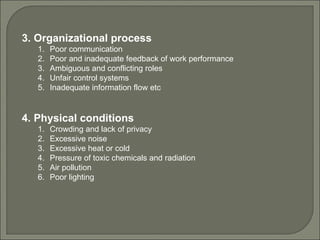
3. Organizational process Poor communication  Poor and inadequate feedback of work performance Ambiguous and conflicting roles Unfair control systems Inadequate information flow etc 4. Physical conditions  Crowding and lack of privacy Excessive noise Excessive heat or cold Pressure of toxic chemicals and radiation Air pollution Poor lighting
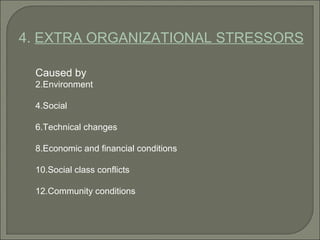
4.  EXTRA ORGANIZATIONAL STRESSORS Caused by  Environment Social Technical changes Economic and financial conditions Social class conflicts Community conditions
EFFECTS OF STRESS Eustress Sales  Creativity  Distress  Physical High B.P ,cholesterol Psychological Mood, emotional status Behavioral  Alcoholism Drug addiction Smoking Sleeplessness Suicide
BURN-OUT IN JOBS  “ Burnout  is a syndrome wherein a person  breaks down  physically and emotionally  due to continuous over-wor k over  a long period of time” Process of  burnout: Stage of job  contentment –  enthusiasm to work with  high  energy Stage of fuel storage – experiencing mental fatigue, frustration Stage of withdrawal and isolation- avoiding contact with co-workers, showing anger Stage of crisis- very low self esteem, negative feelings Stage of final breakdown – alcoholism, drug addiction, heart attacks
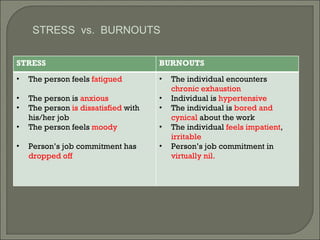
STRESS  vs.  BURNOUTS STRESS BURNOUTS The person feels  fatigued   The person is  anxious The person  is dissatisfied  with his/her job The person feels  moody Person’s job commitment has  dropped off The individual encounters  chronic exhaustion Individual is  hypertensive The individual is  bored and cynical  about the work The individual  feels impatient ,  irritable Person’s job commitment in  virtually nil.


Employee Stress

  • 1.
    “ Stress isa costly business expense that affects both employee health and company’s profit”
  • 2.
    WHAT IS STRESS. . . ? Stress is an adaptive response mediated by individual characteristics and psychological process, that is, a consequence of any external action, situation or event that places special physical and psychological demands upon a person.
  • 3.
    “ STRESS ISAN ADAPTIVE RESPONSE TO AN EXTERNAL SITUATION THAT RESULTS IN PHYSICAL , PSYCHOLOGICAL AND BEHAVIORIAL DEVIATIONS FOR ORGANISATIONAL PARTICIPATION” EMPLOYEE STRESS :: “ It is a condition arising from the interaction of people and their jobs and characterized by changes within people that force them to deviate from their normal functioning”
  • 4.
    TYPES OF STRESSES TEMPORARY STRESS LONG TERM STRESS MILD STRESS SEVERE STRESS Depends on: How long How powerful they are How strong the individual’s power are
  • 5.
    CAUSES OF STRESSES- - STRESSORS INDIVIDUAL STRESSORS EXTRA ORGANISATIONAL STRESSORS ORGANISATIONAL STRESSORS GROUP STRESSORS INDIVIDUAL STRESS
  • 6.
    1. INDIVIDUALSTRESSORS LIFE AND CAREER CHANGES Every change produces a stress Young people > old people , Urban people > rural people Caused by Promotions, demotions, transfers, separations etc. . . Below are life events causes stress Life events Stress levels Death of spouse Divorce Personal injury/illness Change in financial status Change in nature of work Change in working conditions 100 73 53 38 36 20
  • 7.
    2. PERSONALITY TYPECharacteristics – authoritarianism rigidity Masculinity Feminity Extroversion Supportiveness Spontaneity Emotionality Tolerance for ambiguity locus of control Anxiety Need for achievements 2. Type A, Type B personality
  • 8.
    Difference between TypeA, Type B personality Type A personality Type B personality Is always moving Walks rapidly Eats rapidly Talks rapidly Is impatient Does two things at a time Measures success by quantity Is aggressive Is competitive Feels time pressure Is never in hurry Is patient Does not brag Plays for fun, not for win Relaxes without guilt Is mild mannered Has no pressing deadlines
  • 9.
    3. ROLE CHARACTERISTICS Role conflict Incompatibility of 2 or more rules Job, family, club, voluntary organization Job task, rules, resources, policies, other people Role ambiguity Inadequate knowledge / information to do a job People not clear about actual expectations from a role
  • 10.
    Stress levels dependson : Over time Quotas Deadlines Competitiveness Physical demand Environmental conditions Hazards encountered Initiative required Stamina required Win / lose situations Working in the public eye Job Stress scores Firefighter Surgeon Real-estate agent Pilot Lawyer Tax collector 110.9 99.5 73.1 68.7 64.3 34.8
  • 11.
    2. GROUPSTRESSORS LACK OF GROUP COHESIVENESS Satisfaction – group interaction LACK OF SOCIAL SUPPORT CONFLICT
  • 12.
    3. ORGANISATIONALSTRESSORS Organizational policies Unfavorable Unfair and arbitrary performance evaluation Unrealistic job description Frequent reallocation of activity Rotating work shifts Ambiguous procedures Inflexible rules Inequality of incentives 2. Organization structure 1. lack of opportunity of participation 2. lack of advancement 3. lack of high degree of specialization
  • 13.
    3. Organizational processPoor communication Poor and inadequate feedback of work performance Ambiguous and conflicting roles Unfair control systems Inadequate information flow etc 4. Physical conditions Crowding and lack of privacy Excessive noise Excessive heat or cold Pressure of toxic chemicals and radiation Air pollution Poor lighting
  • 14.
    4. EXTRAORGANIZATIONAL STRESSORS Caused by Environment Social Technical changes Economic and financial conditions Social class conflicts Community conditions
  • 15.
    EFFECTS OF STRESSEustress Sales Creativity Distress Physical High B.P ,cholesterol Psychological Mood, emotional status Behavioral Alcoholism Drug addiction Smoking Sleeplessness Suicide
  • 16.
    BURN-OUT IN JOBS “ Burnout is a syndrome wherein a person breaks down physically and emotionally due to continuous over-wor k over a long period of time” Process of burnout: Stage of job contentment – enthusiasm to work with high energy Stage of fuel storage – experiencing mental fatigue, frustration Stage of withdrawal and isolation- avoiding contact with co-workers, showing anger Stage of crisis- very low self esteem, negative feelings Stage of final breakdown – alcoholism, drug addiction, heart attacks
  • 17.
    STRESS vs. BURNOUTS STRESS BURNOUTS The person feels fatigued The person is anxious The person is dissatisfied with his/her job The person feels moody Person’s job commitment has dropped off The individual encounters chronic exhaustion Individual is hypertensive The individual is bored and cynical about the work The individual feels impatient , irritable Person’s job commitment in virtually nil.
  • 18.
  • 19.
  • 20.