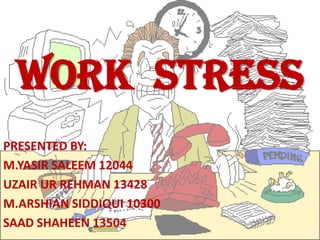
WORK STRESS
PRESENTED BY:
M.YASIR SALEEM 12044
UZAIR UR REHMAN 13428
M.ARSHIAN SIDDIQUI 10300
SAAD SHAHEEN 13504
STRESS
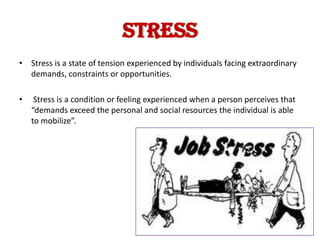
• Stress is a state of tension experienced by individuals facing extraordinary
  demands, constraints or opportunities.

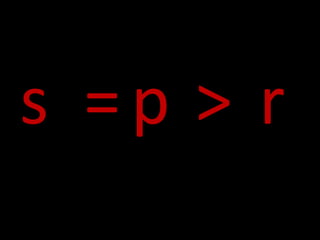
•    Stress is a condition or feeling experienced when a person perceives that
    “demands exceed the personal and social resources the individual is able
    to mobilize”.
s =p > r
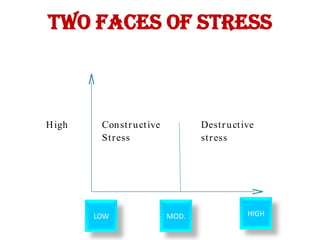
TWO FACES OF STRESS


H igh    Con st r u ct ive          Dest r u ct ive
         St r ess                   st r ess


        LOW                  MOD.                HIGH
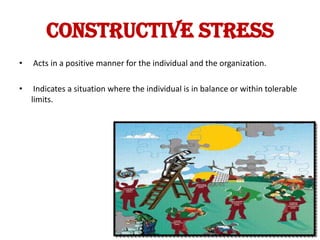
CONSTRUCTIVE STRESS
•   Acts in a positive manner for the individual and the organization.

•    Indicates a situation where the individual is in balance or within tolerable
    limits.
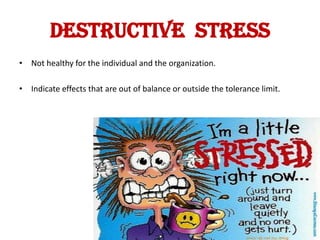
DESTRUCTIVE STRESS
• Not healthy for the individual and the organization.

• Indicate effects that are out of balance or outside the tolerance limit.
OPTIMUM LEVEL OF STRESS
• The important key is to find out an appropriate amount of stress for the
  organization in general and for each individual in particular.


For example,
• Uncertainty can lead to distress, but so can certainty or over control.
• Performance evaluation can lead to distress, but so can lack of feedback
   regarding the efforts.
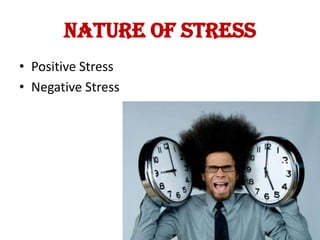
NATURE OF STRESS
• Positive Stress
• Negative Stress
POSITIVE STRESS
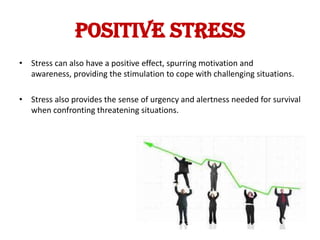
• Stress can also have a positive effect, spurring motivation and
  awareness, providing the stimulation to cope with challenging situations.

• Stress also provides the sense of urgency and alertness needed for survival
  when confronting threatening situations.
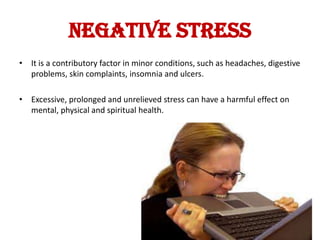
NEGATIVE STRESS
• It is a contributory factor in minor conditions, such as headaches, digestive
  problems, skin complaints, insomnia and ulcers.

• Excessive, prolonged and unrelieved stress can have a harmful effect on
  mental, physical and spiritual health.
SYMPTOMS OF STRESS
Lack of appetite
• - Craving for food when under pressure
• - Frequent indigestion
• - Nervous twitches

- Negativism
• - Expression of boredom & dissatisfaction
• - Forgetfulness
• - Inability to concentrate

- Dread of future
• - Sudden changes in weight
• - Smoking habits
• - Use of alcohol
SOURCES OF STRESS
WHAT IS IT???
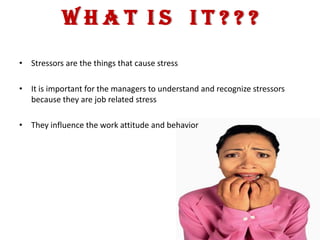
• Stressors are the things that cause stress

• It is important for the managers to understand and recognize stressors
  because they are job related stress

• They influence the work attitude and behavior
MAJOR SOURSES OFS
      TRESS
OCCUPATIONAL DEMANDS
• Some jobs are more stressful then others
• Higher level jobs contain high amount of in-built stress in form of time
  pressures ,too many meetings, difficulties in meeting standards ,inter-
  personal games etc.
• Lower level jobs contain stress-producing situations that emerge on
  technical grounds or role frustration
• The more interdependence between a persons task and the task of others
  ,the more potential stress there is.
ROLE                       CONFLICT
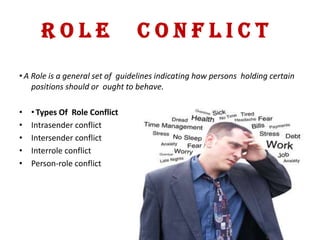
•A Role is a general set of guidelines indicating how persons holding certain
   positions should or ought to behave.

•   •Types Of Role Conflict
•   Intrasender conflict
•   Intersender conflict
•   Interrole conflict
•   Person-role conflict
• ROLE AMBIGUITY
• Occurs when position-holders are uncertain about
• limits of their authority and that of others, company rule s, job security and the
  methods used to evaluate their work.
• It is related to low job satisfaction and to feeling of job related threats to mental
  and physical well being
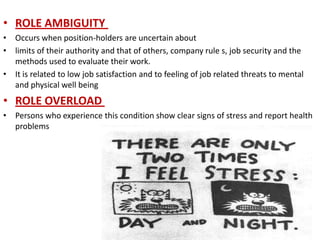
• ROLE OVERLOAD
• Persons who experience this condition show clear signs of stress and report health
  problems
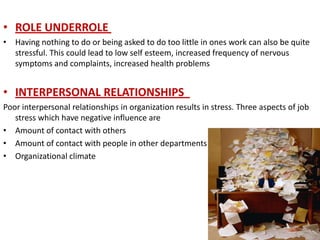
• ROLE UNDERROLE
• Having nothing to do or being asked to do too little in ones work can also be quite
  stressful. This could lead to low self esteem, increased frequency of nervous
  symptoms and complaints, increased health problems


• INTERPERSONAL RELATIONSHIPS
Poor interpersonal relationships in organization results in stress. Three aspects of job
   stress which have negative influence are
• Amount of contact with others
• Amount of contact with people in other departments
• Organizational climate
INEFFECTIVE COMMUNICATION
• Right communication


RESPONSIBILITY
• In control of person.


JOB CHANGE
• Aggressive in the marketplace.
CLIMATE WITHIN A COMPANY
• Physical surroundings, psychological climate and faulty job designs


THE IMPACT OF LIFE CHANGE
• Traumatic experiences in life can have significant impact on the psychological
  well-being of individual.


EXTERNALS VS INTERNALS AND THE BELIEF IN EXTERNAL
  LOCUS OF CONTROL

• A person’s belief in locus of control is related to susceptibility to job stress.
  Internals generally describe their job are less stressful than externals.


OTHER REASONS
• Excessive rules and regulations
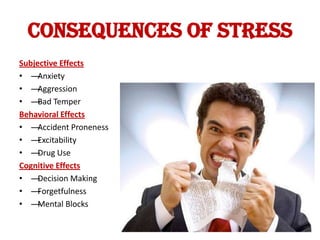
CONSEQUENCES OF STRESS
Subjective Effects
• —Anxiety
• —Aggression
• —Bad Temper
Behavioral Effects
• —Accident Proneness
• —Excitability
• —Drug Use
Cognitive Effects
• —Decision Making
• —Forgetfulness
• —Mental Blocks
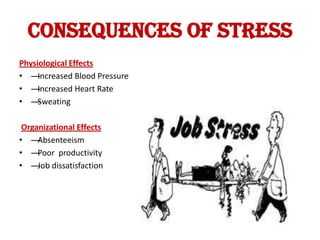
CONSEQUENCES OF STRESS
Physiological Effects
• —Increased Blood Pressure
• —Increased Heart Rate
• —Sweating

 Organizational Effects
• —Absenteeism
• —Poor productivity
• —Job dissatisfaction
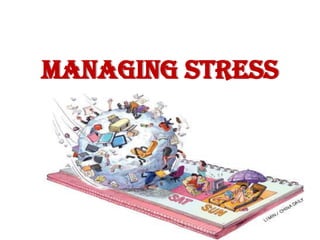
MANAGING STRESS
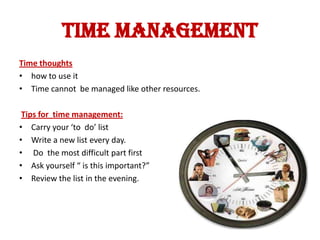
TIME MANAGEMENT
Time thoughts
• how to use it
• Time cannot be managed like other resources.

 Tips for time management:
• Carry your ‘to do’ list
• Write a new list every day.
• Do the most difficult part first
• Ask yourself “ is this important?”
• Review the list in the evening.
EXERCISE
•   Exercise reduces depression , anxiety and phobias.
•   The day-long tension on the job is given a decent burial.
•   The benefits of exercise for overall health and to the cardiac – disease.
•   Not surprisingly, many organizations nowadays encourage their executives
    to be physically fit and active.
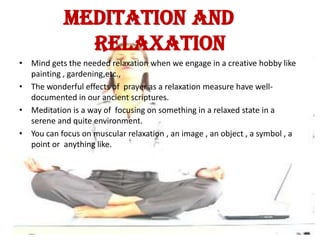
MEDITATION AND
              RELAXATION
• Mind gets the needed relaxation when we engage in a creative hobby like
  painting , gardening,etc.,
• The wonderful effects of prayer as a relaxation measure have well-
  documented in our ancient scriptures.
• Meditation is a way of focusing on something in a relaxed state in a
  serene and quite environment.
• You can focus on muscular relaxation , an image , an object , a symbol , a
  point or anything like.
ORGANIZATIONAL COPING
      STRATEGIES
• ROLE CLARITY
 Define employee roles clearly.
 Clear understanding of the job.
 Stress ,most often , occurs when employees are not
  very sure about their work roles or fear they cannot
  do their jobs.

• SUPPORTIVE CLIMATE
 Freedom to think and act independently , participative
  decision making, friendly conversation.
 Build supportive climate
ORGANIZATIONAL COPING
        STRATEGIES
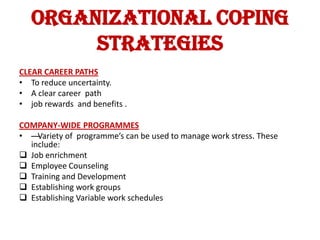
CLEAR CAREER PATHS
• To reduce uncertainty.
• A clear career path
• job rewards and benefits .

COMPANY-WIDE PROGRAMMES
• —Variety of programme’s can be used to manage work stress. These
  include:
 Job enrichment
 Employee Counseling
 Training and Development
 Establishing work groups
 Establishing Variable work schedules
BURNOUT
  !!!!!!
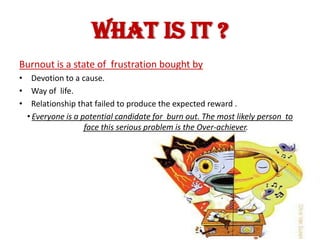
WHAT IS IT ?
Burnout is a state of frustration bought by
• Devotion to a cause.
• Way of life.
• Relationship that failed to produce the expected reward .
  •Everyone is a potential candidate for burn out. The most likely person to
                  face this serious problem is the Over-achiever.
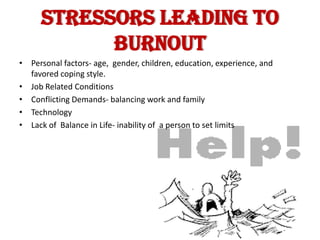
STRESSORS LEADING TO
           BURNOUT
• Personal factors- age, gender, children, education, experience, and
  favored coping style.
• Job Related Conditions
• Conflicting Demands- balancing work and family
• Technology
• Lack of Balance in Life- inability of a person to set limits
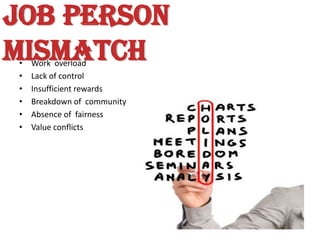
JOB PERSON
MISMATCH
•   Work overload
•   Lack of control
•   Insufficient rewards
•   Breakdown of community
•   Absence of fairness
•   Value conflicts
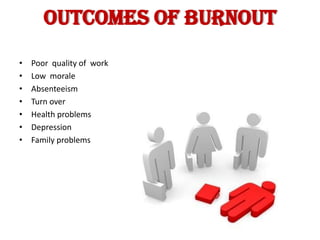
OUTCOMES OF BURNOUT
•   Poor quality of work
•   Low morale
•   Absenteeism
•   Turn over
•   Health problems
•   Depression
•   Family problems
WHAT BELIEFS CONTRIBUTE
         TO BURNOUT ?
• Efforts always be appreciated
• Status and prestige
• Dramatic changes .


Some tips for handling burnout
•   Recognize the symptoms .
•   Ask for help.
•   Be aware of the limitations.
•   Maintain discipline.
•   Take time out during the day.
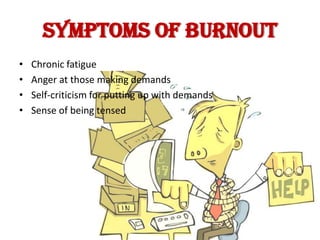
SYMPTOMS OF BURNOUT
•   Chronic fatigue
•   Anger at those making demands
•   Self-criticism for putting up with demands
•   Sense of being tensed
PREVENTION OF BURNOUT
•   Identify goals
•   Seek out helpful supervision.
•   Develop an active outside life .
•   Encourage and practice good communication skills.
•   Provide for flexible working conditions.
•   Seek out encouragement .
•   Mediation and Exercise.
•   Build a support system
GOOD MANAGEMENT
        IS
STRESS MANAGEMENT
        !!!!
Stress management
Stress management

Stress management

  • 1.
    WORK STRESS PRESENTED BY: M.YASIRSALEEM 12044 UZAIR UR REHMAN 13428 M.ARSHIAN SIDDIQUI 10300 SAAD SHAHEEN 13504
  • 2.
    STRESS • Stress isa state of tension experienced by individuals facing extraordinary demands, constraints or opportunities. • Stress is a condition or feeling experienced when a person perceives that “demands exceed the personal and social resources the individual is able to mobilize”.
  • 3.
  • 4.
    TWO FACES OFSTRESS H igh Con st r u ct ive Dest r u ct ive St r ess st r ess LOW MOD. HIGH
  • 5.
    CONSTRUCTIVE STRESS • Acts in a positive manner for the individual and the organization. • Indicates a situation where the individual is in balance or within tolerable limits.
  • 6.
    DESTRUCTIVE STRESS • Nothealthy for the individual and the organization. • Indicate effects that are out of balance or outside the tolerance limit.
  • 7.
    OPTIMUM LEVEL OFSTRESS • The important key is to find out an appropriate amount of stress for the organization in general and for each individual in particular. For example, • Uncertainty can lead to distress, but so can certainty or over control. • Performance evaluation can lead to distress, but so can lack of feedback regarding the efforts.
  • 8.
    NATURE OF STRESS •Positive Stress • Negative Stress
  • 9.
    POSITIVE STRESS • Stresscan also have a positive effect, spurring motivation and awareness, providing the stimulation to cope with challenging situations. • Stress also provides the sense of urgency and alertness needed for survival when confronting threatening situations.
  • 10.
    NEGATIVE STRESS • Itis a contributory factor in minor conditions, such as headaches, digestive problems, skin complaints, insomnia and ulcers. • Excessive, prolonged and unrelieved stress can have a harmful effect on mental, physical and spiritual health.
  • 11.
    SYMPTOMS OF STRESS Lackof appetite • - Craving for food when under pressure • - Frequent indigestion • - Nervous twitches - Negativism • - Expression of boredom & dissatisfaction • - Forgetfulness • - Inability to concentrate - Dread of future • - Sudden changes in weight • - Smoking habits • - Use of alcohol
  • 13.
  • 14.
    WHAT IS IT??? •Stressors are the things that cause stress • It is important for the managers to understand and recognize stressors because they are job related stress • They influence the work attitude and behavior
  • 15.
    MAJOR SOURSES OFS TRESS OCCUPATIONAL DEMANDS • Some jobs are more stressful then others • Higher level jobs contain high amount of in-built stress in form of time pressures ,too many meetings, difficulties in meeting standards ,inter- personal games etc. • Lower level jobs contain stress-producing situations that emerge on technical grounds or role frustration • The more interdependence between a persons task and the task of others ,the more potential stress there is.
  • 16.
    ROLE CONFLICT •A Role is a general set of guidelines indicating how persons holding certain positions should or ought to behave. • •Types Of Role Conflict • Intrasender conflict • Intersender conflict • Interrole conflict • Person-role conflict
  • 17.
    • ROLE AMBIGUITY •Occurs when position-holders are uncertain about • limits of their authority and that of others, company rule s, job security and the methods used to evaluate their work. • It is related to low job satisfaction and to feeling of job related threats to mental and physical well being • ROLE OVERLOAD • Persons who experience this condition show clear signs of stress and report health problems
  • 18.
    • ROLE UNDERROLE •Having nothing to do or being asked to do too little in ones work can also be quite stressful. This could lead to low self esteem, increased frequency of nervous symptoms and complaints, increased health problems • INTERPERSONAL RELATIONSHIPS Poor interpersonal relationships in organization results in stress. Three aspects of job stress which have negative influence are • Amount of contact with others • Amount of contact with people in other departments • Organizational climate
  • 19.
    INEFFECTIVE COMMUNICATION • Rightcommunication RESPONSIBILITY • In control of person. JOB CHANGE • Aggressive in the marketplace.
  • 20.
    CLIMATE WITHIN ACOMPANY • Physical surroundings, psychological climate and faulty job designs THE IMPACT OF LIFE CHANGE • Traumatic experiences in life can have significant impact on the psychological well-being of individual. EXTERNALS VS INTERNALS AND THE BELIEF IN EXTERNAL LOCUS OF CONTROL • A person’s belief in locus of control is related to susceptibility to job stress. Internals generally describe their job are less stressful than externals. OTHER REASONS • Excessive rules and regulations
  • 21.
    CONSEQUENCES OF STRESS SubjectiveEffects • —Anxiety • —Aggression • —Bad Temper Behavioral Effects • —Accident Proneness • —Excitability • —Drug Use Cognitive Effects • —Decision Making • —Forgetfulness • —Mental Blocks
  • 22.
    CONSEQUENCES OF STRESS PhysiologicalEffects • —Increased Blood Pressure • —Increased Heart Rate • —Sweating Organizational Effects • —Absenteeism • —Poor productivity • —Job dissatisfaction
  • 24.
  • 25.
    TIME MANAGEMENT Time thoughts •how to use it • Time cannot be managed like other resources. Tips for time management: • Carry your ‘to do’ list • Write a new list every day. • Do the most difficult part first • Ask yourself “ is this important?” • Review the list in the evening.
  • 26.
    EXERCISE • Exercise reduces depression , anxiety and phobias. • The day-long tension on the job is given a decent burial. • The benefits of exercise for overall health and to the cardiac – disease. • Not surprisingly, many organizations nowadays encourage their executives to be physically fit and active.
  • 27.
    MEDITATION AND RELAXATION • Mind gets the needed relaxation when we engage in a creative hobby like painting , gardening,etc., • The wonderful effects of prayer as a relaxation measure have well- documented in our ancient scriptures. • Meditation is a way of focusing on something in a relaxed state in a serene and quite environment. • You can focus on muscular relaxation , an image , an object , a symbol , a point or anything like.
  • 28.
    ORGANIZATIONAL COPING STRATEGIES • ROLE CLARITY  Define employee roles clearly.  Clear understanding of the job.  Stress ,most often , occurs when employees are not very sure about their work roles or fear they cannot do their jobs. • SUPPORTIVE CLIMATE  Freedom to think and act independently , participative decision making, friendly conversation.  Build supportive climate
  • 29.
    ORGANIZATIONAL COPING STRATEGIES CLEAR CAREER PATHS • To reduce uncertainty. • A clear career path • job rewards and benefits . COMPANY-WIDE PROGRAMMES • —Variety of programme’s can be used to manage work stress. These include:  Job enrichment  Employee Counseling  Training and Development  Establishing work groups  Establishing Variable work schedules
  • 30.
  • 31.
    WHAT IS IT? Burnout is a state of frustration bought by • Devotion to a cause. • Way of life. • Relationship that failed to produce the expected reward . •Everyone is a potential candidate for burn out. The most likely person to face this serious problem is the Over-achiever.
  • 32.
    STRESSORS LEADING TO BURNOUT • Personal factors- age, gender, children, education, experience, and favored coping style. • Job Related Conditions • Conflicting Demands- balancing work and family • Technology • Lack of Balance in Life- inability of a person to set limits
  • 33.
    JOB PERSON MISMATCH • Work overload • Lack of control • Insufficient rewards • Breakdown of community • Absence of fairness • Value conflicts
  • 34.
    OUTCOMES OF BURNOUT • Poor quality of work • Low morale • Absenteeism • Turn over • Health problems • Depression • Family problems
  • 35.
    WHAT BELIEFS CONTRIBUTE TO BURNOUT ? • Efforts always be appreciated • Status and prestige • Dramatic changes . Some tips for handling burnout • Recognize the symptoms . • Ask for help. • Be aware of the limitations. • Maintain discipline. • Take time out during the day.
  • 36.
    SYMPTOMS OF BURNOUT • Chronic fatigue • Anger at those making demands • Self-criticism for putting up with demands • Sense of being tensed
  • 37.
    PREVENTION OF BURNOUT • Identify goals • Seek out helpful supervision. • Develop an active outside life . • Encourage and practice good communication skills. • Provide for flexible working conditions. • Seek out encouragement . • Mediation and Exercise. • Build a support system
  • 38.
    GOOD MANAGEMENT IS STRESS MANAGEMENT !!!!