
Job Stress Management
STRESS Stress is a psychological and physiological response to events that upset our personal balance in some way.  These events or demands are known as stressors.
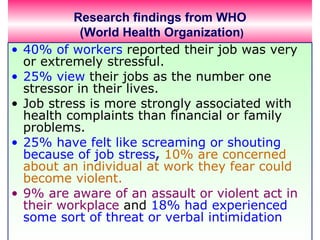
Research findings from WHO  (World Health Organization ) 40% of workers  reported their job was very or extremely stressful. 25% view  their jobs as the number one stressor in their lives. Job stress is more strongly associated with health complaints than financial or family problems. 25% have felt like screaming or shouting because of job stress ,   10% are concerned about an individual at work they fear could become violent.  9% are aware of an assault or violent act in their workplace  and  18% had experienced some sort of threat or verbal intimidation
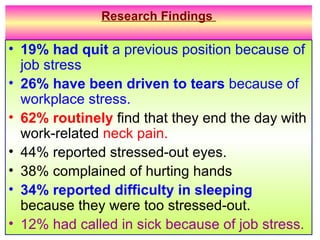
Research Findings  19% had quit  a previous position because of job stress  26% have been driven to tears  because of workplace stress.  62% routinely  find that they end the day with work-related  neck pain. 44% reported stressed-out eyes. 38% complained of hurting hands  34% reported difficulty in sleeping  because they were too stressed-out.  12% had called in sick because of job stress.
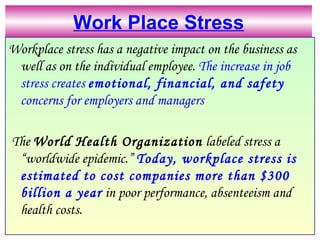
Work Place Stress Workplace stress has a negative impact on the business as well as on the individual employee.  The increase in job stress creates  emotional, financial, and safety  concerns for employers and managers The  World Health Organization  labeled stress a “worldwide epidemic.”  Today, workplace stress is estimated to cost companies more than $300 billion a year  in poor performance, absenteeism and health costs.
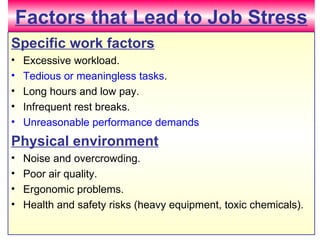
Factors that Lead to Job Stress Specific work factors Excessive workload. Tedious or meaningless tasks . Long hours and low pay. Infrequent rest breaks. Unreasonable performance demands Physical environment Noise and overcrowding. Poor air quality. Ergonomic problems. Health and safety risks (heavy equipment, toxic chemicals).
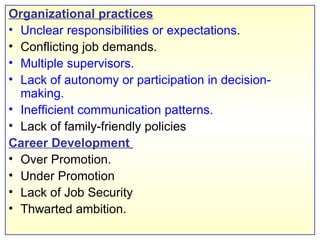
Organizational practices Unclear responsibilities or expectations . Conflicting job demands. Multiple supervisors . Lack of autonomy or participation in decision-making. Inefficient communication patterns. Lack of family-friendly policies Career Development   Over Promotion. Under Promotion Lack of Job Security Thwarted ambition.
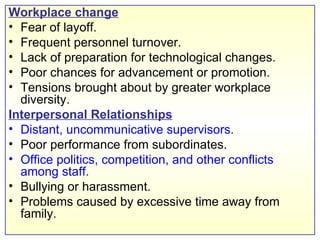
Workplace change Fear of layoff. Frequent personnel turnover. Lack of preparation for technological changes. Poor chances for advancement or promotion. Tensions brought about by greater workplace diversity. Interpersonal Relationships Distant, uncommunicative supervisors . Poor performance from subordinates. Office politics, competition, and other conflicts among staff. Bullying or harassment.  Problems caused by excessive time away from family.
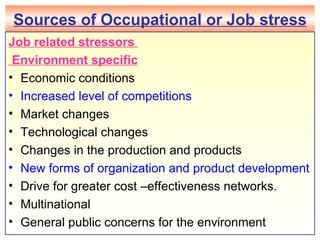
Sources of Occupational or Job stress Job related stressors  Environment specific Economic conditions Increased level of competitions Market changes Technological changes Changes in the production and products New forms of organization and product development Drive for greater cost –effectiveness networks. Multinational General public concerns for the environment
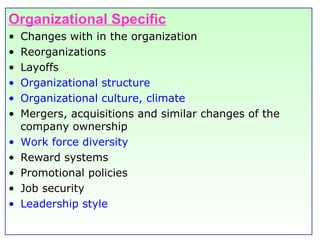
Organizational Specific Changes with in the organization Reorganizations Layoffs Organizational structure Organizational culture, climate Mergers, acquisitions and similar changes of the company ownership Work force diversity Reward systems Promotional policies Job security Leadership style
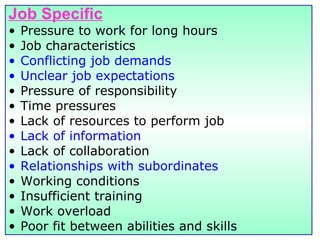
Job Specific Pressure to work for long hours Job characteristics Conflicting job demands Unclear job expectations Pressure of responsibility Time pressures Lack of resources to perform job Lack of information Lack of collaboration Relationships with subordinates Working conditions Insufficient training Work overload Poor fit between abilities and skills
Individual – Related Stressors. Individual Characteristics Personality traits Demographic characteristics Coping skills. Individual life circumstances  Work/life conflict Family problems Personal problems Social problems Financial difficulties.
Worker Characteristics that can Cause Job Stress May Include : 1. A Need to be in Control The worker feels a need to be in control at all times. The worker views lack of control as a sign of weakness. The worker has  difficulty delegating assignments to others. The worker avoids showing signs of weakness or nervousness. 2. A lack or Perceived lack of Competence The worker feels his or her work is inferior compared to  others. The worker feels he or she makes  poor judgments . The worker feels a lack of common sense. The worker  feels doubts  about his or her competence and ability to do the job.
3. A Desire to Please People The worker relies on  favorable opinions and input from others as a basis for building self-esteem . The worker fears he or she may disappoint others The worker cares more about others' needs than his or her own. The worker  avoids communications  and actions that would displease others . 4. A Need to be Perfect (Perfection) The worker feels under pressure to achieve. The worker is  highly self-critical . The worker feels a job well done could have been done  even better.
Signs and Symptoms of stress Intellectual Symptoms   (How stress can affect the Mind) Memory problems.  Difficulty making decisions.  Inability to concentrate. Confusion.  Seeing only the negative. Repetitive or racing thoughts .   Poor judgment.   Loss of objectivity. Desire to escape or run away
Emotional Symptoms   :( How stress can make us feel) Moody and hypersensitive . Restlessness and anxiety. Depression. Anger and resentment. Easily irritated and “on edge ”.  Sense of being overwhelmed. Lack of confidence.
Physical Symptoms :  (How stress can affect the Body) Headaches.  Digestive problems.  Muscle tension and pain. Sleep disturbances .  Fatigue. Chest pain, irregular heartbeat.  High blood pressure.  Weight gain or loss. Asthma or shortness of breath.  Skin problems. Decreased sex drive.
Behavioral Symptoms :  (How stress can affect the Behavior) Eating disorder.  Sleeping too much or too little. Isolating self from others. Neglecting the  responsibilities. Increasing alcohol and drug use.  Nervous habits (e.g. nail biting, pacing). Teeth grinding or jaw clenching. Overdoing activities such as exercising or shopping . Losing the  temper. Overreacting to unexpected problems.
Long term effects of stress   Recent research suggests that anywhere from  two-thirds of illness is stress-related .   some of the health problems that can be caused or exacerbated by long-term stress. Health Problems Linked to long term  Stress Heart attack, Cancer, Stroke, Ulcers,Depressions,Eating disorders, Obesity,Memeory loss,Thyroid problems
Consequences of occupational stress  can be grouped into those on  1.Individual level . 2.Organizational level.  On the individual level ,  There are three main subgroups of strains : 1.Unwanted Feelings and Behaviours 2. Physiological Diseases (Poor Physical Health)  3. Psychological Diseases (Poor Emotional (Mental) Health)
1. Unwanted Feelings and Behaviors  – Job dissatisfaction.   Lower motivation. Low employee morale. Less organizational commitment,. Lowered overall quality of work life . Absenteeism, turnover. Intention to leave the job,   Lower productivity, decreased quantity and quality of work. Inability to make sound decisions.
2. Physiological Diseases   (Poor Physical Health)   such as increased blood pressure and pulse rate, cardiovascular diseases, high cholesterol, high blood sugar, insomnia,  headaches , infections, skin problems, injuries and fatigue.
3.  Psychological Diseases (Poor Emotional (Mental) Health)  –   1. Psychological distress, depression,  anxiousness . 2.Passiveness, Aggressiveness. 3.Boredom, lose of self-confidence  and self-esteem. 4.Lose of dissatisfaction with job and live,  losing of contact with reality  and emotional fatigue.
On the Organization level , Consequences of Occupational or Job Stress  can be Grouped into two Major subgroups. 1 .   Organizational factors 2 . Organizational Costs.
1. Organizational  factors   - 1.Such as discontent and  poor morale among the workforce.  2.Performance/productivity losses, low quality products and services.  3.Poorer relationships with clients, images and reputation, missed opportunities . 4.Disruption to production, high accident and mistakes rates, high labor turnover. 5.Loss of valuable staff, increase sick-leave, permanent vacancies, premature retirement. 6.Diminished cooperation ,  poor internal communications, more internal conflicts, and dysfunctional workplace climate.
2. Organizational Costs   :-  1.Such as cost of  reduced performance , productivity  (lack of added value to product and /or service),  2.High replacement costs in connection with labor turnover ( increase in recruitment, training and retraining costs),  3.Increases sick pay, increased health-care costs and disability payments,  4.Higher grievance and litigation/compensation costs, and costs of equipment damage .
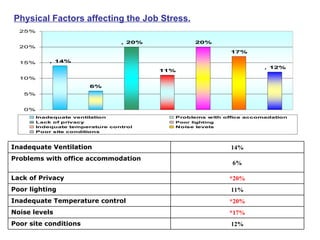
Physical Factors affecting the Job Stress. 12% Poor site conditions *17% Noise levels *20% Inadequate Temperature control 11% Poor lighting *20% Lack of Privacy 6% Problems with office accommodation 14% Inadequate Ventilation
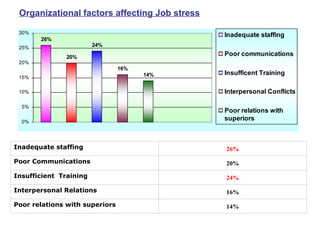
Organizational factors affecting Job stress 14% Poor relations with superiors 16% Interpersonal Relations 24% Insufficient  Training 20% Poor Communications 26% Inadequate staffing
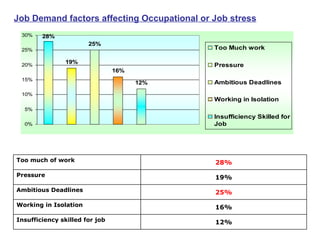
Job Demand factors affecting Occupational or Job stress 12% Insufficiency skilled for job 16% Working in Isolation 25% Ambitious Deadlines 19% Pressure 28% Too much of work
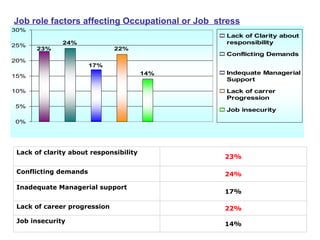
Job role factors affecting Occupational or Job  stress 14% Job insecurity 22% Lack of career progression 17% Inadequate Managerial support 24% Conflicting demands 23% Lack of clarity about responsibility
COPING WITH STRESS STRESS MANAGEMENT  STRESS REDUCTION-TECHNIQUES &
Approach to reduce stress Stress on the job creates high costs for  businesses and institutions, reducing  morale, productivity, and earnings.  Clearly, it is in every employer’s best  interests—fiscal and otherwise—to  reduce workplace stress as much as  possible.
Organizational approach  Organization can foster low levels of job stress and high levels  of productivity: Organization level to Reduce Job Stress   Improve communication  Consult your employees  Offer rewards and incentives  Cultivate a friendly social climate
Employees can reduce job stress While organizational change comes from management,  there are still many things employees—individually or  collectively—can do to reduce workplace stress. Stand Up for Yourself Get a job description  Change your job  Get support  Get a new job
Approaches to Reduce Stress Change of life style habits to Manage Stress better Get enough sleep  Connect with others:  Exercise regularly  Eat a balanced, nutritious diet  Reduce caffeine and sugar  Do something for yourself everyday
Change of thinking and emotional responses to handle stress better Have realistic expectations  Reframe problems Maintain your sense of humor Express your feelings instead of bottling them up  Don’t try to control events or other people
Meet the challenges of stressful situations Manage time  Give priority to the most important tasks and do those first  Schedule time for both work and recreation  Delegate tasks and break up big projects
Stress Relief: Yoga, Meditation, and Other Relaxation Techniques Breathing exercises relieve stress Meditation to Relieve Stress Yoga  help with stress relief
How to Change the Organization to Prevent Job Stress Ensure that the workload is in line with workers' capabilities and resources. Design jobs to provide meaning, stimulation, and opportunities for workers to use their skills. Clearly define workers' roles and responsibilities. Give workers opportunities to participate in decisions and actions affecting their jobs. Improve communications-reduce uncertainty about career development and future employment prospects Establish work schedules that are compatible with demands and responsibilities outside the job.
Preventing Job Stress - Getting Started STEPS TOWARDS PREVENTION Step 1 - Identify the Problem.  Step 2 - Design and Implement Interventions.  Step 3 - Evaluate the Interventions.
Thank You

Job Stress Management

  • 1.
  • 2.
    STRESS Stress isa psychological and physiological response to events that upset our personal balance in some way. These events or demands are known as stressors.
  • 3.
    Research findings fromWHO (World Health Organization ) 40% of workers reported their job was very or extremely stressful. 25% view their jobs as the number one stressor in their lives. Job stress is more strongly associated with health complaints than financial or family problems. 25% have felt like screaming or shouting because of job stress , 10% are concerned about an individual at work they fear could become violent. 9% are aware of an assault or violent act in their workplace and 18% had experienced some sort of threat or verbal intimidation
  • 4.
    Research Findings 19% had quit a previous position because of job stress 26% have been driven to tears because of workplace stress. 62% routinely find that they end the day with work-related neck pain. 44% reported stressed-out eyes. 38% complained of hurting hands 34% reported difficulty in sleeping because they were too stressed-out. 12% had called in sick because of job stress.
  • 5.
    Work Place StressWorkplace stress has a negative impact on the business as well as on the individual employee. The increase in job stress creates emotional, financial, and safety concerns for employers and managers The World Health Organization labeled stress a “worldwide epidemic.” Today, workplace stress is estimated to cost companies more than $300 billion a year in poor performance, absenteeism and health costs.
  • 6.
    Factors that Leadto Job Stress Specific work factors Excessive workload. Tedious or meaningless tasks . Long hours and low pay. Infrequent rest breaks. Unreasonable performance demands Physical environment Noise and overcrowding. Poor air quality. Ergonomic problems. Health and safety risks (heavy equipment, toxic chemicals).
  • 7.
    Organizational practices Unclearresponsibilities or expectations . Conflicting job demands. Multiple supervisors . Lack of autonomy or participation in decision-making. Inefficient communication patterns. Lack of family-friendly policies Career Development Over Promotion. Under Promotion Lack of Job Security Thwarted ambition.
  • 8.
    Workplace change Fearof layoff. Frequent personnel turnover. Lack of preparation for technological changes. Poor chances for advancement or promotion. Tensions brought about by greater workplace diversity. Interpersonal Relationships Distant, uncommunicative supervisors . Poor performance from subordinates. Office politics, competition, and other conflicts among staff. Bullying or harassment. Problems caused by excessive time away from family.
  • 9.
    Sources of Occupationalor Job stress Job related stressors Environment specific Economic conditions Increased level of competitions Market changes Technological changes Changes in the production and products New forms of organization and product development Drive for greater cost –effectiveness networks. Multinational General public concerns for the environment
  • 10.
    Organizational Specific Changeswith in the organization Reorganizations Layoffs Organizational structure Organizational culture, climate Mergers, acquisitions and similar changes of the company ownership Work force diversity Reward systems Promotional policies Job security Leadership style
  • 11.
    Job Specific Pressureto work for long hours Job characteristics Conflicting job demands Unclear job expectations Pressure of responsibility Time pressures Lack of resources to perform job Lack of information Lack of collaboration Relationships with subordinates Working conditions Insufficient training Work overload Poor fit between abilities and skills
  • 12.
    Individual – RelatedStressors. Individual Characteristics Personality traits Demographic characteristics Coping skills. Individual life circumstances Work/life conflict Family problems Personal problems Social problems Financial difficulties.
  • 13.
    Worker Characteristics thatcan Cause Job Stress May Include : 1. A Need to be in Control The worker feels a need to be in control at all times. The worker views lack of control as a sign of weakness. The worker has difficulty delegating assignments to others. The worker avoids showing signs of weakness or nervousness. 2. A lack or Perceived lack of Competence The worker feels his or her work is inferior compared to others. The worker feels he or she makes poor judgments . The worker feels a lack of common sense. The worker feels doubts about his or her competence and ability to do the job.
  • 14.
    3. A Desireto Please People The worker relies on favorable opinions and input from others as a basis for building self-esteem . The worker fears he or she may disappoint others The worker cares more about others' needs than his or her own. The worker avoids communications and actions that would displease others . 4. A Need to be Perfect (Perfection) The worker feels under pressure to achieve. The worker is highly self-critical . The worker feels a job well done could have been done  even better.
  • 15.
    Signs and Symptomsof stress Intellectual Symptoms (How stress can affect the Mind) Memory problems. Difficulty making decisions. Inability to concentrate. Confusion. Seeing only the negative. Repetitive or racing thoughts .  Poor judgment. Loss of objectivity. Desire to escape or run away
  • 16.
    Emotional Symptoms :( How stress can make us feel) Moody and hypersensitive . Restlessness and anxiety. Depression. Anger and resentment. Easily irritated and “on edge ”. Sense of being overwhelmed. Lack of confidence.
  • 17.
    Physical Symptoms : (How stress can affect the Body) Headaches. Digestive problems. Muscle tension and pain. Sleep disturbances . Fatigue. Chest pain, irregular heartbeat. High blood pressure. Weight gain or loss. Asthma or shortness of breath. Skin problems. Decreased sex drive.
  • 18.
    Behavioral Symptoms : (How stress can affect the Behavior) Eating disorder. Sleeping too much or too little. Isolating self from others. Neglecting the responsibilities. Increasing alcohol and drug use. Nervous habits (e.g. nail biting, pacing). Teeth grinding or jaw clenching. Overdoing activities such as exercising or shopping . Losing the temper. Overreacting to unexpected problems.
  • 19.
    Long term effectsof stress Recent research suggests that anywhere from two-thirds of illness is stress-related . some of the health problems that can be caused or exacerbated by long-term stress. Health Problems Linked to long term Stress Heart attack, Cancer, Stroke, Ulcers,Depressions,Eating disorders, Obesity,Memeory loss,Thyroid problems
  • 20.
    Consequences of occupationalstress can be grouped into those on 1.Individual level . 2.Organizational level. On the individual level , There are three main subgroups of strains : 1.Unwanted Feelings and Behaviours 2. Physiological Diseases (Poor Physical Health) 3. Psychological Diseases (Poor Emotional (Mental) Health)
  • 21.
    1. Unwanted Feelingsand Behaviors – Job dissatisfaction. Lower motivation. Low employee morale. Less organizational commitment,. Lowered overall quality of work life . Absenteeism, turnover. Intention to leave the job, Lower productivity, decreased quantity and quality of work. Inability to make sound decisions.
  • 22.
    2. Physiological Diseases (Poor Physical Health) such as increased blood pressure and pulse rate, cardiovascular diseases, high cholesterol, high blood sugar, insomnia, headaches , infections, skin problems, injuries and fatigue.
  • 23.
    3. PsychologicalDiseases (Poor Emotional (Mental) Health) – 1. Psychological distress, depression, anxiousness . 2.Passiveness, Aggressiveness. 3.Boredom, lose of self-confidence and self-esteem. 4.Lose of dissatisfaction with job and live, losing of contact with reality and emotional fatigue.
  • 24.
    On the Organizationlevel , Consequences of Occupational or Job Stress can be Grouped into two Major subgroups. 1 . Organizational factors 2 . Organizational Costs.
  • 25.
    1. Organizational factors - 1.Such as discontent and poor morale among the workforce. 2.Performance/productivity losses, low quality products and services. 3.Poorer relationships with clients, images and reputation, missed opportunities . 4.Disruption to production, high accident and mistakes rates, high labor turnover. 5.Loss of valuable staff, increase sick-leave, permanent vacancies, premature retirement. 6.Diminished cooperation , poor internal communications, more internal conflicts, and dysfunctional workplace climate.
  • 26.
    2. Organizational Costs :- 1.Such as cost of reduced performance , productivity (lack of added value to product and /or service), 2.High replacement costs in connection with labor turnover ( increase in recruitment, training and retraining costs), 3.Increases sick pay, increased health-care costs and disability payments, 4.Higher grievance and litigation/compensation costs, and costs of equipment damage .
  • 27.
    Physical Factors affectingthe Job Stress. 12% Poor site conditions *17% Noise levels *20% Inadequate Temperature control 11% Poor lighting *20% Lack of Privacy 6% Problems with office accommodation 14% Inadequate Ventilation
  • 28.
    Organizational factors affectingJob stress 14% Poor relations with superiors 16% Interpersonal Relations 24% Insufficient Training 20% Poor Communications 26% Inadequate staffing
  • 29.
    Job Demand factorsaffecting Occupational or Job stress 12% Insufficiency skilled for job 16% Working in Isolation 25% Ambitious Deadlines 19% Pressure 28% Too much of work
  • 30.
    Job role factorsaffecting Occupational or Job stress 14% Job insecurity 22% Lack of career progression 17% Inadequate Managerial support 24% Conflicting demands 23% Lack of clarity about responsibility
  • 31.
    COPING WITH STRESSSTRESS MANAGEMENT STRESS REDUCTION-TECHNIQUES &
  • 32.
    Approach to reducestress Stress on the job creates high costs for businesses and institutions, reducing morale, productivity, and earnings. Clearly, it is in every employer’s best interests—fiscal and otherwise—to reduce workplace stress as much as possible.
  • 33.
    Organizational approach Organization can foster low levels of job stress and high levels of productivity: Organization level to Reduce Job Stress Improve communication Consult your employees Offer rewards and incentives Cultivate a friendly social climate
  • 34.
    Employees can reducejob stress While organizational change comes from management, there are still many things employees—individually or collectively—can do to reduce workplace stress. Stand Up for Yourself Get a job description Change your job Get support Get a new job
  • 35.
    Approaches to ReduceStress Change of life style habits to Manage Stress better Get enough sleep Connect with others: Exercise regularly Eat a balanced, nutritious diet Reduce caffeine and sugar Do something for yourself everyday
  • 36.
    Change of thinkingand emotional responses to handle stress better Have realistic expectations Reframe problems Maintain your sense of humor Express your feelings instead of bottling them up Don’t try to control events or other people
  • 37.
    Meet the challengesof stressful situations Manage time Give priority to the most important tasks and do those first Schedule time for both work and recreation Delegate tasks and break up big projects
  • 38.
    Stress Relief: Yoga,Meditation, and Other Relaxation Techniques Breathing exercises relieve stress Meditation to Relieve Stress Yoga help with stress relief
  • 39.
    How to Changethe Organization to Prevent Job Stress Ensure that the workload is in line with workers' capabilities and resources. Design jobs to provide meaning, stimulation, and opportunities for workers to use their skills. Clearly define workers' roles and responsibilities. Give workers opportunities to participate in decisions and actions affecting their jobs. Improve communications-reduce uncertainty about career development and future employment prospects Establish work schedules that are compatible with demands and responsibilities outside the job.
  • 40.
    Preventing Job Stress- Getting Started STEPS TOWARDS PREVENTION Step 1 - Identify the Problem. Step 2 - Design and Implement Interventions. Step 3 - Evaluate the Interventions.
  • 41.