CREATING NEW SYSTEMS
   FOR HEARING AND
 DECIDING CASES WITH
FAIRNESS AND DISPATCH
Would you know how many of our
people live in crowded cities?
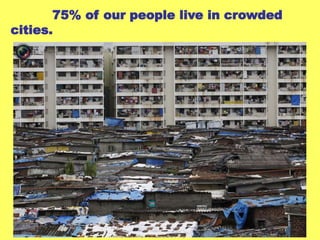
75% of our people live in crowded
cities.
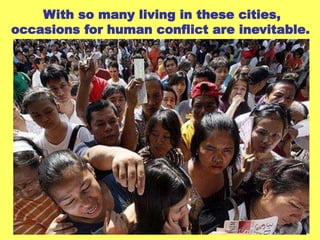
With so many living in these cities,
occasions for human conflict are inevitable.
Thus, courts in these cities are
drowning in cases.
     Many have 1,000 plus cases;
     some have 2,000 plus.
     Many courts hear 30 to 60 cases a
day.
Thus, courts in these cities are
drowning in cases.
     Many have 1,000 plus cases;
     some have 2,000 plus.
     Many courts hear 30 to 60 cases a
day.
Thus, courts in these cities are
drowning in cases.
     Many have 1,000 plus cases;
     some have 2,000 plus.
     Many courts hear 30 to 60 cases a
day.
Thus, courts in these cities are
drowning in cases.
     Many have 1,000 plus cases;
     some have 2,000 plus.
     Many courts hear 30 to 60 cases a
day.
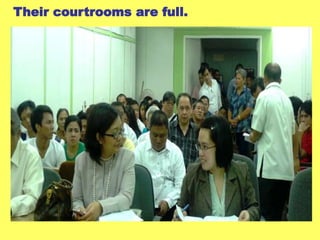
Their courtrooms are full.
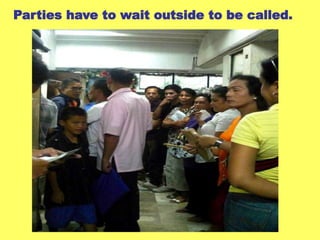
Parties have to wait outside to be called.
It takes 3 to 5 years, at times more,
for cases to be heard and decided,
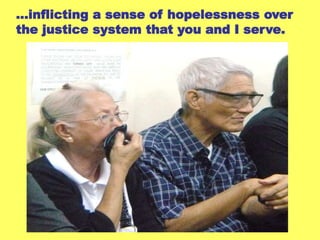
…inflicting a sense of hopelessness over
the justice system that you and I serve.
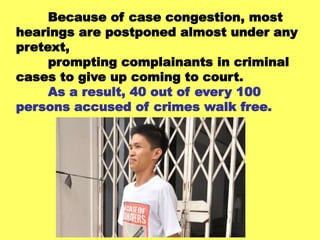
Because of case congestion, most
hearings are postponed almost under any
pretext,
     prompting complainants in criminal
cases to give up coming to court.
     As a result, 40 out of every 100
persons accused of crimes walk free.
Because of case congestion, most
hearings are postponed almost under any
pretext,
     prompting complainants in criminal
cases to give up coming to court.
     As a result, 40 out of every 100
persons accused of crimes walk free.
Because of case congestion, most
hearings are postponed almost under any
pretext,
     prompting complainants in criminal
cases to give up coming to court.
     As a result, 40 out of every 100
persons accused of crimes walk free.
Because of case congestion, most
hearings are postponed almost under any
pretext,
     prompting complainants in criminal
cases to give up coming to court.
     As a result, 40 out of every 100
persons accused of crimes walk free.
… Victims of crimes find no speedy justice
in our courts.
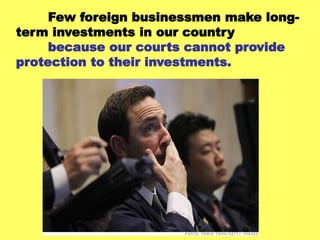
Few foreign businessmen make long-
term investments in our country
     because our courts cannot provide
protection to their investments.
Few foreign businessmen make long-
term investments in our country
     because our courts cannot provide
protection to their investments.
Result: we do not attain economic
growth;
    our people remain poor.
Result: we do not attain economic
growth;
    our people remain poor.
Because people have lost trust in our
ability to render justice,
      many have given up coming to court
with their disputes.
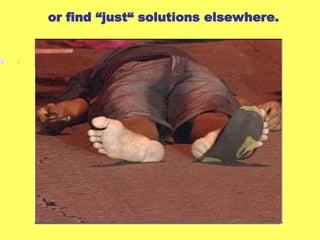
      They either simply endure their pains
      or find “just“ solutions elsewhere.
      And when the justice system does
not work as it should,
      law practice suffers.
or find “just“ solutions elsewhere.

             Email Article
:
What causes these terrible delays in
our justice system?
     There are many causes.
What causes these terrible delays in
our justice system?
     There are many causes.
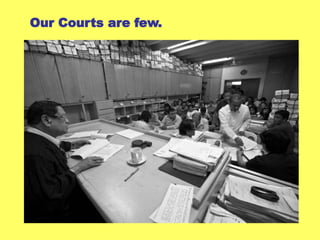
Our Courts are few.
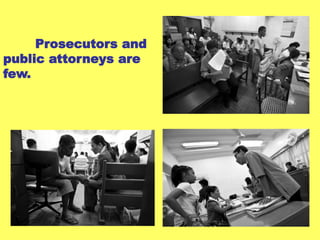
Prosecutors and
public attorneys are
few.
Recently, the Supreme Court has
introduced a very significant systems
change.
     One of the major causes of delays
is our slow and cumbersome system
     for hearing the testimony of
witnesses.
     The witness stand represents the
bottleneck in the judicial machinery.
Recently, the Supreme Court has
introduced a very significant systems
change.
     One of the major causes of delays
is our slow and cumbersome system
     for hearing the testimony of
witnesses.
     The witness stand represents the
bottleneck in the judicial machinery.
Recently, the Supreme Court has
introduced a very significant systems
change.
     One of the major causes of delays
is our slow and cumbersome system
     for hearing and deciding cases.
     more specifically, our antiquated
system for taking the testimonies of
witnesses
     and receiving documentary and
object evidence.
     Where precisely is the bottleneck in
the system?
Recently, the Supreme Court has
introduced a very significant systems
change.
     One of the major causes of delays
is our slow and cumbersome system
     for hearing and deciding cases.
     Where precisely is the bottleneck in
this system?
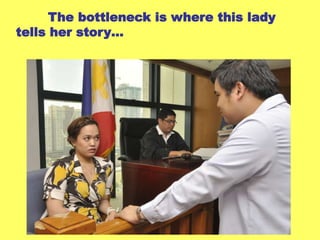
The bottleneck is where this lady
tells her story…
      the witness stand.
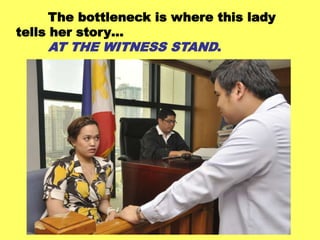
The bottleneck is where this lady
tells her story…
      AT THE WITNESS STAND.
Why?
     Because courts can hear no more
than one witness at a time.
     Assuming there are just two
witnesses per case,
     2,000 witnesses would be waiting to
be called in courts that have 1,000 cases
in their dockets.
     If required to form a line outside the
courtroom,
     they would form a very long line
indeed.
Why?
     Because courts can hear no more
than one witness at a time.
     If you have 1,000 cases in your
dockets
     and just two witnesses for each
case,
     you would have 2,000 witnesses
waiting to be called.
     If required to wait outside the
courtroom,
Why?
     Because courts can hear no more
than one witness at a time.
     If you have 1,000 cases in your
dockets
     and just two witnesses for each
case,
     you would have 2,000 witnesses
waiting to be called.
     If required to wait outside the
courtroom,
Why?
     Because courts can hear no more
than one witness at a time.
     If you have 1,000 cases in your
dockets
     and just two witnesses for each
case,
     you would have 2,000 witnesses
waiting to be called.
     If required to wait outside the
courtroom,
Why?
     Because courts can hear no more
than one witness at a time.
     If you have 1,000 cases in your
dockets
     and just two witnesses for each
case,
     you would have 2,000 witnesses
waiting to be called.
     If required to wait outside the
courtroom,
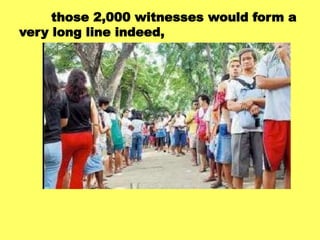
those 2,000 witnesses would form a
very long line indeed.
those 2,000 witnesses would form a
very long line indeed,


with only three witnesses getting in on an
ordinary hearing day.
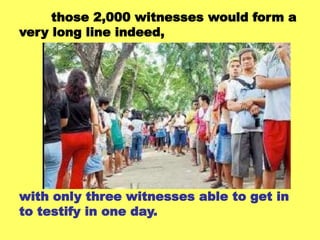
those 2,000 witnesses would form a
very long line indeed,


with only three witnesses able to get in
to testify in one day.
Why is our system for hearing
witnesses slow and cumbersome?
Why is our system for hearing
witnesses slow and cumbersome?
     For one thing, although about 90% of
witnesses testifies in the local dialect,
     we require an interpreter to translate
their testimonies into English.
Why is our system for hearing
witnesses slow and cumbersome?
     For one thing, although about 90% of
witnesses testifies in the local dialect,
     our rules require an interpreter to
translate their testimonies into English.
Why is our system for hearing
witnesses slow and cumbersome?
     For one thing, although about 90% of
witnesses testifies in the local dialect,
     our rules require an interpreter to
translate their testimonies into English.
     Since the trial takes place in two
languages,
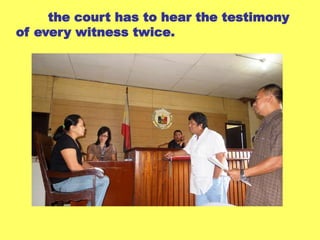
     the court has to hear the testimony
of every witness twice.
the court has to hear the testimony
of every witness twice.
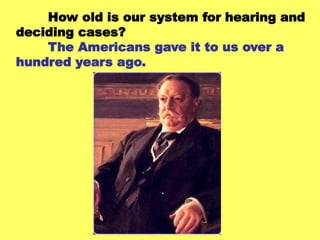
How old is our system for hearing and
deciding cases?
How old is our system for hearing and
deciding cases?
    The Americans gave it to us over a
hundred years ago.
It was unique to their history and
culture,
     yet we adopted it and were taught in
law schools
     that there is no right way to hear the
testimonies of witnesses
     except the American way.
It was unique to their history and
culture,
     yet we adopted it and were taught in
law schools
     that there is no right way to hear the
testimonies of witnesses
     except the American way.
It was unique to their history and
culture,
     yet we adopted it and were taught in
law schools
     that there is no right way to hear the
testimonies of witnesses
     except the American way.
It was unique to their history and
culture,
     yet we adopted it and were taught in
law schools
     that there is no right way to hear the
testimonies of witnesses
     except the American way.
The American system is adversarial.
    The lawyers in a way control the
proceedings
    since they decide which witness the
judge will hear
    and what questions he will answer.
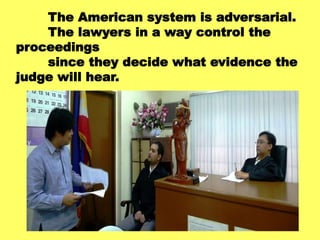
The American system is adversarial.
    The lawyers in a way control the
proceedings
    since they decide what evidence the
judge will hear.
    and what questions he will answer.
The American system is adversarial.
    The lawyers in a way control the
proceedings
    since they decide what evidence the
judge will hear.
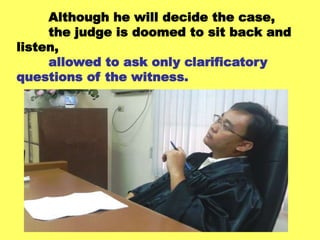
Although he will decide the case,
     but he is doomed to sit back and
listen.
Although he will decide the case,
     the judge is doomed to sit back and
listen,
Although he will decide the case,
     the judge is doomed to sit back and
listen,
     allowed to ask only clarificatory
questions of the witness.
The American system is also
designed for both jury and bench trials.
    Result: using their system, we have a
shadow jury sitting in our courtroom.
The American system is also
designed for both jury and bench trials.
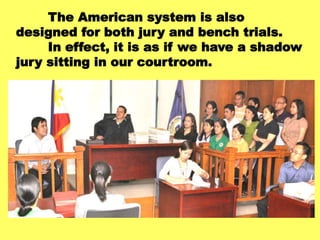
     In effect, it is as if we have a shadow
jury sitting in our courtroom.
The American system is also
designed for both jury and bench trials.
     In effect, it is as if we have a shadow
jury sitting in our courtroom.
Why?
     Because the rules we adopted
require our judge to pre-screens the
questions
     to prevent an unlearned jury from
hearing inadmissible answers.
     But this is pointless since the jury in
our court is the judge himself.
     With his legal training and
experience,
     he has no difficulty disregarding
inadmissible answers even after he hears
them.
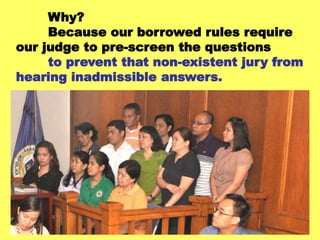
Why?
     Because our borrowed rules require
our judge to pre-screen the questions
     to prevent that non-existent jury from
hearing inadmissible answers.
But this pre-screening is pointless
since the judge
    does not need to pre-screen the
questions for himself.
    With his legal training and
experience,
    he has no difficulty disregarding
inadmissible answers even after he hears
them.
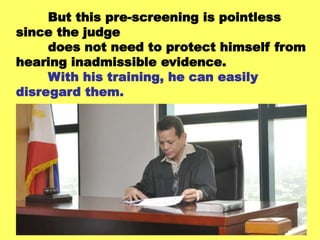
But this pre-screening is pointless
since the judge
    does not need to protect himself from
hearing inadmissible evidence.
    With his legal training and
experience,
    he has no difficulty disregarding
inadmissible answers even after he hears
them.
But this pre-screening is pointless
since the judge
     does not need to protect himself from
hearing inadmissible evidence.
     With his training, he can easily
disregard them.
Further, since it is assumed that the
members of the American jury know
nothing of the case,
      witnesses must tell their stories to
the jurors from beginning to end.
      From A to Z
      Following that system, our witnesses
tell their stories to the judge
      from beginning to end though he
already knows from the record
      the respective stories of the parties.
      Consequently, he can skip the
admitted matters
      and have the witness focus on the
facts in issue.
Further, since it is assumed that the
members of the American jury know
nothing of the case,
      witnesses must tell their stories to
the jurors from beginning to end.
      From A to Z.
      Following that system, our witnesses
tell their stories to the judge
      from beginning to end though he
already knows from the record
      the respective stories of the parties.
      Consequently, he can skip the
admitted matters
      and have the witness focus on the
facts in issue.
Further, since it is assumed that the
members of the American jury know
nothing of the case,
     witnesses must tell their stories to
the jurors from beginning to end.
     From A to Z.
     But our judge already knows from the
record
     the respective stories of the parties.
     Consequently, he can skip the
admitted matters
     and have the witness focus on the
facts in issue.
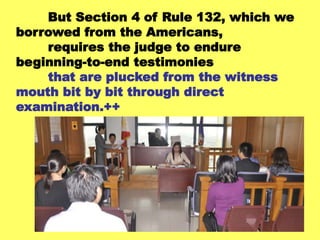
But Section 4 of Rule 132, which we
borrowed from the Americans,
    requires the judge to endure
beginning-to-end stories
    that are plucked from the witness
mouth bit by bit through direct
examination.
    This is a time consuming process.
But Section 4 of Rule 132, which we
borrowed from the Americans,
    requires the judge to endure
beginning-to-end testimonies
    that are plucked from the witness
mouth bit by bit through direct
examination.
    This is a time consuming process.
But Section 4 of Rule 132, which we
borrowed from the Americans,
    requires the judge to endure
beginning-to-end testimonies
    that are plucked from the witness
mouth bit by bit through direct
examination.++
    This is a time consuming process.
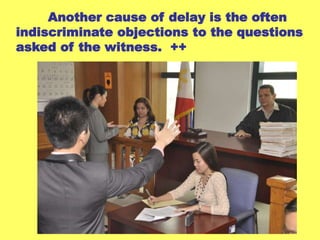
Another cause of delay is the often
indiscriminate objections to the questions
asked of the witness. ++
Theoretically, a lawyer objects to
questions asked of the witness
      to enable the judge to predetermine
if the expected answers are inadmissible
in evidence.
      The judge must see to it that
inadmissible answers do not touch the
ears of the jury,
      lest these irreversibly influence the
members of the jury.
      But we have no jury, only a judge.
Theoretically, a lawyer objects to
questions asked of the witness
     So the judge could prevent
inadmissible answers
     from touching the ears of the jurors,
     lest such answers irreversibly
influence their thinking.
     But we have no jury, only a judge.
Theoretically, a lawyer objects to
questions asked of the witness
     So the judge could prevent
inadmissible answers
     from touching the ears of the jurors,
     lest such answers irreversibly
influence their thinking.
     But we have no jury, only a judge.
Theoretically, a lawyer objects to
questions asked of the witness
     So the judge could prevent
inadmissible answers
     from touching the ears of the jurors,
     lest such answers irreversibly
influence their thinking.
     But we have no jury, only a judge.
Theoretically, a lawyer objects to
questions asked of the witness
     So the judge could prevent
inadmissible answers
     from touching the ears of the jurors,
     lest such answers irreversibly
influence their thinking.
     But we have no jury, only a judge who
is not irreversibly affected by
inadmissible answers.
Another point of delay is the need to
identify,
Another point of delay is the need to
identify,
     mark, and authenticate the exhibits.
     The process is tedious and painfully
time consuming. ++
Another point of delay is the need to
identify,
     mark, and authenticate the exhibits.
     The process is tedious and painfully
time consuming.
Some courts, require pre-markings of
exhibits before the clerks of court
    but these personnel are often just as
busy as the judge.
    And even with such pre-markings,
    still, the witness will have to appear
before the court,
    identify the documents,
    and authenticate them.
Some courts, require pre-markings of
exhibits before the clerks of court
    who are also busy.        And even with
such pre-markings,
    still, the witness will have to appear
before the court,
    identify the documents,
    and authenticate them.
Some courts, require pre-markings of
exhibits before the clerks of court
    who are also busy.
    And even with such pre-markings,
    still, the witness will have to appear
before the court,
    identify the documents,
    and authenticate them.
Some courts, require pre-markings of
exhibits before the clerks of court
    who are also busy.
    And even with such pre-markings,
    still, the witness will have to appear
before the court,
Some courts, require pre-markings of
exhibits before the clerks of court
    who are also busy.
    And even with such pre-markings,
    still, the witness will have to appear
before the court,
    identify the documents one by one,
    and authenticate them.
Some courts, require pre-markings of
exhibits before the clerks of court
    who are also busy.
    And even with such pre-markings,
    still, the witness will have to appear
before the court,
    identify the documents one by one,
    and authenticate them.
In many courts in cities, the cases on
their calendars often range from 30 to 50
cases.
     Just calling the attendance takes
from 8:30 to 10 a.m.
     since there are incidents like
postponements that must be acted on.
     This leaves only 2 hours for hearing
the cases that are ready.
     If 10 cases are ready, the judge gives
the parties in each case 12 minutes
     to present part of the testimony of
just one witness.
In many courts in cities, the cases on
their calendars often range from 30 to 50
cases.
     Just calling the attendance takes
from 8:30 to 10 a.m.
     This leaves only 2 hours for hearing
the cases that are ready.
     If 10 cases are ready, the judge gives
the parties in each case 12 minutes
     to present part of the testimony of
just one witness.
If 10 cases are ready, the judge gives
the parties in each case 10 minutes
     to present part of the testimony of
just one witness.